UI/UX designer resume example
One page. Reverse chronological, no columns, no photo. The portfolio decides whether you get the interview, so the resume's job is to be readable, parse cleanly, and make someone click the link.
Applying in India? See the UI/UX designer resume written for Indian employers

The bullets and skills are this page's own. The name, employer and dates are invented.
An applicant tracking system usually reads your resume as plain text before a person does. This page covers what that text should hold for UI/UX designer roles: the words postings use, bullets with real numbers in them, and a layout a parser can read. Every example here is invented, written to show how specific a strong UI/UX designer resume gets.
Must-have skills for a UI/UX designer resume
These skills come up often in UI/UX designer job postings, and recruiters search their ATS for them. Include every one you genuinely have, in the words the posting uses.
Pro tip: mirror the job description exactly
If the job description says "React.js" and you write "React", a recruiter searching for the exact term may not find you. Use the posting's phrasing and acronyms in your skills section and bullet points, where they are true of you.
Strong UI/UX designer resume bullet examples
Every bullet below follows the same formula: strong action verb + what you did + quantified impact. Study the structure, then replace the numbers with your real achievements. Generic bullets like "responsible for X" tell a recruiter nothing about what you achieved.
Action
Start with Built, Reduced, Migrated, Designed, Optimized, Led.
Tools
Name the exact tool or method: User research, Usability testing, Wireframing, Prototyping.
Impact
End with a number: time saved, cost, volume, quality, or people served.
UI/UX Designer - Outcome
01
Redesigned a four-step signup into two after usability testing with 12 participants showed the address step caused most abandonment, lifting completion from 46% to 71%.
UI/UX Designer - Research
02
Ran 30 user interviews and a diary study that reframed the product problem from discovery to trust, changing the roadmap for two quarters.
UI/UX Designer - Design system
03
Built and documented a 60-component Figma library adopted by three product teams, cutting design-to-development handoff questions by roughly two thirds.
UI/UX Designer - Accessibility
04
Brought the core product flows to WCAG 2.2 AA, redesigning color tokens for contrast and rebuilding four components for keyboard and screen reader use.
Common mistake: weak action verbs
Avoid passive openers like "Responsible for", "Helped with", or "Worked on". These tell the recruiter nothing about your actual contribution. Replace them with ownership verbs: Built, Designed, Led, Reduced, Launched, Architected, Negotiated, Delivered. Then always end with a number.
The bullets above, in a finished resume
Rendered by the same exporter the builder uses, in an ATS-safe single-column template. No tables and no side columns, because that is what the format advice further down this page tells you to avoid.

The bullets and skills are this page's own. The name, employer and dates are invented.
UI/UX designer resume writing guide
Three areas where most UI/UX designer resumes either win or lose against the competition. Read each section carefully, even one improvement here can meaningfully increase your response rate.
Outcomes, not deliverables
Wireframes, prototypes and personas are the medium. A hiring manager wants to know what changed for users and for the business: completion rate, task time, support ticket volume, retention, conversion. Research that changed a decision is the most senior thing you can show. "Ran 30 interviews" is activity; "reframed the problem from discovery to trust and changed two quarters of roadmap" is influence, which is what separates a designer from a person who produces screens.
The portfolio does the work, so protect it
Put the link in the header, make sure it opens without a password, and lead each case study with the problem and the outcome rather than a wall of process artifacts. Hiring managers review many portfolios per role and rarely reach page three of a case study. Three deep case studies beat eight shallow ones. Show your thinking, including what did not work, because a portfolio of unbroken successes reads as a portfolio that has been edited rather than lived.
Sections, in order
Contact with portfolio link, summary, experience, skills, education. Keep the resume itself in a single column with real text, whatever your instincts as a designer say; multi-column art-directed resumes are exactly what parsers scramble. Leave out: a photo, your date of birth, marital status and your full street address. City and state only.
UI/UX designer salary in the United States
National figures for Graphic Designers, the occupation BLS counts this job under. These are percentiles across everyone employed in it, not steps on a career ladder: half of all workers earn more than the median and half earn less. Counted under Graphic Designers, which spans print and digital design.
10th percentile
$39,520
Nine in ten earn more than this
Median
$62,960
Half earn more, half earn less
90th percentile
$104,910
One in ten earns more than this
Source: US Bureau of Labor Statistics, Occupational Employment and Wage Statistics (OEWS), national cross-industry estimates, May 2025, SOC 27-1024. Annual wages, excluding bonuses, equity and other non-wage compensation. Current release at bls.gov/oes.
See the full pay range, from the 10th to the 90th percentile, and pay by metro
How to use these numbers
They are national and cross-industry, so your city and sector move them a long way. Use the median as the anchor, name a specific number rather than a range, and justify it with the single most quantified achievement on your resume.
UI/UX designer resume format and structure
Standard section names in a familiar order are easiest for an ATS to parse and for a recruiter to skim. Use this structure:
Section 01
Contact information
Name, professional email, phone, LinkedIn URL, and city/country. No photo, no date of birth, no full address. Keep it to 2 lines maximum.
Section 02
Professional summary
2-3 sentences. Years of experience as a UI/UX designer, your primary specialty, and your single biggest quantified achievement. No fluff.
Section 03
Work experience
Reverse-chronological order. Company name, your title, dates (month/year), location. 3–5 bullet points per role, each with a number. Most recent role gets the most bullets.
Section 04
Skills
List User research, Usability testing, Wireframing, Prototyping, Figma, and other relevant tools. Group by category if you have 10+ skills.
Section 05
Education
Degree, institution, graduation year. No GPA unless above 3.5 and within 3 years of graduation. Certifications go here or in a separate Certifications section.
Section 06
Optional sections
Projects (essential for early-career), Certifications, Publications, Open Source, or Languages. Only include if genuinely adding signal.
Questions
UI/UX designer resume, frequently asked questions
Answers to the most common questions job seekers have when writing a UI/UX designer resume, covering format, keywords, length, and ATS optimization.
Resume examples for other roles
Need a guide for a different job title? Each page includes role-specific ATS keywords, real bullet examples, and a writing guide.
Build your UI/UX designer resume
Use our free tools to build, score, and optimize your resume for the specific job description you're applying to.
Sources and references
Where the skills, tooling and pay figures on this page come from.
From example to yours
Start from this, then make it yours
The builder takes an example like this one and lets you edit it in place. The score updates as you type, so you can see whether a change helped rather than guessing.
Open the builder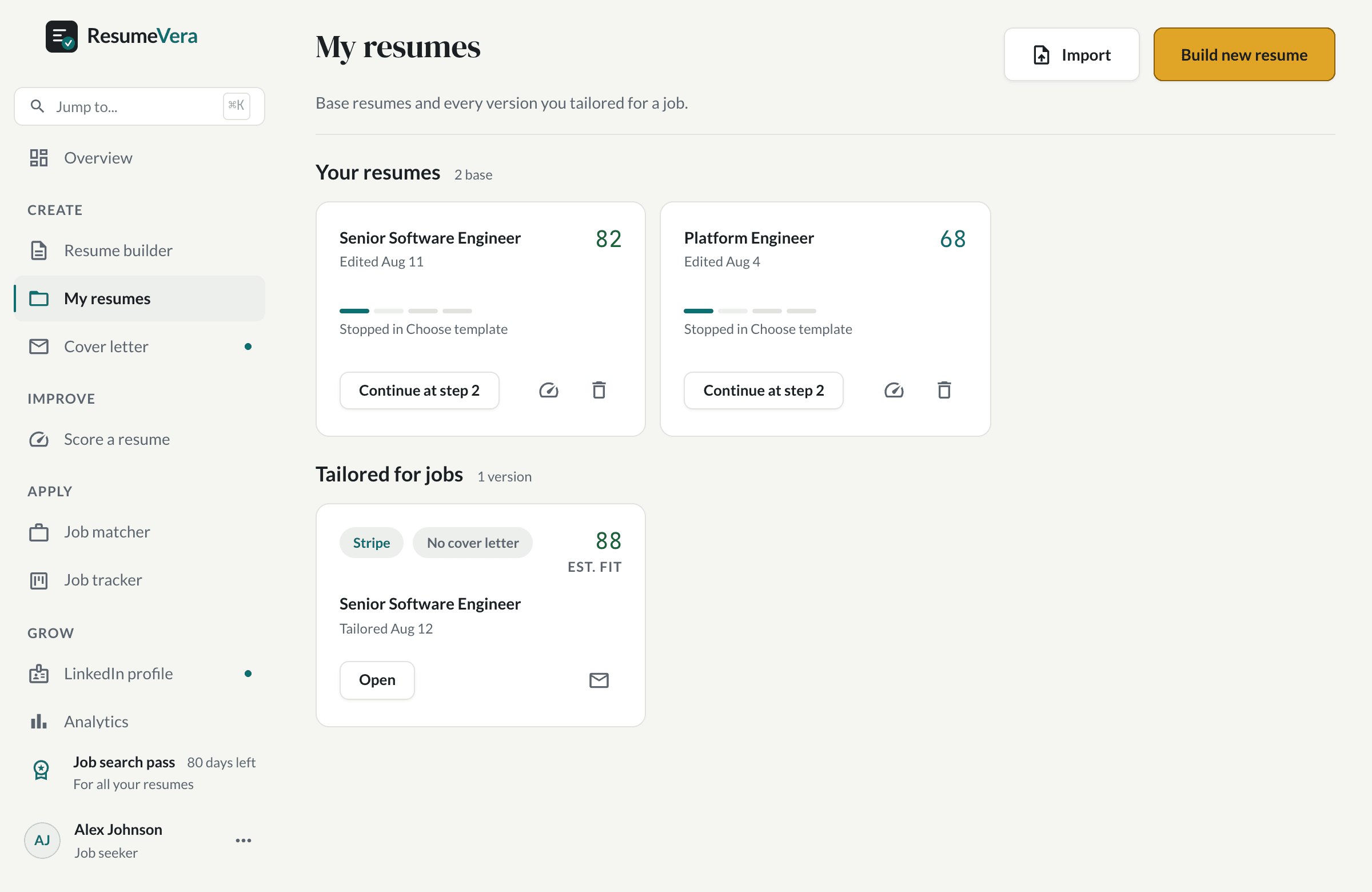
The real resume library, on a sample account with sample scores.
Build your UI/UX designer resume, free
Start from an example like this in the builder and watch the score move as you edit. Building, scoring and a watermarked export are free, with no card.