AI Is Reading Your Resume Before Any Human Does — Here's How to Beat It
Before a recruiter ever sees your name, your resume has already been evaluated. Twice. In some companies, three times.
The first screening is the classic Applicant Tracking System (ATS) — software that has been parsing and ranking resumes since the 1990s. The second, newer, and far less understood screening is an LLM-based layer: AI systems that read your resume the way a human would, assess it against the job description, and assign a suitability score. Some companies, particularly in tech and finance, are now using a third screening pass — a video interview AI that assesses your verbal responses before a human sees you.
According to the Society for Human Resource Management (SHRM), over 90% of large employers use ATS software. And since 2024, AI-augmented screening tools — from companies like HireVue, Paradox, Eightfold, and Beamery — have been integrated into the hiring pipelines of hundreds of major enterprises. The result: most candidates are rejected before any human has ever evaluated them.
This guide explains exactly how each screening layer works, what triggers a rejection at each stage, and the specific resume structures that survive all of them.

Layer 1: The Classic ATS — How It Works and What It Kills
The classic ATS is a database. When you submit your resume, the ATS parses the document — extracting text, identifying sections (Experience, Education, Skills), and indexing the content. The recruiter or hiring manager has pre-defined a list of keywords associated with the role. The ATS ranks incoming resumes by keyword match density: how many of the required terms appear in your resume, and how frequently.
What the classic ATS filters out:
- Wrong formatting. The ATS text parser reads your resume before a human does. If you have used multi-column layouts, text boxes, tables, headers/footers, or graphics — the parser often scrambles the content. Your name ends up in the middle of your work history. Your job titles disappear. Your skills section becomes unreadable. The resume is functionally blank to the system. Standard ATS platforms with known parsing issues include SAP SuccessFactors, Oracle Taleo, and older versions of iCIMS — all widely used in large Indian and multinational enterprises.
- Synonyms instead of keywords. 'Machine learning' does not match a search for 'ML.' 'Artificial intelligence' does not match a search for 'AI.' 'JavaScript framework experience' does not match a search for 'React.' The ATS matches exact strings. You must use the exact terminology from the job description, not your preferred phrasing.
- Missing must-have terms. Most ATS setups have 'knockout' criteria — required terms that, if absent, result in immediate rejection regardless of overall match score. Common knockouts: specific certifications ('AWS Certified Solutions Architect'), specific tools ('Salesforce CRM'), specific degrees ('B.Tech Computer Science'), and minimum experience levels ('5+ years Python'). If the knockout term is not in your resume, you are out before ranking even happens.
- Non-standard section headings. ATS systems are trained to look for standard section names: 'Work Experience,' 'Education,' 'Skills,' 'Certifications.' If you name your experience section 'My Journey' or 'Professional Story,' the parser may not recognise it as a work experience section and will fail to extract the job titles and dates within it.
The fix for classic ATS:
- Single-column layout. No tables, no text boxes, no document headers/footers, no columns. One clean column, top to bottom.
- Standard section headings. 'Work Experience,' 'Education,' 'Skills,' 'Certifications.' Nothing creative.
- Keywords from the job description. Extract the 10–15 most specific technical terms from the posting and verify they appear verbatim in your resume — in both your skills section and within your experience bullets.
- Clean PDF. Most modern ATS platforms handle PDF well. Avoid .docx if possible — it can cause formatting corruption depending on which Microsoft Word version you used.
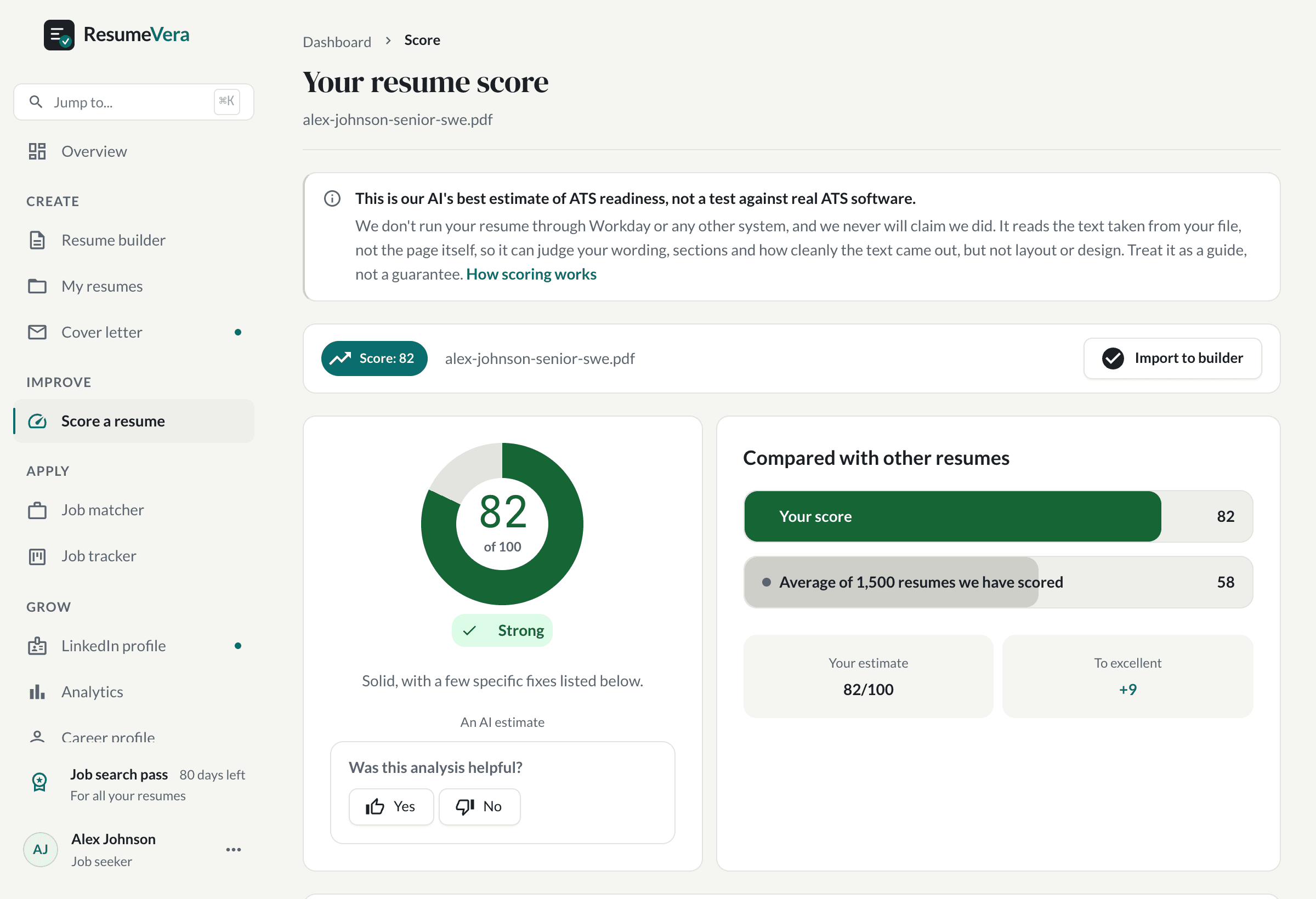
- Run an ATS check before submitting. Use a free ATS checker to score your resume against the specific job description. Target 70%+ match before submitting.
Layer 2: The LLM Screening Layer — The New Filter Most Candidates Don't Know Exists
Since 2024, a growing number of enterprise hiring teams — particularly in tech, finance, consulting, and large consumer companies — have added an LLM-based evaluation layer on top of their ATS. This is the screening that most candidates do not know exists and for which almost no career advice exists.
Tools in this category include Eightfold AI, Beamery, Phenom People, HireVue AI Assessments, and increasingly, in-house systems built by large companies using OpenAI or Anthropic APIs. The mechanism is different from classic ATS in a fundamental way: instead of keyword counting, the LLM reads your resume as a document and evaluates it against the job description the way a thoughtful human reader might.
What the LLM screening layer evaluates:
- Semantic relevance. Does the overall narrative of your resume — your career progression, your accomplishments, your skills profile — align with what the role requires? An LLM screening system can detect that 'built ETL pipelines for financial data' is relevant to a 'Data Engineer at a bank' role even if the keywords do not match exactly. But it can also detect when someone has keyword-stuffed a resume without genuine depth — the sentences are internally inconsistent with each other.
- Career trajectory fit. Does your career path lead logically to this role? An LLM evaluator will notice if you are a UX designer applying for a DevOps Engineer role with no explanation. It will also notice if you are a senior engineer applying for a junior role and flag it as an overqualification risk.
- Quantification quality. LLM evaluators are increasingly trained to give higher scores to resumes with specific, quantified achievements. A resume that says 'improved system performance' scores lower than 'reduced API latency by 43% by implementing Redis caching, improving P99 response time from 1.4s to 0.8s across 3 service endpoints.'
- Recency and relevance weighting. LLM systems weight recent experience more heavily than older experience. If your most relevant skills appear only in roles from 5+ years ago, your score will be lower than a candidate who has applied those skills more recently — even if your overall profile is stronger.
- Consistency checks. LLM evaluators can detect implausible claims: degree obtained before employment started, companies that do not exist, technology claims that do not match the time period (e.g., claiming to have used a tool before it was released), and job titles that do not match industry standard conventions.
The fix for LLM screening:
- Write for comprehension, not just keywords. Your resume should read coherently as a document — each bullet should tell a mini story of a problem, an action, and a result. LLM evaluators understand context and coherence; a resume that reads naturally to a human also reads well to an LLM evaluator.
- Put recent, relevant experience first. If you have career pivots or your most relevant skills are from recent roles, make sure those roles appear prominently and have the most detailed bullets. LLM systems weight recency.
- Quantify aggressively. Every experience bullet should have a number. Time saved, percentage improvement, revenue impact, user count, team size, error rate reduction — any number is better than no number. LLM screening systems are trained to identify specificity as a quality signal.
- Be internally consistent. The skills in your skills section should match what appears in your experience bullets. If you list 'LangChain' in your skills section, there should be an experience bullet that references a project where you used it. LLM evaluators check for this coherence.
- Tailor the summary specifically. Your resume summary is weighted heavily by LLM evaluators because it is the highest-density signal about your overall fit. Write 3–4 sentences that directly address the role's primary requirements using the exact terminology in the job description.

Layer 3: The Video Interview AI — What It Assesses Before You Meet a Human
For many roles at large companies — particularly consumer-facing companies, financial services, and tech — a third AI layer exists: the asynchronous video interview. HireVue is the most widely deployed platform; Spark Hire, Codility (for technical screens), and increasingly custom company systems are also used.
In an asynchronous video interview, you are asked a set of questions and record your responses. An AI system then evaluates your responses before a human watches them. The evaluation criteria vary by platform but commonly include:
- Content alignment: Did your answer address the question asked? Are the specific skills and experiences you mentioned relevant to the role?
- Communication clarity: Is your answer structured (situation, action, result)? Do you use hedging language excessively?
- Keyword presence: Did you mention the technologies and competencies the role requires in your verbal responses?
- Completeness: Did you use the full allotted time? Candidates who end their responses very early are often flagged.
The fix for video AI screening:
Treat the video interview as a verbal extension of your resume. Structure each answer using the STAR format (Situation, Task, Action, Result). Include the specific tool names and keywords relevant to the role in your verbal answers — the same terms you verified in your resume. Use the full time allotted. Speak at a measured pace — rushed answers score lower on communication clarity metrics.
The Resume Structure That Passes All Three Screens
A resume built to pass all three screening layers looks like this:
Section 1: Header
- Name (large, first line)
- Contact information (email, phone, LinkedIn URL, GitHub URL if technical)
- No headshot, no address (country + city is fine)
- Job title that exactly matches the posting you are targeting — this is parsed and weighted by both ATS and LLM systems
Section 2: Summary (3–4 sentences)
- Opening sentence: Your professional identity + years of experience + the domain
- Middle sentence: The most relevant specific skill or achievement for this exact role
- Closing sentence: What you bring to this specific type of role, using the job description's terminology
Section 3: Skills
- Organised by category: Programming Languages, Frameworks & Libraries, Cloud Platforms, AI/ML Tools, Databases, Tools & DevOps
- Every skill listed by exact product/technology name
- Do not include soft skills here — they are invisible to ATS and reduce keyword density of technical terms
Section 4: Work Experience (reverse chronological)
For each role:
- Company name | Job title | Location | Dates (month + year)
- 3–6 bullet points, each structured as: [Strong action verb] + [what you did] + [with what tool/method] + [measurable result]
- Keywords from the job description must appear in at least 2–3 bullets
- Most recent role gets the most bullets (5–6); older roles get fewer (2–3)
Section 5: Education
- Degree, institution, year
- GPA only if above 8.5/10 or 3.8/4.0 and you are within 3 years of graduation
Section 6: Certifications
- Certification name | Issuing organisation | Year
- List all current, non-expired professional certifications
Section 7: Projects (optional but high-impact for technical roles)
- Project name | 1-sentence description | Tech stack used | Link to GitHub or live demo
- This section carries significant weight with LLM evaluators for technical roles — it provides evidence of the skills claimed in the skills section
The 5 Things That Get Your Resume Rejected Before a Human Sees It
- Multi-column layout. The ATS parser scrambles it. Your resume arrives at the ranking engine as garbled text. Single column, always.
- Generic summary. 'Experienced professional with a passion for technology seeking a challenging role.' LLM evaluators score this near zero for relevance. Rewrite with role-specific terminology every time you apply.
- Missing knockout keywords. The recruiter has set 3–5 must-have terms. If any one of them is missing, you are auto-rejected. Run an ATS check before every submission.
- No numbers in experience bullets. LLM evaluators are trained to weight quantified achievements as quality signals. A resume with no numbers signals low accomplishment specificity and scores lower.
- Skills that do not match experience bullets. Listing 'AWS' in your skills section with no mention of AWS in any experience bullet is flagged as inconsistency by LLM evaluators. Every skill in your skills section should have at least one supporting reference in your experience.

ATS Systems Used by Major Employers in India — and What Each Prioritises
Different ATS platforms weight factors differently. Knowing which system a company uses helps you optimise more precisely:
| ATS Platform | Common Users in India | Key Optimisation Tip |
|---|---|---|
| Workday | TCS, Infosys, Wipro, most MNCs | Clean PDF is essential — Workday's parser handles single-column PDFs well but fails on complex layouts. Fill the Workday profile fields completely, not just upload the PDF. |
| SAP SuccessFactors | Large Indian conglomerates, manufacturing, BFSI | Older parsing engine — use extra-simple formatting. Bold section headings, no tables, bullet points only. |
| Oracle Taleo | Public sector, large legacy enterprises | Very keyword-literal. Mirror job description language exactly. Avoid creative synonyms. |
| Greenhouse | Indian tech startups, unicorns, GCCs of product companies | Better parser than legacy systems. Also supports LLM-augmented scoring at some companies. Quantified achievements and career narrative both matter. |
| Lever | High-growth tech companies (e.g., Palantir, Notion) | Keyword matching plus recruiter notes. Strong signal from LinkedIn profile consistency — update your LinkedIn to match your resume exactly. |
| iCIMS | Mid-market companies, some BFSI | Skills section keyword density matters most. Ensure skills section is comprehensive with exact product names. |
Checking Your Resume Before You Submit: The Complete Pre-Submission Checklist
Before clicking Submit on any job application, complete this checklist:
Format checks (classic ATS layer):
- ☐ Single-column layout — no tables, no text boxes, no columns
- ☐ Standard section headings — Work Experience, Skills, Education, Certifications
- ☐ Clean PDF — not Word, not a scanned image
- ☐ No headers/footers with important content (contact info in header often gets lost in parsing)
- ☐ File size under 2MB
Keyword checks (classic ATS layer):
- ☐ ATS checker run — score 70%+ against this specific job description
- ☐ Knockout keywords verified — all must-have terms from job description present
- ☐ Technical terms listed by exact product name in skills section
- ☐ Job title in header matches posting title exactly
Content quality checks (LLM screening layer):
- ☐ Summary tailored to this specific role — uses job description terminology
- ☐ Every experience bullet has at least one number
- ☐ Skills section matches experience bullets — no unsupported skill claims
- ☐ Most relevant experience is in the most recent role with the most detailed bullets
- ☐ Career narrative is coherent — progression makes sense for this role
A resume that passes all these checks is no longer competing with the 75% of applicants who do not understand how automated screening works. It is competing in the top 25% — the pool from which hiring managers actually make their shortlist. Use a free ATS checker to complete the keyword verification step before every submission. If you want automated help with both the formatting and the keyword optimisation, ResumeVera's AI resume builder handles both layers — ATS format compliance and LLM-quality content structuring — and shows you a real-time match score against any job description. Free to start.
Frequently Asked Questions
Does AI read resumes before humans in 2026?
Yes. Over 90% of large employers use ATS (Applicant Tracking System) software that automatically screens and ranks resumes before a recruiter sees them. Since 2024, a growing number of companies have also added LLM-based screening layers — AI systems that read resumes semantically, assess career narrative fit, and score quantified achievement quality. Some companies use a third AI layer: asynchronous video interview evaluation. Most candidates are filtered out before any human has reviewed their application.
What does an ATS actually look for in a resume?
A classic ATS performs keyword matching against a pre-defined list of terms associated with the role. It ranks resumes by keyword density and filters out applications that are missing knockout criteria. It also parses the document structure — and resumes with complex formatting (multi-column layouts, tables, text boxes, headers/footers) are often scrambled during parsing, effectively becoming unreadable to the system.
How is LLM resume screening different from ATS?
Classic ATS counts keywords and checks for exact string matches. LLM screening reads your resume as a document — understanding context, career narrative, coherence, and achievement quality. An LLM evaluator can assess whether your career trajectory logically leads to the role, whether your quantified achievements are specific enough to be credible, and whether your skills claims are supported by your experience bullets. It weights recent experience more heavily and can detect internal inconsistencies.
What is the most common reason resumes get rejected automatically?
The most common reason is formatting failure: multi-column layouts, tables, and text boxes cause ATS parsers to scramble the resume content, making it unreadable to the system. The second most common reason is missing knockout keywords — terms the recruiter has set as must-have filters. The third is low keyword density: the resume uses synonyms or vague descriptions rather than the exact technical terms in the job description.
How do I know if my resume will pass ATS screening?
Use a free ATS checker tool that scores your resume against the specific job description you are targeting. Look for a match score of 70% or higher before submitting. The keyword gap report will show you exactly which terms are in the job description but absent from your resume. Fix those gaps before you submit — adding the right keywords to your skills section and experience bullets takes under 30 minutes and can dramatically change your pass-through rate.
Can I use AI to help write my resume to beat ATS?
Yes — and it is now expected, not unusual. Using ChatGPT, Claude, or a purpose-built resume tool to help identify keywords, restructure experience bullets, and tailor your summary to each job description is a standard part of competitive job application practice in 2026. The important distinction is that you should use AI to help express your real experience more effectively — not to fabricate experience you don't have. LLM-based screening tools are increasingly effective at detecting implausible claims, and human interviewers will probe every line of your resume once you are shortlisted.
Which ATS do most Indian companies use?
The most commonly used ATS platforms in India are: Workday (most large MNCs and tier-1 IT companies including TCS, Infosys, Wipro), SAP SuccessFactors (large Indian conglomerates and BFSI), Oracle Taleo (legacy enterprises), Greenhouse (tech startups and GCCs of product companies), Lever (high-growth tech companies), and iCIMS (mid-market companies). Each has different formatting requirements and keyword weighting — Workday handles clean PDFs well, while SAP SuccessFactors requires simpler formatting.