Career guides
How to get read by a person, not filtered by a parser
Practical guides to getting past the parser and in front of a person: what each format expects, what recruiters actually scan for, and which conventions change by country.

6 min
Where the 75% ATS rejection number came from
The most repeated statistic in resume advice has no study behind it. Here is the paper trail: a 2012 sales pitch from a company that closed the following year, and what the research actually shows instead.
Read the guide →
Most read this week
01
Does a college degree still pay off in 2026? What BLS wage and unemployment data by education show
Salary and Pay · 11 min
02
Contoh surat lamaran kerja 2026: panduan lengkap
Job Applications · 14 min
03
The fastest-growing jobs through 2035, according to the government's own numbers
Job Search · 11 min
04
السيرة الذاتية للعمل في الإمارات: دليل عربي لعروض العمل والتوظيف الآمن
Job Applications · 20 min
05
Resume para Estados Unidos: guía para hispanohablantes
Job Applications · 17 min
Start here
If you only do three things
01
Get the format right
One column, real section headings, no tables or graphics. This decides whether a parser reads you at all.
Start here
02
Score what you have
See how your resume parses and where it thins out, before you spend an evening rewriting the wrong section.
First analysis free
03
Rewrite the weak bullets
Strong verb, real number, one outcome. Most resumes lose more here than anywhere else.
Free tool
Latest guides
Everything we have written

Does a college degree still pay off in 2026? What BLS wage and unemployment data by education show
Every September the Bureau of Labor Statistics quietly publishes the clearest answer available to a question most people only ever guess at: what a degree is actually worth in wages and in unemployment risk, by exact education level. The 2025 figures, released in September 2026, show a gap that holds at every single step up the ladder, not just at the bachelor's degree line. Here is the full table, what the gap adds up to, and what it does not tell you.
Updated Oct 12, 2026
Contoh surat lamaran kerja 2026: panduan lengkap
Panduan menulis surat lamaran kerja di Indonesia: susunan surat, bahasa formal, lampiran, SKCK menurut Polri, contoh untuk lulusan baru dan pelamar berpengalaman, waspada lowongan palsu menurut Permenaker 18 Tahun 2024, dan data pribadi menurut UU PDP.
Updated Oct 6, 2026

The fastest-growing jobs through 2035, according to the government's own numbers
Most "jobs of the future" lists are built on trend pieces and conference talks. The Bureau of Labor Statistics publishes an actual ten-year forecast every two years, built from real employment data. Here is what it says is growing fastest through 2035, what is driving it, and how to use it without mistaking a projection for a guarantee.
Updated Oct 5, 2026
السيرة الذاتية للعمل في الإمارات: دليل عربي لعروض العمل والتوظيف الآمن
دليل عربي للباحثين عن عمل في الإمارات: كتابة السيرة الذاتية، وما تقوله المصادر الرسمية عن عرض العمل والعقد وتصريح العمل وفترة التجربة والإنذار، ومنع تحميل العامل رسوم الاستقدام، والتحقق من العروض والوكالات. واجهة ResumeVera بالإنجليزية.
Updated Oct 4, 2026
Resume para Estados Unidos: guía para hispanohablantes
Qué es un resume y en qué se diferencia del currículum o la hoja de vida: sin foto, edad ni estado civil. Autorización de trabajo, títulos del extranjero, idiomas, ejemplo completo con títulos en inglés, ayuda oficial y estafas de empleo.
Updated Oct 4, 2026
Rédiger son CV au Québec et au Canada : guide complet
Longueur, structure, renseignements à laisser de côté, exigences de langue, CNP 2021, diplômes étrangers et fausses offres : ce que disent les sources officielles, avec un exemple de CV à compléter.
Updated Oct 4, 2026

Which industries are actually hiring in 2026, according to the government's own numbers
Most "best industries to work in" lists are built on headlines and vibes. The federal government publishes the real numbers every month for free: how many jobs are open, how many people actually got hired, and how many quit. Read together, they show where the real demand for workers is right now, and where hiring is mostly churn.
Updated Sep 28, 2026

Pay transparency laws by state in 2026, and what job seekers can do with them
Most articles about pay transparency laws are written for HR departments worried about compliance. This one is written for the person reading a job posting and wondering what the salary range actually means. A dozen states now require it, and used well, it is real leverage.
Updated Sep 22, 2026

Salary negotiation with real numbers, not just scripts
Search salary negotiation and you get a hundred versions of the same scripts. Say this, pause here, use silence. What almost none of them tell you is the one thing that actually decides the outcome: what number to put on the table. This guide pairs the negotiation research with real federal wage data so you can anchor your ask.
Updated Sep 22, 2026

How to tell if you are underpaid, using real government wage data
Most salary advice points you to a crowdsourced average that mixes interns with directors. There is a better source, and it is free. Here is how to read the five wage percentiles the Bureau of Labor Statistics publishes for your exact job, and use them to see where you honestly stand.
Updated Sep 22, 2026

European Union: recruitment is high risk, from 2027
The AI Act classifies CV screening and candidate ranking as high risk, with substantial obligations on the employers and vendors using them. Those obligations were postponed and now start in December 2027.
Updated Aug 15, 2026
United Kingdom: your right to challenge a solely automated decision
Since February 2026, a significant decision taken about you with no meaningful human involvement carries a right to be told, to make representations, to get human intervention and to contest it. It is data protection law, not employment law, and it applies to hiring anyway.
Updated Aug 15, 2026

Knockout questions: the filter that actually rejects you
People blame resume parsing for automatic rejections. The thing that genuinely ends an application on its own is a knockout question, and it sits in the form rather than in your resume.
Updated Aug 15, 2026

Australia: a transparency rule that has not started yet
From December 2026, an organisation using automated decision making that significantly affects you must say so in its privacy policy. It is a policy disclosure rather than a notice to you, and it is not in force yet.
Updated Aug 15, 2026

Illinois: you must be told when AI is used on your application
Since January 2026 an Illinois employer has to notify you when artificial intelligence is used in a hiring, promotion or other employment decision, and may not use your zip code as a stand-in for a protected characteristic.
Updated Aug 15, 2026

Colorado: the AI law you have read about never took effect
SB 24-205 was described everywhere as the first comprehensive US AI act. It was repealed before it ever applied. Its replacement does not start until 2027 and its enforcement is currently stayed by a federal court.
Updated Aug 15, 2026

AI in hiring: what you are entitled to know
Five places now require an employer to tell you when software is screening your application, or let you contest a decision it made. Three more have rules that have not started yet. Here is what is actually in force, where, and what you can ask for.
Updated Aug 15, 2026

New York City: what Local Law 144 entitles you to
If an automated tool screens you for a job or a promotion in New York City, the employer must tell you, must publish a bias audit of the tool, and must let you ask for a different process.
Updated Aug 15, 2026

California: rules aimed at the employer, not a notice to you
California's FEHA regulations have covered automated decision systems in employment since October 2025. They are strong on bias testing and record keeping, and they do not give you a right to be notified.
Updated Aug 15, 2026

Ontario: the disclosure has to be in the job posting
Since January 2026, an Ontario employer with 25 or more employees must say in any publicly advertised job posting whether AI is used to screen, assess or select applicants. It is the only one of these rules that reaches you before you apply.
Updated Aug 15, 2026

What an ATS actually does with your resume, and what it does not (2026)
An applicant tracking system mostly parses, stores and ranks applications. Where it filters people out automatically, it does so on rules the employer set, such as knockout questions, degree requirements or employment gaps. Here is what the published research actually says, what the 75% rejection claim is really based on, and the formatting habits that help a parser and a recruiter read you correctly.
Updated Jul 4, 2026
Beyond reading
Check a guide against your own resume
The guides explain what good looks like. The checker tells you where yours differs, section by section, with the specific lines named.
Check your resume free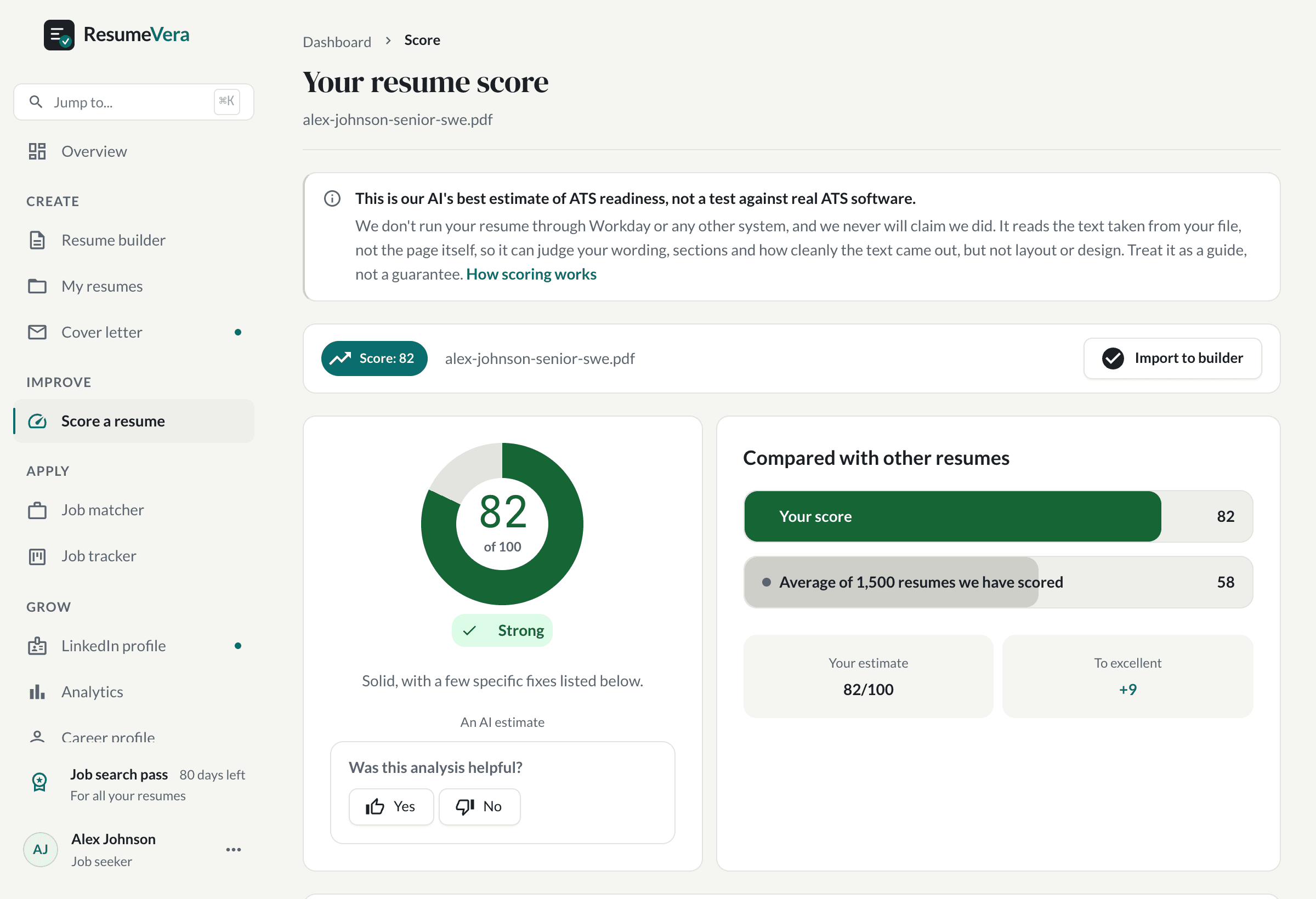
The real score page, with a sample resume and sample scores.
Our ATS score is an estimate from our own model, not a result from any employer's applicant tracking system. Figures in these guides come from named public sources, shown beside the number. Where we are estimating rather than measuring, we say so. How scoring works.