Sourced
Knockout questions: the filter that actually rejects you
The automatic rejection everyone attributes to resume parsing is usually something much simpler, and it is in the form rather than the document.
The ResumeVera team
Written from how these systems are actually configured, with the one recruiter study we could find cited by its sample size rather than quoted as a headline.
Updated Oct 7, 2026
6 min

Section 01
The thing that actually rejects an application
Almost every account of automatic rejection describes software reading a resume and judging it. That is not the mechanism.
The mechanism is a knockout question: a field on the application form that an employer has configured with a disqualifying answer. Are you legally authorised to work in this country. Do you hold a current licence for this practice. Do you have at least three years of experience in this role. Will you relocate. Can you work the listed shift pattern.
Answer one the wrong way and the application ends there, before anything reads your resume at all. It is not a model making a judgement. It is a rule a person set, working exactly as they intended.
Section 02
Why this gets attributed to the parser
Because of the timing. You submit, and within seconds or hours you have a rejection. That feels like a machine reading your resume and disliking it.
What actually happened is that a form field matched a disqualifying rule. The speed is the giveaway: nothing had time to evaluate your experience, because nothing tried.
When Enhancv put the question to a small group of US recruiters in 2025, most said their systems do not auto-reject on formatting, content or design. It is a small sample and we will not pretend otherwise, but it points the same way as how these systems are actually configured. The rejection is coming from the form.
Section 03
The questions that are genuinely absolute
Some knockouts are not negotiable and should not be treated as though they were.
Work authorisation is the clearest. If a role requires authorisation you do not hold and the employer does not sponsor, that is a real constraint rather than a filter to get around.
Licensing is the same. A nursing role requiring an active licence in a particular state, a role requiring a security clearance, a driving role requiring a clean licence. These exist because the job cannot lawfully be done without them.
Answering these dishonestly does not help you. It moves the rejection to a later stage, after you have spent time on interviews, and it can end an offer that has already been made.
Section 04
The questions where the answer is a choice
Others are softer than they look, and this is where most applications are lost unnecessarily.
Years of experience is the common one. Employers frequently set a threshold higher than the role needs, and the question usually asks about experience in a named area rather than in a job title. If you have done the work inside a different role, that counts, and it is on you to read the question as written rather than as you assume it.
Salary expectation is another. A number entered into a form can drop you below or above a band you never see. Where a range is invited, giving one is safer than giving a point.
Notice period, willingness to relocate and shift availability are similar. If the honest answer is conditional, say so where the form allows it, rather than picking the answer that closes the door.
Section 05
How to handle the form
Slow down on the questions and speed up on the upload. Most people do the reverse: they spend an hour on the resume and thirty seconds on the fields that decide whether it is read.
Read each question literally. Answer honestly. Where a free text box sits beside a hard yes or no, use it to explain a conditional answer.
And if you are rejected in minutes, look at the form rather than the resume. Rewriting your bullets will not change an answer that disqualified you.
Section 06
Where parsing does still matter
None of this makes formatting irrelevant. It makes it a different kind of problem.
A resume the parser reads badly is harder to search and harder to shortlist. It costs you quietly, by keeping you out of the results when a recruiter searches their database, rather than by producing a rejection you can point at.
What that looks like in practice is covered in what an ATS actually does with your resume. And the claim that most resumes are auto-rejected outright is traced in where the 75% number came from.
Pro tips
Do these
Spend more time on the form than on the upload. The fields decide whether the resume is read at all.
Read a years-of-experience question literally. It usually asks about experience in an area, not time in a job title.
Where a range is invited for salary, give a range rather than a point.
Use the free text box beside a hard yes or no to explain a conditional answer.
If you were rejected within minutes, look at your form answers rather than rewriting your bullets.
Avoid these
Delete these
Assuming an instant rejection means a model disliked your resume. Nothing had time to read it.
Answering a work authorisation or licensing question dishonestly. It moves the rejection later and can end an offer.
Treating a years-of-experience threshold as absolute when the question asks about an area of work you have done elsewhere.
Entering a single salary figure where a range was invited.
Rewriting a resume to fix a rejection that came from a form field.
Keywords
Keywords by category
Use these in your resume and profile to improve search visibility.
Core phrases
Related questions
Put this into a resume
Building and editing are free, and free PDFs carry a small watermark.
Check my resume freeQuestions
Frequently asked questions
How this guide is maintained
We review this guide every quarter and after any change to the hiring rules or portal behaviour it describes. It was last reviewed on October 7, 2026. Figures come from named sources, shown beside the number. Where we are estimating rather than measuring, we say so.
By the numbers
Yes / No
the shape of the question that does the rejecting, answered by you in the form
How employers configure applicant tracking systems
Before
the parser runs. A disqualifying answer ends it whatever your resume says
How employers configure applicant tracking systems
Try it
Check the guide against your own file
Everything above is general. Your resume is not. Paste it in and the checker tells you which of these points your file actually breaks.
Check your resume free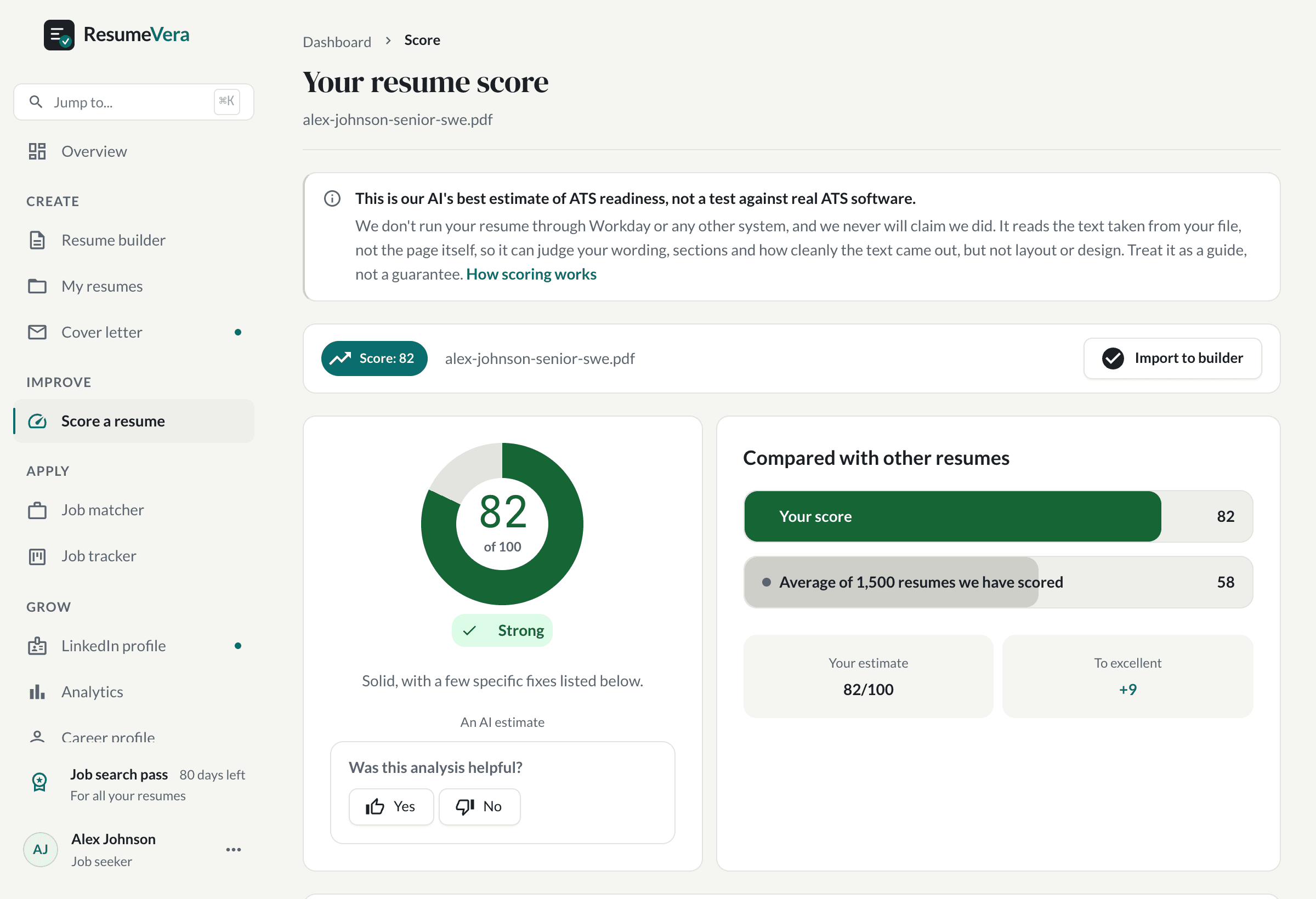
The real score page, with a sample resume and sample scores.
Sources & further reading
The formatting guidance and figures on this page draw on the following authoritative sources.
- Enhancv, recruiter interviews on ATS rejection (2025), 25 US recruiters asked whether their systems auto-reject on formatting, content or design. 23 said no. A small sample, presented here as one.
- The Interview Guys, the ATS resume rejection myth, Background on why automatic rejection is attributed to parsing, and where the claim that most resumes are auto-rejected originated.
Is your resume ATS ready?
Run a free ATS score check and get specific improvements in seconds.