Canadian Resume Format 2026: The Complete Guide
Everything you need to write a resume that meets Canadian employer expectations, passes ATS screening, and aligns with Express Entry and provincial hiring standards.
A Canadian resume, top to bottom
- 1
Contact information
Name, phone, email, city and province.
- 2
Professional summary
Two or three lines aimed at the posting.
- 3
Work experience
Reverse chronological. Quantify what you can.
- 4
Education
Include a Canadian equivalency if your credentials are from elsewhere.
- 5
Skills
Include language proficiency; English and French both count.
- 6
Volunteer experience
Optional, and more expected in Canada than in most markets.
Leave out
Photo, age, marital status and your SIN. Canadian human rights legislation makes these grounds an employer must not consider, so including them creates a problem for the reader rather than for you.
What is the standard Canadian resume format in 2026?
The standard Canadian resume in 2026 is a 1-2 page reverse-chronological document that excludes photos, date of birth, age, marital status, and Social Insurance Number. Canadian resumes closely mirror US conventions but must include Canadian-format contact details and reference Canadian credentials, certifications, and workplace norms.
Canada follows a North American resume standard that prioritizes clarity, brevity, and relevance. Unlike European CVs, Canadian resumes do not include personal photographs, nationality, date of birth, or marital status. The Canadian Human Rights Act and provincial human rights codes prohibit employers from requesting this information during the hiring process. Your resume should focus entirely on your professional qualifications, work experience, and skills.
The reverse-chronological format remains the gold standard for Canadian employers and ATS platforms alike. Start with your most recent position and work backward. Each role should include the company name, your job title, location (city, province), dates of employment, and 3-5 bullet points describing accomplishments with quantified results. Use the Canadian province abbreviation format (ON, BC, AB, QC) rather than spelling out the full province name.
Contact information should include your full name, city and province (full street address is no longer expected), phone number with Canadian country code (+1), professional email address, and LinkedIn URL. If you are applying from outside Canada, include your Canadian phone number if you have one, employers are more likely to contact candidates with local numbers.
Should you include a photo on a Canadian resume?
No. Canadian human rights legislation prohibits discrimination based on appearance. Including a photo on a Canadian resume signals unfamiliarity with local norms and may trigger unconscious bias. ATS systems used by Canadian employers (Workday, Taleo, SmartRecruiters) cannot parse images.
The Canadian Human Rights Act, along with provincial codes in Ontario, British Columbia, Alberta, and Quebec, explicitly prohibits employers from making hiring decisions based on race, national origin, age, gender, or physical appearance. When you include a photo, you inadvertently provide information that could lead to conscious or unconscious bias, even with well-intentioned hiring managers.
From a practical standpoint, Applicant Tracking Systems cannot read images. A photo embedded in your resume file may actually interfere with ATS parsing, causing text around the image to be misread or skipped entirely. Recruiters at Canadian companies like Shopify, RBC, TD Bank, and Manulife have confirmed that resumes with photos are flagged as non-standard and may receive lower priority in initial screening rounds.
This rule applies universally across Canada, including Quebec, where some newcomers from France assume the European CV format (with photo) is acceptable. It is not. Quebec employers follow the same no-photo standard as the rest of Canada.
How long should a Canadian resume be?
One to two pages. Early-career candidates should keep their resume to a single page. Mid-career and senior professionals with 10+ years of experience may extend to two pages. Federal government applications (GC Jobs) may be longer to address all screening criteria.
For most private-sector roles in Canada, a concise one-page resume is ideal for candidates with fewer than seven years of experience. A two-page resume is acceptable when you have substantial relevant experience, multiple certifications, or a career that spans different industries. Going beyond two pages is generally discouraged unless you are applying to academic, medical, or federal government positions.
Canadian federal government job postings on the GC Jobs portal (jobs-emplois.gc.ca) require detailed responses to each essential qualification listed in the Statement of Merit Criteria. These applications are evaluated against specific criteria rather than screened by ATS, so thoroughness matters more than brevity. Government resumes of three to five pages are common and expected.
Regardless of length, every line on your resume must earn its space. Remove outdated certifications, irrelevant early-career roles, and generic skills like "Microsoft Office" unless the posting explicitly requests them. Recruiters spend an average of 7.4 seconds (Ladders 2018 eye-tracking study) on an initial resume review, make every word count.
Check yours
You do not have to guess whether yours follows this
Paste yours in and the checker reads it the way an ATS would. It will tell you if you have left a photo or date of birth on it, and whether your dates and sections parse.
Check your resume free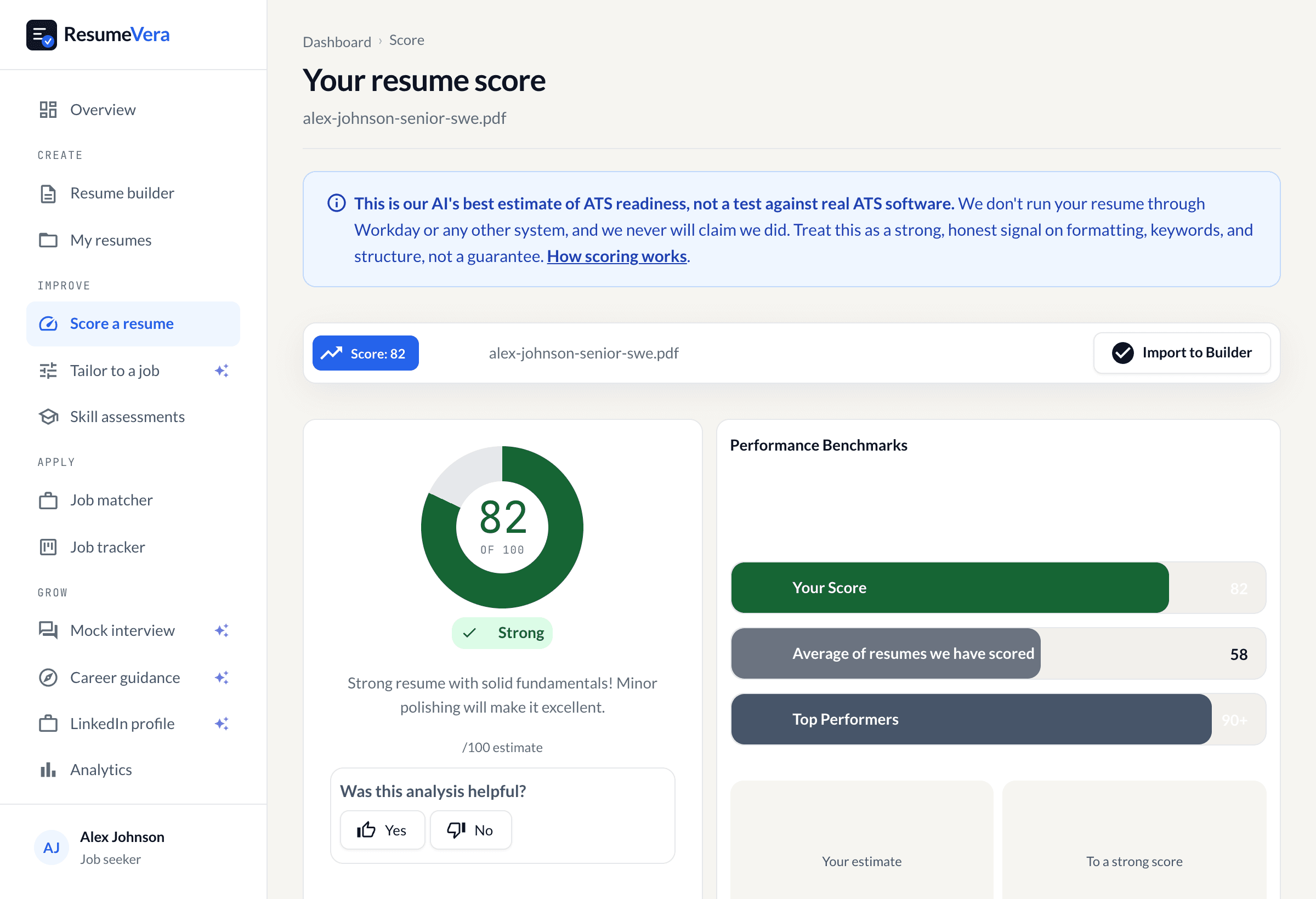
A sample resume in the real checker. The 82 and the sub-scores are what the scorer returns for it.
What sections must a Canadian resume include?
Contact information, professional summary, work experience, education, and skills are essential. Optional sections include volunteer work (highly valued in Canada), certifications, languages (French/English bilingualism is an asset), and professional associations.
Contact Information
Full name, city and province, phone (+1 format), professional email, LinkedIn URL. No street address, no photo, no SIN.
Professional Summary
3-4 sentences highlighting years of experience, key skills, industry focus, and what you bring to the role. Tailor this for each application.
Work Experience
Reverse-chronological order. Company, title, city/province, dates, 3-5 bullet points per role with quantified achievements.
Education
Degree, institution, graduation year. Include WES or IQAS equivalency if your degree is from outside Canada.
Skills
Technical and soft skills relevant to the posting. Include tools, programming languages, certifications, and platforms.
Volunteer Experience
Highly valued by Canadian employers. List like work experience with organization, role, dates, and measurable impact.
Which ATS systems do Canadian employers use?
Workday, Taleo, SmartRecruiters, Lever, and Greenhouse dominate the Canadian market. The federal government uses the GC Jobs portal. Understanding which ATS your target employer uses helps you optimize formatting, keywords, and file type for maximum parse accuracy.
Canadian employers across banking, technology, energy, healthcare, and retail rely on ATS platforms to manage high application volumes. The Big Five banks (RBC, TD, Scotiabank, BMO, CIBC) process hundreds of thousands of applications annually through enterprise ATS systems. Understanding how these systems parse resumes gives you a significant advantage over other candidates.
| ATS System | Used By | Tips |
|---|---|---|
| Workday | RBC, TD Bank, Shopify, Rogers, Telus, Loblaw | Use standard section headers. Avoid tables, columns, and text boxes. PDF or .docx accepted. |
| Taleo (Oracle) | Government of Canada contractors, Deloitte Canada, KPMG | Plain formatting only. Use keywords from the job posting verbatim. Submit .docx for best parsing. |
| SmartRecruiters | Visa, Sanofi Canada, Equinix, Bosch Canada | Handles PDF well. Use clear headers: "Work Experience," "Education," "Skills." Avoid graphics. |
| Lever | Wealthsimple, Clio, Hootsuite, Clearco | Strong PDF parser. Clean single-column layout recommended. Include LinkedIn URL. |
| Greenhouse | Shopify, Ritual, Top Hat, FreshBooks | Excellent parsing. Standard formatting works well. Include cover letter when option is provided. |
| GC Jobs Portal | Federal government of Canada | Direct text entry required. No file upload in most cases. Address each merit criterion separately. |
How does Express Entry affect your Canadian resume?
Express Entry uses the Comprehensive Ranking System (CRS) to score immigration candidates. Your resume should reflect NOC (National Occupational Classification) aligned job titles and duties, reference LMIA-supported positions, and demonstrate skills that match Provincial Nominee Program (PNP) criteria.
If you are applying to Canadian jobs through Express Entry (Federal Skilled Worker Program, Canadian Experience Class, or Federal Skilled Trades Program), your resume must align with the NOC system. Each NOC code defines specific duties, skill levels, and job titles. Your resume should use the exact terminology from the NOC description for your target occupation. For example, if you are a software developer targeting NOC 21232, your job title and bullet points should mirror the lead statement and main duties listed in the NOC definition.
CRS scores are influenced by factors including age, education, language proficiency (CLB levels), and Canadian work experience. While your resume does not directly determine your CRS score, employers reviewing applications from Express Entry candidates expect to see evidence of the qualifications that earned the candidate their score. Reference your CLB levels, WES-evaluated credentials, and any Canadian work experience prominently.
Employers offering LMIA-supported positions are actively seeking foreign workers, which means they are already familiar with Express Entry candidates. When applying to LMIA roles, emphasize your immigration status (e.g., "Open Work Permit holder," "PR eligible through Express Entry"), relevant NOC-aligned experience, and willingness to relocate to the specific province. Provincial Nominee Programs (PNPs) in Ontario (OINP), British Columbia (BC PNP), Alberta (AINP), and Saskatchewan (SINP) each have unique occupational demand lists, tailor your resume keywords accordingly.
For regulated professions (engineering, nursing, accounting, law), your resume should clearly state your credential evaluation status, any bridging programs completed, and your Canadian licensing timeline. Employers understand that international professionals may need time to complete Canadian licensing, transparency about your status builds trust.
How is a Canadian resume different from a US resume?
Canadian and US resumes share a common North American format but differ in key areas: bilingualism matters in Canada, volunteer work carries significantly more weight, foreign credentials require Canadian-equivalent evaluation through WES, and provincial certification differences exist across regulated professions.
If you are applying to jobs in both Canada and the US, you cannot use an identical resume for both markets. While the overall structure is similar: reverse-chronological format, no photo, 1-2 pages. several important differences affect how Canadian employers evaluate your application. The table below highlights the key distinctions you need to address.
| Feature | Canada | United States |
|---|---|---|
| Resume Length | 1-2 pages; government roles may be longer | 1-2 pages; federal resumes (USAJOBS) can be 4-5 pages |
| Photo | Never included | Never included |
| Language Skills | French/English bilingualism is a major asset; include CLB levels | Bilingualism is a plus but rarely required outside specific roles |
| Volunteer Work | Highly valued; often expected as a dedicated section | Valued but typically secondary to paid experience |
| Foreign Credentials | Must be evaluated by WES, IQAS, or ICES for equivalency | Evaluated by WES or ECE; less standardized requirements |
| Professional Licensing | Province-specific (e.g., PEO in Ontario, EGBC in BC for engineers) | State-specific licensing (e.g., PE license varies by state) |
| Date Format | Month Year (e.g., January 2024) or YYYY-MM-DD (ISO standard) | Month Year (e.g., January 2024) |
| Government Jobs | GC Jobs portal; merit-criteria based screening | USAJOBS portal; KSA-based screening |
| Spelling | Canadian English (organize, not organise; program, not programme) | American English |
| Privacy Laws | PIPEDA governs personal data handling | No single federal privacy law for resumes |
Templates
Start from one that already follows these rules
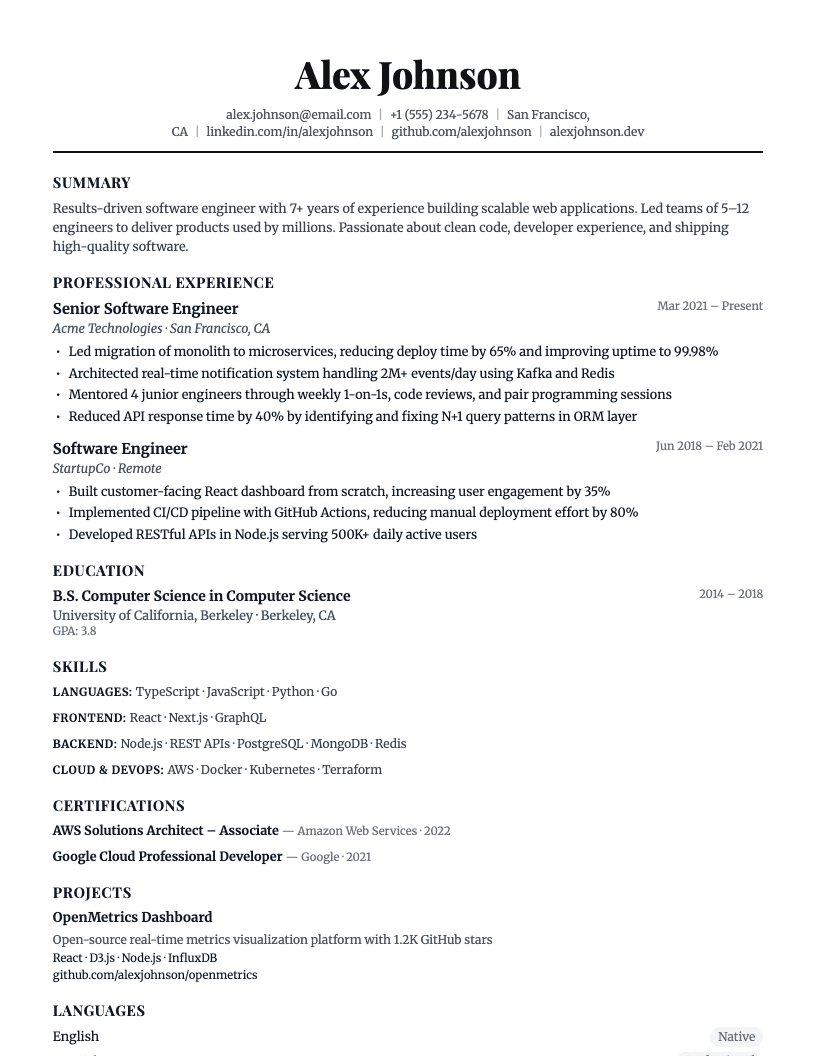
Single column, real text, standard headings, and no text boxes or tables for a parser to trip over. Every one renders your own content before you commit to it.
Browse the templates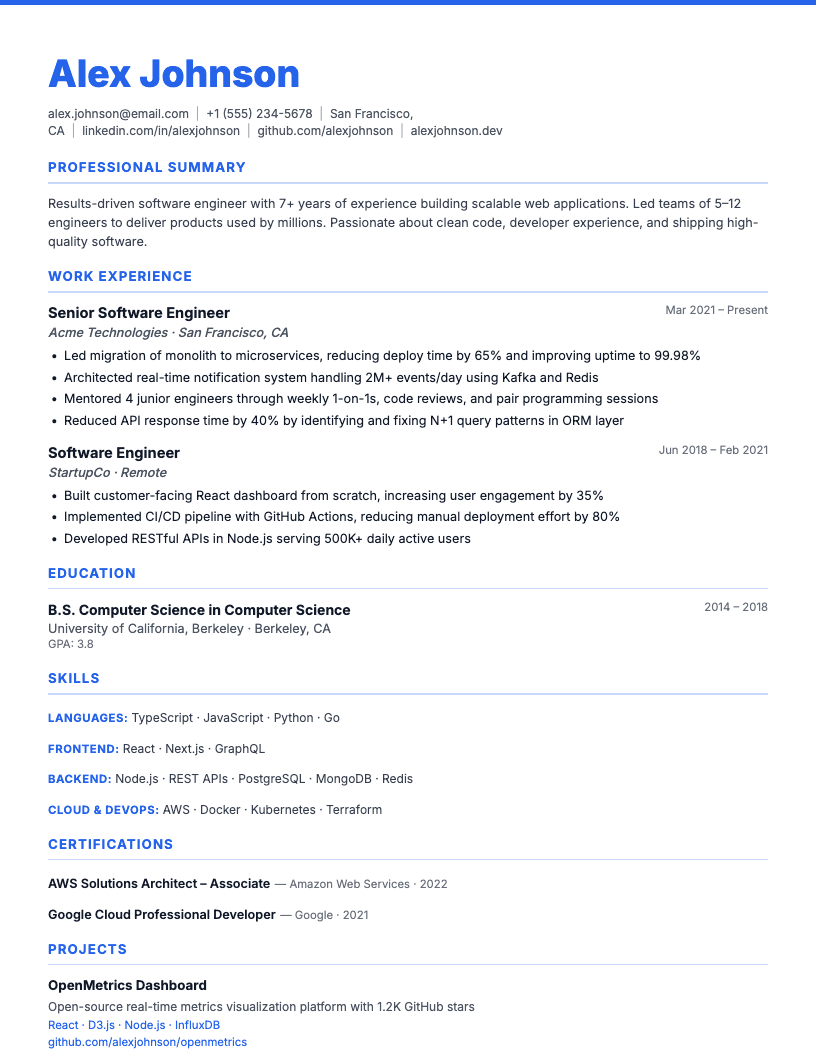
What thirteen points of difference looks like
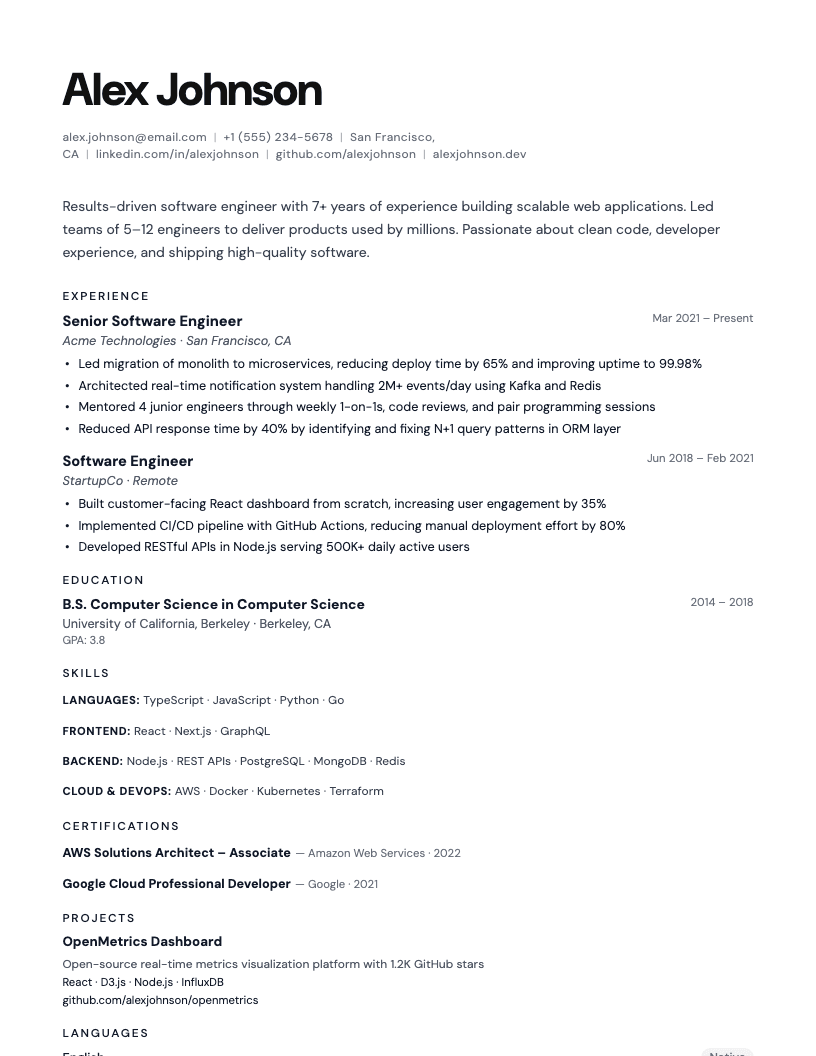
These are the two sample resumes our own scorer rates 54 and 82. Nothing was rewritten to sound better; the second one is the first one with its structure fixed.
82
of 100
- Two-line summary naming the role
- Every role dated, month and year
- Skills as a comma-separated list
- Four bullets in nine carry a number
Drag to compare. Same person, same jobs, same words for the most part, the difference is structure.
Questions
Frequently asked questions about Canadian resumes
Formatting and file types, employment gaps, and listing foreign credentials.
Applying to Australia as well as Canada? The Australian resume format has its own distinct conventions, most notably the mandatory referee page with named contacts that Canadian and US resumes do not require. Our Australian resume format guide covers the referee page, personal statement, and ATS platforms like SEEK that differ from the Canadian market.
Sources & further reading
The formatting guidance and figures on this page draw on the following authoritative sources.
- Government of Canada Job Bank, How to write a good resume, no photo, two-page limit, third-person, 5–7 bullets per section
- Canadian Human Rights Commission, basis for omitting photo, age, and marital status
- Ladders 2018 recruiter eye-tracking study, source of the 7.4-second screening figure
Resume and CV formats by country
Applying abroad? Resume conventions differ by market. Explore the correct format for where you are applying.
Build your Canada-ready resume
Use ResumeVera's AI-powered tools to create a resume optimized for Canadian employers and ATS systems. Get instant feedback, keyword suggestions, and formatting that meets Canadian hiring standards.
ATS-Optimized for Canada
Express Entry Aligned
Bilingual Support