UK CV Format 2026: The Complete Guide for British Job Applications
Everything you need to write a professional British CV, correct structure, length, ATS optimisation, Equality Act compliance, and how to present GCSEs, A-levels, and degrees to UK employers.
A UK CV, top to bottom
- 1
Personal details
Name, phone, email, town or city. No photo.
- 2
Personal profile
Three or four lines. A UK CV is expected to open with one.
- 3
Work experience
Reverse chronological.
- 4
Education
Below experience for experienced hires, above it for graduates.
- 5
Skills
Grouped, using the advertisement's own vocabulary.
- 6
References
“Available on request” at most, and usually left off entirely.
Leave out
Photo, date of birth and marital status. Under the Equality Act 2010 these are protected characteristics, and many UK employers strip them before a hiring manager sees the CV.
What is the standard UK CV format in 2026?
The standard UK CV in 2026 is a 2-page document written in British English. It excludes photographs, date of birth, nationality, and marital status under the Equality Act 2010. British CVs use A4 paper size, list qualifications including GCSEs and A-levels, and are optimised for ATS platforms like Workday, Taleo, and Oracle Recruiting Cloud.
The UK CV format has evolved significantly over the past decade. Where once a CV might stretch to three or four pages with exhaustive personal details, British employers in 2026 expect a concise, well-organised document that respects both their time and legal frameworks. The Equality Act 2010 fundamentally changed what information belongs on a British CV, photographs, dates of birth, marital status, nationality, and religious affiliation are all excluded to prevent unconscious bias in the hiring process.
A modern UK CV follows a clear structure: personal details at the top (name, address, phone number, email, nothing more), followed by a personal profile or career summary, then work experience listed in reverse chronological order, education with specific British qualifications, and a skills section tailored to the role. References are either listed at the bottom or replaced with “References available upon request.”
British CVs are formatted on A4 paper (210 × 297mm), not US Letter size. This distinction matters because ATS platforms parse documents based on expected page dimensions, and submitting a US Letter-formatted document to a UK employer can cause alignment and parsing issues. Use professional fonts such as Calibri, Arial, or Garamond at 10–12pt, with margins of 2–2.5cm. Avoid columns, text boxes, tables, headers, and footers, these elements break ATS parsing on systems like Workday and Taleo, which are widely deployed across UK employers.
Personal Details
Name, address, phone number, email address. No photo, date of birth, nationality, or marital status. Include LinkedIn URL if relevant.
Personal Profile
A 3–5 sentence career summary highlighting your key achievements, experience level, and what you bring to the role. Tailored to each application.
Work Experience
Reverse chronological order. Job title, company name, dates (month/year), key responsibilities and achievements with quantifiable results.
Education & Qualifications
Degrees, A-levels (with grades), GCSE summary. Include professional certifications such as CIPD, ACCA, or PRINCE2.
Skills
Technical and professional skills relevant to the role. Include software proficiency, language abilities, and industry-specific competencies.
References
"References available upon request" is standard. Only include full details if the job advert specifically asks for them.
Should you include a photo on a British CV?
No. UK employers actively discourage photos to comply with the Equality Act 2010. Including a photograph on a British CV signals unfamiliarity with UK recruitment norms. ATS systems used across the UK: Workday, Taleo, Oracle Recruiting Cloud cannot process images and will discard them during parsing.
The question of whether to include a photo on a CV is one of the most common queries from international professionals relocating to the United Kingdom. In many European countries, such as Germany, France and Spain, a professional headshot is expected. In the UK, it is the opposite. British recruitment culture has evolved to prioritise skills-based assessment, and the legal framework reinforces this approach.
The Equality Act 2010 protects job applicants from discrimination based on nine protected characteristics: age, disability, gender reassignment, marriage and civil partnership, pregnancy and maternity, race, religion or belief, sex, and sexual orientation. A photograph can reveal several of these characteristics, creating legal exposure for the employer and introducing unconscious bias into the screening process.
From a practical standpoint, ATS platforms cannot interpret image data. When you upload a CV containing a photo, the ATS extracts text content and ignores the image entirely. In some cases, a large image file can disrupt the document layout, causing the parser to misread adjacent text fields. Your name, contact details, or profile summary could be garbled, meaning your CV is rejected before a human ever sees it. The solution is straightforward: remove the photo and use that space for a stronger personal profile or additional skills.
How long should a UK CV be?
2 pages is the UK standard for all career levels. Unlike American resumes where 1 page is common for early careers, British recruiters expect a full 2-page CV. Academic CVs may be longer. Graduate CVs can be 1 page but 2 is preferred.
The 2-page convention in British recruitment is remarkably consistent. Whether you are a recent graduate from a Russell Group university or a senior director with 20 years of experience, the expectation is the same: two pages of A4. This differs fundamentally from the American approach, where early-career candidates are expected to fit everything onto a single page, and senior professionals may use two or three.
The rationale is practical. UK recruiters spend an average of 6–8 seconds on an initial CV scan, consistent with recruiter eye-tracking studies (Ladders, 2018). Two pages provide enough space to present a compelling personal profile, detailed work experience with achievements, and properly formatted education, without overwhelming the reader. A single-page CV from an experienced professional may signal that you have omitted important information. A three-page CV suggests you cannot prioritise.
There are exceptions. Academic CVs in the UK can extend to four or more pages, as they must include publications, research grants, conference presentations, and teaching experience. Medical CVs follow a similar pattern, with detailed clinical placements and GMC registration information. For all other roles, commercial, public sector, charity, technology, two pages is the expectation. If you are struggling to fill two pages as a graduate, include relevant coursework, dissertation topics, volunteer work, and transferable skills from part-time employment.
Check yours
You do not have to guess whether yours follows this
Paste yours in and the checker reads it the way an ATS would. It will tell you if your CV runs past two pages, if your dates are ambiguous, or if you have left a photo on it.
Check your resume free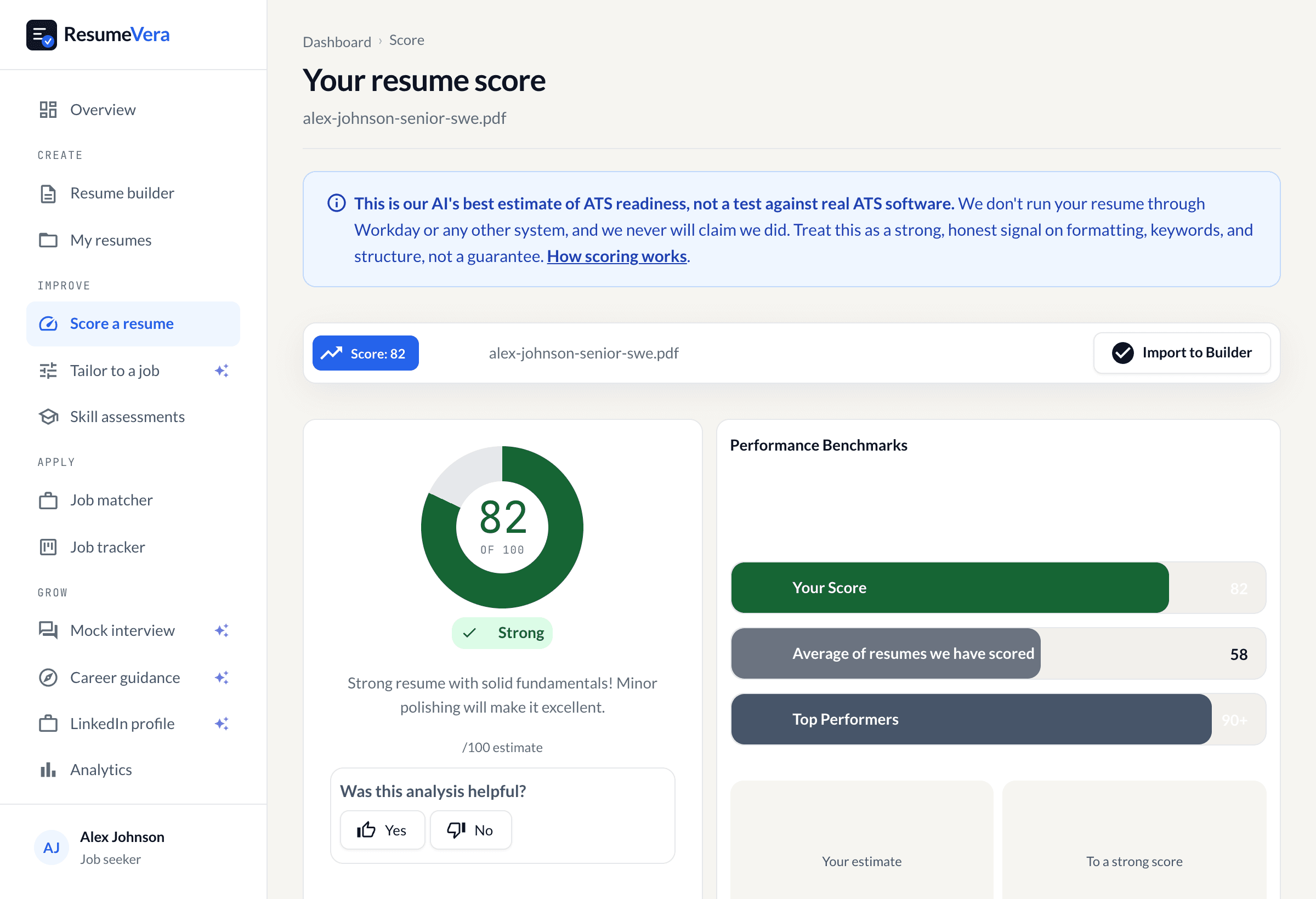
A sample resume in the real checker. The 82 and the sub-scores are what the scorer returns for it.
What sections must a UK CV include?
Personal details (name, address, phone, email, no photo), personal profile/statement, work experience, education (GCSEs, A-levels, degrees), skills, references or “References available upon request”.
Every UK CV must contain six core sections, each serving a distinct purpose in the British recruitment process. The order matters, recruiters expect to find information in a standardised sequence, and deviating from this structure can cause confusion during both human review and ATS parsing.
Which ATS systems do UK employers use?
Workday, Taleo, Oracle Recruiting Cloud, SAP SuccessFactors, Oleeo (used by NHS), SmartRecruiters. Understanding which ATS your target employer uses helps you optimise your CV format, structure, and keyword strategy for maximum compatibility.
The UK recruitment market is dominated by a handful of Applicant Tracking Systems, each with different parsing capabilities and formatting preferences. Large employers, FTSE 100 companies, NHS trusts, government departments, and major consultancies, rely on these systems to process thousands of applications per role. Understanding how each ATS handles your CV gives you a measurable advantage over candidates who submit without considering format compatibility.
Workday is the most widely deployed ATS among large UK employers, used by companies like Unilever, GlaxoSmithKline, Rolls-Royce, and Aon. Taleo (now Oracle Recruiting Cloud) remains prevalent in financial services and professional services firms including the Big Four accountancy practices. SAP SuccessFactors is common in manufacturing, engineering, and multinational corporations with German or European headquarters. Oleeo holds a strong position in the public sector, particularly within NHS trusts and local authorities. SmartRecruiters has gained significant traction among technology companies and high-growth businesses.
| ATS Platform | Market Sector | Key UK Users | CV Optimisation Tips |
|---|---|---|---|
| Workday | FTSE 100, large corporates | Unilever, GSK, Rolls-Royce, Aon, BP | Use .docx format; avoid headers/footers; standard section headings; no columns or text boxes |
| Taleo / Oracle Recruiting Cloud | Financial services, professional services | Deloitte, PwC, KPMG, Barclays, HSBC | Plain formatting; avoid special characters; spell out abbreviations on first use |
| SAP SuccessFactors | Manufacturing, engineering, multinationals | Siemens UK, BAE Systems, Bosch, Shell | PDF or .docx; consistent date format (DD/MM/YYYY); clear job title hierarchy |
| Oleeo | Public sector, NHS, local government | NHS trusts, Civil Service, Metropolitan Police | Match competency framework language; use specific NHS band/grade terminology if applicable |
| SmartRecruiters | Technology, high-growth businesses | Visa, Equinix, Colliers, Travis Perkins | Modern parser: handles most formats; still avoid graphics and multi-column layouts |
| Greenhouse | Technology, startups, scale-ups | Deliveroo, Monzo, Revolut, Wise | Supports PDF well; keep formatting simple; use standard section headings |
Employer examples above are illustrative of the sectors where each platform is common. Most organisations do not publicly disclose which ATS they use, and deployments change over time.
How is a UK CV different from a US resume?
The differences between a UK CV and a US resume extend beyond terminology. Length, education format, date conventions, paper size, spelling, and personal information rules all differ significantly between British and American job applications.
International job seekers, particularly those moving between the United States and the United Kingdom, often underestimate how different the two document formats are. A CV that works perfectly for American employers will be immediately recognisable as a foreign document by British recruiters, and vice versa. The differences are not merely cosmetic; they reflect distinct legal frameworks, cultural expectations, and recruitment practices.
In the UK, the term “CV” (curriculum vitae) is used universally. In the US, “resume” is the standard term, and “CV” is reserved for academic and medical positions. British CVs are consistently 2 pages; American resumes are typically 1 page for early-career candidates and 2 pages for experienced professionals. UK education sections list specific qualifications: GCSEs, A-levels, BTECs, degrees with classifications (First, 2:1, 2:2), while US resumes list degrees with GPA scores.
Date formats differ: the UK uses DD/MM/YYYY while the US uses MM/DD/YYYY. Paper size is A4 in the UK and US Letter (8.5 × 11 inches) in America. Spelling follows British conventions in the UK, “organise” not “organize”, “programme” not “program”, “colour” not “color”, “centre” not “center”. Using American spelling on a British CV immediately signals that the document has not been localised for the UK market.
| Feature | UK CV | US Resume |
|---|---|---|
| Terminology | CV (curriculum vitae) | Resume |
| Standard Length | 2 pages (all career levels) | 1 page (early career), 2 pages (experienced) |
| Photo | Never included (Equality Act 2010) | Never included (anti-discrimination law) |
| Education Format | GCSEs, A-levels, degree classification (First, 2:1) | Degree, GPA (e.g., 3.8/4.0) |
| Date Format | DD/MM/YYYY | MM/DD/YYYY or Month YYYY |
| Paper Size | A4 (210 × 297mm) | US Letter (8.5 × 11 in) |
| Spelling | British English (optimise, organise, colour) | American English (optimize, organize, color) |
| Personal Profile | Expected (3–5 sentences) | Optional (summary or objective) |
| References | “Available upon request” or listed | Not included on the resume |
| Covering Letter | Called “covering letter” | Called “cover letter” |
If you are transitioning from the US market to the UK, or applying to British companies from abroad, these differences are critical. A US-formatted resume submitted to a UK employer will stand out for the wrong reasons. Similarly, using American spelling throughout your CV suggests you have not taken the time to adapt your application for the British market, a detail that matters to employers evaluating attention to detail and cultural awareness.
How to optimise your UK CV for ATS
British employers receive hundreds of applications per role. Your CV must pass automated screening before reaching a human recruiter. These optimisation strategies ensure your CV performs well on UK ATS platforms.
Use Standard Section Headings
Stick to recognised headings: "Personal Details", "Personal Profile", "Work Experience", "Education", "Skills", "References". Creative alternatives like "My Journey" or "What I Bring" confuse ATS parsers and reduce your match score.
Mirror Job Advert Language
If the job advert says "programme management", use "programme management", not "project management" or "program management". ATS platforms match keywords literally, and British spelling variants are treated as different terms by most systems.
Format Dates Consistently
Use DD/MM/YYYY or "Month YYYY" consistently throughout your CV. Do not mix formats. British ATS platforms expect UK date conventions, and inconsistent formatting can cause parsing errors in work experience chronology.
Save as .docx or PDF
Most UK ATS platforms accept both .docx and PDF formats. Workday and Taleo prefer .docx for optimal text extraction. If you use PDF, ensure the text is selectable (not a scanned image). Never submit .pages, .odt, or image files.
Avoid Graphics and Columns
Multi-column layouts, text boxes, skill bars, pie charts, and infographic elements are not parsed by ATS platforms. Use a single-column layout with clear headings and bullet points. This is not a design limitation, it is how you ensure your content is read correctly.
Quantify Achievements
British recruiters value evidence-based achievements. Instead of "Managed a team", write "Managed a team of 12 across 3 UK offices, delivering a 22% increase in quarterly output." Numbers, percentages, and pound values make your CV concrete and memorable.
UK-specific CV considerations
British CVs have unique requirements shaped by UK employment law, qualification frameworks, and recruitment culture. These details distinguish a professional UK CV from a generic international document.
Templates
Start from one that already follows these rules
Single column, real text, standard headings, and no text boxes or tables for a parser to trip over. Every one renders your own content before you commit to it.
Browse the templates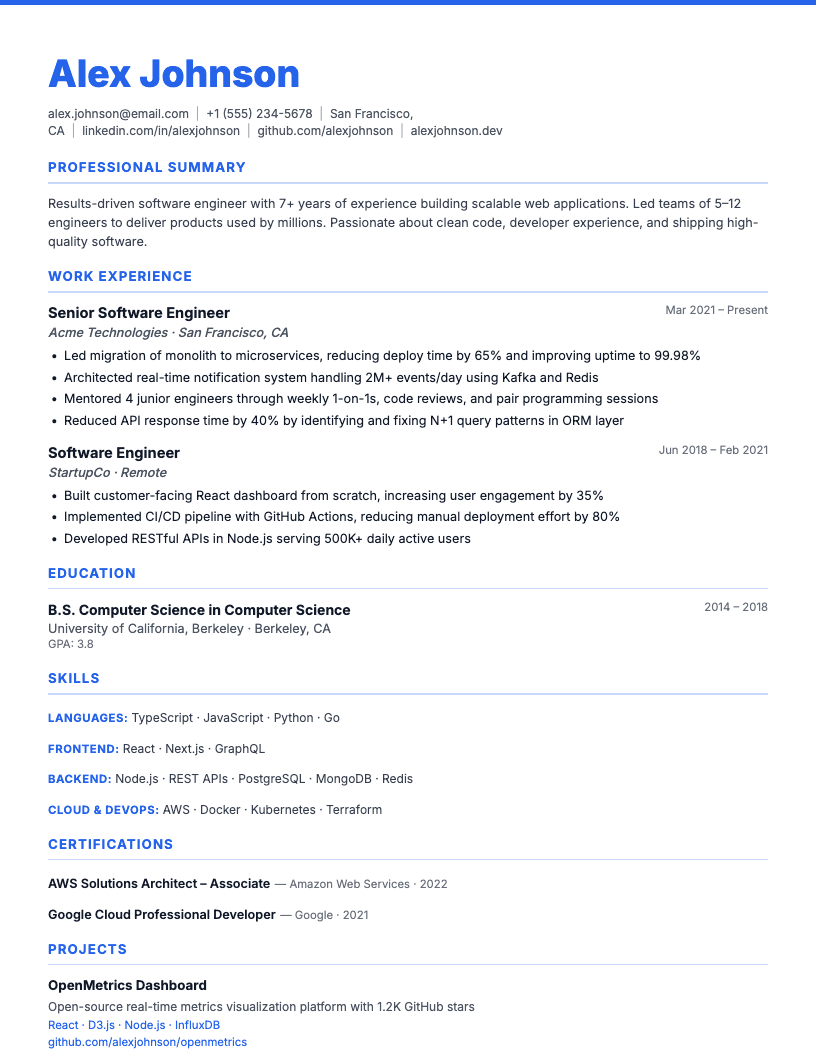
What thirteen points of difference looks like
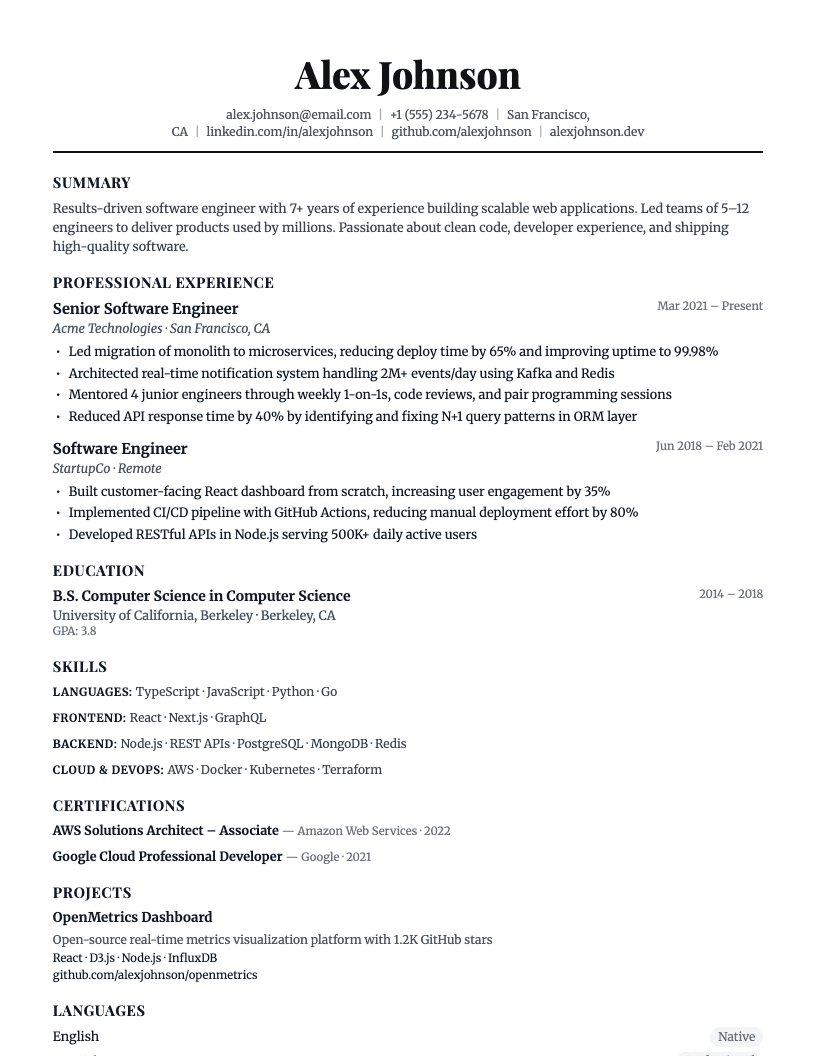
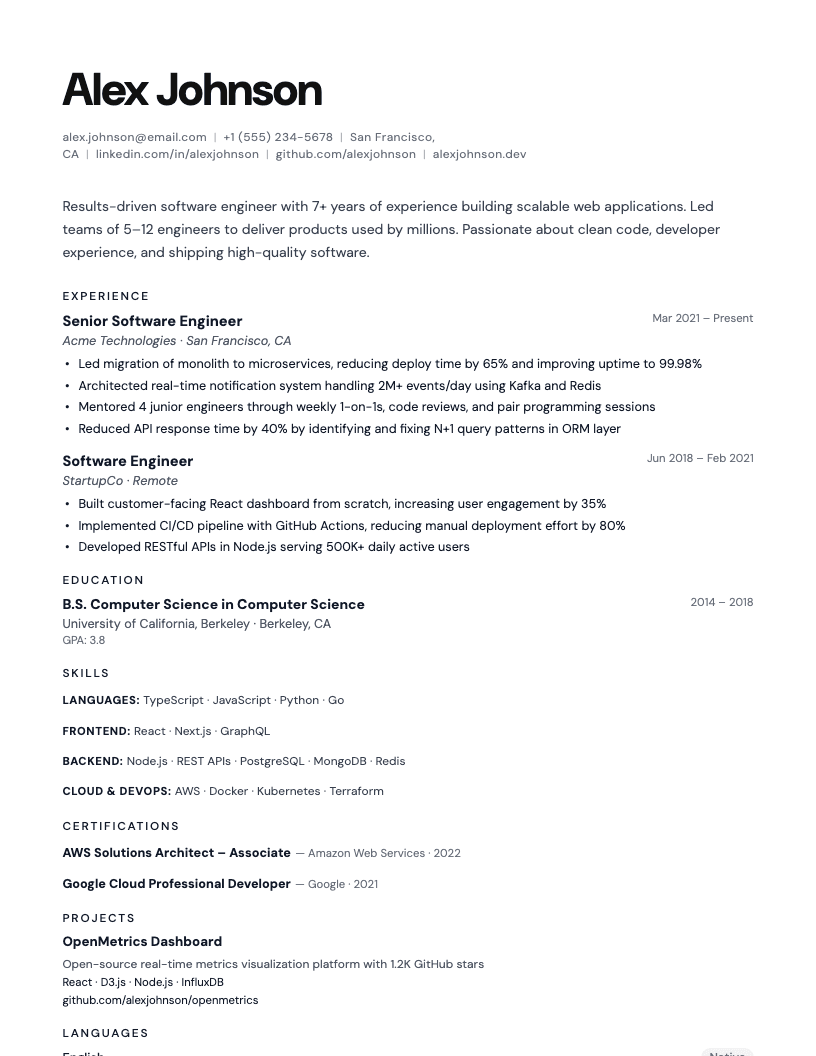
These are the two sample resumes our own scorer rates 54 and 82. Nothing was rewritten to sound better; the second one is the first one with its structure fixed.
82
of 100
- Two-line summary naming the role
- Every role dated, month and year
- Skills as a comma-separated list
- Four bullets in nine carry a number
Drag to compare. Same person, same jobs, same words for the most part, the difference is structure.
Questions
Frequently asked questions
Common questions about UK CV format, British recruitment norms, and ATS optimisation.
Sources & further reading
The formatting guidance and figures on this page draw on the following authoritative sources.
- National Careers Service (gov.uk), How to write a CV, official UK guidance on sections, length, and what to omit
- Civil Service Careers, How to write your CV, competency-based UK public-sector CV conventions
- Equality Act 2010 guidance (gov.uk), why UK CVs omit photo, age, and personal details
- Ladders 2018 recruiter eye-tracking study, basis for the 6–8 second scan figure
Resume and CV formats by country
Applying abroad? Resume conventions differ by market. Explore the correct format for where you are applying.
Build your UK-ready CV
Whether you are a British professional, an international graduate, or a skilled worker visa holder. ResumeVera helps you create a CV that meets UK standards, passes ATS screening, and presents your qualifications in the format British employers expect.
Optimised for UK ATS platforms
British English spelling check
Skilled Worker Visa support
Right to work guidance