Australian resume format 2026: the complete guide
Everything you need to write a resume that meets Australian employer expectations, passes SEEK and LinkedIn ATS screening, and follows the referee-page convention that most international applicants miss.
An Australian resume, top to bottom
- 1
Contact information
Name, phone, email, suburb and state.
- 2
Personal statement
Three or four lines. Expected here in a way a US summary is not.
- 3
Work experience
Reverse chronological.
- 4
Education
Below experience for experienced hires, above it for recent graduates.
- 5
Skills
Grouped, and matched to the words in the advertisement.
- 6
Referees
Australia is unusual: naming referees on the document is still normal.
Leave out
Photo, date of birth and marital status.
What do Australian employers call it: CV or resume?
In Australia, "CV" and "resume" are used interchangeably. This is different from the strict US/UK split where a CV is a multi-page academic document. When an Australian job ad says "submit your CV," it means the same two-to-three page resume that every other applicant submits.
This distinction matters because Indian professionals often default to one of two incorrect extremes: submitting a one-page US-style resume (too short) or a lengthy academic CV (too detailed for most private-sector roles). The Australian standard sits between these: a professional document of two to three pages that covers your work history in detail, includes a personal statement, and ends with a named referee page.
The format is reverse-chronological for work experience, with your most recent role first. Each position should include the company name, your job title, the city and state (e.g., Sydney NSW, Melbourne VIC), dates of employment in Month Year format, and three to five bullet points describing accomplishments with quantified results wherever possible.
Contact details should include your full name, Australian phone number (or +61 prefix if calling from overseas), professional email, LinkedIn URL, and optionally your suburb and state. A full street address is not required. If you are applying from outside Australia, mention your visa status or eligibility to work in Australia clearly in your personal statement.
The referee page: Australia's most distinctive resume convention
Australian resumes end with a dedicated referee page listing two to three professional referees by name, title, company, phone, and email. "References available on request" is considered evasive and outdated. Referees may be contacted before a formal job offer is made, so notify them before you apply.
Key fact for international applicants
In the US and Canada, it is standard to omit referees from your resume entirely. In Australia, omitting the referee page is a red flag. Hiring managers view it as either evasive or unfamiliar with local norms. Always include a named referee page. It is not optional.
A standard Australian referee page includes two to three contacts: typically your direct manager from your most recent role, a senior colleague or project sponsor, and optionally a client or cross-functional lead. For each referee, list their full name, current job title, company name, direct phone number, and professional email address. Use a simple heading: "Referees" or "Professional References."
Australian employers frequently contact referees by phone before making an offer, and sometimes before inviting you to a final-round interview. This is a materially different norm from India, where reference checks typically happen only after an offer is accepted. You should contact each referee before you submit your application, brief them on the role you are applying for, and confirm they are willing to speak positively on your behalf.
If you are a recent migrant with no Australian referees yet, use international referees initially while building local professional relationships. Acknowledge this in your cover letter if necessary. A credible international manager at a well-known company is far better than leaving the page blank or writing "available on request."
How long should an Australian resume be?
Two to three pages is the Australian standard for mid-career professionals. Early-career candidates aim for one to two pages. No photo, no age, no marital status, no religion. A4 paper size is preferred for Australian-based applications.
Unlike the US one-page norm, Australian employers expect and are comfortable reading a two-to-three page resume from a mid-career candidate. The additional page is typically used for a more detailed work history, a skills section, and the referee page. The extra length reflects more detail per role rather than a longer career span.
Australian resumes follow the same anti-discrimination conventions as US and Canadian resumes. Do not include a photo, date of birth, age, marital status, religion, or national origin. The Australian Human Rights Commission and state equal opportunity laws apply to all employers. Including personal details that reveal any of these attributes is both unnecessary and potentially disadvantageous.
A4 paper size (210mm x 297mm) is the standard for Australian applications, though most digital applications are submitted as PDFs and the physical paper size is rarely relevant. If you are applying to an Australian employer while currently based in India, A4 is the right choice. Australian Letter size does not exist. The US Letter format (8.5 x 11 inches) is acceptable for digital PDFs but A4 is preferred.
Check yours
You do not have to guess whether yours follows this
Paste yours in and the checker reads it the way an ATS would. It will tell you whether your dates parse, whether your sections are found, and where the selection criteria are thin.
Check your resume free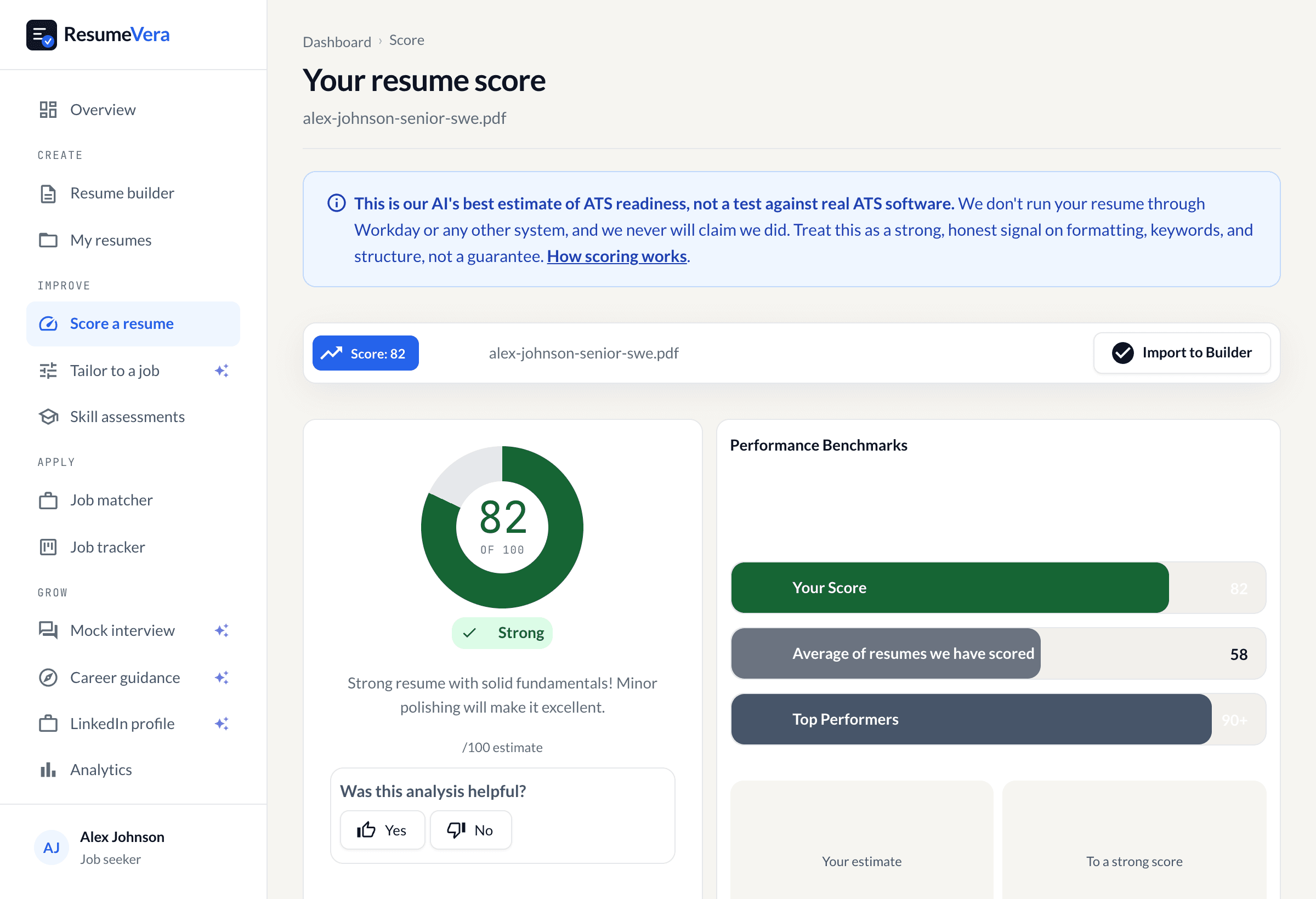
The real score page, with a sample resume and sample scores.
What sections must an Australian resume include?
Contact information, personal statement, work experience, education, skills, and referees are essential. A personal statement at the top is expected, and slightly more personality-forward than the terse US-style summary.
Personal Statement
3-5 sentences at the top. State your years of experience, key strengths, and what you bring to the role. Australian employers expect a slightly warmer, more direct tone than a US-style objective.
Contact Information
Full name, suburb and state, Australian phone number, professional email, LinkedIn URL. No street address required. State your right to work in Australia if relevant.
Work Experience
Reverse-chronological order. Company, job title, city and state, dates (Month Year), and 3-5 bullet points per role with quantified achievements.
Education
Degree, institution, and graduation year. For Indian degrees, add the equivalent Australian level if known (e.g., "B.Tech = Australian Bachelor's degree"). Skills assessment equivalency if completed.
Skills
Technical skills, tools, programming languages, certifications. List skills relevant to the specific role. Avoid generic entries like "Microsoft Word" unless required.
Referees
2-3 professional referees with name, title, company, phone, and email. This is mandatory in Australia. Never write "available on request."
How is an Australian resume different from an Indian resume?
The most significant differences are the referee page (mandatory in Australia, absent in India), resume length (2-3 pages vs 1-2 pages), and what personal details to include. Many Indian resume conventions that are standard at home are red flags in Australia.
Indian resume conventions differ from Australian norms in several important ways. The table below covers the key differences so you can adjust your document before applying to Australian employers.
| Feature | Australia | India |
|---|---|---|
| Resume length | 2-3 pages standard; 1-2 for early career | 2-3 pages common; often shorter for junior roles |
| Photo | Never included (discrimination risk) | Commonly included (Indian job portals often show it) |
| Date of birth | Never included | Often listed under personal details |
| Marital status | Never included | Frequently listed under personal details |
| Religion / caste | Never included (illegal to request in Australia) | Sometimes included; caste rarely but does appear |
| Referee page | Mandatory: 2-3 named referees with full contact details | "References available on request" or absent entirely |
| Personal statement | Expected: 3-5 sentences, personality-forward tone | Objective statement common; often formulaic |
| Hobbies / interests | Optional; rarely included in professional roles | Frequently included under personal details |
| Salary expectations | Not on resume; addressed in cover letter or interview | Sometimes listed as "Current CTC / Expected CTC" |
| Job portals used | SEEK (dominant), LinkedIn Australia, Indeed AU | Naukri, LinkedIn India, Shine, Monster India |
Mistakes Indian applicants make on Australian resumes
The most common errors come from applying Indian resume conventions to an Australian context. Each of these signals unfamiliarity with the local market and can cost you an interview.
Common mistakes to avoid:
- Writing "References available on request" instead of listing actual referees
- Including a passport-size photo in the header
- Listing date of birth, marital status, or religion under personal details
- Including current and expected CTC or salary details on the resume
- Omitting the personal statement at the top (Australian employers expect it)
- Submitting a one-page US-style resume (too thin for Australian standards)
What to do instead:
- Name 2-3 referees with full contact details on a dedicated last page
- Remove the photo entirely. No exceptions for any Australian employer.
- Keep personal details to: name, suburb/state, phone, email, LinkedIn
- Discuss salary only when asked; never include it in the resume or unsolicited
- Open with a 3-5 sentence personal statement that is direct and specific
- Aim for 2-3 pages with detailed work history and a referee page
If you are applying for skilled migration to Australia, the resume conventions are somewhat different for your skills assessment application versus your eventual job search in Australia. Our Australian skilled migration resume guide covers the ANZSCO alignment and ACS skills assessment requirements that apply before you arrive.
Which ATS systems do Australian employers use?
SEEK's native application system, Workday, PageUp, and LinkedIn are the dominant platforms in Australia. The federal government uses APS Jobs. The same ATS formatting rules apply: plain text, standard section headers, no tables or columns in the main body.
Most Australian employers route job applications through SEEK, which has its own application system in addition to allowing file uploads. Large Australian enterprises and multinationals operating in Australia use enterprise ATS platforms. Understanding which system your target employer uses helps you optimise formatting, file type, and keyword density.
| ATS / Platform | Used By | Formatting Tips |
|---|---|---|
| SEEK Apply | Most Australian employers (dominant job board) | Upload PDF or .docx. Use standard section headers. Avoid text boxes and columns. |
| LinkedIn Easy Apply | Multinational companies, tech sector, startups | PDF preferred. Ensure your LinkedIn profile matches your resume exactly. |
| Workday | Commonwealth Bank, Westpac, BHP, Woolworths, Telstra | Standard formatting only. No tables, columns, or text boxes. PDF or .docx accepted. |
| PageUp | Australian universities, government agencies, healthcare | Plain formatting. Use standard headers. Keyword-dense content matters more than design. |
| APS Jobs | Australian Federal Government (APS) | Structured form entry. Responses must address Key Selection Criteria (KSC) separately. |
Templates
Start from one that already follows these rules
Single column, real text, standard headings, and no text boxes or tables for a parser to trip over. Every one renders your own content before you commit to it.
Browse the templates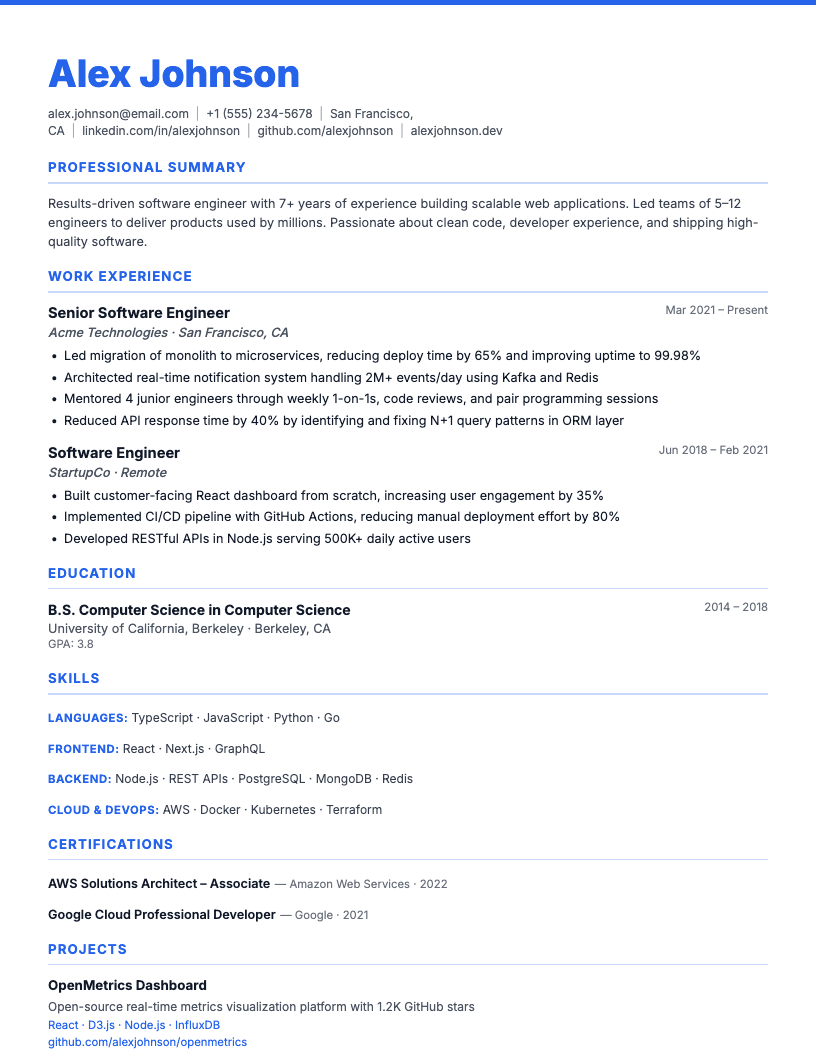
What thirteen points of difference looks like
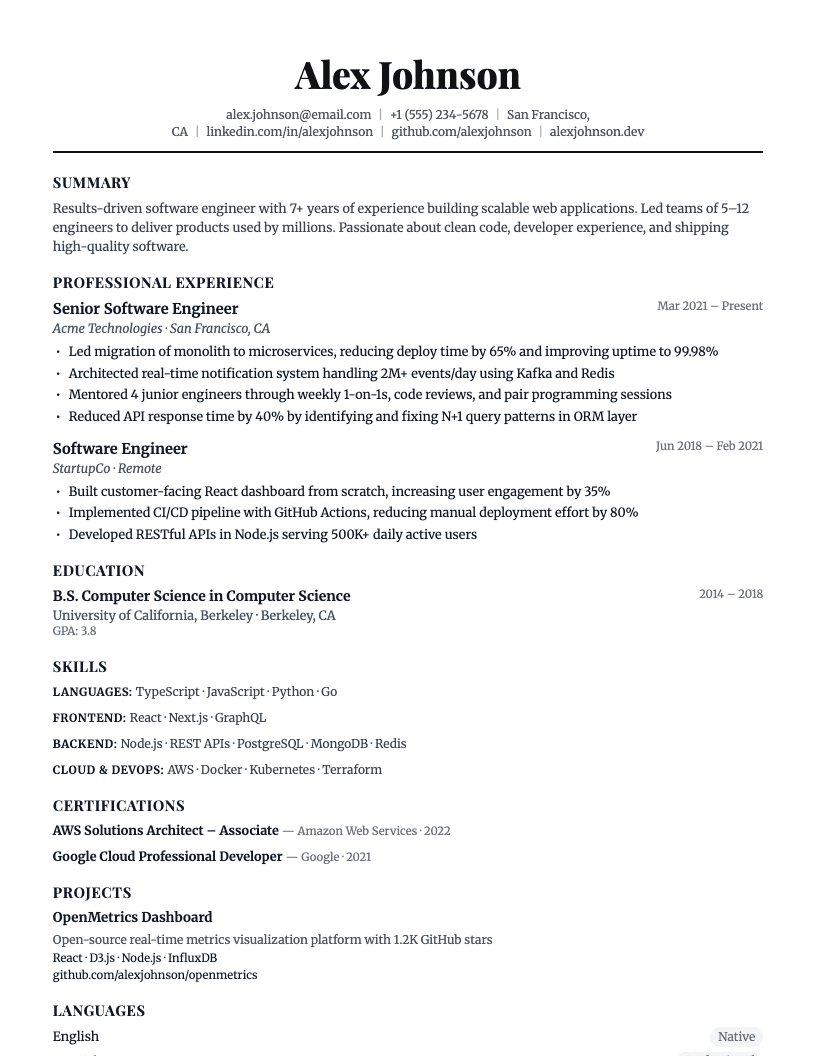
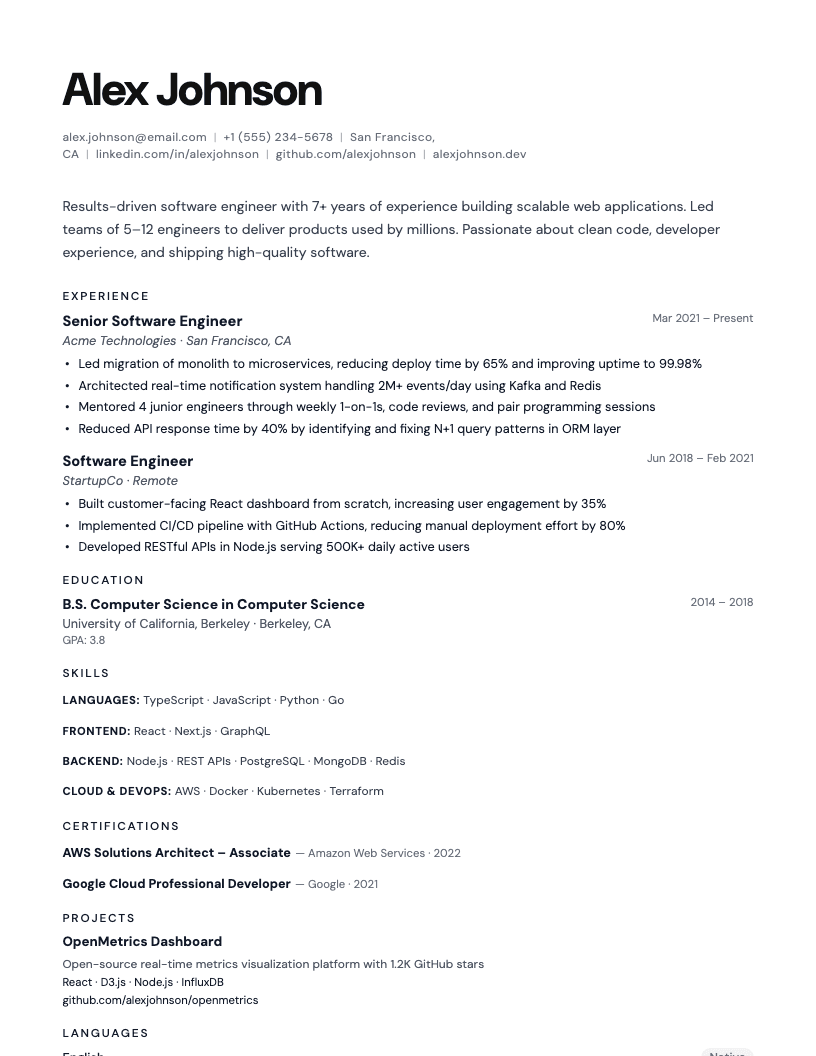
These are the two sample resumes our own scorer rates 54 and 82. Nothing was rewritten to sound better; the second one is the first one with its structure fixed.
82
of 100
- Two-line summary naming the role
- Every role dated, month and year
- Skills as a comma-separated list
- Four bullets in nine carry a number
Drag to compare. Same person, same jobs, same words for the most part, the difference is structure.
Questions
Frequently asked questions about Australian resumes
Formatting and file types, the referee page, and personal statement conventions.
Sources & further reading
The formatting guidance and figures on this page draw on the following authoritative sources.
- APSJobs, Australian Public Service recruitment, selection-criteria and STAR-response conventions
- Australian Human Rights Commission, basis for omitting photo and personal details
- Fair Work Ombudsman, Australian employment and anti-discrimination framework
Resume and CV formats by country
Applying abroad? Resume conventions differ by market. Explore the correct format for where you are applying.
Build your Australia-ready resume
Use ResumeVera's AI-powered tools to create a resume optimized for Australian employers and ATS systems. Get instant feedback on referee page formatting, keyword density, and the personal statement that Australian hiring managers expect.
ATS-Optimized for Australia
Referee Section Ready
No Photo Needed