Resume for Australian Skilled Migration
A complete guide for Indian professionals applying through subclass 189, 190, and 491 skilled migration visas. Covers ANZSCO code alignment, ACS and VETASSESS assessment requirements, the points test, and how your assessment resume differs from your job-search resume.
What skilled migration visa subclasses require a resume?
Australia's General Skilled Migration (GSM) program uses three main visa subclasses for independent and state-nominated applicants. Each requires a positive skills assessment before you can lodge an expression of interest through SkillSelect, and your resume is the primary document your assessing authority evaluates.
| Visa Subclass | Type | Key Requirement |
|---|---|---|
| 189: Skilled Independent | No sponsorship needed | High points score (typically 65+ points). Occupation must be on the Medium and Long-term Strategic Skills List (MLTSSL). |
| 190: Skilled Nominated | State or territory nominates you | State nomination adds 5 points. Must commit to living and working in the nominating state for at least 2 years. |
| 491: Skilled Work Regional | Regional nomination or family sponsorship | Regional state nomination adds 15 points. Must live and work in a regional area for 3 years before applying for PR (subclass 191). |
All three pathways begin with the same step: a positive skills assessment from the relevant assessing authority for your nominated ANZSCO occupation. Your resume is the foundation of this assessment. Once you receive a positive assessment, you submit an expression of interest through SkillSelect and wait to be invited to apply for the visa.
What is ANZSCO and why does it affect your resume?
ANZSCO (Australian and New Zealand Standard Classification of Occupations) is the occupation classification system used for skilled migration. Each ANZSCO code defines specific duties, skill levels, and qualifications. Your resume must demonstrate that your past work experience aligns with the listed duties for your nominated ANZSCO code, because this is precisely what the assessing authority verifies.
The most common rejection reason
Skills assessments are rejected most often because the applicant's resume duties do not closely match the ANZSCO code description. Your job titles, responsibilities, and bullet points must mirror the language in the ANZSCO definition. Do not use generic duty lists or copy-paste from a job description that does not match your nominated code.
To find your ANZSCO code, search the Australian Bureau of Statistics ANZSCO database or use the Department of Home Affairs occupation list. Read the "main duties" section for your target code carefully. Then rewrite your resume bullet points to mirror this language. For example, ANZSCO 261313 (Software Engineer) lists duties including "designing and developing software solutions," "reviewing and testing software," and "supervising the work of programmers." Your bullet points must address these categories.
This is structurally identical to how the Canada Express Entry system works with NOC codes. If you have previously applied for Canadian immigration, the ANZSCO alignment process will be familiar: identify your code, extract the duty language, and map your real experience to that language as accurately as possible. The difference is that Australian assessing authorities often conduct more rigorous employer verification than Canadian immigration officers.
How skills assessment bodies evaluate your resume
The assessing authority varies by occupation. For most Indian IT professionals, ACS is the relevant body. Your resume is the primary document reviewed, supplemented by employment reference letters, payslips, and qualifications. Assessors check that your duties align with your ANZSCO code and that your experience is of the required duration and skill level.
| Assessment Body | Occupations Assessed | Key Evidence Required |
|---|---|---|
| ACS (Australian Computer Society) | Software engineers, developers, systems analysts, network engineers, ICT business analysts | Resume with ANZSCO-aligned duties, employment references, degree transcripts, IELTS or PTE scores, payslips for each role |
| VETASSESS | General professional occupations: HR managers, accountants, marketing professionals, project managers in non-ICT sectors | Resume, employment references, degree certificates, performance reviews if available, professional memberships |
| Engineers Australia | Civil, mechanical, electrical, chemical, structural engineers | Competency demonstration report (CDR): a structured document separate from your resume. Resume is supplementary. |
| CPA Australia / CAANZ | Accountants, auditors, finance professionals | Resume, degree transcripts, professional qualification evidence, employer references with detailed duty descriptions |
| AHPRA | Medical, nursing, allied health professionals | Proof of registration in country of origin, clinical training records, specialist qualifications, reference letters |
For ACS assessments, your resume must list your employer name, exact dates (month and year), weekly hours worked, and a detailed duty list for every role claimed as relevant skilled employment. ACS assessors verify employment through reference letters from each employer on company letterhead. Vague or missing duty descriptions are the most common reason ACS downgrades or rejects an application.
How does the points test affect what you put on your resume?
Australia's General Skilled Migration points test scores applicants on age, English proficiency, education, skilled work experience, and other factors. Your resume must clearly document the number of years of skilled work experience in your nominated ANZSCO occupation, because this maps directly to points claimed.
Work experience points are awarded by duration of skilled employment outside Australia (up to 15 points for 8+ years) and inside Australia (up to 20 points for 8+ years). Every role claimed as skilled employment must appear on your resume with exact dates. Gaps between roles or roles where your duties do not align with your ANZSCO code do not count toward experience points. Be precise about start and end dates: month and year, not just year.
| Factor | Points Range | Resume Impact |
|---|---|---|
| Age (25-32 years) | 30 (maximum) | Cannot be changed; not listed on resume |
| English proficiency (IELTS/PTE) | 0-20 | Demonstrate through clear writing; scores submitted separately |
| Overseas skilled work experience | 0-15 (8+ years = 15 pts) | Every role must be on resume with exact dates and ANZSCO-aligned duties |
| Australian skilled work experience | 0-20 (8+ years = 20 pts) | Higher value: list any Australian work, internships, or contractor roles |
| Education (bachelor's or higher) | 15 | List degree with AQF equivalency if completed outside Australia |
| Australian study requirement (2 years) | 5 | Include Australian institution, dates, and qualification if applicable |
| State nomination (190) / Regional (491) | 5-15 | Tailor resume to state's priority sectors when applying for nomination |
| STEM qualification | 10 | List STEM degree clearly: computer science, engineering, science, maths |
Resume for skills assessment vs resume for Australian job search
These are two different documents with different purposes. Your assessment resume is a duty-focused document for an immigration authority. Your job-search resume is an achievement-focused document for an employer. Using the wrong one for the wrong purpose reduces your chances in both contexts.
| Aspect | Skills Assessment Resume (ACS/VETASSESS) | Australian Job-Search Resume |
|---|---|---|
| Primary reader | Skills assessor (immigration bureaucrat) | Recruiter and hiring manager |
| Tone and language | Technical, duty-focused, must mirror ANZSCO language exactly | Achievement-focused, quantified results, personality-forward summary |
| Dates | Exact month and year with weekly hours worked (critical for experience points) | Month and year format (no hours needed) |
| Referee page | Not required; employer reference letters are submitted separately | Mandatory: 2-3 named referees with full contact details |
| Personal statement | Not expected; assessors focus on duties and qualifications | Expected: 3-5 sentences at the top |
| Length | As long as needed to document all relevant roles thoroughly | 2-3 pages maximum |
Once your visa is granted and you begin your job search in Australia, switch to the standard Australian job-search resume format. This means adding a personal statement, converting duty lists to achievement bullet points with quantified results, adding the referee page, and trimming length to 2-3 pages. Our Australian resume format guide covers every convention you need for the job-search version in detail.
Mistakes Indian IT professionals make on skilled-migration resumes
Skills assessment rejections from ACS and VETASSESS are rarely about qualifications. They are almost always about how experience is documented. These are the most common errors Indian applicants make.
- Using a project-focused resume instead of a duties-focused resume. Indian resumes often list projects with technologies used. ACS assessors need to see the specific duties you performed: designing, developing, testing, maintaining. Not just the project outcomes. Rewrite your bullet points around duties, then add project context.
- Omitting weekly hours for each role. ACS requires you to document that each role was full-time (or the exact hours if part-time). Include this in parentheses after your job title or in a separate line under each role: "Full-time, 40 hours/week."
- Claiming experience in roles that do not align with the nominated ANZSCO code.If you held a project coordinator role early in your career but are now claiming software engineering, do not include the PM role as relevant experience; assessors will reject that period. Only include roles whose duties match your nominated ANZSCO code.
- Using only year ranges instead of month and year. "2020 - 2023" may seem equivalent to 3 years of experience, but if you started in November 2020 and left in January 2023, that is only 26 months. ACS counts months precisely. Always write the full date range, for example "November 2020 to January 2023."
- Not matching the LinkedIn profile to the resume before applying. ACS may cross-reference your LinkedIn profile with your resume. Discrepancies in job titles, dates, or employer names raise red flags. Update your LinkedIn to match your assessment resume before submitting.
If you also plan to use LinkedIn for your Australian job search, make sure your profile reflects Australian-standard presentation. Our LinkedIn profile optimizer can help you align your profile with the way Australian recruiters search for candidates on the platform.
Questions
Frequently asked questions
Common questions about writing a resume for Australian skilled migration.
Check yours
See whether your resume follows this
Paste it in and the checker reads it the way an ATS would, then tells you where the selection criteria are thin.
Check your resume free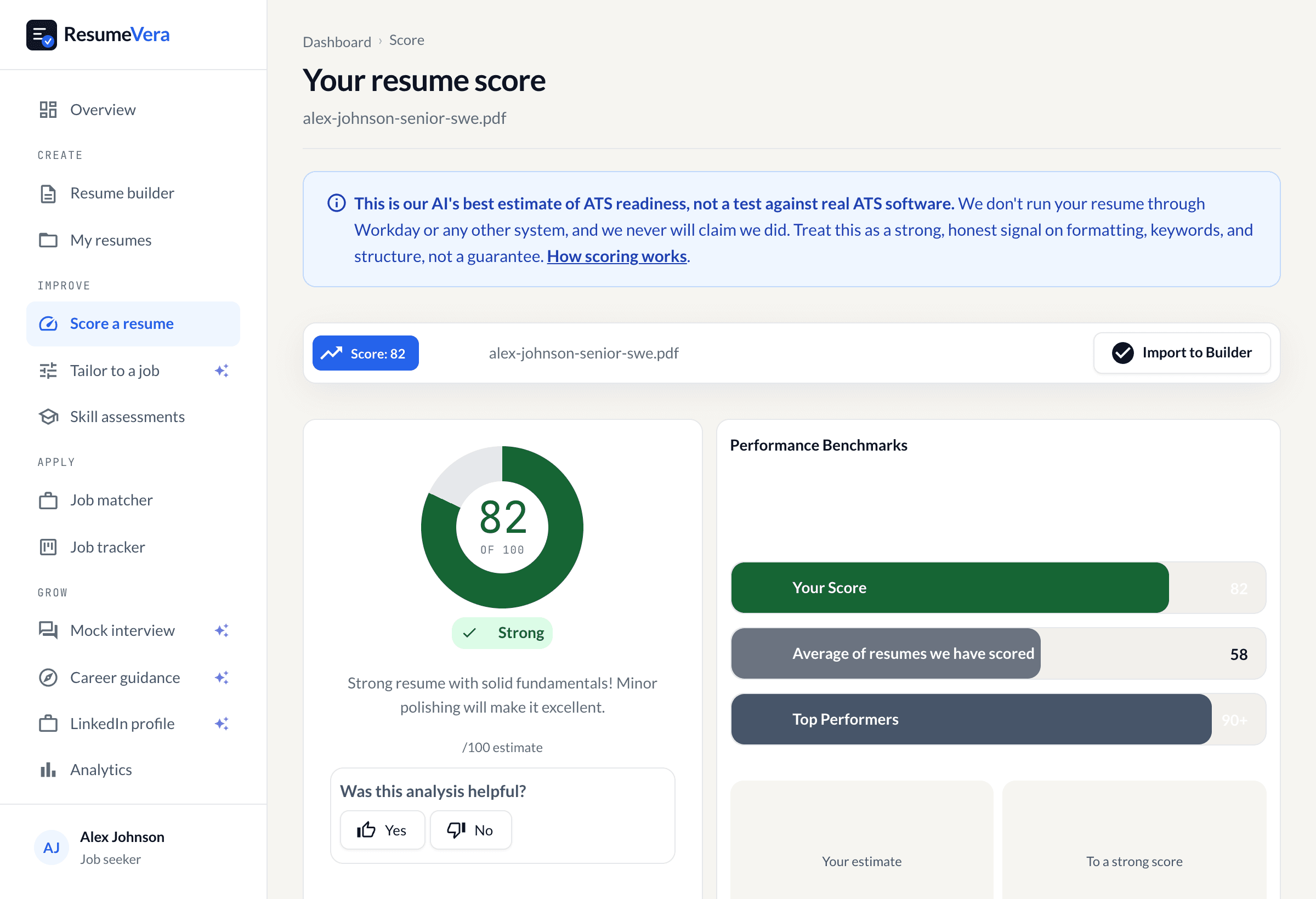
The real score page, with a sample resume and sample scores.
Build your Australian migration resume
Create a resume that meets ACS and VETASSESS assessment standards. Get instant AI feedback on ANZSCO alignment, duty documentation, and formatting that immigration assessors expect.
ACS and VETASSESS Ready
ANZSCO Aligned
Subclass 189 / 190 / 491