US Resume Format 2026: The Complete Guide
The American resume follows strict conventions that differ from CVs used in Europe, Asia, and the Middle East. This guide covers everything you need to know about formatting a resume for the US job market: from ATS optimization and no-photo policies to section ordering and page length rules.
A US resume, top to bottom
- 1
Contact information
Name, phone, email, city and state, LinkedIn. No street address.
- 2
Professional summary
Two or three lines naming the role you are applying for.
- 3
Work experience
Reverse chronological, most recent first. This is most of the page.
- 4
Education
Degree, institution, year. Below experience unless you graduated within the last year or two.
- 5
Skills
A list, not a paragraph. A parser reads commas; it does not read prose.
Leave out
Photo, date of birth, marital status and nationality. US anti-discrimination practice means a photo can get a resume discarded before anyone reads it. References go on a separate page when asked for.
What is the standard US resume format in 2026?
The standard US resume in 2026 is a 1-2 page reverse-chronological document. It excludes personal photos, date of birth, marital status, and nationality. American resumes focus on quantified achievements, use standard letter-size (8.5x11") formatting, and are optimized for Applicant Tracking Systems like Workday and Greenhouse.
The reverse-chronological format is the most widely accepted resume structure in the United States. It lists your most recent position first and works backward through your career history. In a 2023 Jobscan survey of 1,000 recruiters, 88% preferred this format because it immediately shows career progression and recent, relevant experience.
Two alternative formats exist but are used in specific situations. The functional resume (also called skills-based) organizes content by skill categories rather than chronological work history. It is sometimes used by career changers or professionals with employment gaps, but many US recruiters view it with suspicion because it can obscure work history. The combination resume merges both approaches, opening with a skills summary followed by chronological work experience. This format works well for senior professionals transitioning into leadership roles or professionals with diverse skill sets.
Regardless of which format you choose, every US resume must be formatted for US Letter size paper (8.5 x 11 inches), not A4. Use single-column layouts for maximum ATS compatibility, standard section headings (e.g., "Work Experience" not "Career Journey"), and save as .docx or .pdf depending on the submission method.
Reverse Chronological
Most recent experience first. Preferred by 88% of recruiters (Jobscan, 2023). Best for candidates with a steady career progression and no significant employment gaps.
Functional / Skills-Based
Organized by skill categories. Used by career changers and those re-entering the workforce. Many ATS systems struggle to parse this format correctly.
Combination / Hybrid
Skills summary followed by chronological history. Ideal for senior professionals transitioning into leadership or pivoting industries while showing relevant expertise.
Should you include a photo on an American resume?
No. Including a photo on a US resume is strongly discouraged and may cause immediate rejection. US anti-discrimination laws (Title VII of the Civil Rights Act) make employers wary of photo-bearing resumes. Most ATS systems used by American employers, including Workday and Taleo, strip images during parsing.
The United States has some of the strictest employment anti-discrimination laws in the world. Title VII of the Civil Rights Act of 1964 prohibits employment discrimination based on race, color, religion, sex, and national origin. The Age Discrimination in Employment Act (ADEA) adds age to that list. When a resume includes a photo, it exposes the employer to potential bias claims, which is why most US companies have explicit policies against reviewing resumes that contain photographs.
This is a significant departure from resume norms in many other countries. In Germany, France, and most of continental Europe, a professional headshot is expected. In Japan, South Korea, and China, passport-style photos are standard. In the Middle East, photos are common on CVs. However, when applying to US-based companies, even from abroad, you should always omit the photo.
The only exception is if you are applying for a role where physical appearance is a legitimate occupational qualification, such as acting or modeling. For every other profession in the United States, including customer-facing roles, a photo has no place on your resume.
How long should a US resume be?
A US resume should be 1 page for early-career professionals (0-10 years experience) and 2 pages maximum for senior roles. Federal resumes and academic CVs are the only exceptions where longer documents are acceptable. Recruiters spend an average of 7.4 seconds on the initial screening of each resume, according to the 2018 Ladders eye-tracking study.
The one-page rule is deeply ingrained in American hiring culture. For entry-level candidates, recent graduates, and professionals with fewer than 10 years of experience, a single-page resume is the expectation. Exceeding one page at this career stage suggests an inability to prioritize information, a red flag for recruiters who review hundreds of resumes daily.
Senior professionals, executives, and technical specialists with 10+ years of experience may use two pages. The second page should contain genuinely relevant experience, not padding. If your second page is less than half full, cut it back to one page. A resume that trails off partway through page two looks worse than a tightly edited single page.
| Experience Level | Recommended Length | Notes |
|---|---|---|
| New Graduate (0-2 years) | 1 page | Include internships, projects, and relevant coursework |
| Early Career (3-5 years) | 1 page | Focus on measurable achievements in each role |
| Mid-Career (6-10 years) | 1-2 pages | Second page only if all content is highly relevant |
| Senior / Executive (10+ years) | 2 pages | Trim early-career roles to 1-2 bullet points |
| Federal Government | 3-5 pages | USAJOBS requires detailed duties, hours, and supervisor info |
| Academic CV | No limit | Full publication list, grants, teaching history required |
Check yours
You do not have to guess whether yours follows this
Paste yours in and the checker reads it the way an ATS would: it finds the sections, dates and contact block, and tells you which of the rules above your file actually breaks.
Check your resume free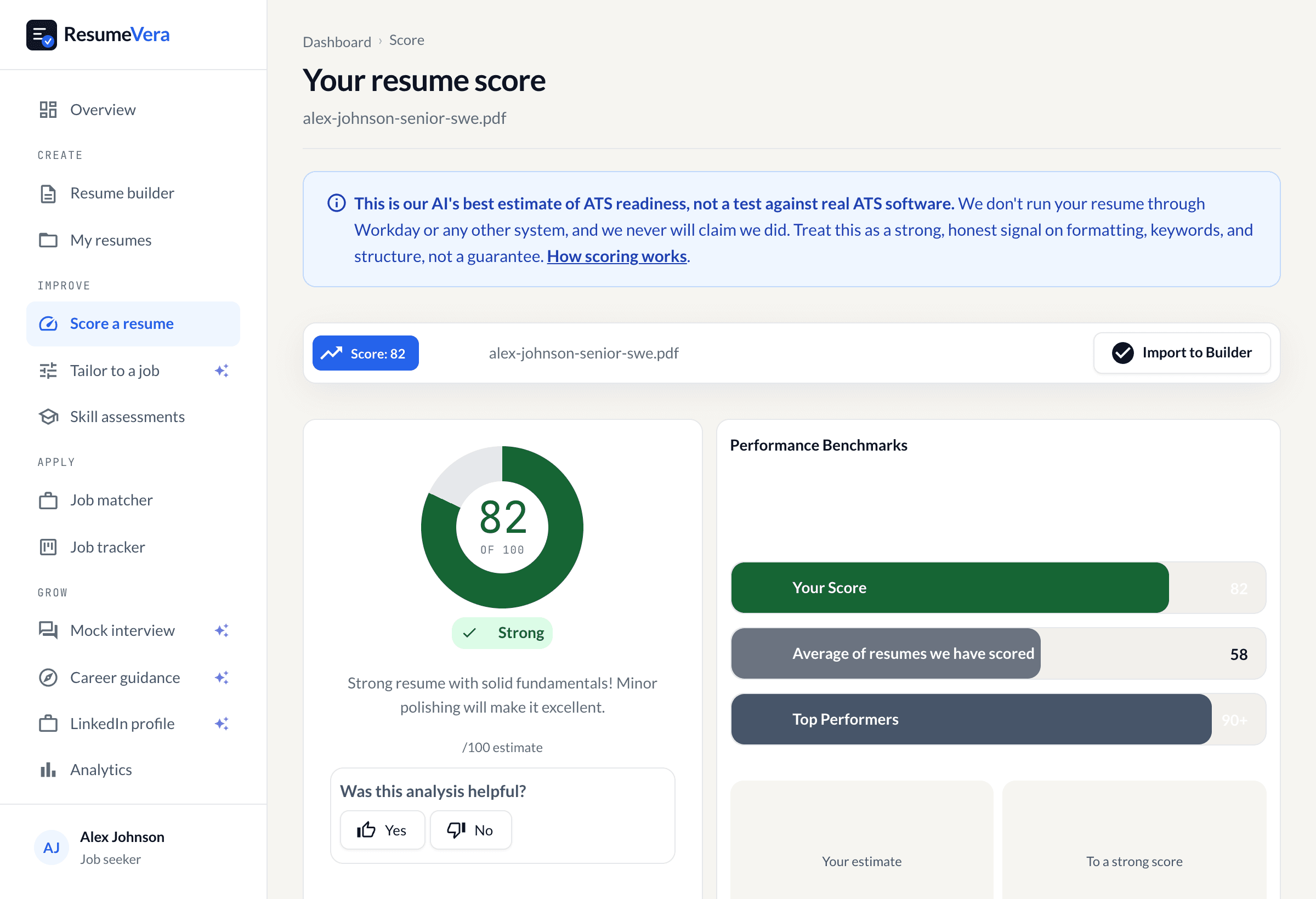
A sample resume in the real checker. The 82 and the sub-scores are what the scorer returns for it.
What sections must a US resume include?
Every US resume must include five core sections: contact information (no photo), professional summary or objective, work experience with quantified achievements, education, and relevant skills. Optional sections include certifications, volunteer work, and publications. The header should never include Social Security numbers, age, or marital status.
Contact Information: Place your full name, phone number, professional email address, city and state (full street address is no longer required), LinkedIn profile URL, and optionally a portfolio or GitHub link. Never include your Social Security number, date of birth, marital status, visa status, or a photograph.
Professional Summary: A 2-3 sentence statement highlighting your experience level, core expertise, and key achievement. Replace the outdated "Objective" statement (which focuses on what you want) with a summary (which focuses on what you offer). Example: "Senior software engineer with 8 years of experience building scalable cloud applications. Led migration of monolithic architecture to microservices, reducing infrastructure costs by 35%. Expertise in Python, AWS, and Kubernetes."
Work Experience: List each position with company name, job title, location (city, state), and dates of employment (month/year format). Use 3-6 bullet points per role, starting each with a strong action verb and including quantified results wherever possible. Use the CAR method: Challenge, Action, Result.
Education: Include degree name, institution, graduation year, and honors if applicable. For experienced professionals, education goes after work experience. For recent graduates, place it before work experience. Do not include high school education if you have a college degree.
Skills: List technical skills, tools, certifications, and languages relevant to the target role. Match keywords from the job description. Group skills by category (e.g., Programming Languages, Frameworks, Cloud Platforms, Tools) for clarity.
| Required | Optional | Never Include |
|---|---|---|
| Contact Information | Certifications | Photo / Headshot |
| Professional Summary | Volunteer Experience | Date of Birth / Age |
| Work Experience | Publications | Social Security Number |
| Education | Awards & Honors | Marital Status |
| Skills | Professional Affiliations | Nationality / Visa Status |
| Projects / Portfolio | Religion | |
| Languages | Political Affiliation |
Which ATS systems do US employers use?
The ATS platforms you are most likely to encounter with US employers include Workday Recruiting, Oracle (Taleo and Recruiting Cloud), iCIMS, Greenhouse, and Lever. Market-share estimates vary widely by methodology, but the top ten vendors together account for roughly half of the market (Apps Run The World, 2025). Each system parses resumes differently, yet all prefer single-column layouts, standard section headings, and .docx or .pdf files without headers or footers.
Understanding which ATS a company uses can give you a meaningful advantage. Most enterprise employers in the United States have moved away from simple keyword-matching systems toward AI-powered platforms that evaluate context, skills adjacency, and career trajectory. However, formatting issues remain the primary cause of resume rejection at the ATS stage, not content quality.
To maximize compatibility across all US ATS platforms: avoid text boxes, tables within tables, headers and footers (many ATS systems ignore content in these areas), columns, graphics, and custom fonts. Use standard section headings like "Work Experience," "Education," and "Skills" rather than creative alternatives. Save your file as a .docx when uploading through a portal, or .pdf when emailing directly.
| ATS System | Where You'll Encounter It | Key Feature | Resume Tip |
|---|---|---|---|
| Workday Recruiting | Leading enterprise & Fortune 500 ATS | AI-powered candidate matching | Use standard section headings; avoid tables and text boxes |
| Greenhouse | Tech & mid-market companies | Structured hiring scorecards | PDF and .docx both parse well; keep formatting simple |
| Lever | Startups & tech companies | CRM + ATS hybrid platform | Single-column layout strongly recommended |
| iCIMS | Large enterprises & high-volume hiring | High-volume hiring automation | Avoid headers/footers: content gets stripped |
| Oracle Taleo | Legacy Oracle enterprises | Deep Oracle HCM integration | .docx format strongly preferred over PDF |
| BambooHR | Small & mid-size businesses | All-in-one HR platform | Standard formatting; keywords from job description |
How is a US resume different from a CV?
In the United States, a resume is a concise 1-2 page career marketing document, while a CV (curriculum vitae) is an exhaustive academic record that can exceed 10 pages. Most American employers expect a resume for industry positions. CVs are reserved for academic, research, medical, and some government roles.
This distinction is important because the terms "resume" and "CV" are used interchangeably in many countries outside the United States. In the UK, Ireland, Australia, and New Zealand, what Americans call a "resume" is referred to as a "CV." In continental Europe, the term CV typically refers to a 1-2 page document similar to an American resume. In the US, however, the two are fundamentally different documents with different purposes, lengths, and content expectations.
If a US job posting asks for a "resume," submit a 1-2 page document. If it asks for a "CV," it is almost certainly an academic, research, or medical position expecting a comprehensive document. When in doubt, check the organization type: universities, research institutions, hospitals, and think tanks typically want CVs; corporations, startups, and government agencies (except for research roles) want resumes.
| Feature | US Resume | US Academic CV |
|---|---|---|
| Length | 1-2 pages | No limit (often 5-20+ pages) |
| Photo | Never | Never |
| Personal Information | Name, phone, email, LinkedIn only | Name, phone, email, institutional affiliation |
| Work Experience | 3-6 bullet points per role with metrics | Full list of positions, duties, and affiliations |
| Publications | Not included (unless relevant) | Complete bibliography required |
| Target Audience | Corporations, startups, government | Universities, research labs, hospitals |
| Customization | Tailored for each job application | Comprehensive and generally static |
| ATS Optimization | Critical: keyword matching required | Less important: often reviewed manually |
US resume format quick reference
A side-by-side summary of the standard US resume format elements, including common mistakes to avoid.
| Element | US Standard | Common Mistakes |
|---|---|---|
| Page Length | 1-2 pages (letter size 8.5x11") | Using A4 size or exceeding 2 pages for non-academic roles |
| Photo | Never included | Including a headshot (common in European/Asian resumes) |
| Personal Details | Name, phone, email, LinkedIn, city/state | Including age, DOB, marital status, nationality, or SSN |
| Format | Reverse chronological (most common) | Using functional format without strong justification |
| Font | Calibri, Arial, Georgia: 10-12pt body | Decorative fonts, sizes below 10pt or above 12pt |
| Margins | 0.5-1 inch on all sides | Margins below 0.5 inches causing clipped content |
| File Format | .docx for ATS portals, .pdf for direct email | Submitting .pages, .odt, or image-based PDFs |
| Section Headings | Standard: Work Experience, Education, Skills | Creative headings like "My Journey" or "Toolkit" |
| Bullet Points | Start with action verbs, include metrics | Listing duties instead of achievements |
| References | Not included on resume | Writing "References available upon request" |
| Layout | Single column for ATS compatibility | Multi-column layouts, text boxes, or infographics |
| Date Format | Month Year - Month Year (e.g., Jan 2023 - Present) | Using DD/MM/YYYY or other non-US date formats |
Templates
Start from one that already follows these rules
Single column, real text, standard headings, and no text boxes or tables for a parser to trip over. Every one renders your own content before you commit to it.
Browse the templates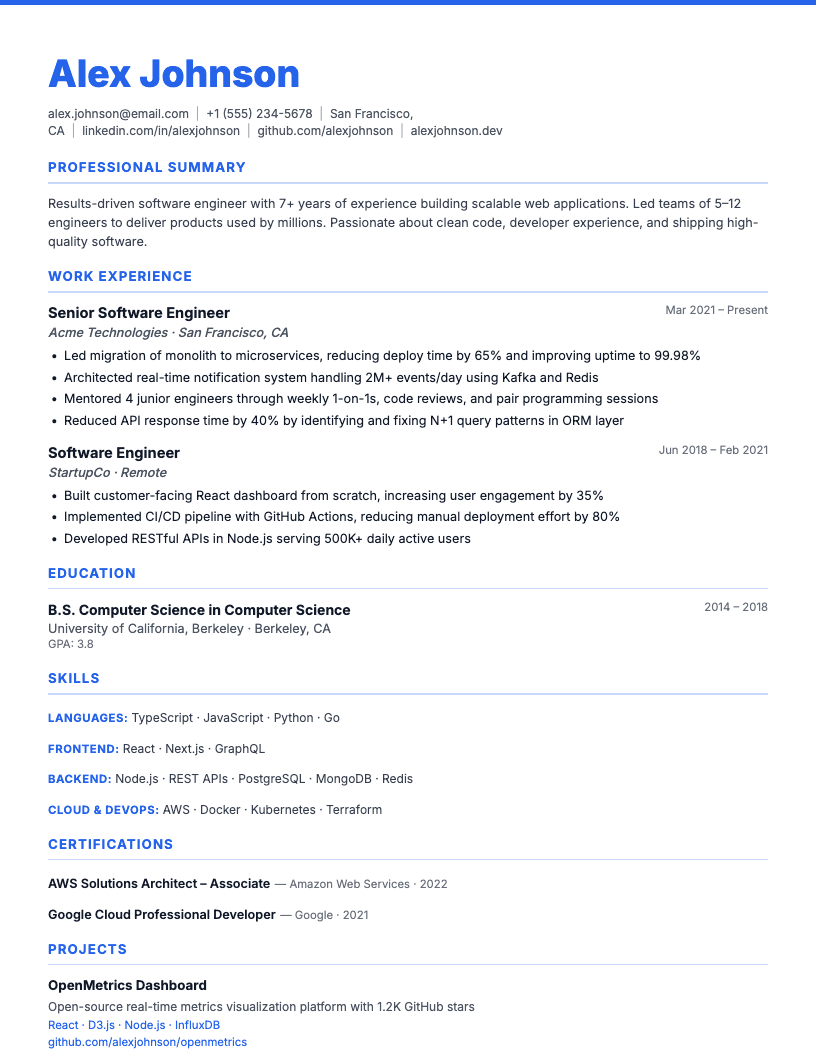
What thirteen points of difference looks like
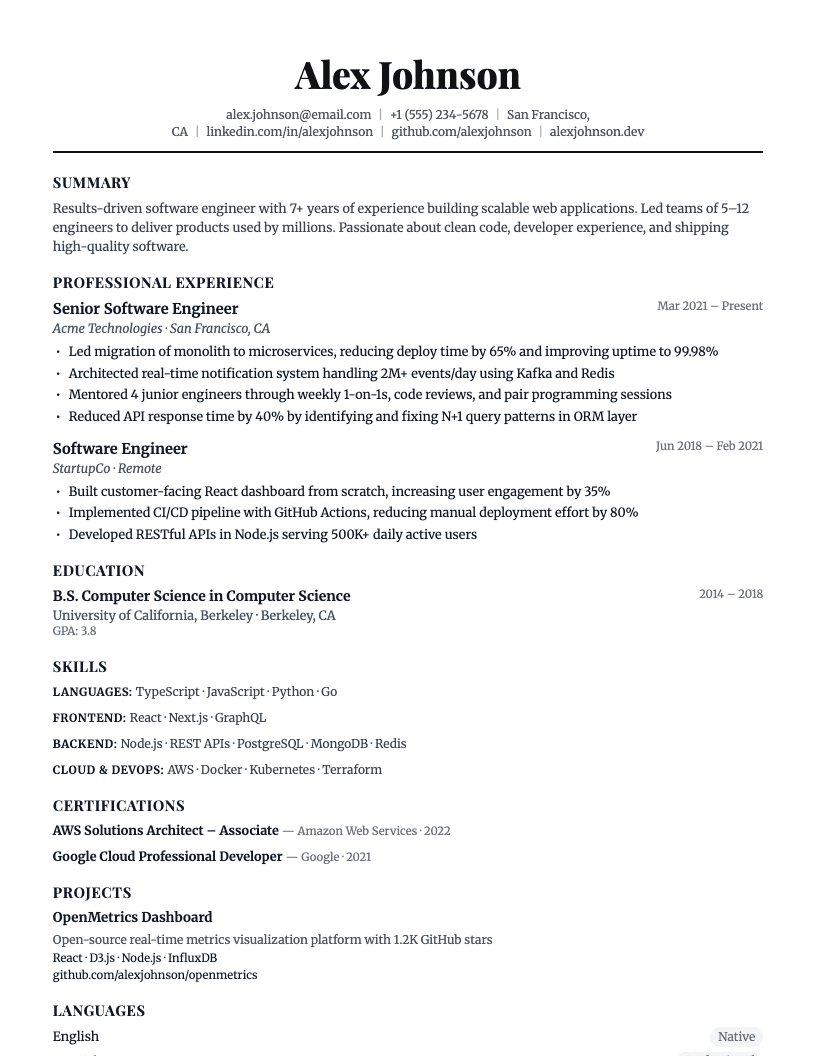
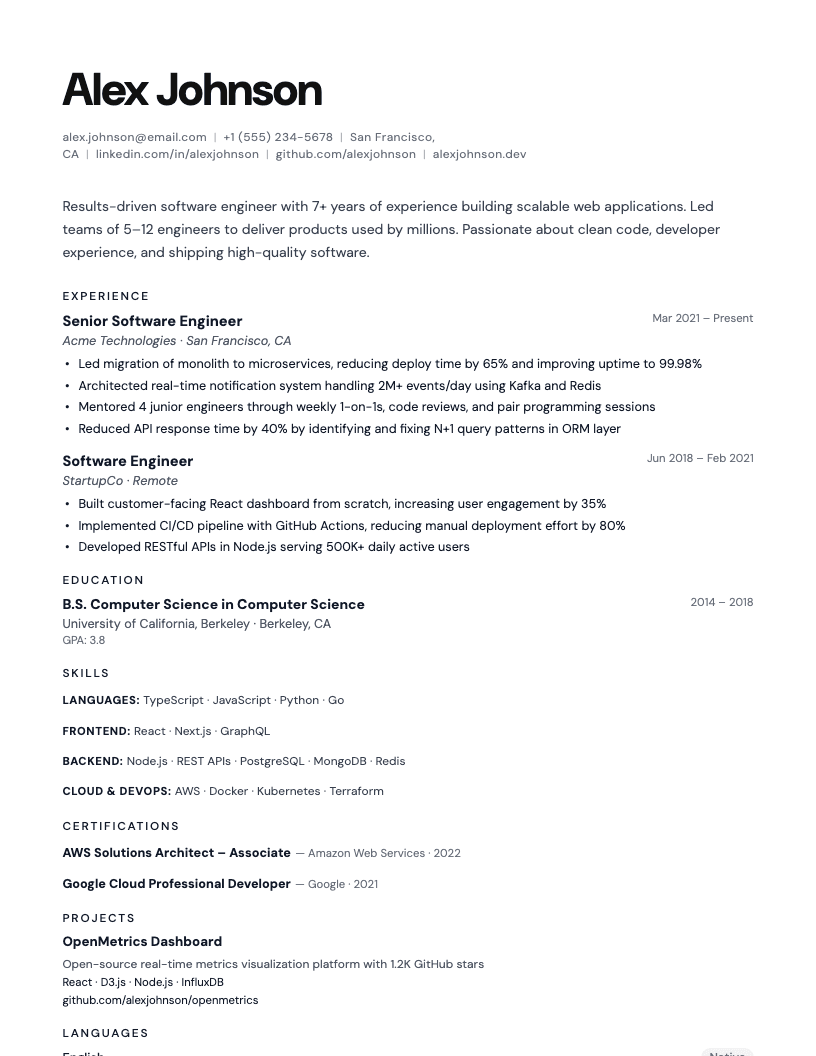
These are the two sample resumes our own scorer rates 54 and 82. Nothing was rewritten to sound better; the second one is the first one with its structure fixed.
82
of 100
- Two-line summary naming the role
- Every role dated, month and year
- Skills as a comma-separated list
- Four bullets in nine carry a number
Drag to compare. Same person, same jobs, same words for the most part, the difference is structure.
Questions
Frequently asked questions about the US resume format
Answers to the most common questions about formatting a resume for the American job market.
Sources & further reading
The formatting guidance and statistics on this page draw on the following authoritative sources.
- U.S. Equal Employment Opportunity Commission, Prohibited Employment Policies & Practices : legal basis for omitting photos, age, and personal details (Title VII).
- Ladders 2018 recruiter eye-tracking study : source of the 7.4-second average screening time.
- Jobscan, resume format research : recruiter preference for the reverse-chronological format (88%, 2023 survey).
- USAJOBS, what to include in a federal resume : basis for the longer federal-resume length guidance.
- Apps Run The World, applicant tracking system market share : context for ATS platform adoption.
Resume and CV formats by country
Applying abroad? Resume conventions differ by market. Explore the correct format for where you are applying.
Build your US-ready resume
Use ResumeVera's AI-powered tools to create an ATS-optimized resume that follows every US formatting standard. Get instant feedback on structure, keywords, and readability.
ATS-Optimized Formatting
US Standard Compliant
AI-Powered Feedback