UAE CV Format 2026: The Complete Guide for Jobs in Dubai, Abu Dhabi & the Emirates
Everything you need to know about writing a CV for the UAE job market: photo requirements, visa details, ATS platforms, and what makes a UAE CV different from a Western resume.
A UAE CV, top to bottom
- 1
Contact details
Name, phone with country code, email, city.
- 2
Personal details
Nationality and visa status are not optional here: employers need them for visa quota compliance and labour card processing.
- 3
Professional summary
Two or three lines aimed at the role.
- 4
Work experience
Reverse chronological.
- 5
Education
Note whether your degree is attested, which many employers require.
- 6
Languages and skills
List each language with a level. Arabic is a significant advantage in government, banking and Emirati client-facing roles.
What is the standard UAE CV format in 2026?
The standard UAE CV in 2026 is a 2-3 page document that uniquely includes a professional photograph, nationality, visa status, and date of birth. Unlike Western CVs, UAE employers expect personal details because work sponsorship depends on nationality and visa type. CVs are processed through ATS platforms like Bayt, Taleo, and GulfTalent.
The UAE job market is one of the most international in the world. Dubai alone hosts workers from over 200 nationalities, and Abu Dhabi's government sector is expanding rapidly. This diversity means your CV must communicate not just your professional qualifications, but your legal eligibility to work in the country.
A well-structured UAE CV follows a specific order: contact information with photo at the top, followed by a professional summary, key skills, work experience (detailed and reverse-chronological), education with attestation details, languages, and references. Unlike the US, where a single-page resume is the gold standard, UAE employers expect comprehensive documentation of your career history.
The UAE labour market is regulated by the Ministry of Human Resources and Emiratisation (MOHRE). All work visas are tied to a sponsoring employer, which is why your CV must clearly state your current visa status. Free zone employers (JAFZA, DMCC, DIFC, ADGM) have their own visa regulations, but the CV expectations are broadly the same.
Key sections of a standard UAE CV:
- Professional photo (passport-style, top right corner)
- Full name, nationality, visa status, date of birth
- Contact: UAE mobile (+971), email, LinkedIn
- Professional summary (3-4 lines, tailored to the role)
- Core competencies / key skills
- Work experience: company, role, dates, achievements with metrics
- Education: degree, university, year, attestation status
- Languages: English, Arabic, Hindi, Urdu, etc.
- Driving licence status (UAE or international)
- References: available upon request, or listed directly
Should you include a photo on a UAE CV?
Yes. A professional headshot is expected and often required on UAE CVs. Use a passport-style photo with professional attire and a neutral background. Dubai and Abu Dhabi recruiters routinely filter CVs that lack photos. This is the opposite of US/UK norms where photos are discouraged.
The photo should be recent (taken within the last 6 months), in colour, with a white or light grey background. Dress professionally, a suit jacket or business attire is standard. The photo is typically placed in the top right corner of the CV, sized approximately 3.5cm x 4.5cm. Avoid selfies, group photos cropped down, or casual images.
Some candidates worry that including a photo opens the door to discrimination. While this concern is valid in Western markets, the UAE operates differently. Employers expect to see the photo because it is part of the cultural norm, and many HR portals (especially Bayt.com) have dedicated photo upload fields. A CV without a photo may be deprioritised or rejected outright, particularly for client-facing roles in hospitality, banking, and real estate.
What personal details should a UAE CV include?
Full name, nationality, visa status (employment visa, visit visa, family sponsorship), date of birth, marital status (optional but common), driving licence status, languages spoken. Arabic name transliteration tips: provide both Arabic and English versions if applicable.
Nationality is non-negotiable. UAE employers need to know your nationality for visa quota compliance and labour card processing. The visa status field tells them whether they need to initiate a new visa or can process a visa transfer. Common visa statuses to list: Employment Visa (transferable), Visit Visa, Tourist Visa, Family/Spouse Sponsorship, Golden Visa, or Freelance Permit.
Date of birth is standard on UAE CVs; some government roles have age requirements. Marital status is optional but commonly included, especially for positions that offer family benefits (housing, education allowances, annual flight tickets). If you have a UAE driving licence, list it prominently. Many roles, particularly in sales, logistics, and field operations, require it.
For language proficiency, list all languages with your level (native, fluent, intermediate, basic). Arabic fluency is a significant advantage, especially for government, banking, and Emirati client-facing roles. Hindi, Urdu, Malayalam, and Tagalog are also valued given the UAE's large South Asian and Filipino workforce.
Check yours
You do not have to guess whether yours follows this
Paste yours in and the checker reads it the way an ATS would. It will tell you whether your dates parse, whether your sections are found, and what is missing from each one.
Check your resume free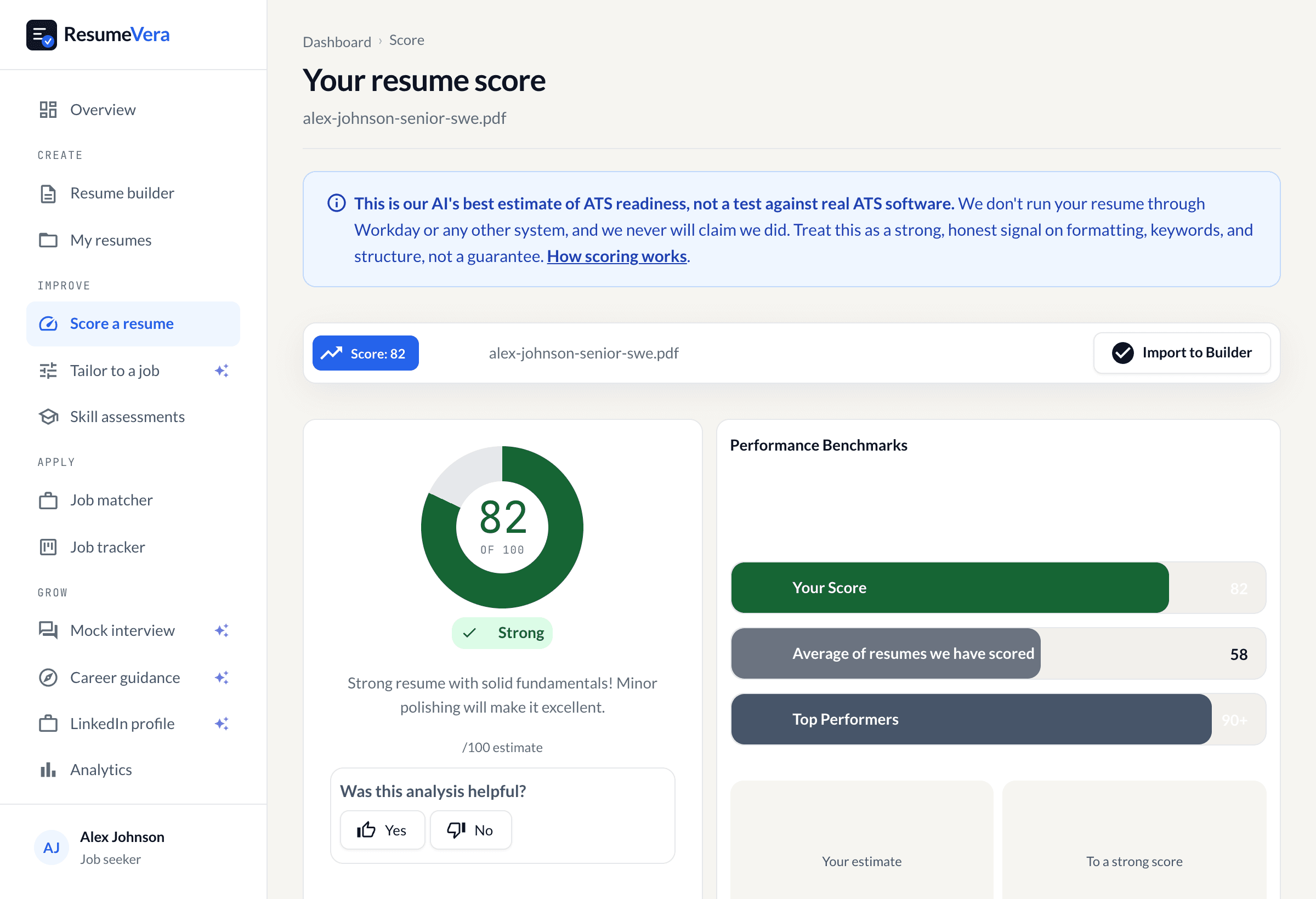
A sample resume in the real checker. The 82 and the sub-scores are what the scorer returns for it.
How long should a UAE CV be?
2-3 pages is standard. Senior roles may extend to 4 pages. Emphasise comprehensive work history as UAE employers value detailed documentation. Government and semi-government positions may require longer CVs with full career timelines.
Unlike the US, where recruiters want a one-page resume, UAE hiring managers appreciate detail. Each role should include the company name, your title, employment dates, location, and 4-6 bullet points describing your achievements with quantified metrics. Use the CAR format (Challenge, Action, Result) for impact-driven bullets.
For entry-level candidates (0-3 years of experience), a 1-2 page CV is acceptable. Mid-career professionals (4-10 years) should target 2-3 pages. Senior executives and C-suite candidates can go up to 4 pages, especially if they have worked across multiple countries or industries. Government positions (Abu Dhabi Executive Council, federal ministries) often require exhaustive documentation including all certifications, training, and professional memberships.
Which ATS systems do UAE employers use?
Bayt.com (largest job portal in the Middle East), Taleo, GulfTalent, SAP SuccessFactors, and LinkedIn Recruiter are the dominant platforms. Government entities use their own portals. Understanding these systems is critical for CV optimisation.
Applicant Tracking Systems are widely used across the UAE, particularly by multinational companies and large local conglomerates like Emaar, ADNOC, Majid Al Futtaim, and Al Futtaim Group. Your CV must be ATS-compatible: use standard section headings, avoid tables and graphics in the body text, and save as PDF or DOCX depending on the portal's requirements.
UAE Job Portals & ATS Systems 2026
| Platform | Type | Key Feature | Best For |
|---|---|---|---|
| Bayt.com | Job Portal + ATS | Largest Middle East database; 40,000+ employers | All industries, entry to mid-level |
| GulfTalent | Job Portal + ATS | Premium listings, salary benchmarks | Mid to senior professionals |
| LinkedIn Recruiter | Recruiting Platform | Direct sourcing, InMail outreach | White-collar, tech, finance |
| Oracle Taleo | Enterprise ATS | Used by MNCs and large conglomerates | Corporate roles at Emaar, ADNOC, etc. |
| SAP SuccessFactors | Enterprise ATS | Integrated HR suite with recruiting module | Large enterprises, banking, oil & gas |
| Naukri Gulf | Job Portal | Popular with Indian expat community | Indian professionals seeking UAE roles |
| Dubizzle Jobs | Classifieds + Jobs | Local listings, SME employers | Blue-collar, retail, hospitality |
| MOHRE Portal | Government Portal | Official labour ministry job listings | Government and semi-government roles |
How is a UAE CV different from a US resume?
UAE CVs and US resumes differ fundamentally in structure, content, and expectations. Understanding these differences is essential if you are transitioning from a Western job market to the UAE or applying to international companies with UAE offices.
UAE CV vs Western Resume Comparison
| Feature | UAE Standard | US/UK Standard |
|---|---|---|
| Photo | Expected and often required | Not included (anti-discrimination laws) |
| Personal details | Nationality, DOB, visa status, marital status | Name, email, phone only |
| Length | 2-3 pages standard, up to 4 for senior roles | 1 page (US), 2 pages max (UK) |
| Visa information | Mandatory: visa type and transferability | Not included (work authorisation stated separately) |
| Language section | Important: Arabic proficiency is an advantage | Optional, listed only if relevant |
| Driving licence | Commonly included, especially for field roles | Rarely included |
| References | Often included directly on CV | "Available upon request" or omitted |
| Salary expectations | Sometimes included (monthly AED, tax-free) | Never included on resume |
| File format | PDF or Word (portal-dependent) | PDF preferred |
| Degree attestation | Must mention attestation status | Not applicable |
The most significant difference is cultural expectation around personal information. In the US and UK, anti-discrimination legislation means that age, nationality, gender, photo, and marital status are deliberately excluded. In the UAE, these details are standard because the visa and sponsorship system requires them. Employers are not making hiring decisions based on these details, they need them for administrative and legal processing.
Another key difference is the concept of "notice period." UAE CVs often include the candidate's current notice period (30 days, 60 days, 90 days) because UAE labour law mandates specific notice periods based on the employment contract. This helps recruiters assess availability and plan onboarding timelines accordingly.
What should Indian expats know about UAE CVs?
Indian nationals make up the largest expatriate community in the UAE. Understanding degree attestation from MEA India and UAE embassy, MOFA attestation, common scams to avoid (never pay for a visa), and the right job portal strategy is essential for a successful UAE job search.
Degree attestation: The four-step process is mandatory. First, get your degree certificate attested by the issuing university. Second, get it attested by the Ministry of External Affairs (MEA) India. Third, get it attested by the UAE Embassy in India (New Delhi or consulates in Mumbai, Hyderabad, Kolkata, Chennai, or Thiruvananthapuram). Fourth, get it attested by MOFA (Ministry of Foreign Affairs) in the UAE after you arrive. Without this chain of attestation, your employment visa cannot be processed.
Job portal strategy: Use a multi-portal approach. Bayt.com has the widest employer base. Naukri Gulf (naukrigulf.com) is popular among Indian employers hiring in the UAE and is familiar to many Indian candidates. GulfTalent offers premium listings, particularly in finance and engineering. LinkedIn MENA (Middle East and North Africa) is essential for white-collar roles. Ensure your profile and CV are consistent across all platforms, recruiters cross-reference.
Salary negotiation: UAE salaries are quoted in AED (Arab Emirates Dirham) per month and are tax-free. When negotiating, consider the total package: basic salary (typically 60% of total), housing allowance, transport allowance, annual flight tickets, medical insurance, and education allowance if applicable. Do not compare directly with Indian CTC, factor in the tax-free advantage, cost of living in Dubai or Abu Dhabi, and the package structure.
Scam awareness: Never pay for a job offer, visa, or interview. Legitimate UAE employers cover all visa and work permit costs. Be wary of unsolicited WhatsApp or email offers promising guaranteed employment. Verify company trade licences on the Dubai Department of Economic Development (DED) website or Abu Dhabi Department of Economic Development. Use the MOHRE website to verify that a company is authorised to hire foreign workers.
Templates
Start from one that already follows these rules
Single column, real text, standard headings, and no text boxes or tables for a parser to trip over. Every one renders your own content before you commit to it.
Browse the templates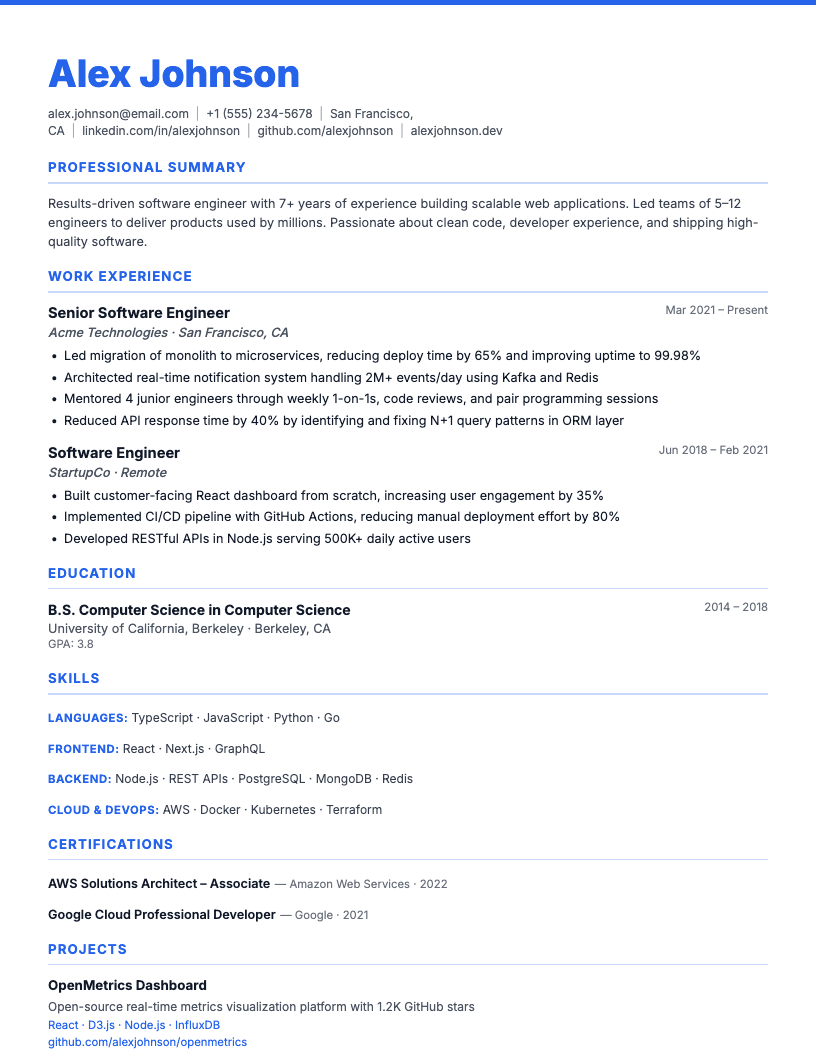
What thirteen points of difference looks like
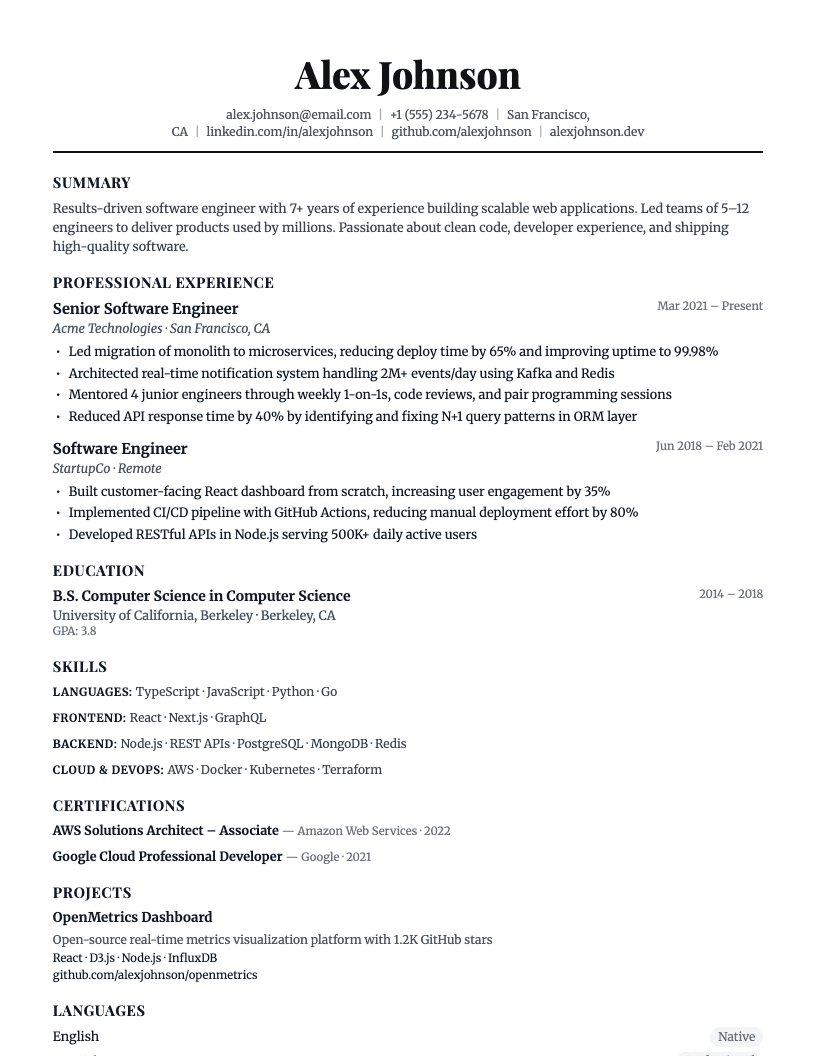
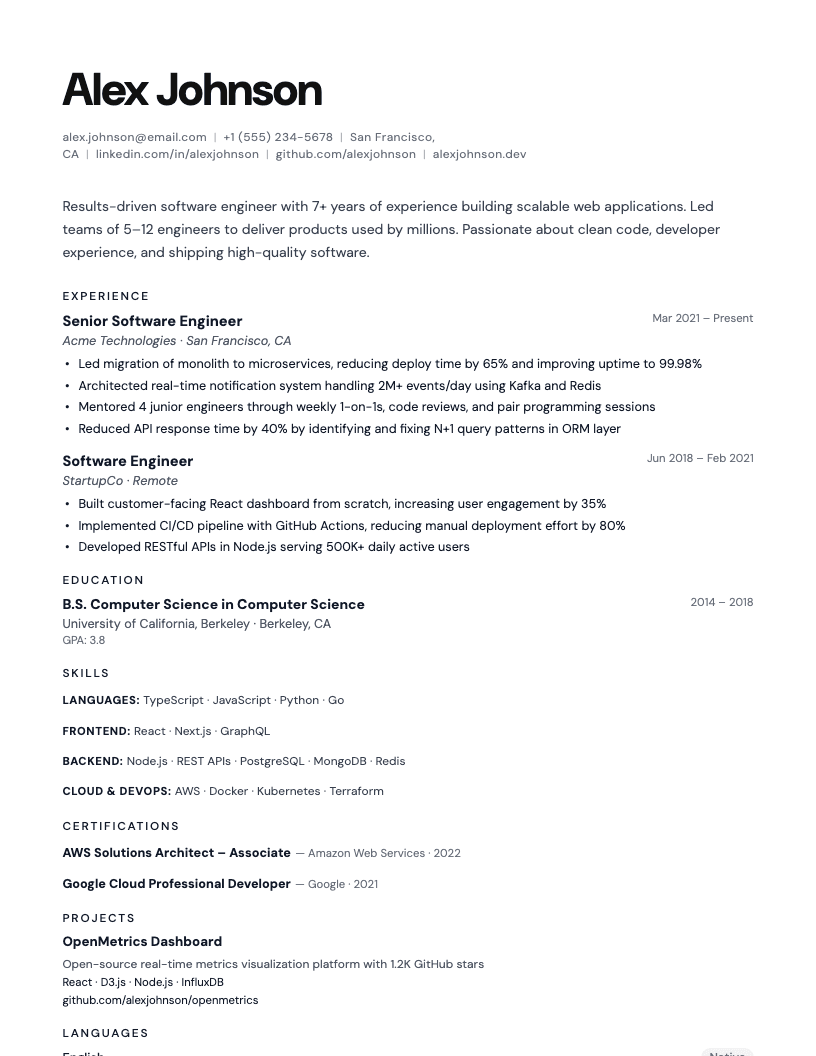
These are the two sample resumes our own scorer rates 54 and 82. Nothing was rewritten to sound better; the second one is the first one with its structure fixed.
82
of 100
- Two-line summary naming the role
- Every role dated, month and year
- Skills as a comma-separated list
- Four bullets in nine carry a number
Drag to compare. Same person, same jobs, same words for the most part, the difference is structure.
Questions
Frequently asked questions about the UAE CV format
Photo requirements, visa details, language expectations, salary formatting, and how to avoid scams.
Sources & further reading
The formatting guidance and figures on this page draw on the following authoritative sources.
- UAE Ministry of Human Resources & Emiratisation (MOHRE), UAE labour law, contracts, and work-permit rules
- The UAE Government Portal, Jobs, official guidance on working in the UAE
- Bayt.com, leading Gulf job platform; regional CV and photo conventions
Resume and CV formats by country
Applying abroad? Resume conventions differ by market. Explore the correct format for where you are applying.
Build your UAE-ready CV
Use ResumeVera to create an ATS-optimised CV tailored for Dubai, Abu Dhabi, and the wider UAE job market. Get instant feedback on format, keywords, and recruiter readability.
UAE-optimised
ATS-friendly
Instant feedback