Stop guessing why your answer was weak. Get it graded instead.
A mock interview that asks you questions written by people, grades every answer against a rubric we publish in full, and asks the follow-up a real interviewer would ask next. Not a copilot. A coach.
No card to start · One payment · Nothing renews
Experience: Operations Lead
Lesson 04
Responsible for onboarding new hires and improving processes.
vague + no number. what changed because of you?
Rewrite: Cut new-hire onboarding time from 6 weeks to 4 by rebuilding the training checklist, now used across 3 teams.
Three steps, every skill.
Every question in a session goes through all three, and the session is saved, so you can put it next to the one you do a week later.
Answer a real question
For the roles we cover, the questions are written by people and reviewed, not invented fresh each time. You get a mix of behavioural, technical and situational, easiest first.
Get graded on four things
Structure, specificity, evidence and relevance, each from 0 to 4, against anchors we publish word for word. The 0 to 100 figure is calculated from those four in our code, never asked of the AI.
Answer the follow-up, then try again
When a dimension comes back weak, the interviewer asks what they would really ask next, aimed at that exact gap. Retry as often as you like: every attempt is kept, and only your best one counts.
You don't need someone whispering answers.
You need to not need them.
Real-time interview copilots feed you answers live. Most companies ban it, and it teaches you nothing for the next round. This does the opposite.
✗ Interview Copilots
Feeds you answers during the real interview
Risky: many companies actively detect and ban it
You learn nothing for next time
Useless for resumes, LinkedIn, or written work
✓ ResumeVera mock interview
Builds the skill before the interview happens
100% above-board: it is practice, not cheating
Every session makes the next one easier
Graded against a rubric you can read before you start
Here is exactly what you are graded on.
Four dimensions, 0 to 4 each. This is the scale, not a description of it: the same text goes to the AI that reads your answer.
Structure
Whether the answer is easy to follow from start to finish.
No shape. A single sentence, or a stream of thoughts with no beginning or end.
Tight and well paced. Opens with the point, spends time where it matters, ends on the result.
Specificity
Whether the answer describes one real thing rather than what you usually do.
Entirely generic. Could have been said by anyone in any job.
A specific example with the detail an interviewer would probe for already supplied.
Evidence
Whether the outcome is backed by something other than an assertion.
No outcome at all. The answer stops before the result.
A result with a number and a baseline, so the size of the change is clear.
Relevance
Whether it answers the question that was actually asked.
Answers a different question.
Answers it and anticipates the natural follow-up.
The AI, working
What the AI does with a real document
It rewrites your bullets in the language of a specific posting and re-scores the result, and it never adds a skill you have not claimed.
Join the tailoring waitlist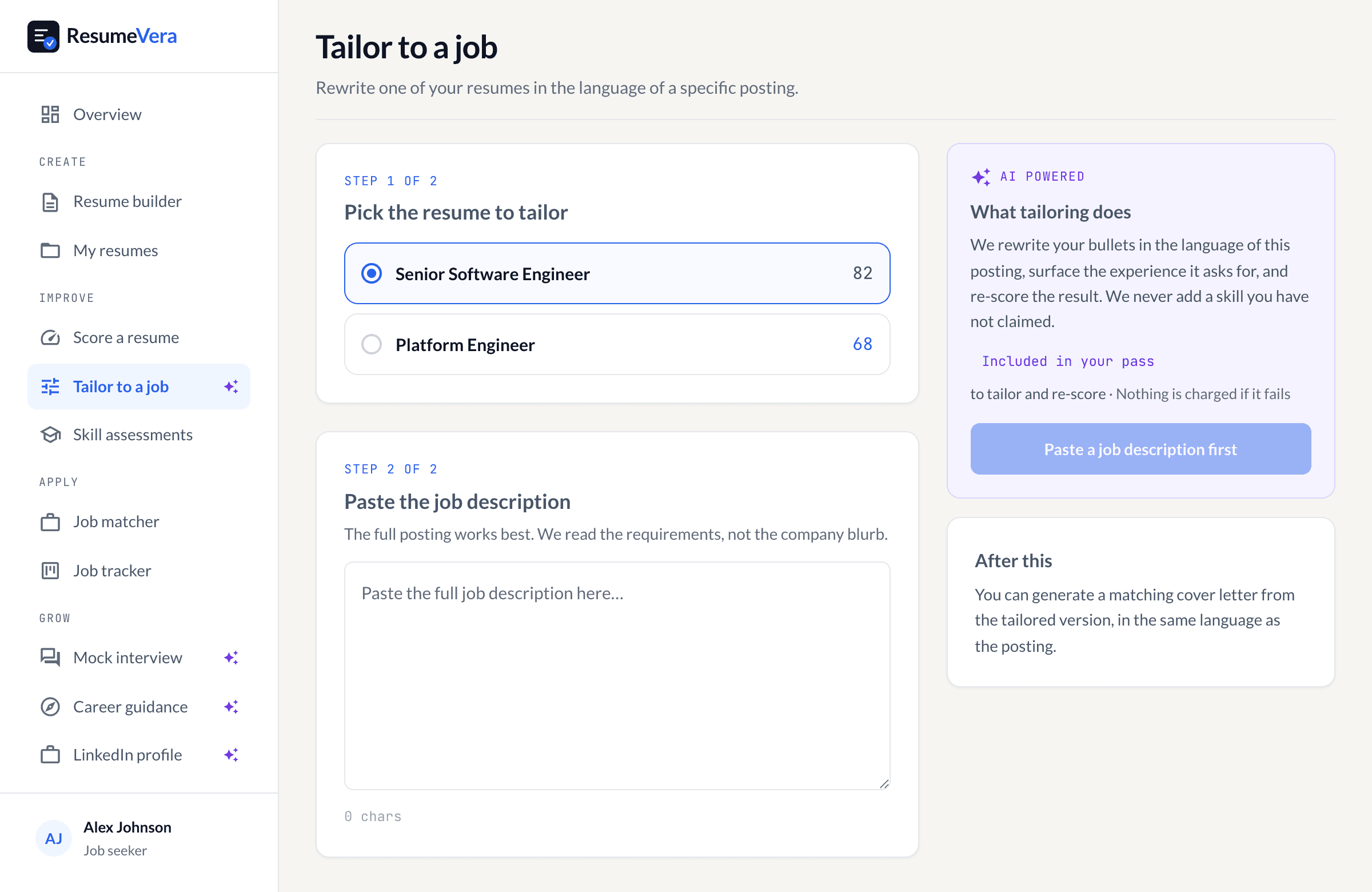
The real screen. It rewrites your bullets in the language of the posting and never adds a skill you have not claimed.
Practise before it counts
A full session of questions for your role, graded on a rubric you have already read. Or start with the free ATS check if your resume is the part you are unsure about.
Questions written by people for the roles we cover, not generated on the spot
Every attempt kept, so you can see whether the second one was better
One payment covers the whole session, including retries and follow-ups