Resume for Express Entry Canada
A comprehensive guide for Express Entry applicants writing a Canadian resume. Learn how to align your work experience with NOC codes, present WES-evaluated credentials, optimize for Canadian ATS systems, and target Provincial Nominee Programs.
How should Express Entry applicants write a Canadian resume?
Express Entry applicants should write a 1-2 page Canadian-format resume that aligns work experience with NOC (National Occupational Classification) codes. Your resume must demonstrate that your previous roles match the NOC code claimed in your Express Entry profile, as IRCC officers verify this during application processing.
The Canadian resume format closely mirrors the US standard: no photo, no date of birth, no marital status, no nationality. Use Canadian-format contact details (+1-XXX-XXX-XXXX phone format), include a LinkedIn profile URL, and list your Canadian address if you have one. If you are applying from abroad, include your current city and country.
Structure your resume with these sections: contact information, professional summary, work experience (reverse chronological), education with WES equivalency, skills, and certifications. Canadian employers also highly value volunteer experience, so include a volunteer section if you have relevant contributions.
Write in Canadian English, which generally follows American spelling conventions ("organize" not "organise," "color" not "colour"). However, some Canadian institutions prefer British spellings, when in doubt, match the language used in the job posting.
What are NOC codes and why do they matter for your resume?
NOC (National Occupational Classification) codes are the backbone of Express Entry. Each code defines specific duties, required skills, and educational qualifications. Your resume must list responsibilities that directly match your claimed NOC code's lead statement and main duties. Mismatched duties can result in application refusal by IRCC.
The NOC system was updated in 2022 to use the TEER (Training, Education, Experience, and Responsibilities) framework. Express Entry accepts NOC TEER 0 (management), TEER 1 (degree required), TEER 2 (college diploma or apprenticeship), and TEER 3 (secondary school or occupation-specific training) under the Federal Skilled Worker and Canadian Experience Class streams.
To find your NOC code, search the Government of Canada's NOC 2021 database. Read the lead statement and list of main duties for your target code. Then rewrite your resume bullet points to mirror this language. For example, NOC 21232 (Software developers and programmers) lists duties including "writing, modifying, integrating, and testing software code," "maintaining existing computer programs," and "identifying and communicating technical problems."
IRCC officers compare your resume duties against the NOC code's duty list during application processing. If fewer than half of the listed duties appear in your work experience, your application may be flagged for additional review or refused. Ensure each role on your resume includes at least 3-4 duties that directly correspond to your claimed NOC code.
How does the CRS score affect your Canadian job search?
The Comprehensive Ranking System (CRS) score determines your Express Entry ranking. Key factors include age (maximum points at 20-29), education (maximum at Master's or PhD), language proficiency (CLB 9+ in IELTS), and Canadian work experience. A valid job offer from a Canadian employer adds 50-200 CRS points, making your resume a critical tool.
Current CRS cutoff scores for Federal Skilled Worker draws typically range from 470-510 points. Candidates below this threshold should pursue strategies to increase their score: improving IELTS to CLB 9+ (significant point gain), obtaining a Canadian credential, securing a job offer with LMIA, or applying through a Provincial Nominee Program (which adds 600 CRS points).
CRS Score Breakdown for Express Entry 2026
| Factor | Maximum Points | Resume Impact |
|---|---|---|
| Age | 110 (single) / 100 (married) | Cannot be changed: focus on other factors |
| Education | 150 (single) / 140 (married) | List WES-evaluated credentials prominently |
| Language (IELTS/CELPIP) | 160 (single) / 150 (married) | Demonstrate proficiency through clear writing |
| Canadian work experience | 80 (single) / 70 (married) | Highlight any Canadian internships, co-ops, or roles |
| Foreign work experience | 50 (single) / 50 (married) | List all relevant international experience |
| Valid job offer (LMIA) | 50-200 | Resume must attract Canadian employer offers |
| Provincial nomination (PNP) | 600 | Tailor resume to provincial priority sectors |
| Canadian education credential | 30 | Include Canadian degrees or diplomas if obtained |
| French language proficiency | 50 | List French skills if applicable (TEF/TCF) |
| Sibling in Canada | 15 | Not relevant to resume but affects overall score |
How should you present WES-evaluated credentials?
WES (World Education Services) evaluates international credentials for Canadian equivalency. List your degree with the WES equivalent: "B.Tech Computer Science, IIT Delhi (WES: equivalent to Canadian Bachelor's degree, 4-year)." Include your WES reference number if the employer or IRCC requests it.
An Educational Credential Assessment (ECA) from WES or another designated organization (IQAS, WES, CES, ICAS, or MCC for medical professionals) is mandatory for Express Entry if your education was completed outside Canada. The WES assessment costs approximately CAD $220, requires official transcripts sent directly from your institution, and takes about 20 business days to process.
On your resume, format your education section to include both the original qualification and the Canadian equivalent. This helps Canadian employers immediately understand the level of your education without needing to research international qualification systems. For example: "Master of Business Administration, Indian Institute of Management Ahmedabad (WES-evaluated: equivalent to Canadian Master's degree)."
What Canadian resume norms should immigrants follow?
Canadian resumes exclude photos, age, date of birth, marital status, nationality, and religion. Use a Canadian-format phone number (+1-XXX-XXX-XXXX) and include a Canadian address if available. A LinkedIn profile URL is expected. Bilingual abilities in English and French are a significant asset, especially for roles in Quebec, New Brunswick, and the federal government.
Volunteer experience carries significant weight on Canadian resumes. Canadian employers and immigration officers view volunteer work as evidence of community integration and soft skills. If you have volunteered at Canadian organizations, settlement agencies, or community groups, include this in a dedicated "Volunteer Experience" section.
Canadian resumes typically use ATS platforms similar to those in the US. The major systems used by Canadian employers include Workday (large enterprises), Taleo (government and financial services), SmartRecruiters (mid-market companies), Lever (tech startups), and Greenhouse (technology companies). The Government of Canada's GC Jobs portal has its own application system that often accepts resume uploads in addition to structured forms.
What are Provincial Nominee Programs and how do they affect your resume?
Provincial Nominee Programs (PNPs) allow Canadian provinces and territories to nominate immigrants who meet specific labour market needs. A provincial nomination adds 600 CRS points to your Express Entry profile, virtually guaranteeing an Invitation to Apply. Your resume should emphasize skills matching the province's priority sectors.
Each province targets different occupations. British Columbia and Ontario focus heavily on technology workers. Atlantic provinces (Nova Scotia, New Brunswick, Prince Edward Island, Newfoundland) prioritize healthcare, trades, and agriculture. Saskatchewan targets farming, manufacturing, and healthcare. Alberta focuses on energy, construction, and technology. Tailoring your resume to the specific province's priority sectors increases your chances of nomination.
Provincial Nominee Programs and Target Sectors
| Province | Key PNP Stream | Priority Sectors | NOC Examples |
|---|---|---|---|
| Ontario | OINP Tech Draw | Technology, finance, healthcare | 21232, 21211, 21234 |
| British Columbia | BC PNP Tech | Technology, digital media | 21232, 21231, 21233 |
| Alberta | AAIP Opportunity Stream | Energy, construction, tech | 21311, 22310, 21232 |
| Saskatchewan | SINP International Skilled Worker | Agriculture, manufacturing, healthcare | 31301, 72010, 82030 |
| Nova Scotia | NS Nominee Program | Healthcare, trades, transportation | 31301, 72010, 73301 |
| Manitoba | MPNP Skilled Worker | Healthcare, manufacturing, IT | 31301, 94100, 21232 |
| New Brunswick | NBPNP Skilled Worker | Healthcare, education, bilingual services | 31301, 41221, 12011 |
| Prince Edward Island | PEI PNP | Food processing, healthcare, tourism | 94201, 31301, 64314 |
Also considering Australia? The Australian skilled migration system uses ANZSCO codes (rather than NOC codes) and a different points test structure, and the resume for skills assessment is a separate document from the resume you use for job search once in Australia. Our Australian skilled migration resume guide covers subclass 189, 190, and 491 pathways and the ACS assessment process for IT professionals.
Questions
Frequently asked questions
Common questions about writing a Canadian resume for Express Entry.
Check yours
See whether your resume follows this
Paste it in and the checker reads it the way an ATS would, then tells you which of the conventions above your file misses.
Check your resume free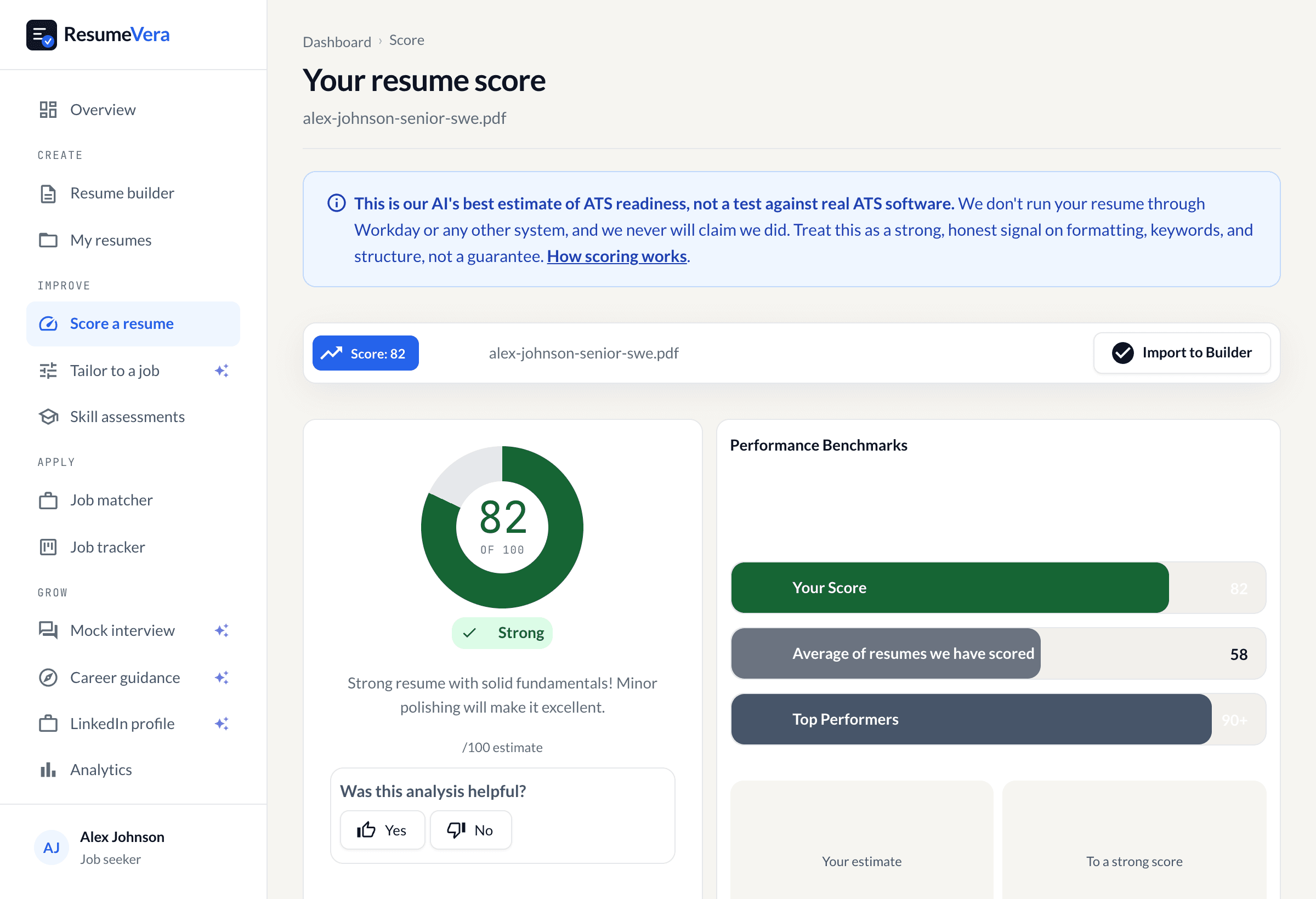
A sample resume in the real checker. The 82 and the sub-scores are what the scorer returns for it.
Build your Express Entry resume
Create a Canadian-format resume optimized for ATS systems and aligned with NOC codes. Get instant AI feedback on formatting, keywords, and credential presentation.