How scoring works
What our numbers mean, and what they do not
Three different scores appear in ResumeVera. None of them is a verdict from an employer, and this page explains exactly what each one is measuring.
On this page
The resume score
Your resume score is an estimate produced by our own model. It reads your resume the way a parser would, then judges structure, phrasing, completeness and how well the content matches the kind of role you are targeting.
It is not a result from any employer's applicant tracking system. We do not have access to Workday, Greenhouse, Taleo or any other ATS, and nobody outside those companies does. Anyone claiming to test your resume against a real ATS is describing something they cannot do.
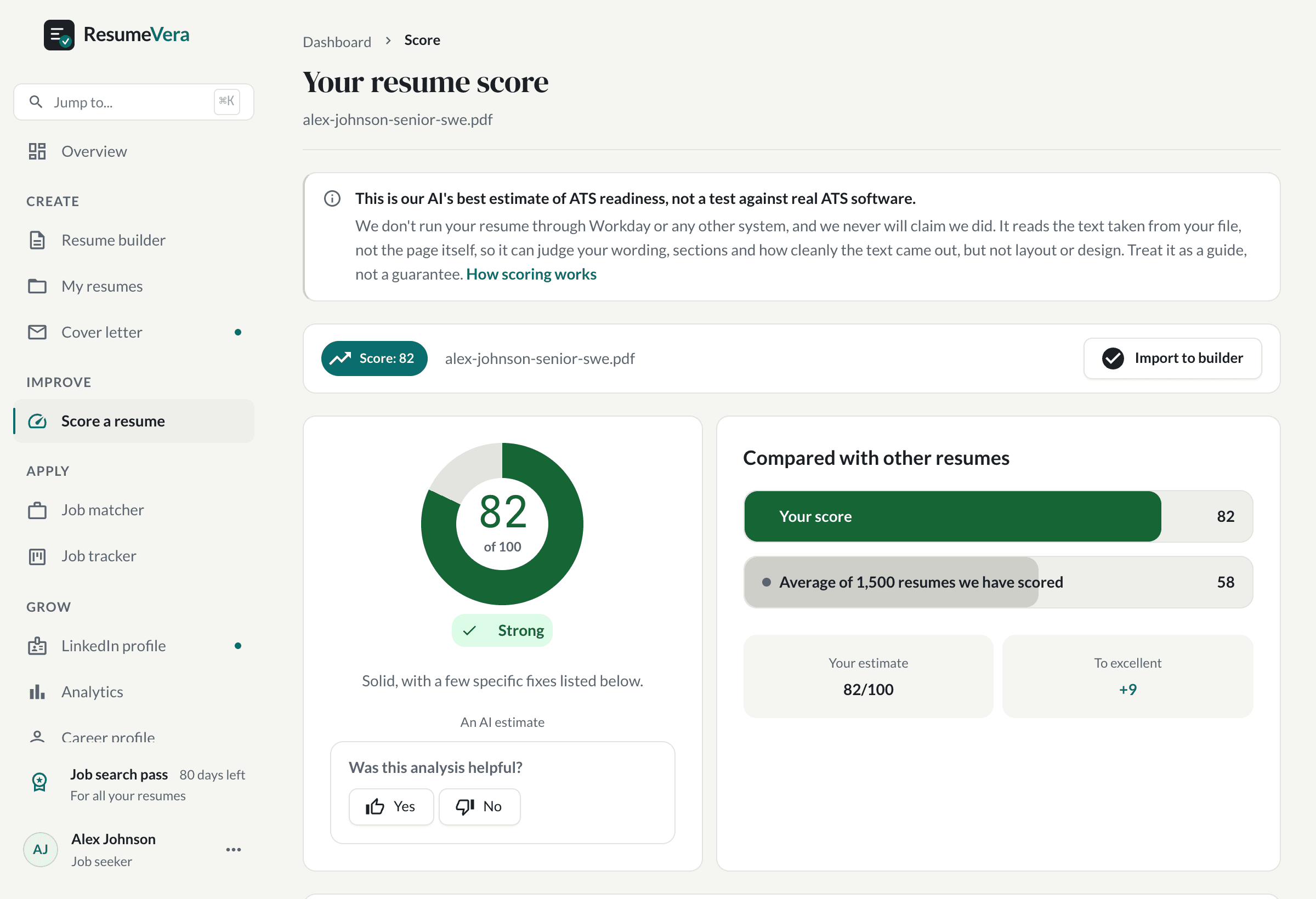
The real score page, with a sample resume and sample scores.
What the score says
Your resume is structured so a parser can read it
Your bullets lead with actions and carry measurable outcomes
The sections a recruiter looks for are present and findable
Your wording overlaps with the language of the roles you want
What it does not say
Whether a specific employer's ATS will rank you
Whether you will get an interview
Whether you are qualified for the job
Anything about candidates you are competing against
What the four sections mean
Each is scored from 0 to 4 against the wording below, and the numbers you see are calculated from those levels in our code: levels 0 to 4 count as 0, 20, 45, 65 and 94. We do not ask the AI for a score, because a number produced that way cannot be explained and moves between runs on the same resume.
Keywords and clarity
Whether the wording matches how roles like this are actually described.
- 0Almost no usable wording. Too little text to judge, or nothing role-relevant in it.
- 1Generic throughout. Could describe almost any job at almost any company.
- 2Some role-relevant terms, used inconsistently or without context.
- 3Clear role-relevant terms used in context, consistently across the document.
- 4Specific and precise throughout, with the terms a person in this field would actually use.
Parse safety
Whether the document survived text extraction cleanly.
- 0Text arrives jumbled or out of order, which usually means columns, tables or an image-only file.
- 1Frequent ordering problems: fragments interleaved, headings separated from what they head.
- 2Mostly linear with some ordering problems, or section headings that are hard to recover.
- 3Clean linear text with standard, recoverable section headings.
- 4Clean linear text, standard headings, parseable dates, and no sign of content trapped in a table or a header.
Completeness
Whether the sections an employer looks for are present.
- 0Essential sections are missing. There is no way to contact this person or see what they have done.
- 1One essential section present; the rest absent.
- 2Core sections present, with real gaps in what they contain.
- 3All core sections present: contact, experience, education or equivalent, and skills.
- 4All core sections present and developed enough to judge, with nothing an employer would have to ask for.
Credibility
Whether claims are backed by something a reader can check.
- 0Vague and unverifiable throughout. Responsibilities listed, nothing shown.
- 1Mostly general claims with little supporting detail.
- 2Some claims backed by specifics; others asserted.
- 3Most claims backed by a specific, a number or a named outcome.
- 4Consistently specific and internally consistent: dates line up, scope matches seniority, results are stated concretely.
The four are weighted: keywords and clarity counts for 35 per cent, credibility 25, parse safety 20 and completeness 20. Keywords and parsing decide whether a resume is read at all; credibility, whether your results are shown rather than claimed, is what the person reading it looks for.
What your text has to show
The AI chooses a level for each dimension, and then our code checks it against your resume. A level can be lowered by these checks, never raised, and when one is lowered your report says which check and why.
- Credibility is held at level 1 when fewer than a quarter of your achievement lines (lines that start with what you did, such as "Built" or "Led") state a number, a percentage, money or a scale; at level 2 below half; and at level 3 below seven in ten, or when there are fewer than six such lines.
- Completeness is held at level 2 under 150 words or with fewer than three of the standard sections, and at level 3 under 250 words. The top level also needs all four standard sections (experience, education, skills and a summary), at least 300 words, and both an email address and a phone number.
- Keywords and clarity is held at level 2 under 150 words and at level 3 under 300, because there is not enough text to use the language of a role throughout.
- Parse safety is held at level 2 when the text comes out of your file with noise, which usually means columns, text boxes or an unusual font, and at level 3 when a little noise comes through or fewer than two dates can be read (write them as "Jan 2021 - Present").
These checks arrived in September 2026 (scoring version 3) and were tightened in October 2026 (version 4). Before version 3, the AI's levels were used as given and many resumes scored at or near 100: of the 113 uploaded resumes scored under version 2 in the thirty days to 30 September 2026, 27 scored exactly 100, which tells nobody what to improve. Version 3's checks still left the top level too easy to reach, so version 4 asks the top level of each dimension to be shown in the text. Version 5 (October 2026) changed what each level counts for. Under the old even steps, a resume judged sound but not outstanding scored in the eighties and one judged at the top everywhere scored 100. Tested on a fixed set of 30 sample resumes, strong ones averaged 99 and middling ones 84. Now a sound resume (level 3 throughout) scores 65, the top level must stand out, and the highest score shown is 94. Resumes scored before August 2026 used an earlier scale again, whose fourth section rated formatting rather than parse safety. We never convert an old score to a new scale, because your resume text is not kept after analysis and a converted score would be a number we made up. Older scores stay as they were and are labelled with their version.
The interview answer score
Every answer in a mock interview is graded on the same four things, each from 0 to 4. The 0 to 100 score you see is calculated from those four levels in our code. We never ask the AI for a score, because a number produced that way cannot be explained and moves around between runs on the same answer.
The exact wording below is what the AI is given when it grades you. It is not a summary of the rubric, it is the rubric.
Structure
Whether the answer is easy to follow from start to finish.
- 0No shape. A single sentence, or a stream of thoughts with no beginning or end.
- 1Rambling. The listener has to work out what the situation was and what happened.
- 2A recognisable arc, but one part carries all the weight and the rest is thin.
- 3Clear situation, action and outcome. Easy to follow at interview pace.
- 4Tight and well paced. Opens with the point, spends time where it matters, ends on the result.
Specificity
Whether the answer describes one real thing rather than what you usually do.
- 0Entirely generic. Could have been said by anyone in any job.
- 1Mostly generalities, with a passing mention of something particular.
- 2A real situation, but described at a distance and without detail.
- 3One concrete example with the details that make it real: the system, the constraint, the people.
- 4A specific example with the detail an interviewer would probe for already supplied.
Evidence
Whether the outcome is backed by something other than an assertion.
- 0No outcome at all. The answer stops before the result.
- 1An outcome asserted with nothing behind it: "it went well".
- 2A described outcome, but no way to judge its size.
- 3A stated result with a number, a timeframe or a named consequence.
- 4A result with a number and a baseline, so the size of the change is clear.
Relevance
Whether it answers the question that was actually asked.
- 0Answers a different question.
- 1Touches the question on the way past but mostly talks about something else.
- 2Addresses the question, but leaves the central part of it unanswered.
- 3Answers the question that was asked, in full.
- 4Answers it and anticipates the natural follow-up.
The four are not weighted equally, and the weighting depends on what kind of question it was. A technical question leans on specificity and relevance; a behavioural one leans on structure and evidence. That is why a strong technical answer is not marked down for lacking a measured business result.
Where a role has a question bank we have written, your answer is also compared against a human-written reference answer for that specific question. It is one strong answer rather than the only one, and a different valid approach is not penalised.
A session score is the average of your best attempt at each question, so retrying a question can only help you. Every attempt is kept either way.
Skill assessment results
An assessment is a timed set of multiple-choice questions in one domain. Your raw score is the share you answered correctly. Unanswered questions count as wrong, which is why we tell you to guess rather than skip.
They are not proctored. We do not use your camera and do not track your tabs. A result therefore describes the answers that were given, not who gave them, and we say so on the report and on any badge you share. We never use the word certified, because an assessment attempt on a date is not a certification.
A percentile compares your raw score against everyone who has taken the same assessment. We withhold it entirely until a domain has at least 50 attempts, because below that the number would be noise dressed up as a ranking. When it is shown, it always appears with the number of attempts behind it, and the figure is frozen at the moment you submit, so a badge you share today does not quietly change meaning next month.
Your report shows your most recent attempt, not your best one. You can retake a domain every 14 days.
Why we publish the limits
A score is only useful if you know what it covers. Tools that imply certainty they do not have send people to rewrite the wrong things. Everything above is what we can stand behind; where we are estimating rather than measuring, we say so on the screen itself, not only here.
Questions about any of this? Ask us.
Where our numbers come from
Every figure on a guide links to the thing it came from, and we say when a figure is weak. Two on our own ATS guide are: a 7.4 second average first pass is eye tracking of thirty recruiters in a study run by a jobs board, and the finding that 88% of employers (Harvard Business School and Accenture, 2021) say their own software screens out qualified people is employers describing themselves rather than a measured rate. Both are the best available and neither is conclusive, so both are labelled on the page.
When we cannot find the study behind a number, we take the number out. That page used to open with a claim that a quarter of applicant tracking systems miss contact details placed in a header. We went looking for the research and there is none, so it is gone, even though it argued for something we believe and sell against.
The most repeated statistic in this industry, that most resumes are thrown out by software before a person reads them, has no study behind it at all. We traced it, and we published where it actually came from, including the eight pages of our own that had been repeating it.
Common questions
What people ask about the score
The output
What the scoring actually produces
Not a single number. The score breaks into sections, each section into specific findings, and each finding names the line it is about.
Check your resume freeThe real score page, with a sample resume and sample scores.
Now see what it says about yours
You have read exactly how the estimate is produced and where it stops. Run it.