Free Resume Bullet Point Analyzer
Paste your resume bullet points and get each one rated on the same five-tier scale the builder uses, instantly. See exactly what's wrong, including missing metrics, weak verbs, passive voice, and how to fix it. Free, instant, no signup.
One of the free tools in the ResumeVera resume builder, which scores your whole resume and rewrites the weak bullets for you.
Paste your resume bullet points, one per line
0 bullets detected
What makes a resume bullet parse well?
An ATS-friendly bullet point has three things: a strong action verb at the start, a measurable result (%, $, time, team size), and 10–20 words total. ATS systems extract achievement data from bullets and score them, vague responsibility-based bullets score near zero while quantified achievement bullets score highest.
Start With a Strong Action Verb
The first word of every bullet should be a strong, specific verb: Led, Built, Reduced, Increased, Launched, Designed. Never start with 'Responsible for', 'Worked on', or 'Helped with'.
Quantify Every Achievement
Add specific numbers wherever possible: team size ('led 8 engineers'), magnitude ('reduced costs by 42%'), scale ('serving 500K users'), or time ('delivered in 3 months'). Numbers = credibility.
Keep It 10–20 Words
Under 8 words is too vague to score well. Over 25 words loses scannability. ATS systems parse bullet points best when they're concise, active, and specific.
How the bullet analyser works
Paste. Analyze. Fix. Done in under 3 minutes.
Paste Your Bullets
Copy bullets from your resume and paste them into the analyzer, one per line, up to 20 at once. Dashes and bullet symbols are stripped automatically.
Get Instant Ratings
Each bullet is rated on the same five-tier scale as your resume score, based on action verb strength, quantification, word count, and passive voice detection.
Fix Each Weak Bullet
See exactly what to fix (missing metric, weak opener, passive voice) and get AI-powered rewrites with a free account.
Weak and strong resume bullets, side by side
Here are real before/after examples for common job roles. Each transformation adds an action verb, a metric, and cuts passive language:
✗ Weak
“Worked on improving performance of the web application”
✓ Excellent
“Reduced API response time by 67% by implementing Redis caching, improving P99 latency from 800ms to 260ms”
Added action verb (Reduced)
Quantified impact (67%, 800ms→260ms)
Specified what you did (Redis caching)
✗ Weak
“Responsible for managing email marketing campaigns”
✓ Excellent
“Launched 12-email nurture sequence achieving 38% open rate, 2.1× industry average, and generating 140 qualified leads per quarter”
Replaced passive opener (Launched)
Added 3 metrics (38%, 2.1×, 140 leads)
Showed business outcome (qualified leads)
✗ Weak
“Helped the team ship the mobile app on time”
✓ Excellent
“Led cross-functional team of 11 to ship iOS app in 90 days, achieving 4.6★ App Store rating in first month”
Action verb (Led)
Team size (11 people)
Timeline + outcome (90 days, 4.6★)
How bullets are scored
Our analyzer scores each bullet out of 100 across four criteria. A bullet needs at least 70 points to reach Excellent, 40–69 for Good, and below 40 is Weak:
Strong action verb at start
Led, Built, Reduced, Launched
Quantifiable metric present
%, $, team size, time saved
Optimal word count (8–22 words)
Penalized if < 8 or > 25 words
Active voice (no passive opener)
Not "Worked on", "Responsible for"
The screen
Feedback that points at a line, not at your resume
The score breaks into sections and the sections break into bullets, so what you get back is a list of specific edits rather than a grade and a shrug.
Check your resume free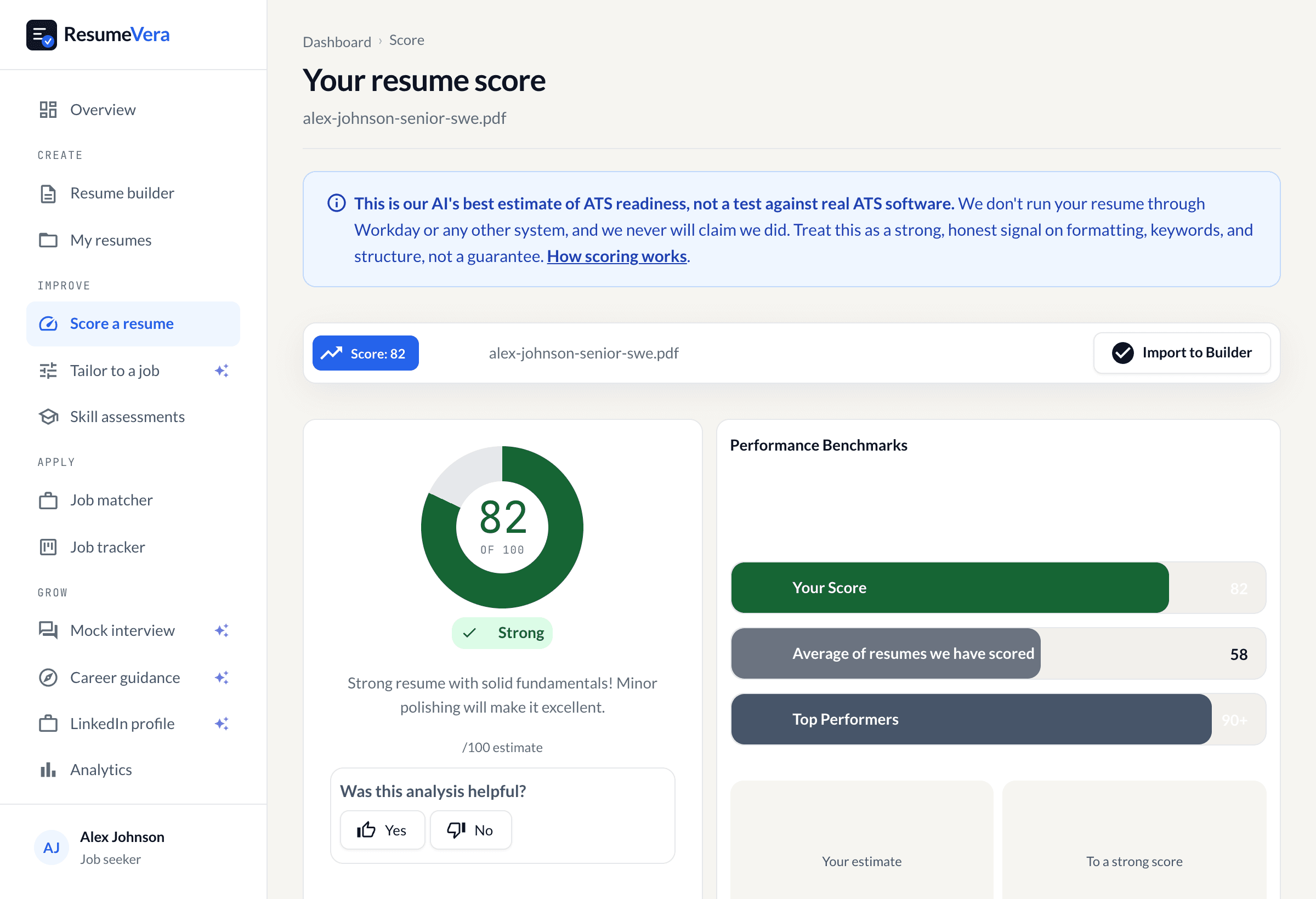
A sample resume in the real checker. The 82 and the sub-scores are what the scorer returns for it.
Questions
Frequently asked questions
Also check your full resume ATS score
Great bullets are one part of ATS optimization. Check if your full resume passes ATS screening, keywords, formatting, and section structure.