Sourced
Where the 75% ATS rejection number came from
It is the most repeated figure in resume advice, and there is no study underneath it. This is the paper trail, and what is actually known instead.
The ResumeVera team
We followed the citations backwards until they ran out, and we link every source so you can do the same. Where a figure is weak, this page says so.
Updated Oct 7, 2026
6 min

Section 01
The claim, stated plainly
You have almost certainly read some version of it. Around three quarters of resumes are thrown out by software before a person ever looks at them. It appears in blog posts, in LinkedIn advice, in the sales copy of products that exist to save you from it, and until recently it appeared in eight articles on this site, which is part of why this page exists.
It is a myth. Not an exaggeration or a figure that has aged badly, but a number that was never measured in the first place.
Section 02
The paper trail
Following the citations backwards is unusually easy, because they run out fast. Almost every article quoting the figure cites another article quoting the figure. Keep going and the trail ends in the same place: marketing material published in 2012 by Preptel, a company selling resume optimisation.
Preptel went out of business in 2013. It published no methodology, no sample size and no survey. Christine Assaf documented this in a 2020 HRTact article titled Your Job Application Was Rejected by a Human, Not a Computer, concluding that the statistic was created without any study, survey or context behind it.
So the most repeated number in resume advice originates with a defunct vendor that had every commercial reason to make screening software sound frightening, because it was selling the remedy.
Section 03
Why it spread so well
A statistic does not need to be true to travel. This one had three things going for it.
It explains a painful experience. Applying for work and hearing nothing is demoralising, and a number that blames a machine is kinder than the alternatives.
It is unfalsifiable from where you sit. You cannot see what happened to your application, so nothing you experience will ever contradict it.
And it sells things. Every product that promises to get you past the robot is easier to sell once you believe the robot is there.
Section 04
What the research actually shows
The honest answer is that there is no good public figure for how many resumes are discarded without human review, because the data sits inside employers rather than in published research.
What does exist is narrower. Harvard Business School and Accenture found in 2021 that 88% of employers say their own systems filter out qualified candidates (Hidden Workers: Untapped Talent). Read that precisely: it is employers describing what they believe their software does, which is a different measurement from a rejection rate, and it says the problem is real without saying how large it is.
Section 05
What actually filters an application
The mechanism people attribute to parsing is usually something simpler. Employers configure knockout questions, and those genuinely do filter automatically: work authorisation, a required licence, a minimum years-of-experience gate answered yes or no. That is a rule someone deliberately set, not a machine judging your formatting, and it is worth understanding properly: how knockout questions work.
Parsing still matters, just not as an execution. A resume the parser reads badly is harder to search and harder to shortlist, which costs you opportunities without ever producing a rejection.
Which formatting choices genuinely cause a parser trouble is covered in what an ATS actually does with your resume, and what an employer is required to disclose is in AI in hiring: what you are entitled to know.
Section 06
What we can and cannot tell you
We sell a resume score, so it is worth being direct about what ours is. It is an AI estimate of how well a resume is likely to parse and match a posting. It is not a test against any employer's applicant tracking system. Nobody outside Workday, Greenhouse or Taleo can run one, and anyone who claims to is describing something they cannot do.
We would rather tell you that than repeat a number that would make our own product sound more necessary.
Pro tips
Do these
Check where a statistic came from before you act on it. If every source cites another article rather than a study, there is usually no study.
Treat knockout questions as the real automatic filter, because they are the one thing an employer genuinely configures to reject on.
Write for a parser because it makes you easier to find, not because you believe a machine is about to delete you.
Prefer figures that come with a sample size. A small sample stated honestly is worth more than a large one with no methodology.
Be suspicious of any number that makes the product quoting it sound more necessary.
Avoid these
Delete these
Repeating the figure because it appears everywhere. Frequency is not evidence, and in this case every repetition traces to the same 2012 source.
Buying a product on the strength of a claim that the product's own category invented.
Assuming silence after applying means a machine rejected you. Most applications are read and passed over by a person.
Treating an ATS match score as a pass mark. No employer publishes a threshold, and any specific number you see quoted is a guess.
Over-correcting into the belief that formatting does not matter. It does, just not as an execution.
Keywords
Keywords by category
Use these in your resume and profile to improve search visibility.
Core phrases
Related questions
Put this into a resume
Building and editing are free, and free PDFs carry a small watermark.
Check my resume freeQuestions
Frequently asked questions
How this guide is maintained
We review this guide every quarter and after any change to the hiring rules or portal behaviour it describes. It was last reviewed on October 7, 2026. Figures come from named sources, shown beside the number. Where we are estimating rather than measuring, we say so.
By the numbers
2012
the year the number first appears, in marketing material rather than research
Christine Assaf, HRTact, Your Job Application Was Rejected by a Human, Not a Computer (2020)
2013
the year the company that published it went out of business
Christine Assaf, HRTact, Your Job Application Was Rejected by a Human, Not a Computer (2020)
0
methodologies, sample sizes or surveys ever published to support it
Christine Assaf, HRTact, Your Job Application Was Rejected by a Human, Not a Computer (2020)
Try it
Check the guide against your own file
Everything above is general. Your resume is not. Paste it in and the checker tells you which of these points your file actually breaks.
Check your resume free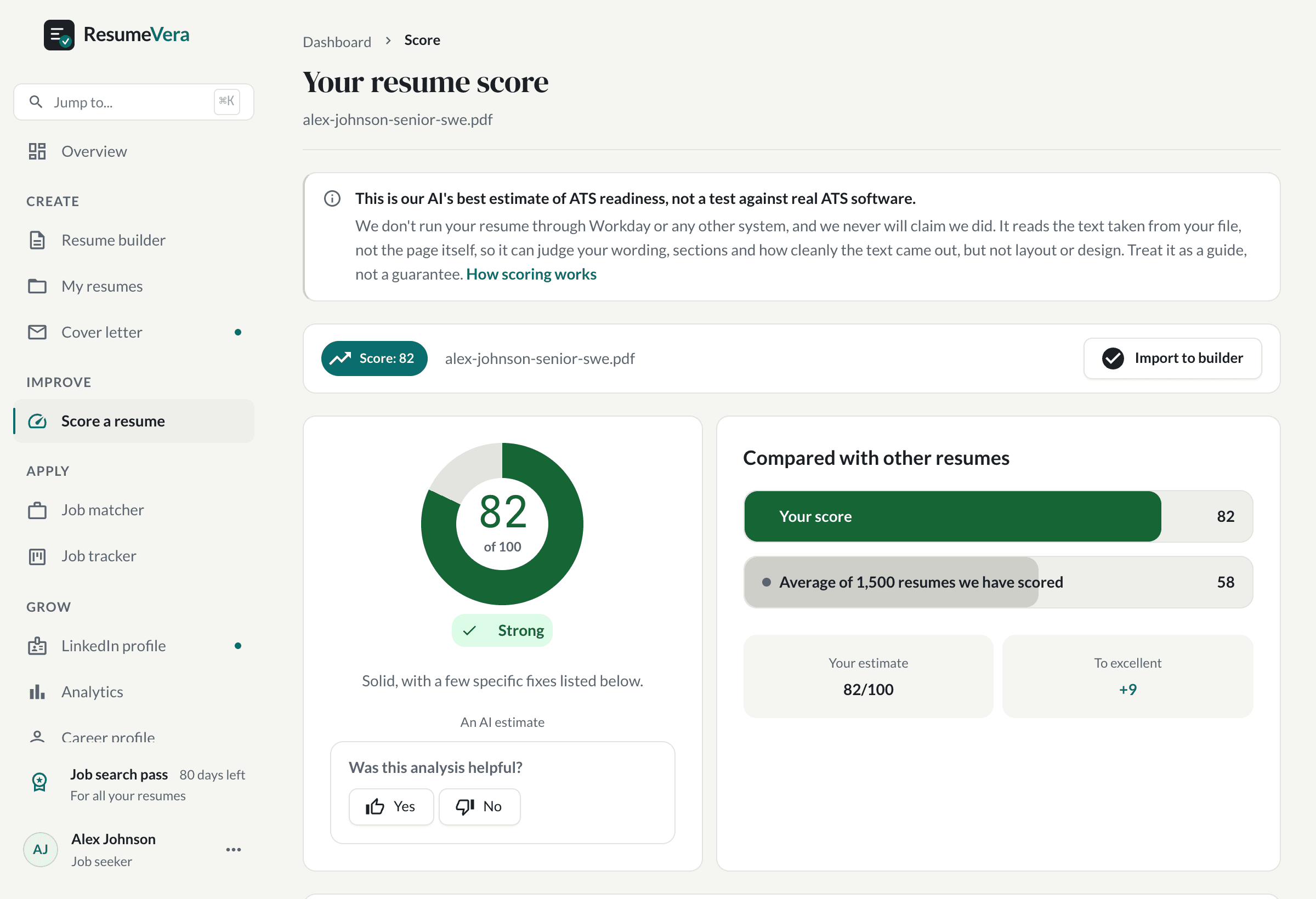
The real score page, with a sample resume and sample scores.
Sources & further reading
The formatting guidance and figures on this page draw on the following authoritative sources.
- Christine Assaf, HRTact: your job application was rejected by a human, not a computer (October 2020), Traces the "75% rejected by ATS" claim to Preptel, a company that closed in 2013 without publishing a methodology.
- Harvard Business School and Accenture, Hidden Workers: Untapped Talent (September 2021), The 88% figure: employers agreeing that qualified candidates are screened out for not matching the exact criteria in a job description. It is what employers believe, not a measured rejection rate.
Is your resume ATS ready?
Run a free ATS score check and get specific improvements in seconds.