Resume for H-1B Visa Applicants
A complete guide to writing a US-format resume as an international candidate. Learn how to present work authorization, list foreign credentials, and optimize for ATS systems used by top H-1B sponsors.
How should H-1B visa applicants write their US resume?
H-1B visa applicants should write a standard US-format resume (one to two pages, no photo, no personal details) with one critical addition: work authorization status. Use phrases like "Authorized to work in the US" or "H-1B visa holder" in the header. Never write "Will sponsor" — that is the employer's statement, not yours.
US Resume Format Essentials
A US resume differs significantly from CVs used in India, China, Europe, or the Middle East. There is no photo, no date of birth, no marital status, no nationality field, and no passport number. The document is typically one page for early-career candidates and two pages for experienced professionals. It begins with a professional summary or objective, followed by work experience listed in reverse chronological order, education, and skills. US employers expect concise bullet points with quantified achievements, not paragraph descriptions of responsibilities.
Where to Place Work Authorization
Place your work authorization status directly below your name and contact information, or in a dedicated "Authorization" line in your header. For example: "H-1B Visa Holder | Authorized to work in the US." This placement ensures that both human recruiters and ATS systems capture the information immediately. Some candidates also include it in their professional summary: "Software engineer with 6 years of experience, currently authorized to work in the US on an H-1B visa." Either approach works as long as the information appears on the first page.
Should you mention H-1B sponsorship on your resume?
Include your current work authorization status but avoid terms like "requires sponsorship." Instead, state your actual status: "H-1B visa holder," "OPT-authorized," or "US Permanent Resident." Many employers filter resumes through ATS systems (Workday, Greenhouse, Lever) that flag sponsorship-related keywords negatively.
The Sponsorship Language Trap
Many international candidates make the mistake of writing "Requires H-1B sponsorship" or "Will need visa sponsorship" on their resumes. This language is problematic for two reasons. First, it frames your candidacy as a cost and legal burden before the employer has even evaluated your skills. Second, many ATS systems are configured to filter out resumes containing the word "sponsorship" because employers receive thousands of applications and use this as a quick screening criterion. Instead, state what you have, not what you need. "H-1B visa holder" tells the employer you are already authorized. "OPT-authorized through December 2027" communicates a clear timeline. These factual statements pass ATS filters while conveying the same information.
If you are currently on OPT and will need H-1B sponsorship in the future, focus on your current authorization. You are legally authorized to work right now. The sponsorship conversation belongs in the interview, not on your resume. By the time an employer is ready to discuss sponsorship, they have already decided you are a strong candidate — and that is exactly when you want to have that conversation.
How do you handle work authorization on a US resume?
Different visa categories require different resume language. OPT (Optional Practical Training) and CPT (Curricular Practical Training) are for students. The H-1B cap limits new visas to 85,000 annually, while cap-exempt employers (universities, research institutions) can petition year-round. STEM OPT extends work authorization to 36 months. Understanding these distinctions helps you choose the right language for your resume.
| Visa Status | Recommended Resume Language | Avoid |
|---|---|---|
| H-1B (active) | "H-1B visa holder — Authorized to work in the US" | "Requires sponsorship" |
| H-1B (transfer) | "H-1B visa holder — Transfer-eligible" | "Seeking new sponsor" |
| OPT (Pre-completion) | "OPT-authorized — Eligible to work in the US" | "Student visa, need sponsorship" |
| STEM OPT Extension | "STEM OPT-authorized through [date]" | "Will need H-1B in [year]" |
| CPT | "Authorized to work in the US (CPT)" | "Part-time student worker" |
| L-1 (transferring to H-1B) | "L-1 visa holder — Authorized to work in the US" | "Intracompany transferee" |
| H-1B Cap-Exempt | "H-1B visa holder (cap-exempt employer)" | "Exempt from lottery" |
| EAD (Employment Authorization Document) | "Authorized to work in the US (EAD)" | "Dependent visa with work permit" |
| US Permanent Resident | "US Permanent Resident — No sponsorship required" | "Green card holder" (less formal) |
Premium Processing and Timing
H-1B premium processing (Form I-907) guarantees a USCIS response within 15 business days for an additional $2,805 filing fee. If you are on OPT and your employer plans to file for H-1B, premium processing can reduce uncertainty in your employment timeline. While this detail does not belong on your resume, understanding it helps you plan your job search. Candidates on STEM OPT have up to 36 months of work authorization, giving them up to three chances at the H-1B lottery (FY2026, FY2027, FY2028 if OPT started in 2025).
What do US employers look for from international candidates?
US employers evaluating international candidates look for a US degree or evaluated equivalent (WES or ECE), strong English communication skills, US work experience (including internships and co-ops), domain expertise in a specialty occupation, and cultural fit demonstrated through US-style achievement-oriented bullet points with quantified metrics.
Specialty Occupation Proof
H-1B visas require a "specialty occupation" — a role that requires at minimum a bachelor's degree in a specific field. Your resume must clearly connect your degree to your job function. A computer science graduate applying for a software engineering role is straightforward. A business administration graduate applying for a data analyst role should emphasize relevant coursework, certifications (SQL, Python, Tableau), and quantified analytical achievements.
US-Style Achievements
US resumes prioritize measurable impact over duties. Instead of "Responsible for managing a team," write "Led a 12-person engineering team that shipped 3 products generating $2.4M in first-year revenue." Convert all currencies to USD. Use metrics US employers understand: revenue impact, cost savings, user growth percentages, uptime improvements, and sprint velocity gains.
Cultural Fit Signals
US employers look for evidence of cross-functional collaboration, initiative beyond assigned duties, and communication skills. Include bullet points about presenting to stakeholders, leading cross-team projects, mentoring junior engineers, or contributing to open-source projects. If you have US conference presentations, hackathon wins, or published articles in English, feature them prominently.
How should you list international education on a US resume?
Foreign degrees need credential evaluation context for US employers. Include the evaluation equivalency directly in your education section: "B.Tech in Computer Science, IIT Delhi (WES-evaluated: equivalent to US Bachelor's in CS)." This removes ambiguity and helps both recruiters and ATS systems parse your qualifications correctly.
Indian Degrees
B.Tech / B.E.: Equivalent to a US Bachelor of Science in Engineering. List as "B.Tech in Computer Science, IIT Bombay, Mumbai, India (WES-evaluated: equivalent to US BS in Computer Science)."
M.Tech: Equivalent to a US Master of Science. This qualifies for the H-1B master's cap (additional 20,000 visas) only if earned from a US institution. An Indian M.Tech does not qualify for the US master's cap.
MBA (IIM/ISB): List as "MBA, Indian Institute of Management Ahmedabad, India (WES-evaluated: equivalent to US Master's in Business Administration)." Indian MBA programs are typically two years, matching the US MBA structure.
Chinese and UK Degrees
Chinese Bachelor's (4-year): Generally equivalent to a US bachelor's degree. List as "BS in Computer Science, Tsinghua University, Beijing, China (ECE-evaluated: equivalent to US Bachelor's in Computer Science)."
UK Bachelor's (3-year): This is a common pain point. A 3-year UK bachelor's is often evaluated as equivalent to a US bachelor's, but some employers and USCIS officers have questioned it. Get a WES or ECE evaluation that explicitly states the equivalency.
Credential Evaluation Services: WES (World Education Services) and ECE (Educational Credential Evaluators) are the two most recognized agencies. USCIS accepts both for H-1B petitions. Processing takes 7 to 20 business days; rush service is available.
What ATS systems are used by H-1B sponsor employers?
The largest H-1B sponsors use enterprise ATS platforms to screen thousands of applications. Workday dominates Fortune 500 companies, Greenhouse is the standard in venture-backed tech startups, Lever powers mid-size tech firms, iCIMS serves enterprise hiring, and Taleo remains in use at legacy organizations. Understanding which system your target employer uses helps you optimize your resume format and keywords.
| Company | Industry | ATS Used | H-1B Petitions Filed (FY2025) |
|---|---|---|---|
| Amazon | Technology / E-commerce | Workday | 15,000+ |
| Google (Alphabet) | Technology | Custom (Google Hire successor) | 12,000+ |
| Microsoft | Technology | Workday | 10,000+ |
| Meta | Technology | Workday | 5,500+ |
| Apple | Technology | Workday | 4,500+ |
| Infosys | IT Consulting | Workday | 8,000+ |
| Tata Consultancy Services | IT Consulting | iCIMS | 7,500+ |
| Cognizant | IT Consulting | Workday | 5,000+ |
| Deloitte | Consulting / Professional Services | Workday | 4,000+ |
| JPMorgan Chase | Financial Services | Workday | 3,500+ |
| Stripe | Fintech | Greenhouse | 1,200+ |
| Salesforce | Cloud / SaaS | Workday | 2,800+ |
ATS Optimization Tips for H-1B Candidates
Use standard section headers. Workday and Greenhouse parse resumes using section header recognition. Use "Work Experience," "Education," and "Skills" — not creative alternatives like "My Journey" or "What I Know."
Submit as PDF unless told otherwise. Modern ATS systems (Workday, Greenhouse, Lever) parse PDFs reliably. Only use .docx if the application portal specifically requests it.
Mirror the job description keywords. ATS systems score resumes based on keyword match to the job posting. If the posting says "React.js," use "React.js" on your resume, not just "React." If it says "machine learning," do not abbreviate to "ML."
Answer the work authorization question correctly. Most ATS application forms ask "Are you authorized to work in the US?" and "Will you now or in the future require sponsorship?" If you are on H-1B, answer "Yes" to the first and "Yes" to the second (since H-1B renewal is technically future sponsorship). If you are a permanent resident, answer "Yes" and "No."
Check yours
See whether your resume follows this
Paste it in and the checker finds the sections, dates and contact block, then tells you which of the rules above your file actually breaks.
Check your resume free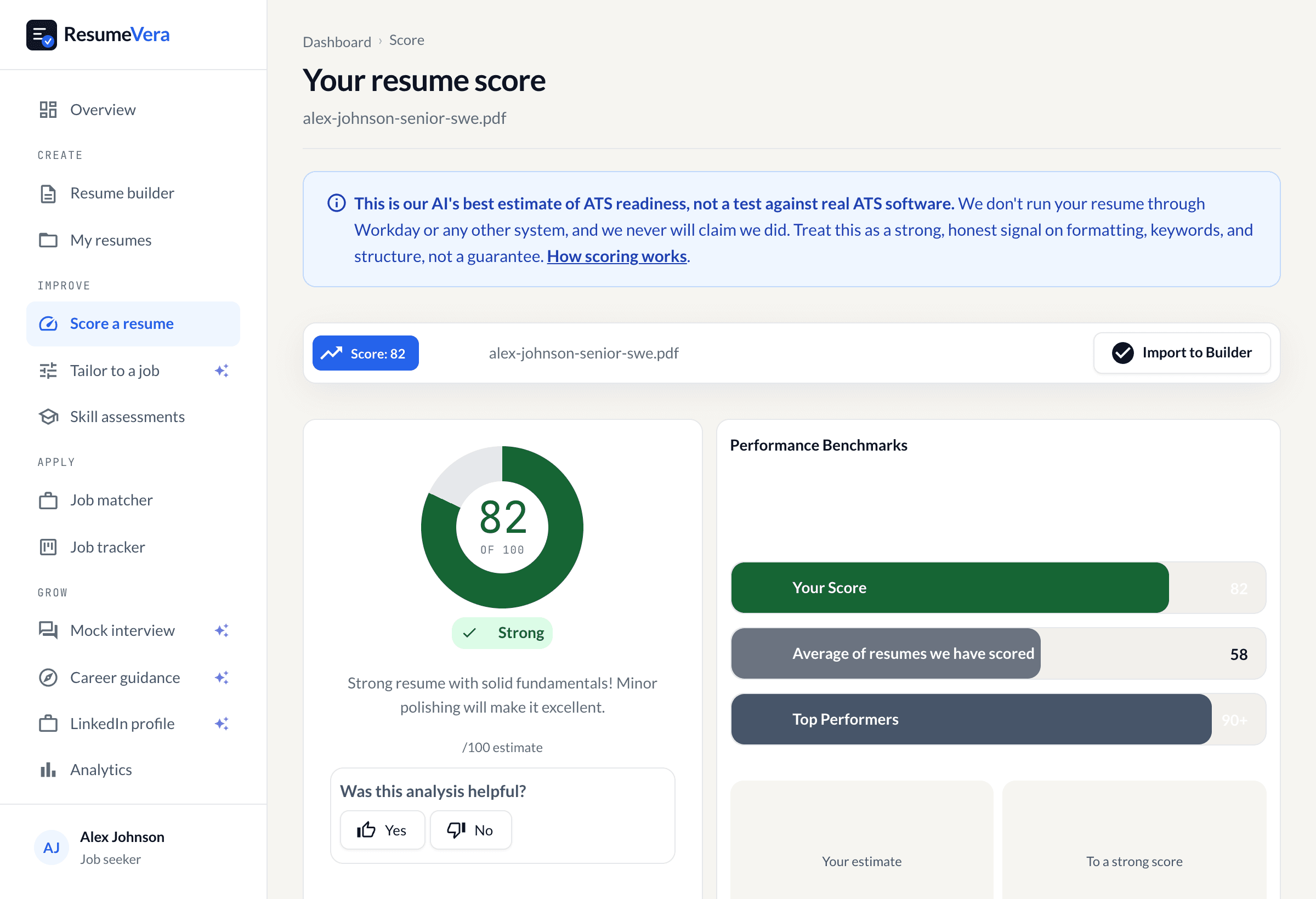
A sample resume in the real checker. The 82 and the sub-scores are what the scorer returns for it.
Build your H-1B ready resume
Create a US-format resume optimized for ATS systems used by top H-1B sponsors. Get instant feedback on work authorization language, keyword optimization, and formatting.
ATS-optimized formatting
Work authorization guidance
Keyword matching for H-1B sponsors
Questions
Frequently asked questions
Common questions from international candidates preparing US resumes for H-1B visa applications.