Updated August 2026
AI in hiring: what you are entitled to know
Almost all of the writing on this is aimed at employers. This is the same information from the other side of the table, with the dates and the gaps.
The ResumeVera team
Every statute here was read against its primary source and date-stamped, and the page says which of them are unsettled. Where we could not verify something, it is not on the page.
Updated Oct 7, 2026
8 min

Section 01
What this page is and is not
This is information, not legal advice, and it is current as at August 2026. This area is moving quickly: one of the laws described below was repealed before it ever took effect, and another is in force but with its enforcement stayed by a federal court. If you are relying on any of this for a decision that matters, check the primary source, which is linked at the end.
Section 02
What software actually does to your application
The common picture is a machine reading your resume and deciding. That is rarely what happens.
What almost always happens is parsing and search. The system extracts your details into fields, indexes them, and helps a recruiter search and sort. A poorly parsed resume is harder to find in that search, which costs you quietly rather than producing a rejection.
What genuinely rejects automatically is a knockout question, and that is a rule a person configured: work authorisation, a required licence, a minimum years-of-experience gate answered yes or no. If your application disappeared instantly, that is the likelier explanation than a model reading your bullets, and it is covered in knockout questions.
We wrote about where the belief that most resumes are auto-rejected came from, because it has no study behind it: where the 75% number came from.
Section 03
New York City: you must be told, and you can ask for a different process
Local Law 144 covers automated employment decision tools used to screen candidates or evaluate employees for promotion in New York City.
If one is used on you, the employer must give clear and timely notice, must say which job qualifications and characteristics the tool assesses, and must tell you that you can request an alternative selection process or a reasonable accommodation. For a promotion decision about an existing employee, that notice has to come at least ten business days beforehand.
Employers also have to publish a summary of the most recent bias audit of the tool, clearly and conspicuously, on their website. That is a document you can go and read before you apply.
Worth knowing how well this is policed. On 2 December 2025 the New York State Comptroller published an audit concluding that the Department of Consumer and Worker Protection's enforcement has been ineffective. Three quarters of test calls to 311 about these tools were misrouted and never reached the department, and while the department's own survey of 32 companies found a single case of non-compliance, the Comptroller's auditors reviewing the same companies identified at least 17 potential violations. Expect the rule to be enforced more actively from here, and do not assume an employer is complying because nobody has stopped them.
Section 04
Illinois: notice, and no zip code proxies
HB 3773 amends the Illinois Human Rights Act and took effect on 1 January 2026.
It requires an employer to notify you when AI is used in recruitment, hiring, promotion and other employment decisions. It separately prohibits using a zip code as a proxy for a protected class, which is aimed at a specific and well documented way that a model reproduces discrimination without ever being told to.
One caveat that matters for what you can expect in practice. The Illinois Department of Human Rights proposed rules setting out the timing, wording and delivery of that notice, and then withdrew them. The statutory duty stands; the detail of how notice must be given is unsettled, so what you actually receive may vary between employers.
Section 05
Ontario: it has to be in the job posting
Since 1 January 2026, Ontario's Employment Standards Act requires an employer with 25 or more employees to disclose in any publicly advertised job posting whether artificial intelligence is used to screen, assess or select applicants.
This is the most useful of the three for a job seeker, because the disclosure arrives before you apply rather than after. If you are applying in Ontario to an employer of that size and the posting says nothing, that is itself informative.
Employers below 25 employees are outside the requirement.
Section 06
Colorado: the law you may have read about never took effect
This one is worth stating carefully, because a great deal of writing about it is out of date.
Colorado SB 24-205, widely described as the first comprehensive US AI act, was repealed before it ever came into force. Its implementation was postponed, xAI filed suit in April 2026 seeking to block it, a federal magistrate stayed enforcement later that month, and the governor signed a replacement, SB 26-189, on 14 May 2026.
The replacement takes effect on 1 January 2027 and drops the original's discrimination duty in favour of disclosure. Its enforcement is currently on hold pending the same federal litigation. So as at August 2026 there is no Colorado AI hiring law you can rely on, and anything telling you otherwise is describing a statute that was withdrawn.
Section 07
California, the UK, Australia and the EU
These four were missing from the first version of this page because we had not checked them properly yet. They are here now, and two of them turn out not to be in force.
California has covered automated decision systems under its Fair Employment and Housing Act since October 2025, for employers with five or more staff. It is strong on bias testing and four year record keeping, and it gives you no notice right at all, which is the main way it differs from New York City.
The United Kingdom has the strongest rights on this page and the least well known, because nothing about them mentions employment. Since February 2026, a significant decision taken with no meaningful human involvement carries a right to information, to make representations, to human intervention and to contest it.
Australia is not in force yet. The new transparency obligation commences on 10 December 2026, and it puts the disclosure in an organisation’s privacy policy rather than in a notice to you.
The European Union is not in force yet either. The AI Act classifies CV screening and candidate ranking as high risk, and those obligations were postponed from August 2026 to 2 December 2027. Until then your protection in the EU comes from the GDPR.
Section 08
What you can actually ask for
In New York City, ask for the bias audit summary before you apply, and if a tool is used on you, ask for the alternative selection process the law says you may request.
In Illinois, ask whether AI was used in the decision, since you are entitled to be told.
In Ontario, read the posting. If the employer has 25 or more staff, the answer should already be there.
Everywhere, you can ask a recruiter directly whether an automated tool screened your application and what it looked at. None of these laws gives you a right to see your own score or ranking, so that is a request rather than an entitlement, and how it lands tells you something about the employer either way.
Section 09
What it means for how you write your resume
Less than the coverage suggests. The advice that follows from all of this is the same advice that follows from wanting a person to read you clearly: one column, contact details in the body rather than a header, standard section headings, a real text layer in the file, and the language of the job you are applying for rather than a thesaurus of it.
Write it so software can read it because that makes you findable. Do not write it for software, because a person still makes the decision.
What a parser actually does with the file, and which formatting choices genuinely cause trouble, is covered in what an ATS actually does with your resume.
Pro tips
Do these
In New York City, read the employer's published bias audit summary before you apply. It is a public document and most candidates never look at it.
In Ontario, the disclosure is in the job posting itself, so you can know before you spend time on an application.
Ask a recruiter directly whether an automated tool screened you. No law entitles you to an answer, and how they respond is informative.
Treat a knockout question as the real automatic filter. Answer those carefully, because that is where an application genuinely ends.
Check the date on anything you read about AI hiring law. One widely described statute was repealed before it took effect.
Avoid these
Delete these
Assuming these laws give you a right to see your score or ranking. None of them do.
Relying on articles about Colorado SB 24-205. It never came into force and has been replaced.
Assuming an employer is compliant because nobody has enforced against them. The New York State Comptroller found enforcement of Local Law 144 ineffective in December 2025.
Believing your application was deleted by a model. Most applications sit in the ATS for a recruiter to search and read, and knockout questions do the actual rejecting.
Rewriting a resume for software rather than for a reader. The changes that help a parser are the same ones that help a person.
Keywords
Keywords by category
Use these in your resume and profile to improve search visibility.
Core phrases
By jurisdiction
Put this into a resume
Building and editing are free, and free PDFs carry a small watermark.
Check my resume freeQuestions
Frequently asked questions
How this guide is maintained
We review this guide every quarter and after any change to the hiring rules or portal behaviour it describes. It was last reviewed on October 7, 2026. Figures come from named sources, shown beside the number. Where we are estimating rather than measuring, we say so.
By the numbers
5
places with a rule in force today: New York City, Illinois, Ontario, California and the UK
Local Law 144, HB 3773, Ontario ESA, California FEHA regulations, UK DUAA 2025
Jan 2026
when the Illinois and Ontario requirements came into force
Illinois HB 3773; Ontario Employment Standards Act
25+
employee threshold for the Ontario disclosure rule, so smaller employers are outside it
Ontario Employment Standards Act job posting requirements
0
of these laws give you a right to see your own score or ranking
Reading of the statutes as at August 2026
Try it
Check the guide against your own file
Everything above is general. Your resume is not. Paste it in and the checker tells you which of these points your file actually breaks.
Check your resume free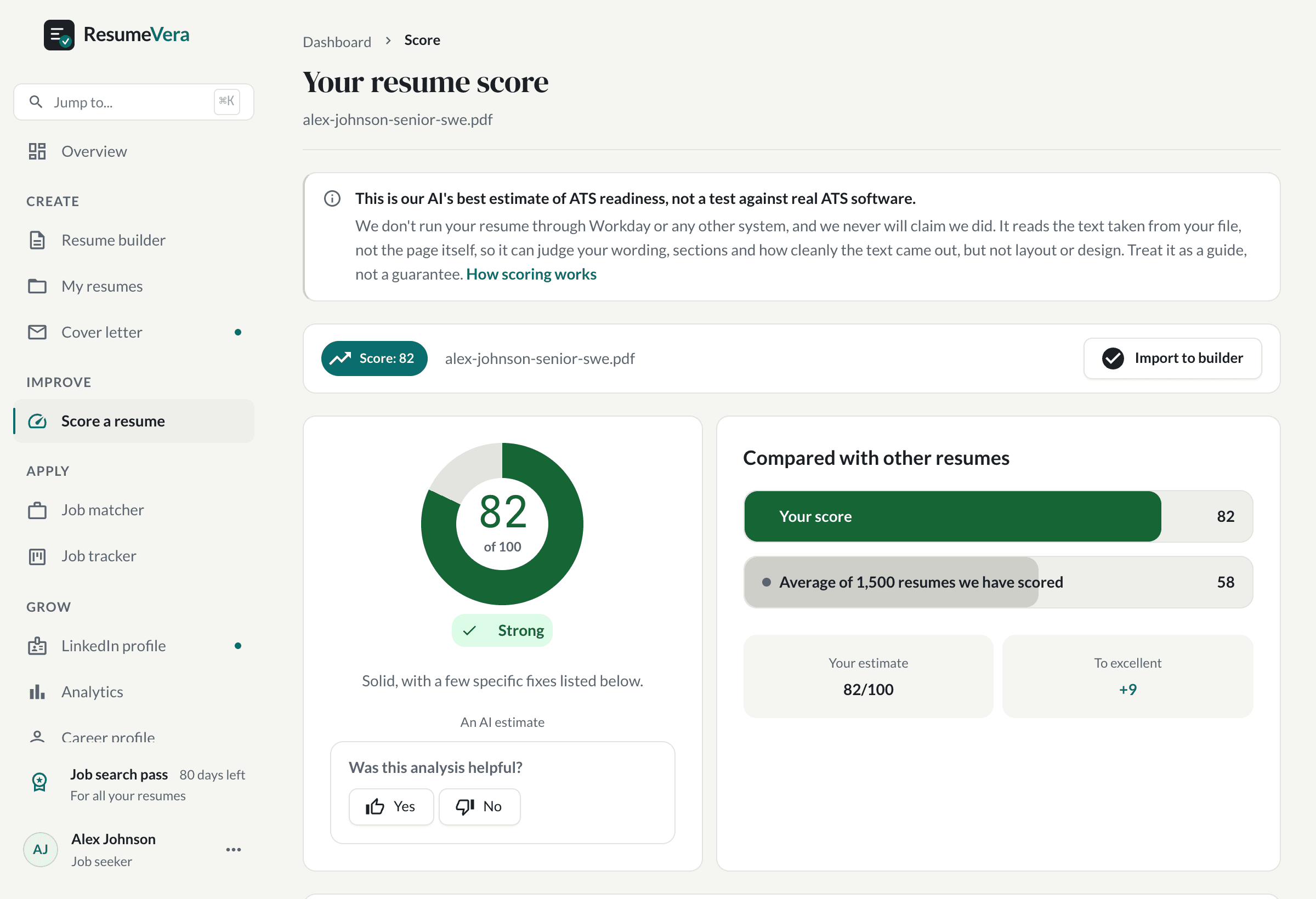
The real score page, with a sample resume and sample scores.
Sources & further reading
The formatting guidance and figures on this page draw on the following authoritative sources.
- New York City DCWP, Automated Employment Decision Tools, The city's own page on Local Law 144: bias audit, candidate notice, and the right to request an alternative selection process.
- New York State Comptroller, audit of DCWP enforcement of Local Law 144 (2 December 2025), Concluded enforcement has been ineffective. Three quarters of 311 test calls were misrouted, and auditors found at least 17 potential violations among 32 companies the department had cleared but one.
- Illinois HB 3773, amending the Illinois Human Rights Act, In force 1 January 2026. Requires notice when AI is used in employment decisions and bans zip code proxies for protected classes. The Department of Human Rights proposed implementing rules and then withdrew them.
- Ontario, job posting requirements under the Employment Standards Act, In force 1 January 2026 for employers with 25 or more employees. AI use to screen, assess or select applicants must be disclosed in the publicly advertised posting.
- Colorado SB 26-189, the replacement for the repealed SB 24-205, Signed 14 May 2026, effective 1 January 2027. The original SB 24-205 never took effect. Enforcement of the replacement is currently stayed pending federal litigation brought by xAI.
- California Civil Rights Department, automated-decision system regulations, In force 1 October 2025 for employers with five or more employees in California. Employer duties rather than a candidate notice.
- Data (Use and Access) Act 2025, automated decision-making provisions, Section 80 replaced UK GDPR Article 22 with Articles 22A to 22D, in force 5 February 2026.
- OAIC, automated decision-making transparency under APP 1, Commences 10 December 2026. Not in force as at publication.
- EU AI Act, Annex III high-risk classification, Category 4(a) covers recruitment and selection. Application postponed from 2 August 2026 to 2 December 2027.
Is your resume ATS ready?
Run a free ATS score check and get specific improvements in seconds.