Workers With AI Skills Earn 56% More — But Your Resume Doesn't Show It
PwC analysed close to a billion job advertisements across six continents and published one of the most consequential findings in workforce research in years: workers who have AI skills earn a 56% wage premium compared to peers doing the same job without those skills. That figure is up from 25% the previous year — the premium is accelerating, not stabilising.
The same research, published in the PwC 2025 Global AI Jobs Barometer, found that every industry analysed pays wage premiums for AI skills — not just technology. Financial services, energy, healthcare, professional services — the premium is real and present across the board.
Here is the problem: most Indian IT professionals are using AI tools at work every day. GitHub Copilot, ChatGPT, Google Gemini, Claude — these are now standard tools in software development, data analysis, content workflows, and customer operations at companies like TCS, Infosys, Wipro, HCL, and Tech Mahindra. But almost none of them have updated their resume to reflect it. They are doing the work that commands the premium. They are not claiming the premium.
This guide is the correction. Here is exactly what AI skills to add to your resume, how to frame them so they pass ATS screening and impress hiring managers, and what the salary difference actually looks like in the Indian job market in 2026.

The 56% Gap: What the Data Actually Shows
To understand why the wage premium is so large, it helps to understand what PwC actually measured. They did not compare AI engineers to traditional engineers — roles that are fundamentally different. They compared workers in the same role, at similar experience levels, where the only distinguishing factor was whether the individual had demonstrable AI skills. A data analyst with prompt engineering experience versus a data analyst without it, at the same company, at the same seniority. A software developer who can use Copilot effectively versus one who cannot.
The wage premium was 56% on average in favour of the AI-skilled worker — up from 25% in the prior year's analysis. PwC also found:
- Skills for AI-exposed jobs are changing 66% faster than skills in other roles — meaning the gap between workers who adapt and workers who don't is widening faster than ever
- Revenue growth in industries most exposed to AI is 3x higher than in less AI-exposed industries since 2022
- Wages are rising 2x faster in the most AI-exposed industries compared to the least exposed
- 100% of industries analysed are increasing AI skill requirements — including mining and agriculture, not just tech
For Indian IT professionals, the additional context from PwC's companion survey — the Global Workforce Hopes and Fears Survey 2025 — is sobering: only 14% of workers globally use GenAI daily at work, despite 54% having used it in the past year. The usage gap is enormous. The vast majority of people who have access to these tools are not using them consistently — which means the workers who are using them consistently are in a very small, highly valued pool.
Why Indian IT Professionals Are Leaving the Premium on the Table
The Indian IT services industry has a particular dynamic that makes this gap worse. At tier-1 service companies — TCS, Infosys, Wipro, Cognizant, HCL — AI tool adoption is happening on the ground in delivery teams, but it is rarely being captured in employee-facing communications, performance reviews, or HR systems. When a developer at TCS starts using GitHub Copilot to write boilerplate code 40% faster, that productivity gain accrues to the project, but it does not appear on the developer's resume.
There are three specific reasons Indian IT professionals are not claiming their AI skills:
- They undervalue informal tool use. If you used ChatGPT to draft a requirements document, you did not sit a formal AI course. So you do not think it counts. It counts — and it counts significantly.
- They have never been told the vocabulary. 'Prompt engineering' sounds like jargon. Most developers do not know that 'writing effective prompts to get consistent, usable outputs from a large language model' is now a named and valued skill with a 56% wage premium attached to it.
- They are worried about appearing dishonest. 'I only use it sometimes' or 'I'm not an expert' leads them to omit it entirely. This is a false binary — the question is whether you use AI tools to produce better work, not whether you have a PhD in machine learning.
Each of these is solvable. Let's solve them.

What AI Skills Actually Count on a Resume in 2026
There are two categories of AI skills that matter on a resume: AI tools you use (practical application skills) and AI knowledge you have (conceptual and technical understanding). You do not need both. You need whichever category is real for you, framed correctly.
Category 1: AI Tools (Applicable to Almost Every IT Professional)
These are tools you use to do your job better. If you use any of these, they belong on your resume:
- GitHub Copilot — AI code completion and pair programming. Used by: software engineers, full-stack developers, data engineers. Frame it as: 'Reduced boilerplate code generation time by approximately 40% using GitHub Copilot for code completion and test generation.'
- ChatGPT / Claude / Gemini for work tasks — Used for drafting technical documentation, requirements specs, code review explanations, user stories, client emails, test cases. Frame it as: 'Accelerated requirements documentation cycle using large language model drafting tools, cutting first-draft time from 4 hours to under 1 hour.'
- Midjourney / DALL-E / Adobe Firefly — If you are in any role with design, marketing, or content touchpoints. Frame it as: 'Produced presentation visuals and client-facing graphics using AI image generation, eliminating external design dependency for internal deliverables.'
- Notion AI / Microsoft Copilot for M365 — Used for meeting summaries, email drafting, document structuring. Frame it as: 'Implemented Copilot for M365 to reduce meeting documentation time, generating actionable summaries within 5 minutes of call completion.'
- Cursor / Codeium — AI-augmented IDEs used by developers for faster debugging and refactoring. Frame it as: 'Used Cursor AI IDE to accelerate legacy codebase refactoring, reducing debugging cycle time by approximately 35%.'
- Perplexity / AI-augmented search — For research acceleration in analyst and consulting roles. Frame it as: 'Reduced competitive research cycle from 2 days to 4 hours using AI-augmented research workflows.'
Category 2: AI Technical Knowledge (For Developers, Data Scientists, ML Engineers)
If you have built anything with AI or understand how it works technically, these skills command the highest premium:
- Prompt engineering — Designing, testing, and iterating on prompts for consistent LLM outputs. This is a named role and a named skill on hundreds of thousands of job postings in 2026.
- LLM API integration — Experience calling OpenAI, Anthropic, Google Gemini, or Mistral APIs in production applications. Even if you built a small internal tool.
- RAG (Retrieval-Augmented Generation) — If you have built any system that retrieves context to improve LLM responses — chatbots, internal knowledge bases, document Q&A tools.
- Fine-tuning — If you have fine-tuned any model, even on a small dataset for a proof-of-concept project.
- Vector databases — Experience with Pinecone, Weaviate, ChromaDB, or pgvector. These underpin most RAG architectures.
- AI evaluation / testing — Methods for measuring LLM output quality, hallucination rates, and safety properties. Increasingly required in enterprise AI deployments.
- Python AI libraries — LangChain, LlamaIndex, HuggingFace Transformers, PyTorch. Even if you have used them in learning projects.
How to Add AI Skills to Your Resume the Right Way
The mistake most people make when adding AI skills is creating a bullet point that says: 'Used AI tools including ChatGPT and GitHub Copilot.' That is not useful to a hiring manager or an ATS. Here is the correct structure:
The Skills Section: List Them Specifically
In your skills section, list AI tools and frameworks by name. ATS systems perform keyword matching — if the job description says 'GitHub Copilot' and your resume says 'AI coding tools,' it will not match. Be specific:
Good:
AI Tools: GitHub Copilot, ChatGPT API, Google Gemini, Claude, LangChain, HuggingFace Transformers, Pinecone, Prompt Engineering
Not useful:
Skills: AI tools, machine learning, artificial intelligence
The Experience Section: Quantify the Impact
Every AI skill claim is worth more when paired with a number. You do not need perfect precision — a reasonable estimate is fine. Use this structure:
[Action] + [AI tool] + [what you did with it] + [measurable result]
Examples:
| Role | Weak Version | Strong Version (ATS + Hiring Manager Ready) |
|---|---|---|
| Software Engineer | Used GitHub Copilot for development | Reduced code review preparation time by 30% using GitHub Copilot for test case generation and boilerplate automation across a 120-component React codebase |
| Data Analyst | Used ChatGPT to help with reports | Automated first-draft generation of 12 monthly business performance reports using ChatGPT API integration with our internal BI data pipeline, saving approximately 8 hours per report cycle |
| Project Manager | Familiar with AI tools | Implemented Notion AI and Copilot for M365 across a 15-person project team, reducing meeting documentation overhead by approximately 60% over 3 months |
| Business Analyst | Used AI for research | Built a Perplexity-assisted competitive research workflow that reduced client market analysis deliverable time from 3 business days to same-day, across 6 engagements in FY2025 |
| ML Engineer | Worked on LLM projects | Built a RAG-based internal knowledge retrieval system using LangChain, OpenAI embeddings, and Pinecone, reducing support ticket first-response time by 45% for a 2,000-employee client |
The Summary Section: Signal AI Fluency Upfront
The resume summary is the first thing an ATS and a recruiter see. If AI skills are relevant to the roles you are targeting, they should appear in the first 2 lines of your resume. Example:
'Software engineer with 5 years of experience in full-stack development at TCS, with proven application of AI-augmented development workflows including GitHub Copilot, LangChain, and OpenAI API integration. Currently targeting roles in AI-first product companies.'
This accomplishes three things: it surfaces AI skill keywords for ATS matching, it frames you as current and adaptable to a human reviewer, and it sets up the AI skills in your experience section as supporting evidence rather than unsupported claims.

What AI Skills Are Hiring Managers in India Actually Looking For in 2026
Based on patterns in Indian job postings on Naukri, LinkedIn, and Internshala through early 2026, the most-searched AI skill terms for Indian IT roles by seniority are:
0–3 Years Experience (Fresher / Junior)
- Python (with NumPy, Pandas, Scikit-learn)
- Prompt engineering basics
- ChatGPT / Gemini API usage
- Basic LLM concepts (tokens, context windows, temperature)
- Jupyter notebooks / Google Colab
- SQL with AI tools (text-to-SQL, AI-assisted queries)
3–7 Years Experience (Mid-Level)
- LangChain / LlamaIndex
- RAG architecture design
- Vector database management (Pinecone, ChromaDB)
- Fine-tuning open-source models (Mistral, LLaMA, Falcon)
- LLM evaluation and testing frameworks
- AI integration into enterprise workflows (ServiceNow, SAP, Salesforce)
- GitHub Copilot / Cursor advanced usage
7+ Years Experience (Senior / Architect)
- MLOps pipelines (Kubeflow, MLflow, SageMaker)
- Responsible AI / AI governance frameworks
- Multi-agent AI system design
- Cost optimisation for LLM API usage at scale
- AI product strategy and roadmap ownership
- Enterprise AI risk assessment
The India-Specific Salary Impact: What the 56% Premium Translates To
Translating the 56% wage premium into Indian salary figures helps make this concrete. Using approximate 2026 market data from Naukri and LinkedIn Salary Insights for IT roles in Bengaluru, Hyderabad, and Pune:
| Role | Without AI Skills (approx.) | With AI Skills (approx.) | Annual Difference |
|---|---|---|---|
| Software Engineer (3 yrs) | ₹12–18 LPA | ₹18–28 LPA | +₹6–10 LPA |
| Data Analyst (4 yrs) | ₹10–15 LPA | ₹16–23 LPA | +₹6–8 LPA |
| Project Manager (6 yrs) | ₹20–28 LPA | ₹30–42 LPA | +₹10–14 LPA |
| Business Analyst (5 yrs) | ₹12–18 LPA | ₹19–28 LPA | +₹7–10 LPA |
| ML Engineer (4 yrs) | ₹18–25 LPA | ₹28–40 LPA | +₹10–15 LPA |
These are not guaranteed — they reflect market ranges, not formulaic outcomes. But the direction is clear and consistent with the PwC global data: AI skills at every level of experience are attracting substantially higher compensation offers.
The ATS Problem: Why Your AI Skills Might Already Be Getting Filtered Out
Here is a specific problem for Indian IT professionals who have been in the industry for 5+ years: you may already have AI skills but your resume was last updated before those skills were worth naming explicitly. The terms have changed.
In 2022, you might have written: 'Experience with ML model deployment.' In 2026, the same experience needs to say: 'Production deployment of scikit-learn classification models via FastAPI with MLflow experiment tracking and SageMaker inference endpoints.' The first version will not match the keyword filters of most modern ATS systems. The second will.
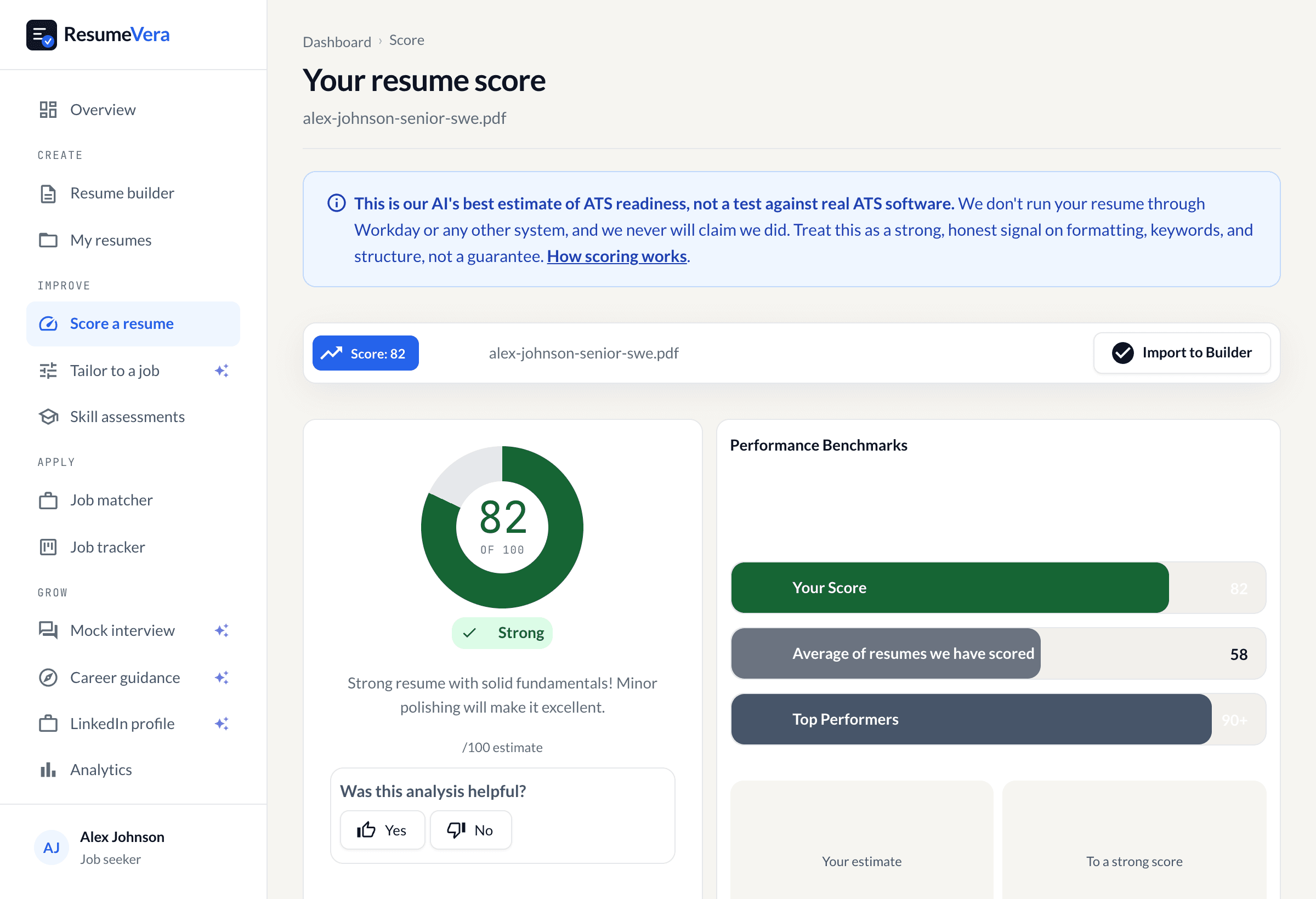
The vocabulary drift is fast. Skills for AI-exposed jobs are changing 66% faster than in other roles — that means if you have not updated your resume in 12 months, the keywords that represented your skills accurately last year may no longer be the keywords hiring managers and ATS systems are searching for today. Use a free ATS checker to run your current resume against a job description you are targeting — the keyword gap report will show you exactly which AI skill terms you are missing.
How to Build AI Skills If You Do Not Have Them Yet
If you are reading this and genuinely have not yet used any AI tools in your work, here is the fastest path to building the skills that show up in the 56% wage premium:
Week 1: Start using the tools (free tier, no cost)
- Activate GitHub Copilot (free for students, ₹1,000/month for professionals — typically the best ROI in software development tools available)
- Get a ChatGPT free account and start using it for one real work task per day — drafting documents, summarising reports, explaining code
- Try Gemini Advanced (available with Google One) for research and document analysis
Week 2–4: Build something small
- Follow any of the free LangChain tutorials to build a basic document Q&A chatbot. Even a toy project counts — it gives you a concrete achievement to reference
- Complete the DeepLearning.AI short courses — 'ChatGPT Prompt Engineering for Developers' takes 3 hours and gives you genuine prompt engineering capability
Month 2: Get the credential
- AWS Certified Machine Learning – Specialty (most recognised in India's IT services companies)
- Google Cloud Professional Machine Learning Engineer
- Microsoft Azure AI Engineer Associate (AZ-102) — particularly valuable given Microsoft Copilot adoption in enterprise India
- IBM AI Engineering Professional Certificate (Coursera)
A certification alone will not deliver the 56% premium — the premium is for demonstrated skill that improves work output. But a certification combined with even a small practical project gives you two things on your resume: proof of learning intent and proof of capability.
Building Your Optimised Resume for AI-Era Roles
The final step is translating everything in this guide into a resume that actually gets through ATS screening and lands in front of hiring managers at companies paying the premium. The key elements:
- Lead with AI skills in your summary — 2 lines that reference specific tools and your most impactful AI use case
- Dedicated AI skills section — Listed by tool name, not by vague category ('AI tools' is invisible to ATS; 'GitHub Copilot, LangChain, Pinecone, Prompt Engineering' is not)
- AI-quantified experience bullets — Every AI skill application should have a number attached to it — time saved, quality improved, cost reduced, output volume increased
- Certifications — Any relevant AI certification listed clearly in an Education or Certifications section
- ATS score check — Before sending to any company, run through a free ATS checker against the exact job description to verify your AI skill keywords are matching
If you want to do all of this without manually extracting keywords from every job description, ResumeVera's AI resume builder handles the optimisation automatically. Paste the job description you are targeting and your current resume — the tool identifies which AI skill keywords are in the job description but missing from your resume, suggests specific edits, and shows you a real-time ATS match score. Free to start.
Frequently Asked Questions
How much more do workers with AI skills earn?
According to PwC's 2025 Global AI Jobs Barometer, which analysed close to a billion job advertisements across six continents, workers with AI skills earn a 56% wage premium on average compared to peers in the same role without AI skills. This is up from 25% the previous year. The premium applies in every industry analysed — not just technology. Financial services, energy, healthcare, and professional services all show significant AI skill wage premiums.
What AI skills should I add to my resume in 2026?
For most Indian IT professionals, the highest-value AI skills to add in 2026 are: GitHub Copilot (if you are in any development role), prompt engineering (if you use ChatGPT, Claude, or Gemini for work tasks), LangChain or LlamaIndex (if you have built any LLM-integrated application), RAG architecture (if you have built any document search or Q&A system), and vector databases such as Pinecone or ChromaDB. For non-technical roles, list specific tools: Notion AI, Microsoft Copilot, ChatGPT with the specific use cases (document drafting, research, data analysis). Always be specific — vague terms like 'AI tools' do not register in ATS systems.
Is it okay to put ChatGPT on my resume?
Yes, absolutely — if you use it for work tasks. 'Used ChatGPT' is weak; 'Used ChatGPT to accelerate requirements documentation, reducing first-draft time from 4 hours to 45 minutes across 8 client projects in FY2025' is strong. The key is framing it as a productivity tool with a quantifiable outcome, not just name-dropping the tool. The same applies to GitHub Copilot, Google Gemini, and any other AI tool you use professionally. Using AI tools to produce better output is now a positive signal to most hiring managers — not a red flag.
Do I need a certification to list AI skills on my resume?
No. A certification is helpful evidence but not a prerequisite. If you use GitHub Copilot to write code, you have GitHub Copilot skills. If you use ChatGPT to draft technical documents, you have prompt engineering skills. The key is framing the skill with a concrete work application and a measurable outcome. A certification strengthens the claim but does not create it. That said, if you are targeting roles that specifically require AI credentials — machine learning engineer, AI architect, data scientist — certifications from AWS, Google Cloud, or Microsoft Azure carry significant weight in Indian enterprise hiring.
Why are Indian IT professionals not putting AI skills on their resumes?
Three main reasons: they undervalue informal tool use (if you used ChatGPT but didn't take a formal course, you may not think it counts — it does), they lack the vocabulary (many professionals don't know that 'writing effective prompts' is called 'prompt engineering' and is a named, valued skill), and they worry about appearing dishonest if they are not an expert. None of these is a valid reason to omit skills that are contributing to your work output and that command a 56% wage premium in the market. If you use the tool to do your job better, list it — with the specific application and the measurable result.
Which companies in India are paying the AI skills premium?
The AI skills premium is most pronounced in product companies (startups and mid-stage), global capability centres (GCCs) of international companies like Google, Microsoft, Amazon, JPMorgan, and Goldman Sachs in Bengaluru and Hyderabad, and specialist AI/ML companies. The traditional IT services giants — TCS, Infosys, Wipro — have generally slower compensation adjustment cycles, but are increasingly using AI skill levels in their internal banding and promotion assessments. For maximum premium capture, target GCCs and product companies where AI skill is directly revenue-linked, not just operationally useful.
How do I pass ATS screening for AI skills roles?
ATS systems perform keyword matching against the job description. For AI skills roles, this means: list AI tools by their exact product names (not generic terms), mirror the specific terminology in the job description in your skills section and experience bullets, and ensure your resume is formatted as a clean single-column PDF (no tables, no text boxes, no headers/footers that ATS parsers misread). Use a free ATS checker to run your resume against the specific job description before submitting — the keyword gap report shows exactly which AI skill terms are in the posting but missing from your resume.