How to Write a Data Analyst Resume That Gets Interviews (2026 Guide)
Data analyst hiring has become increasingly competitive. Companies are being selective, ATS filters are tight, and the difference between a resume that gets an interview and one that gets ignored often comes down to three things: specific tool names, quantified outcomes, and targeted keyword alignment with the job description.
This guide covers exactly how to build a data analyst resume that passes ATS and earns interviews in 2026.
What Hiring Managers Look for in a Data Analyst Resume
Before getting into format and keywords, understand what actually drives hiring decisions for analyst roles:
Tool proficiency with context. "SQL" is a keyword. "Wrote complex multi-join SQL queries across 50M+ row datasets in BigQuery" is evidence. Hiring managers want to know which tools you use, how deeply, and at what scale.
Business impact, not just analysis performed. The analyst who ran A/B tests is less interesting than the analyst whose A/B tests led to a product decision that increased conversion by 18%. Connect your analysis to what changed because of it.
Communication and stakeholder influence. Data analysts must translate findings into decisions. Resumes that show you presented findings to leadership, built self-serve dashboards that reduced ad-hoc requests, or translated data insights into product changes demonstrate a higher-value analyst than one who just ran queries.
Domain knowledge. A data analyst who has worked in e-commerce and is applying to another e-commerce company is easier to hire than a generalist. Lean into your domain expertise in the summary and framing of your experience.
Data Analyst Resume Structure

Use this structure in this order:
- Contact information
- Professional summary
- Work experience
- Skills
- Education
- Projects (optional, strongly recommended for analysts with under 3 years experience)
- Certifications (optional)
Contact Information
Name, professional email, phone, LinkedIn. For analysts: include a link to a data portfolio if you have one (Observable, GitHub with Jupyter notebooks, Tableau Public, or a personal data blog). A portfolio link is worth more than almost anything else on a junior analyst's resume because it shows, not tells.
Professional Summary for Data Analysts
The professional summary should anchor you in a domain, list your key tools, and include one concrete outcome. Three to four sentences maximum.
Strong example: "Data Analyst with 5 years of experience in e-commerce analytics and marketing measurement. Proficient in SQL, Python (pandas, NumPy), Tableau, and BigQuery. Built the attribution model that reallocated $2M in annual marketing spend to channels with 40% lower customer acquisition cost. Interested in senior analyst and analytics engineering roles."
That summary passes ATS on role (data analyst), tools (SQL, Python, Tableau, BigQuery), domain (e-commerce), level (5 years, senior interest), and impact (attribution model + $2M reallocation).
Weak example: "Analytical professional with a passion for data-driven decision making and strong attention to detail." No tools. No domain. No impact. This passes zero ATS filters.
Work Experience: Writing Strong Data Analyst Bullets
Data analyst bullets fail most often because they describe the work done but not the outcome enabled. The formula: Action verb + analysis type or tool + data scale + business outcome.
Strong Data Analyst Bullet Point Examples
- Built automated SQL + Python reporting pipeline that reduced weekly dashboard prep from 12 hours to 45 minutes, enabling daily instead of weekly stakeholder reviews.
- Designed Tableau dashboard tracking $8M in annual ad spend across 6 channels; insights led marketing team to reallocate 22% of budget, improving blended ROAS from 2.1x to 3.4x.
- Ran A/B test on checkout flow redesign (n=240K sessions); identified button placement change that increased conversion 14%, equivalent to $620K additional annual GMV.
- Cleaned and modeled 80M-row customer transaction dataset in Snowflake; reduced reporting query times from 4 minutes to under 8 seconds through partitioning and clustering.
- Built churn prediction model (XGBoost, 89% accuracy) that identified 1,200 at-risk accounts/month; proactive outreach program reduced 90-day churn rate by 23%.
- Automated ETL pipeline pulling data from Salesforce, HubSpot, and Google Ads into Redshift using Airflow and dbt; eliminated 15 hours of manual data reconciliation per week.
Weak Bullets to Rewrite
- "Created dashboards for the marketing team" — which tool, what data, what decision did it enable?
- "Analyzed customer data to find insights" — what type of analysis, how large was the dataset, what was the insight, and what changed because of it?
- "Used SQL to query databases" — every data analyst uses SQL; this adds no differentiation
- "Supported data-driven decision making" — this is a purpose statement, not an achievement
Skills Section for Data Analysts
Group your skills into four categories:
Query and Programming Languages: SQL, Python, R — list specific proficiency. "Advanced SQL" is more informative than just "SQL."
Visualization and BI Tools: Tableau, Power BI, Looker, Google Data Studio / Looker Studio, Matplotlib, Seaborn, Plotly
Data Platforms and Warehouses: Snowflake, BigQuery, Redshift, Databricks, Hive — list the platforms you have used, as ATS systems for analyst roles frequently filter on these exact names
Analytics Methods: A/B testing, statistical analysis, regression modeling, forecasting, cohort analysis, funnel analysis, attribution modeling, data modeling, ETL, dbt
Keep it to 15-20 items. A 40-item skills list reads as inflated. A concise, accurate list reads as confident and specific.
ATS Keywords That Matter Most for Data Analyst Roles
These are the most frequently screened terms in data analyst job descriptions in 2026:
Non-negotiable tools (you need these or close equivalents): SQL, Excel, Python or R, at least one BI tool (Tableau, Power BI, or Looker), at least one data warehouse (Snowflake, BigQuery, or Redshift)
High-value tools: dbt (data build tool), Airflow, Spark, pandas, NumPy, Jupyter, git
Analysis methods: A/B testing, statistical significance, regression analysis, cohort analysis, funnel analysis, customer segmentation, churn analysis, forecasting, data modeling
Business terms ATS screens for: KPI, metrics, dashboard, reporting, data-driven, stakeholder, business intelligence, insights, visualization
Role-specific terms: If the JD says "analytics engineer" or "business intelligence analyst" rather than "data analyst," adjust your title framing accordingly.
Quantifying Data Work: A Practical Framework
The most common challenge for data analysts writing their resume is: my work is analysis, how do I quantify it? Here is a practical framework:
Time saved: How long did the manual process take before you automated it? How much time does the dashboard save per week? Example: "Automated weekly report reduced analyst time by 8 hours/week."
Scale of data: How many rows, records, tables, or gigabytes? Example: "Modeled 200M+ row clickstream dataset."
Business impact of findings: What changed because of your analysis? Revenue increase, cost reduction, conversion improvement, churn reduction, headcount decision, budget reallocation. Example: "A/B test findings informed pricing strategy change, increasing average order value by $14."
Reach of work product: How many stakeholders use your dashboards? How often? Example: "Self-serve Tableau dashboard used by 80+ stakeholders across 6 teams, reducing ad-hoc requests by 60%."
Accuracy or performance of models: For predictive modeling, include accuracy, precision/recall, AUC, or whatever metric is relevant to the problem. Example: "Customer lifetime value model (R², 0.87) used to inform retention budget allocation."
Projects Section for Data Analysts
If you have under 3 years of experience, a projects section is extremely valuable. Include personal analytics projects, Kaggle competitions with top results, or any analysis you have published publicly.
What makes a project worth including:
- Uses real data (public datasets are fine: Kaggle, government data, sports data)
- Asks and answers a specific question
- Uses the tools you want to be known for
- Has a link (GitHub, Tableau Public, blog post)
Example project entry: "NBA Player Performance Prediction (Python, scikit-learn, Tableau Public) — Built regression model predicting player efficiency ratings from 15 seasons of per-game stats. Model achieved 0.91 R² on held-out test set. Dashboard on Tableau Public with 800+ views."
Certifications Worth Including
Certifications that carry weight on data analyst resumes: Google Data Analytics Professional Certificate, Tableau Desktop Specialist or Certified Data Analyst, Microsoft Power BI Data Analyst, dbt Analytics Engineering, AWS Certified Data Analytics, Databricks Certified Associate Developer.
Do not include: generic "Microsoft Office" certifications, coursework completions that are not industry-recognized certifications, or certifications that expired more than 3 years ago (unless the content is still current).
Common Mistakes Data Analysts Make on Their Resumes
Listing tools without demonstrating usage. "Proficient in SQL, Excel, Tableau, Python" with no evidence of application in any bullet point is a weak signal to both ATS and humans.
Describing outputs instead of outcomes. "Created a monthly sales report" is an output. "Monthly sales report used by VP of Revenue to identify underperforming regions, leading to regional hiring freeze that saved $340K" is an outcome.
Not listing the data warehouse. If you have used Snowflake, BigQuery, Redshift, or Databricks, name it explicitly. ATS systems filter heavily on data platform names and many analysts forget to list them.
Generic soft skills in the skills section. Do not list "communication," "teamwork," or "problem-solving" in the skills section of a technical resume. These belong in your experience bullets with evidence, not as line items alongside SQL.
No portfolio link. Data analysts have the unusual advantage of being able to show their work publicly through Tableau Public, GitHub, or a data blog. Not including a link is a missed opportunity that costs you the primary differentiator your role category has access to.
Pre-Submit Checklist for Data Analyst Resumes
- Professional summary mentions role, key tools, domain, and one outcome
- Every bullet has a number (time saved, data scale, business impact, or model metric)
- SQL, Python/R, and primary BI tool all appear in experience bullets (not just skills section)
- Data warehouse name(s) appear explicitly (Snowflake, BigQuery, Redshift)
- Skills section is 15-20 items, grouped by category
- Portfolio or GitHub link included (for analysts with projects to show)
- Single-column layout
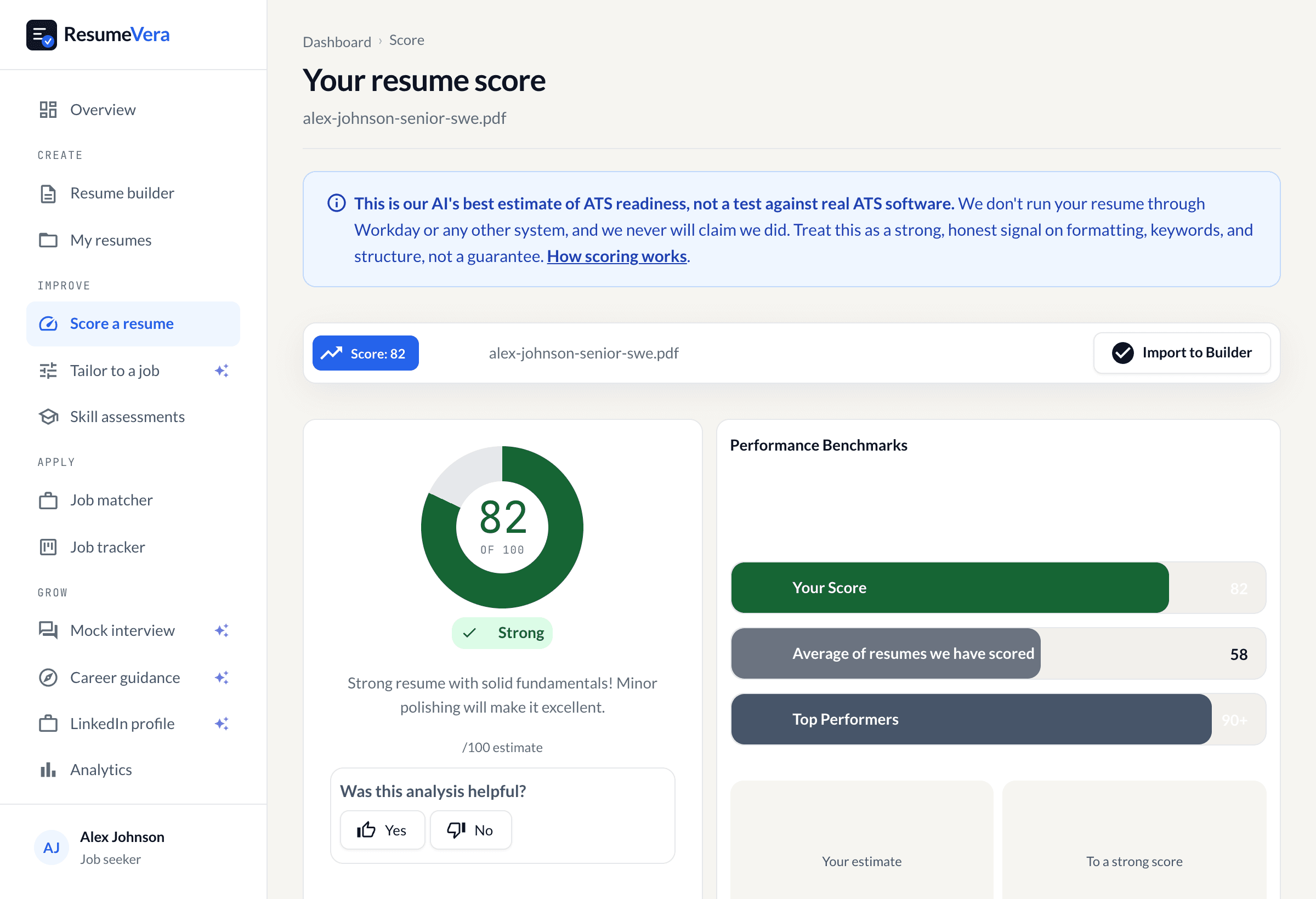
- ATS score checked against target JD (aim 70%+)
- Copy-paste test passed
- File saved as PDF
Run your resume through ResumeVera before every application. Paste the job description, see your keyword gaps, fix them, and submit with confidence.