How to Pass ATS in 2026: The Updated Guide to Beating Applicant Tracking Systems
The rules for passing ATS have changed. What worked in 2022 — stuffing your skills section with exact-match keywords — is no longer enough. Modern applicant tracking systems use AI-powered semantic analysis, multi-factor scoring, and structured data parsing that require a different approach.
This is the definitive guide to passing ATS in 2026, updated for the platforms companies are actually using right now.
What Has Changed About ATS in 2026
Three developments have fundamentally changed how ATS systems evaluate resumes:
1. AI-Powered Semantic Matching Has Replaced Pure Keyword Matching
Older ATS software searched for exact keyword matches. Write "Python" and you matched. Modern systems — including Workday, Greenhouse, and iCIMS in their 2025-2026 updates — use large language models to understand context and synonyms. "Built backend APIs in Python" is understood as evidence of Python experience even without the word appearing as a standalone keyword.
This is good news and bad news. It means you can write naturally and still pass. It also means keyword stuffing in your skills section is no longer a reliable workaround — the system now looks at how skills appear in the context of your experience.
2. Skills-Based Scoring Has Overtaken Title-Based Scoring
Increasingly, ATS systems score candidates on demonstrated skills rather than job title matches. A candidate titled "Platform Engineer" at one company matches "DevOps Engineer" roles because the skills overlap — not because the title is the same.
The implication: do not count on title matching. You need to show your skills in your experience descriptions, not just list them. Recruiters and ATS alike are now scoring you on what you did, not what they called you.
3. Resume Parsing Has Improved — But Only for Clean Formats
AI-based parsers are significantly better at extracting data from complex layouts than older rule-based systems. However, there is still a hard floor: tables, multi-column layouts, and text embedded in graphics still fail in the oldest enterprise ATS deployments (including some legacy Taleo and iCIMS instances still common in large corporations).
The safest strategy in 2026 is still a clean, single-column format. Modern parsers handle it perfectly, and legacy parsers require it.
The 2026 ATS Optimization Framework

Step 1: Mirror the Job Description at the Section Level
Pull the job description apart into three categories: required skills, preferred skills, and context terms (the industry language around the role).
Your resume needs: all required skills (with evidence in bullet points, not just in a skills list), most preferred skills, and liberal use of the context terms throughout the experience section.
Context terms are words that signal you belong in this world: if the JD says "distributed systems," "microservices," and "on-call rotations," use those phrases. They are the vocabulary of the role even when they are not technically required skills.
Step 2: Prove Skills in Bullet Points, Not Just List Them
This is the biggest shift in 2026 ATS optimization. A skills section that says "Kubernetes" gives a signal. A bullet that says "Migrated 14 microservices to Kubernetes on EKS, reducing infrastructure costs by $140K/year" proves the skill and gives the AI scoring model far more signal to work with.
The formula that works: Action verb + technology/skill + scope/scale + measurable outcome. Every bullet should follow this pattern.
Step 3: Use the Right File Format and Section Structure
File format: PDF is now universally safe for modern ATS, and it preserves your formatting. Use a Word DOCX only if the application explicitly requires it. Never use .pages, .odt, or .txt.
Section order: Contact information → Professional Summary → Work Experience → Skills → Education. Do not deviate from this. Non-standard section names and unusual ordering still trip up parsers, especially in legacy systems.
Section headers: Use the exact standard names. "Work Experience" not "Career History." "Education" not "Academic Background." "Skills" not "Competencies." ATS section detection is tuned on the standard terms.
Step 4: Optimize the Professional Summary
The professional summary is the highest-density section for ATS keyword matching. Aim for 3-4 sentences that include: your role category, your key skills, your seniority level, and one concrete outcome.
Example: "Senior Software Engineer with 8 years of experience building distributed systems and cloud-native applications on AWS. Specializes in Python, Go, and Kubernetes. Most recently scaled a real-time event processing platform from 10K to 4M events/day at [Company].
That summary passes ATS on role, level, skills, and scale — while reading naturally to a human.
Step 5: Do Not Hide Keywords — Use Them In Context
A tactic that circulated in 2023-2024 was hiding keywords in white text. Modern ATS and recruiter screening tools detect this and will flag your application. The only approach that works in 2026 is legitimate keyword integration in real content.
The 10 Most Common ATS Failures in 2026 (And How to Avoid Them)
1. Multi-Column Layouts
Still the number one reason for parsing failures. When an ATS parses a two-column resume, it reads left column and right column line by line — resulting in garbled sentences that mix skills with dates, job titles with education. Use a single-column layout.
2. Contact Information in Headers or Footers
Header and footer content is still frequently dropped by enterprise ATS parsers. Put your name, email, phone, and LinkedIn URL in the main body of the document at the top.
3. Job Titles That Don't Match Industry Standard
"Chief Happiness Officer" signals a company culture, not a role the ATS can classify. Add the industry-standard equivalent in parentheses: "Chief Happiness Officer (Customer Success Manager)." Both the ATS and the recruiter will thank you.
4. Skills Section Without Evidence
A skills section that lists 40 technologies gives every ATS signal and proves nothing. Keep your skills section concise (10-20 items maximum) and make sure every skill also appears in at least one bullet point in your experience section. This is now required for high scores in semantic matching systems.
5. Missing Quantification
ATS scoring systems in 2026 weight quantified achievements more heavily than unquantified ones. "Improved performance" scores lower than "Reduced API latency from 800ms to 90ms." If you cannot find a number, find a scale: team size, user count, transaction volume, revenue impacted.
6. Dates in Non-Standard Formats
"Mar 2023 – Present" is fine. "3/23 – current" may not parse. "March 2023 to present" is safer. Use the spelled-out month format when in doubt.
7. Gaps Without Context
Modern ATS systems can identify employment gaps and some flag them for human review. If you have a gap longer than 3 months, include a brief note: "Career break for caregiving" or "Consulting / independent projects" to prevent automatic flagging.
8. Using Abbreviations Without Spelling Them Out
"SWE with 8 YOE in MLOPS" — this is ATS noise. Spell out abbreviations at first use, include acronym in parentheses: "Machine Learning Operations (MLOps)." Do this for every industry-specific abbreviation.
9. Wrong Keywords for the Target Company Stack
A backend engineer resume optimized for Python and Django that applies to a Java + Spring shop will score poorly even if the underlying skills are transferable. Read the JD and temporarily move the company's specific stack to the front of your skills section when applying.
10. Applying Without an ATS Score Check
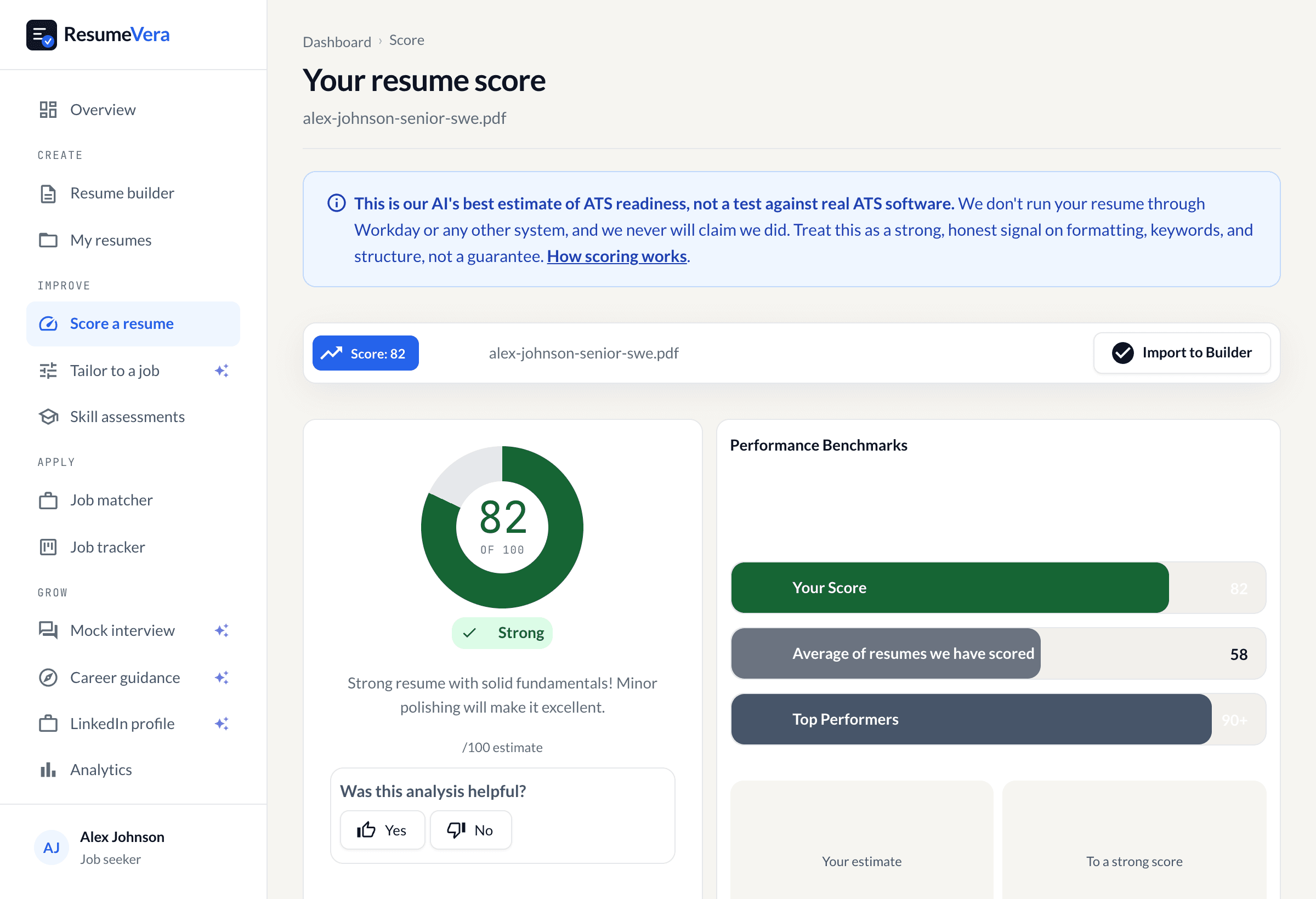
In 2026, running your resume through an ATS checker before each application is table stakes. ResumeVera's ATS score engine analyzes your resume against the specific job description and shows you exactly which keywords are missing, which are present, and what your estimated match score is. Use it before you hit submit.
ATS Scoring by Major Platform in 2026
Workday
Workday has deployed AI-powered matching that considers semantic similarity, not just keyword presence. Scoring is heavily weighted toward work experience descriptions over skills sections. Optimize your bullet points first.
Greenhouse
Greenhouse relies more heavily on recruiter-defined knockout questions at the top of the application than on resume parsing alone. Pass the knockout questions, then make sure your resume has clear keyword density for the next stage of review.
Lever
Lever's matching tends to emphasize recent experience. Your most recent 2-3 roles carry disproportionate weight. Ensure your latest roles are richly detailed with keywords and quantified outcomes.
iCIMS
iCIMS includes legacy parsing in many enterprise deployments. This is the platform where format matters most. Single column, standard fonts, no tables. iCIMS also scores heavily on job title matching — use standard titles.
Taleo (Oracle)
Still deployed by many large enterprises, Taleo uses older keyword-matching logic. Exact match keywords matter more here than in AI-powered systems. Mirror the JD language precisely for Taleo applications.
Your Pre-Submit ATS Checklist for 2026
- Single-column layout with standard margins
- Contact information in the main document body (not header/footer)
- Standard section names: Work Experience, Education, Skills
- All required keywords from JD appear in bullet points, not just the skills section
- Every bullet point has a quantified outcome or a scale indicator
- Professional summary mentions your role, level, and top 3 skills
- Abbreviations spelled out on first use
- No tables, text boxes, or multi-column layouts
- Dates in spelled-out month format
- File saved as PDF (or DOCX if explicitly required)
- Resume scanned through an ATS checker against the target JD
The Bottom Line
Passing ATS in 2026 is less about gaming the system and more about writing a fundamentally strong, well-structured resume that accurately represents your experience in the language of your target role. AI-powered ATS systems reward authentic, detailed, quantified experience descriptions — and penalize the keyword-stuffing shortcuts that once worked.
The candidates who consistently pass ATS and land interviews are the ones who treat every application as a targeted document: tailored to the specific role, using the specific vocabulary of that company and function, with proof behind every claim.
Run your resume through ResumeVera before every application. See your ATS score, identify your keyword gaps, and fix them before you submit.