Resume Keywords for Software Engineers: Complete Optimization Guide
In the competitive software engineering job market, the right keywords can make the difference between your resume landing in the interview pile or being automatically rejected by Applicant Tracking Systems (ATS). With most Fortune 500 companies using ATS software to screen applications, understanding keyword optimization is essential for software engineers at every career stage.
This comprehensive guide breaks down the critical keywords for software engineering resumes, explains how to identify and integrate them effectively, and provides specific strategies for different experience levels and specializations.
Why Keywords Matter for Software Engineering Resumes
Software engineering is a keyword-intensive field. Recruiters and ATS systems search for specific programming languages, frameworks, methodologies, and tools when evaluating candidates. Your resume must include these keywords to:
- Pass ATS Screening: Many resumes are rejected by ATS before human review. Including the right keywords ensures your application makes it past this initial filter.
- Match Job Requirements: ATS assigns match scores based on keyword presence. Higher scores mean higher rankings in recruiter dashboards.
- Demonstrate Technical Expertise: Keywords signal your familiarity with industry-standard technologies and practices.
- Improve Searchability: Recruiters often search resume databases for specific skills. The right keywords make you discoverable for relevant opportunities.
Categories of Software Engineering Keywords

Effective software engineering resumes integrate keywords across multiple categories. Here's a comprehensive breakdown:
1. Programming Languages
The foundation of any software engineering resume. Always include languages you've worked with professionally, listing them in order of proficiency:
Mainstream Languages:
- Python
- JavaScript / TypeScript
- Java
- C / C++ / C#
- Go (Golang)
- Ruby
- PHP
- Swift
- Kotlin
- Rust
Specialized Languages:
- SQL (and specific dialects: PostgreSQL, MySQL, T-SQL)
- R (for data-focused roles)
- Scala (for big data roles)
- Objective-C (for iOS maintenance)
- Shell Scripting (Bash, PowerShell)
Integration Strategy: Create a dedicated "Programming Languages" section listing languages by proficiency level (Expert, Advanced, Intermediate). Also mention specific languages in project descriptions to provide context.
2. Frameworks and Libraries
Frameworks demonstrate your ability to build applications efficiently using established tools:
Frontend Frameworks:
- React.js / React Native
- Angular
- Vue.js
- Next.js
- Svelte
- jQuery (still relevant for maintenance)
Backend Frameworks:
- Node.js / Express.js
- Django / Flask (Python)
- Spring / Spring Boot (Java)
- Ruby on Rails
- .NET / ASP.NET Core
- FastAPI (Python)
Mobile Frameworks:
- React Native
- Flutter
- SwiftUI
- Ionic
Data Science / ML Libraries:
- TensorFlow
- PyTorch
- scikit-learn
- pandas
- NumPy
- Keras
3. Development Tools and Technologies
Version Control:
- Git / GitHub / GitLab / Bitbucket
- SVN (for legacy systems)
Containerization and Orchestration:
- Docker
- Kubernetes
- Docker Compose
- Helm
CI/CD Tools:
- Jenkins
- GitLab CI/CD
- GitHub Actions
- CircleCI
- Travis CI
- Azure DevOps
Testing Frameworks:
- Jest / Mocha / Chai (JavaScript)
- JUnit / TestNG (Java)
- pytest / unittest (Python)
- Selenium (automation)
- Cypress / Playwright (E2E testing)
Build Tools:
- Webpack / Vite
- Maven / Gradle (Java)
- npm / yarn / pnpm
- Make / CMake
4. Cloud Platforms and Services
Cloud expertise is increasingly essential for modern software engineers:
Amazon Web Services (AWS):
- EC2 (Elastic Compute Cloud)
- S3 (Simple Storage Service)
- Lambda (serverless)
- RDS (Relational Database Service)
- DynamoDB
- ECS / EKS (container services)
- CloudFormation
- API Gateway
Microsoft Azure:
- Azure Virtual Machines
- Azure Functions
- Azure Kubernetes Service (AKS)
- Azure DevOps
- Azure SQL Database
Google Cloud Platform (GCP):
- Compute Engine
- Cloud Functions
- Google Kubernetes Engine (GKE)
- BigQuery
- Cloud Storage
5. Databases and Data Storage
Relational Databases:
- PostgreSQL
- MySQL / MariaDB
- Microsoft SQL Server
- Oracle Database
- SQLite
NoSQL Databases:
- MongoDB
- Redis
- Cassandra
- DynamoDB
- Elasticsearch
- Neo4j (graph database)
Data Warehouses:
- Snowflake
- Amazon Redshift
- Google BigQuery
6. Software Development Methodologies
Demonstrate your familiarity with industry-standard development practices:
- Agile / Scrum: Sprint planning, daily standups, retrospectives
- Kanban: Continuous delivery, WIP limits
- DevOps: CI/CD, infrastructure as code, automation
- Test-Driven Development (TDD): Write tests before code
- Behavior-Driven Development (BDD): User story focused development
- Waterfall: Traditional sequential development (legacy projects)
- Extreme Programming (XP): Pair programming, continuous integration
7. Architecture and Design Patterns
Architectural Patterns:
- Microservices Architecture
- Monolithic Architecture
- Event-Driven Architecture
- Service-Oriented Architecture (SOA)
- Serverless Architecture
- Layered (N-Tier) Architecture
Design Patterns:
- Model-View-Controller (MVC)
- Model-View-ViewModel (MVVM)
- RESTful API Design
- GraphQL API Design
- Observer Pattern
- Factory Pattern
- Singleton Pattern
- Dependency Injection
8. Security and Compliance
- OAuth 2.0 / OpenID Connect
- JSON Web Tokens (JWT)
- SSL/TLS
- Encryption (AES, RSA)
- OWASP Top 10
- Penetration Testing
- GDPR / CCPA Compliance
- SOC 2 / ISO 27001
9. Soft Skills and Leadership Keywords
Technical skills alone aren't enough. Include keywords that demonstrate collaboration and leadership:
- Cross-functional Collaboration
- Technical Leadership / Team Leadership
- Mentoring / Coaching
- Code Review
- Technical Documentation
- Stakeholder Communication
- Problem Solving / Troubleshooting
- Requirements Gathering
- Project Planning / Estimation
Keywords by Experience Level
Tailor your keyword strategy to your career stage:
Junior Software Engineer / Entry-Level (0-2 years)
Focus Areas:
- Core programming languages (emphasize coursework and projects)
- Fundamental frameworks (React, Spring Boot, Django)
- Version control (Git proficiency is essential)
- Testing basics (unit testing, integration testing)
- Agile participation (attended standups, contributed to sprints)
- Academic projects and internships
Sample Keywords:
TECHNICAL SKILLS
Programming Languages: Python, JavaScript, Java, SQL
Web Development: React.js, Node.js, Express.js, HTML5, CSS3
Databases: PostgreSQL, MongoDB
Tools: Git, GitHub, VS Code, Postman
Methodologies: Agile (Scrum), Test-Driven Development (TDD)

SOFTWARE ENGINEER INTERN | Tech Company | Summer 2023
• Developed React components for customer dashboard, improving load time by 30%
• Collaborated with senior engineers on RESTful API development using Node.js and Express
• Participated in daily Agile standup meetings and bi-weekly sprint planning
• Wrote unit tests using Jest, achieving 85% code coverage
Mid-Level Software Engineer (3-5 years)
Focus Areas:
- Specialized expertise in specific technologies
- Full project lifecycle experience
- Architecture and design decisions
- Mentoring junior developers
- Performance optimization
- Cloud platform experience
Sample Keywords:
TECHNICAL EXPERTISE
Core Languages: Python (Expert), JavaScript/TypeScript (Advanced), Go (Intermediate)
Frontend: React.js, Next.js, Redux, Material-UI, Responsive Design
Backend: Node.js, Django, FastAPI, GraphQL, RESTful APIs
Cloud & DevOps: AWS (EC2, S3, Lambda), Docker, Kubernetes, CI/CD (GitHub Actions)
Databases: PostgreSQL, MongoDB, Redis (caching)
Architecture: Microservices, Event-Driven Architecture, API Design

SENIOR SOFTWARE ENGINEER | Tech Corp | 2021-Present
• Architected microservices-based e-commerce platform serving 500K+ monthly users
• Led migration from monolithic to microservices architecture, reducing deployment time by 60%
• Implemented CI/CD pipeline using Docker, Kubernetes, and GitHub Actions
• Mentored 3 junior engineers on best practices for React and Node.js development
• Optimized database queries and implemented Redis caching, improving API response time by 45%
Senior Software Engineer / Tech Lead (6-10 years)
Focus Areas:
- System design and architecture
- Technical leadership and mentorship
- Cross-functional collaboration
- Strategic technical decisions
- Performance at scale
- Team productivity and process improvement
Sample Keywords:
TECHNICAL LEADERSHIP
Languages: Python, Java, Go, TypeScript (10+ years combined experience)
Architecture: Microservices, Event-Driven Systems, Distributed Systems, Scalability Design
Cloud Architecture: AWS (Solutions Architect Associate), Multi-Region Deployment, High Availability
Leadership: Technical Team Lead (5-10 engineers), Mentoring, Code Review, Architecture Design Reviews
Methodologies: Agile Leadership, DevOps Culture, Site Reliability Engineering (SRE)

STAFF SOFTWARE ENGINEER / TECH LEAD | Large Tech Company | 2020-Present
• Lead technical direction for payments platform processing $100M+ annually
• Designed and implemented distributed microservices architecture handling 10K+ requests/second
• Managed team of 8 engineers, conducting code reviews, architecture discussions, and technical interviews
• Drove adoption of containerization (Docker/Kubernetes), reducing infrastructure costs by 40%
• Collaborated with product and design teams to define technical requirements and feasibility
• Established engineering best practices and coding standards across 3 product teams
Principal Engineer / Engineering Manager (10+ years)
Focus Areas:
- Strategic technical vision
- Organization-wide impact
- Innovation and R&D
- Engineering culture and processes
- Budget and resource management
- Executive communication
Sample Keywords:
EXECUTIVE TECHNICAL LEADERSHIP
Strategic Planning: Technical Roadmap, Architecture Strategy, Technology Stack Selection
Leadership: Engineering Management (20+ engineers), Hiring, Performance Management, Team Building
Impact: Platform Scalability (millions of users), Cost Optimization, Technical Debt Reduction
Innovation: R&D, Proof of Concepts, Emerging Technologies Evaluation
Business Acumen: Budget Management, Vendor Negotiations, ROI Analysis

VICE PRESIDENT OF ENGINEERING | Tech Company | 2021-Present
• Define technical vision and engineering strategy for company serving 5M+ users
• Build and lead engineering organization of 50+ engineers across 6 product teams
• Established engineering culture emphasizing quality, innovation, and continuous learning
• Drove platform re-architecture supporting 10x user growth while reducing infrastructure costs by 35%
• Partner with C-suite on product strategy, technical feasibility, and resource allocation
• Implemented data-driven engineering metrics improving team productivity by 40%
How to Extract Keywords from Job Descriptions
Every job posting is a goldmine of keywords. Follow this systematic approach:
Step 1: Identify Required vs. Preferred Keywords
Job descriptions typically separate "Required Qualifications" and "Preferred Qualifications" or "Nice to Have." Required keywords should appear multiple times in your resume, while preferred keywords should be included when you possess those skills.
Step 2: Categorize Keywords
Create a list organized by category:
- Programming Languages
- Frameworks and Libraries
- Tools and Platforms
- Methodologies
- Soft Skills
Step 3: Look for Repeated Emphasis
Keywords mentioned multiple times in the job description are especially important. If "Python" appears five times and "Java" appears once, Python is the critical skill.
Step 4: Match Exact Phrasing
Use the exact terminology from the job description. If they say "REST APIs," use "REST APIs" rather than "RESTful services."
Example Job Description Analysis
Sample Job Posting: "Senior Full-Stack Engineer"
Requirements:
- 5+ years professional software development experience
- Expert in React.js and Node.js
- Strong experience with TypeScript
- Experience with AWS (EC2, S3, Lambda)
- Proficiency in PostgreSQL and MongoDB
- Familiarity with Docker and Kubernetes
- Experience with CI/CD pipelines
- Agile/Scrum methodology experience

Preferred:
- GraphQL API experience
- Next.js framework knowledge
- Terraform for infrastructure as code
- Experience with microservices architecture
Extracted Keywords (prioritized):
- Critical (Must Include): React.js, Node.js, TypeScript, AWS, EC2, S3, Lambda, PostgreSQL, MongoDB, Docker, Kubernetes, CI/CD, Agile, Scrum
- Important (Include if Applicable): GraphQL, Next.js, Terraform, Microservices Architecture
- Context Keywords: 5+ years experience, Full-Stack, Senior, API development
Step 5: Integrate Keywords Naturally
Don't just list keywords. Integrate them into context that demonstrates applied experience:
Weak: "Used React.js, Node.js, AWS, Docker, Kubernetes"
Strong: "Developed full-stack web application using React.js and Node.js, deployed on AWS (EC2, Lambda) using Docker containers orchestrated by Kubernetes, serving 100K+ monthly active users"
Keyword Placement Strategy
Where you place keywords matters as much as which keywords you include:
1. Professional Summary (Top Section)
Include 5-7 of your most critical keywords in the summary:
Full-Stack Software Engineer with 6+ years building scalable web applications using React.js, Node.js, and TypeScript. Proven expertise in AWS cloud architecture (Lambda, EC2, S3), Docker containerization, and CI/CD pipeline implementation. Passionate about clean code, test-driven development, and Agile methodologies.
2. Skills Section (Highly Scannable)
Create a comprehensive skills section organized by category:
TECHNICAL SKILLS

Programming Languages: JavaScript/TypeScript (Expert), Python (Advanced), Java (Intermediate), SQL
Frontend: React.js, Next.js, Redux, HTML5, CSS3, Material-UI, Responsive Design
Backend: Node.js, Express.js, Django, RESTful APIs, GraphQL
Cloud & DevOps: AWS (Lambda, EC2, S3, RDS), Docker, Kubernetes, Terraform, CI/CD (GitHub Actions, Jenkins)
Databases: PostgreSQL, MongoDB, Redis
Methodologies: Agile/Scrum, Test-Driven Development (TDD), Microservices Architecture
3. Work Experience (Contextual Integration)
Weave keywords naturally into your accomplishment descriptions:
SENIOR SOFTWARE ENGINEER | Tech Company | 2021-Present
• Architected and developed microservices-based platform using Node.js and TypeScript, handling 50K+ requests/hour
• Implemented CI/CD pipeline with GitHub Actions, Docker, and Kubernetes, reducing deployment time from 2 hours to 15 minutes
• Built React.js admin dashboard with TypeScript and Redux for state management, improving operational efficiency by 35%
• Designed RESTful and GraphQL APIs consumed by web and mobile applications
• Collaborated with cross-functional Agile team of 8 engineers, participating in sprint planning, daily standups, and retrospectives
4. Projects Section (For Junior Engineers)
If you lack extensive professional experience, create a projects section:
TECHNICAL PROJECTS

E-Commerce Platform (Personal Project)
• Full-stack web application built with React.js, Node.js, Express, and MongoDB
• Implemented JWT authentication, RESTful API endpoints, and Stripe payment integration
• Deployed on AWS using EC2 and S3, configured with NGINX as reverse proxy
• Technologies: React.js, Node.js, MongoDB, AWS, Docker, Jest (testing)
Common Keyword Mistakes to Avoid
1. Keyword Stuffing
Repeating keywords excessively or listing them without context signals manipulation to both ATS and human reviewers.
Bad: "Python Python expert Python developer Python programming Python software engineer Python specialist"
Good: "Python software engineer with expertise in Django and Flask frameworks"
2. Using Outdated Technologies
Unless you're applying for legacy system maintenance, focus on current, in-demand technologies. Emphasizing jQuery over React or AngularJS over Angular signals outdated skills.
3. Ignoring Soft Skills
Technical keywords alone aren't sufficient. Include soft skill keywords like "cross-functional collaboration," "mentoring," and "technical communication."
4. Inconsistent Terminology
Use consistent terms throughout. Don't switch between "JavaScript" and "JS" or "Kubernetes" and "K8s."
Testing Your Keyword Optimization
Before submitting your resume, verify keyword effectiveness:
1. ATS Scanning Tools
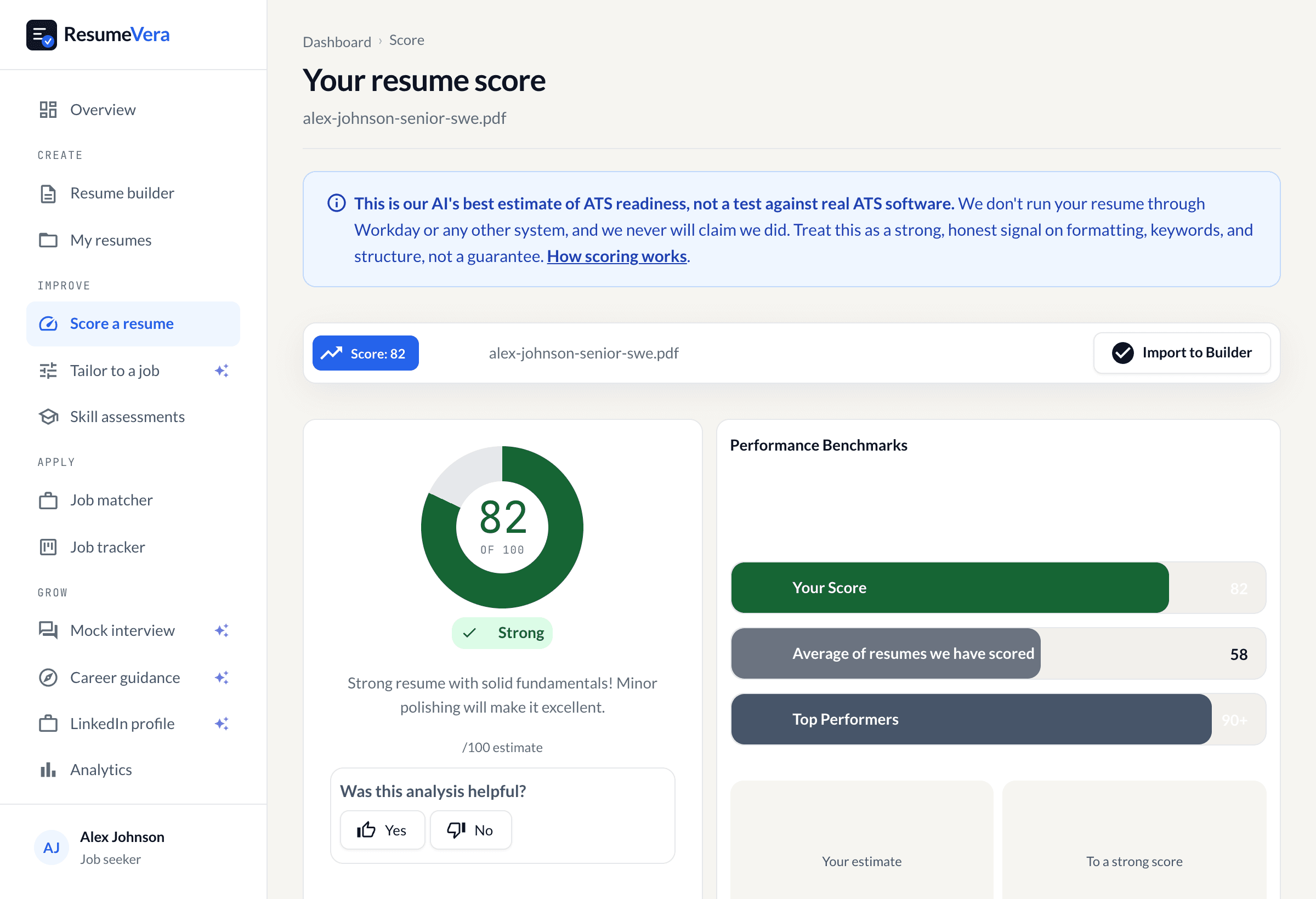
Use tools like ResumeVera's free resume checker to analyze keyword coverage against job descriptions.
2. Keyword Density Check
Critical keywords should appear 2-4 times throughout your resume (once in skills, once in summary, 1-2 times in experience).
3. Manual Job Description Comparison
Create a checklist of required keywords from the job posting and verify each appears in your resume.
4. Peer Review
Have another software engineer review your resume to ensure keywords are used correctly in context.
Industry-Specific Keyword Variations
Different software engineering specializations require different keyword emphases:
Frontend Engineer
Emphasize: React, Angular, Vue, TypeScript, CSS, Responsive Design, Accessibility, Browser Compatibility, Webpack, Performance Optimization
Backend Engineer
Emphasize: Node.js, Python, Java, RESTful APIs, GraphQL, Databases, Microservices, API Design, Performance, Scalability
DevOps Engineer
Emphasize: CI/CD, Docker, Kubernetes, Terraform, Ansible, AWS/Azure/GCP, Infrastructure as Code, Monitoring, Jenkins, Linux
Data Engineer
Emphasize: Python, Scala, SQL, Spark, Kafka, Airflow, Data Pipelines, ETL, Data Warehousing, BigQuery, Snowflake
Mobile Engineer
Emphasize: Swift, Kotlin, React Native, Flutter, iOS, Android, App Store, Play Store, Mobile UI/UX, RESTful APIs
Machine Learning Engineer
Emphasize: Python, TensorFlow, PyTorch, scikit-learn, Neural Networks, Deep Learning, Model Training, MLOps, Feature Engineering
Keeping Your Keywords Current
Technology evolves rapidly. Update your keyword strategy regularly:
- Monitor Industry Trends: Follow tech news and job postings to identify emerging technologies
- Continuous Learning: Acquire new skills in in-demand technologies
- Update Your Resume Quarterly: Add new technologies you've learned or used professionally
- Review Job Posting Trends: Analyze what skills are most frequently requested
- Remove Obsolete Keywords: Phase out truly outdated technologies unless directly relevant
Conclusion
Effective keyword optimization for software engineering resumes requires a strategic balance of technical accuracy, comprehensive coverage, and natural integration. By understanding the categories of relevant keywords, tailoring them to your experience level, extracting them systematically from job descriptions, and placing them strategically throughout your resume, you significantly improve your chances of passing ATS screening and impressing hiring managers.
Remember that keywords are just one component of a strong resume. They must be supported by quantified achievements, clear communication of impact, and evidence of problem-solving ability. Use this guide to ensure your technical qualifications are properly recognized, giving you the best chance to land interviews and advance your software engineering career.
Additional Resources
- Use ResumeVera's ATS checker to analyze your resume's keyword coverage
- Browse software engineering resume templates optimized for ATS
- Download our job description keyword extraction checklist
- Read our guide on quantifying software engineering achievements
- Access our database of in-demand technical skills by specialization