Employment Gap on Resume 2026: How to Explain Career Gaps Without Losing Offers
Career gaps are more common than ever in 2026. LinkedIn introduced a dedicated Career Break feature in 2022 specifically to normalise employment gaps, reflecting how common this has become globally. Tech layoffs, the post-COVID career reset, caregiving responsibilities, mental health breaks, and the rise of freelance and part-time work have made employment gaps a standard part of many professionals' histories.
ATS systems do not penalise gaps - they parse dates and flag inconsistencies, but do not score gaps negatively. But humans reviewing your resume will notice them - and the interview will almost certainly include "so tell me about this gap." This guide shows you exactly how to handle both.
Do Employment Gaps Actually Hurt Your Application?
Short answer: gaps under 6 months rarely matter if you explain them briefly on your resume. Gaps of 6 months to 2 years matter more in the interview than on paper. Gaps over 2 years - especially in technical roles - require you to demonstrate currency: that your skills are current, not stuck at the pre-gap level.
What actually hurts you is not the gap itself, but:
- Refusing to acknowledge it exists
- Giving a vague or evasive explanation
- Not being able to show what you did (or learned) during the gap
- Skills that appear outdated for roles you're applying to
How to Handle a Gap on Your Resume
Gaps Under 3 Months
Use years only in your employment dates. Most applicant tracking systems and reviewers see this as standard: "Jan 2023 – Dec 2024" leaves a seamless appearance even with a 3-month gap between Dec 2024 and the present.
Gaps of 3–12 Months
Include the gap as an entry if you did something during it - freelance work, a course, caregiving, travel, health. If you did nothing visible, still use years-only formatting and be ready to explain in the cover letter or interview.
Gaps Over 12 Months
Address it directly - either in the resume itself (as a gap entry) or in the cover letter. Silence on a 2-year gap looks worse than a brief honest explanation.
Resume Entries for Different Gap Types
Layoff or Involuntary Unemployment
[Month Year] – [Month Year]
Career Transition / Job Search
Completed [relevant course/certification] during this period. Actively exploring opportunities in [specific area].
Caregiving (Child, Parent, Family Member)
[Month Year] – [Month Year]
Career Break - Family Caregiving
Took a deliberate break to provide primary care for [family member]. Maintained technical currency through [side project, online course, community work if any].
Health-Related Break
[Month Year] – [Month Year]
Personal Medical Leave
Took time off to address a personal health matter. Fully recovered and ready to contribute at full capacity.
Note: You are not required to disclose the nature of a health condition. This entry is intentionally brief. Do not elaborate in writing - if asked in interview, give a similar brief answer and pivot to "I'm fully recovered and ready to hit the ground running."
Self-Study / Upskilling
[Month Year] – Present
Independent Learning - Cloud Architecture / AI Engineering / [Area]
Completed AWS Solutions Architect (SAA-C03) certification. Built [project] using [technology]. Contributed to open source project [name] - [what you did].
Freelance or Consulting Work
[Month Year] – [Month Year]
Freelance [Role] - Independent
Delivered [type of work] for [number or type of clients - anonymised is fine]. Key project: [brief description with outcome if possible].
Higher Education
[Month Year] – [Month Year]
Full-Time Postgraduate Study - [Degree, Institution]
[Brief description of what you studied or built, if relevant to the role].
How to Answer "Why Is There a Gap in Your Employment?" in an Interview
The formula for every gap explanation: Context → What you did → Why you're ready now
Layoff / Retrenchment
"My previous company went through a significant restructuring in [year] - my team of [X] was part of the reduction. I used the time to do something I'd been wanting to do: I completed my [certification/course] and also started building [side project/tool] which gave me hands-on experience with [technology]. I've now been actively interviewing for the last [Y weeks/months] and am ready to commit fully."
Burnout / Mental Health
"I made a deliberate decision to take a break after [X] years of consecutive intense work. I needed to reset. During that time I [briefly mention anything productive if true - travel, reading, a course]. I'm fully re-energised and looking forward to getting back to doing challenging work. This role in particular appealed to me because [specific reason]."
Family / Caregiving
"I took time off to care for [parent/child - you don't need to specify]. That situation has now resolved [or: my family situation has stabilised and I've arranged full-time support], and I'm ready to return to full-time work. During the break I [kept skills current via X if true]."
Exploring Entrepreneurship / Startup That Didn't Work Out
"I co-founded a startup that worked in [domain] for [period]. We ultimately weren't able to achieve product-market fit and wound down. What I took from it: [2–3 genuine learnings]. I'm now genuinely excited to apply that experience - especially [specific skill] - in a structured product environment."
What to Do NOW If You Have an Active Gap
If you are currently in a gap and job searching, prioritise these activities - they all improve your resume narrative:
- Get a certification - AWS, Google Cloud, PMP, CPA, Google Analytics, any role-relevant cert. It gives you something to put on the resume for the gap period.
- Build a portfolio project - open source contribution, a GitHub repo, a Kaggle competition, a Notion case study. Something verifiable.
- Freelance or consult - even 1 client project is a resume entry. Platforms: Toptal, Upwork, Fiverr, direct outreach on LinkedIn.
- Volunteer with a relevant organisation - nonprofits need tech, finance, and marketing help. It's a real resume entry.
Cover Letter Language for Employment Gaps
If your gap is significant, address it briefly in the cover letter's opening or closing - before the interviewer wonders:
"After a [X-month] career break [for health/caregiving/personal reasons], I am returning to full-time [software development/data analysis/etc.] with renewed focus. During that time I [brief what you did]. I am fully committed and looking forward to contributing from day one."
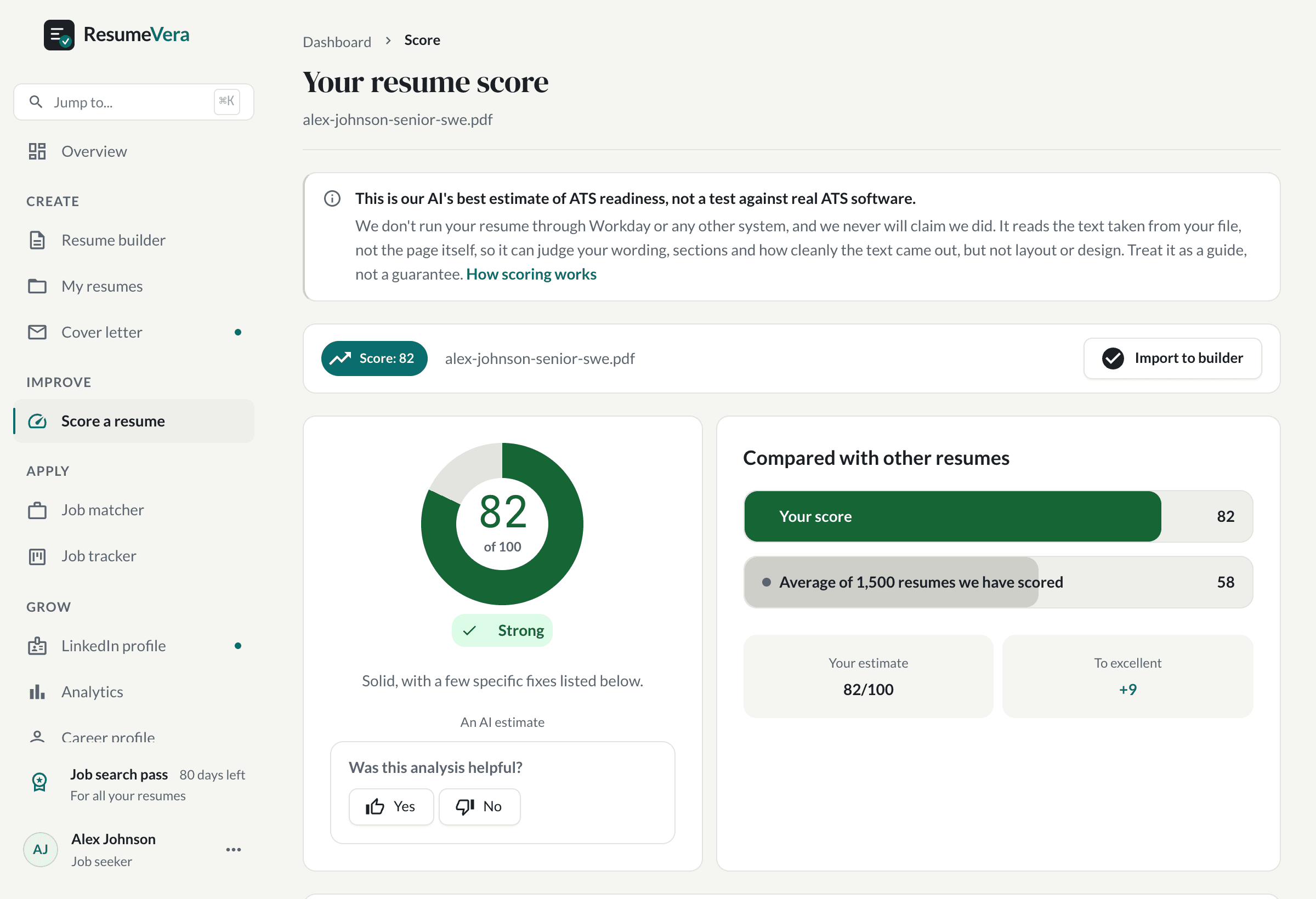
A polished, ATS-optimised resume helps you get past the first filter before the gap even comes up. Check your resume's ATS performance at ResumeVera's free ATS checker.
Frequently Asked Questions
How do I explain a 2-year gap in my resume?
Be direct and honest, but brief. Add a resume entry for the gap period with a title like "Career Break - [reason]". In the interview, follow Context → What you did → Why you're ready now. If you did anything during the gap - caregiving, freelance, courses, personal projects - mention it. The worst answer is evasion. Interviewers understand gaps in 2026; they just want to know you're honest about it and that your skills are still relevant.
Do ATS systems reject resumes with employment gaps?
No. ATS systems parse keywords and formatting - they don't calculate employment gaps or score them. The gap matters to the human reviewer, not the software. Focus on optimising your resume for ATS keywords for the role, and handle the gap explanation in your cover letter and interview preparation.
Should I put a career break on my LinkedIn profile?
LinkedIn now has a dedicated "Career Break" feature - use it. It's better than having a gap that's obvious from your timeline but unexplained. You can categorise it as caregiving, health and wellbeing, travel, education, or other. It normalises the gap and preempts the question from recruiters viewing your profile.
What if I was fired - should I say that in the interview?
If you were let go in a layoff or restructuring, say so clearly - it carries no stigma. If you were terminated for performance, you need a brief, honest answer: "My role and my strengths weren't the right fit" - then pivot to what you learned and what you're doing differently. Never lie about being fired; background checks and reference calls often reveal this, and it's grounds for immediate termination from the new company.
How long is too long of a gap on a resume?
There's no hard rule, but gaps over 2 years in technical fields require demonstrating skill currency - through certifications, projects, or freelance work done during the gap. A 6-month gap with a certification is often viewed more favourably than a 6-month gap with no explanation. For non-technical roles, gaps of 3+ years may require upskilling to re-enter competitive roles.
Sources & References
- LinkedIn Career Break Feature - LinkedIn's guide to representing employment gaps professionally
- LinkedIn Talent Solutions - Hiring Research - Data on recruiter attitudes toward employment gaps
- Naukri Career Advice - India-specific guidance on explaining gaps in the Indian job market