HR Interview Questions and Answers 2026: Complete Guide with Sample Answers
The HR interview is often treated as a formality - but it's the round that eliminates the most candidates in 2026. Technical skills get you to the HR round. How you handle HR questions decides if you get the offer.
This guide covers every major HR interview question, the psychology behind what interviewers are really asking, and sample answers you can adapt to your own background.
The 5 Things HR Interviewers Are Actually Evaluating
- Culture fit - will you work well with the team?
- Motivation - why do you want this specific job, not just any job?
- Communication skills - how clearly do you think and express yourself?
- Self-awareness - do you understand your strengths, weaknesses, and past mistakes honestly?
- Red flags - anything that suggests you'll be difficult, unreliable, or leave too quickly?
Keep these five in mind as you read every question below.
"Tell Me About Yourself" - The Most Important Question
This is the first question in the vast majority of HR interviews - LinkedIn Talent research shows it is used as an icebreaker and evaluation starting point in over 75% of structured interviews and the one most people answer badly. It sets the tone for everything that follows.
The Formula: Present → Past → Future
- Present: Your current role and what you're responsible for (2 sentences)
- Past: How you got here - your educational background and key career milestones (2 sentences)
- Future: Why you're looking now and what you're targeting (1–2 sentences)
Sample Answer - Experienced Professional
"I'm currently a Senior Java Developer at Infosys, where I lead a team of 5 building microservices for a US retail banking client. We handle transaction processing for about 2 million customers daily. I graduated from NIT Trichy in 2019 and spent my first two years at TCS before moving to Infosys for more ownership-heavy work. I'm at the stage where I want to move into a product environment - specifically, I want to work on systems where I can see the direct user impact of what I build. That's what brought me to your opening."
Sample Answer - Fresher
"I recently completed my B.Tech in Computer Science from VIT Chennai with a CGPA of 8.2. Over the last year, I've been focusing on backend development - I built two full-stack projects using Java and Spring Boot, and completed an 8-week internship at a startup where I worked on their API layer. I'm particularly interested in [Company] because of your focus on [specific product/area]. I want to start my career somewhere where the work is technically challenging from day one."
"Why Do You Want to Leave Your Current Job?"
This is a trap question for those who answer emotionally. Always answer in terms of what you're moving toward, not what you're running away from.
What NOT to Say
- "My manager is terrible" - even if true
- "The salary is too low" - even if true, don't lead with this
- "The company is in trouble" - even if true, sounds disloyal
- "There's no growth" - too vague; sounds like complaining
Sample Answer
"I've had a good 3 years at [Company] - I learned a lot about [area] and delivered [achievement]. I'm at a point now where I want more ownership over product direction, and the current structure doesn't offer that opportunity in the near term. When I saw that [Target Company] is [something specific - expanding, working on a problem you care about, at a stage you're excited about], it felt like the right timing to make a move."
"What Are Your Strengths?"
Don't just list adjectives. Give evidence.
The STAR Format for Strengths
Situation → Task → Action → Result. Pick 2 strengths and briefly illustrate each with a real example.
Sample Answer
"Two strengths I've consistently relied on: problem-solving under pressure and communication across technical and non-technical audiences. On the first - at Wipro, we had a production incident at 2am that was affecting 30,000 active users. I was the on-call engineer and diagnosed and patched the root cause within 40 minutes. On communication - I've regularly been asked to present technical architecture to client stakeholders who aren't engineers, and I've gotten positive feedback specifically on translating complexity into plain language."
"What Are Your Weaknesses?"
The goal is honesty + growth - showing self-awareness and that you're actively improving. Never say "I work too hard" or "I'm a perfectionist." These are seen as dishonest avoidance.
Sample Answer
"I've historically struggled with delegation - I tend to want to do things myself to ensure quality. In my last role, this became a bottleneck when my team grew. I recognised it, and over the last year I've deliberately pushed myself to assign ownership and just review rather than redo. I'm better at it, but it's still something I'm consciously working on."
"Where Do You See Yourself in 5 Years?"
Show ambition without implying you'll leave after 1 year. Connect your growth to this company's growth.
Sample Answer
"In 5 years, I see myself as a technical lead - owning architecture decisions and mentoring junior engineers. I want to grow in a company where that path exists. From what I understand about [Company]'s trajectory, there's real opportunity for that. I'm not looking to jump around - I want to grow deep somewhere."
"Why Do You Want to Work at [This Company]?"
This is where most candidates fail with generic answers. Research the company before every interview.
Bad Answer
"It's a reputed company with great growth opportunities and work culture."
Good Answer
"I've been following Zerodha for 3 years as a customer. The fact that they built India's largest broker without external funding, using fundamentally engineering-driven thinking, is the kind of culture I want to be part of. Specifically, the way your tech team writes publicly about architecture decisions - I've read [specific blog post or article] - tells me the engineering culture here is the kind that will make me better. That's not something I can find at most companies."
Salary Expectation Questions
"What Are Your Salary Expectations?"
Always give a range. Research market rates before the interview (use LinkedIn Salary, Glassdoor, levels.fyi for tech). Lead with the upper bound of your realistic range:
"Based on my research on market rates for this role and my [X] years of experience in [specific area], I'm targeting ₹[upper bound] to ₹[lower bound] CTC. I'm open to discussion based on the overall package, growth path, and role scope."
"What Is Your Current CTC?"
In India, this is commonly asked and legally can't be verified directly. Answer honestly, but you can frame it strategically:
"My current CTC is ₹[X] LPA - including fixed and variable components. I'm targeting ₹[Y] LPA in my next role, which reflects a [Z]% increment for the additional responsibility and market rate for this skill set."
Behavioural Questions: The STAR Method
For questions that start with "Tell me about a time when..." use STAR:
- Situation - brief context (1 sentence)
- Task - what your role was (1 sentence)
- Action - what you specifically did (2–3 sentences)
- Result - the outcome with a metric if possible (1 sentence)
"Tell Me About a Time You Failed"
"In my first year at [Company], I underestimated the complexity of a data migration task and committed to a 2-week timeline. We ended up needing 5 weeks - the client was frustrated, and I had to have a difficult conversation with my manager. What I learned: I now always add a 40% buffer to migration estimates, and I scope-out risk assumptions explicitly before committing to timelines. That mistake has made every delivery estimate since much more reliable."
"Describe a Conflict With a Colleague"
"My team-mate and I disagreed on the database architecture for a new module - I wanted to use a relational model, he preferred document store. Instead of escalating, we both wrote up the trade-offs and presented them to our tech lead together. The tech lead chose a hybrid approach. What I valued: we kept it professional and data-driven. The outcome was actually better than either of our original proposals."
Questions You Should Ask the HR Interviewer
Always have 2–3 questions ready. Asking nothing signals low interest.
- "What does success look like in the first 90 days for this role?"
- "What's the biggest challenge the team is currently facing that this hire would help solve?"
- "Can you tell me about the growth path from this role - what have previous people in this position moved on to?"
- "How would you describe the working culture here, specifically around how feedback is given?"
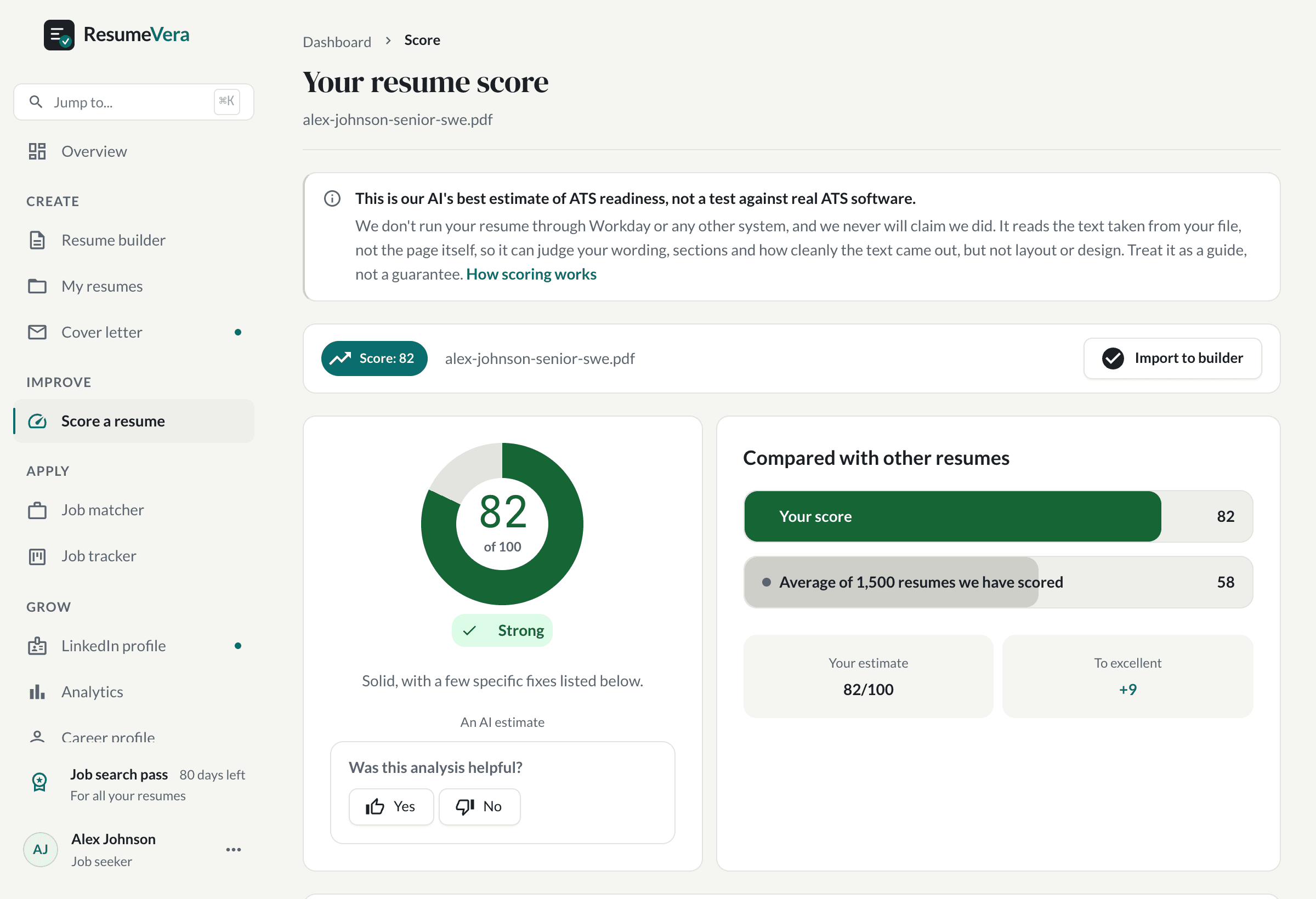
Prepare for your HR interview with a strong resume that tells the right story. Check your resume's ATS performance at ResumeVera's free ATS checker.
Frequently Asked Questions
How do I answer "tell me about yourself" in an HR interview?
Use the Present → Past → Future formula. Present: your current role and key responsibility (2 sentences). Past: your educational/career path that brought you here (2 sentences). Future: why you're looking and what you want from this role (1–2 sentences). Keep it under 2 minutes. Practice until you can say it conversationally, not like you're reading a script.
What are the most common HR interview questions in 2026?
The top 10: Tell me about yourself, Why do you want to leave, Why this company, What are your strengths, What are your weaknesses, Where do you see yourself in 5 years, Salary expectations, Describe a conflict with a colleague, Tell me about a failure, What motivates you. Prepare specific examples for each using the STAR method.
How to answer salary questions in HR interview?
Research your market rate first (Glassdoor, LinkedIn Salary, AmbitionBox for India). Give a range, not a single number. Lead with the upper bound: "I'm targeting ₹X to ₹Y based on market rates for this role." Add context: "I'm open to discussing the full package including variable pay, ESOPs, and growth path." Never lie about your current CTC - it can be grounds for offer revocation or termination.
What should I not say in an HR interview?
Never: badmouth your current or previous employer, give generic answers like "I'm a hard worker and team player" without evidence, say you have no weaknesses, reveal personal information that could bias the interviewer, discuss personal financial needs as reasons for wanting the job, or express doubts about whether you can do the role. Stay professional, specific, and forward-looking throughout.
How long should HR interview answers be?
Most answers: 1–2 minutes (90–120 seconds). "Tell me about yourself": 1.5–2 minutes. Behavioural STAR answers: 2–3 minutes maximum. Salary discussion: 30–60 seconds. If you're regularly going over 3 minutes per answer, you're over-explaining. Concise, structured answers signal confidence and communication skill.
Sources & References
- LinkedIn Talent Solutions - Interview Resources - Research on interview best practices and hiring manager insights
- Harvard Business Review - Hiring & Recruitment - Academic and practitioner research on interview effectiveness
- SHRM (Society for Human Resource Management) - HR best practices and interview guidance