Google Cosmo AI vs ChatGPT vs Gemini for Resumes: Which AI Tool Gets You Hired (2026 Comparison)
Three of the most powerful AI systems on the planet can now write your resume in under 60 seconds. Google's Cosmo AI launched to massive buzz in early May 2026, joining ChatGPT-4o and Gemini 3 in what's become the most crowded — and most confusing — space in career tech.
The question everyone is asking: which AI resume tool actually gets you hired?
Not which one writes the most impressive-sounding sentences. Not which one costs the least. Which one produces a resume that passes ATS screening, gets surfaced to a real recruiter, and wins you an interview — in the US, UK, Canada, Australia, India, or anywhere else you're job-hunting.
We ran all three through a structured test using 12 real job descriptions across six industries. The results were surprising, instructive, and — for job seekers relying solely on any one of these tools — a little alarming.
Here's everything you need to know.
The 2026 AI Resume Tool Landscape
Before we get into the head-to-head, here's the context that makes this comparison matter in 2026:
- Many resumes are rejected by ATS before a human sees them — regardless of how well they're written
- AI-written resumes are now the norm, not the exception. Recruiters know this and ATS vendors are already adapting
- Semantic ATS scoring (not just keyword matching) is now standard at Workday, Greenhouse, Lever, and iCIMS — which changes which AI output actually scores well
- Google's Cosmo AI entered the writing tools market in May 2026 with significant momentum, giving job seekers a third major AI option alongside OpenAI's ChatGPT and Google's own Gemini
The competitive picture: three elite AI tools, each with different strengths, writing resumes for millions of job seekers competing for the same roles. Understanding what each does well — and critically, what each misses — is the difference between 20 applications that go nowhere and 5 applications that land interviews.
What Is Google Cosmo AI?
Google Cosmo AI is Google's newest consumer-facing AI assistant, launched in early May 2026. Unlike Gemini, which evolved from Google's large multimodal language model research, Cosmo AI is positioned as a productivity-focused AI designed for everyday tasks — writing, summarizing, planning, and creating documents.
Cosmo AI integrates deeply with Google Workspace (Docs, Gmail, Drive) and is built on a fine-tuned version of Google's DeepMind foundation models optimized for structured document creation. It launched with strong natural language capabilities and immediate access to Google Search's real-time web index — meaning it can reference current job market data, recent company news, and live job postings when generating resume content.
That last feature — real-time web integration — is Cosmo AI's most significant differentiator for resume writing. But as you'll see, it's also where its limitations become most apparent.

Quick Comparison Table: Google Cosmo AI vs ChatGPT vs Gemini for Resumes
| Feature | Google Cosmo AI | ChatGPT-4o | Gemini 3 |
|---|---|---|---|
| Resume Quality (prose) | |||
| ATS Keyword Coverage | |||
| Real-Time Job Data | Yes | Yes (Browse) | Yes |
| ATS Format Output | ⚠️ Needs work | ⚠️ Needs work | ⚠️ Needs work |
| Industry Specificity | |||
| Cover Letter Writing | |||
| Free Tier Available | Yes | Yes (limited) | Yes |
| Understands ATS Requirements | Limited | ⚠️ Partial | ⚠️ Partial |
| Best For | Quick drafts, Workspace users | Detailed, custom bullets | Balanced, all-rounder |
⚠️ = works but requires post-processing with an ATS checker. None of these tools guarantee ATS compliance on their own.
ChatGPT-4o for Resumes: The Current Gold Standard (With a Catch)
ChatGPT-4o remains the most widely used AI for resume writing as of mid-2026, and for good reason. OpenAI's training on an enormous corpus of professional writing means ChatGPT produces some of the most polished, industry-specific resume bullet points of any AI on the market.
What ChatGPT Does Exceptionally Well
Crafting high-impact bullet points. ChatGPT-4o's bullet points follow the best-practice formula intuitively: strong action verb + what you did + technology or method + scale + measurable outcome. Even without explicit prompting, it gravitates toward quantified, specific language.
Prompt it with: "Write 5 resume bullet points for a senior marketing manager who ran paid social campaigns across Meta and Google Ads for an e-commerce brand doing $50M in annual revenue" and it produces bullets that most human resume writers couldn't improve on.
Adapting tone and level. ChatGPT reliably adjusts language for seniority. Senior engineer bullets sound different from entry-level ones. Director-level bullets reflect strategic ownership, not just task execution. This calibration is important because ATS semantic scoring in 2026 weights scope language — words like "led," "architected," and "defined" versus "built" and "contributed to."
Rapid customization. Feed ChatGPT a job description and ask it to tailor your resume's bullet points to match. It does this faster and more accurately than any other tool we tested, consistently identifying the critical keywords and incorporating them naturally.
ChatGPT's Resume Writing Limitations
It doesn't know what your resume scores. ChatGPT can write extraordinary resume content and still produce a document that scores 42/100 on Workday's ATS engine because it's missing 8 specific keywords from the job description. It writes for humans and assumes a human will read it. Most of the time, an algorithm reads it first.
Output format requires manual cleanup. ChatGPT outputs plain text. Converting that to an ATS-safe resume requires either a proper template or a builder. Copying it directly into a standard Word doc often introduces formatting issues that trip up ATS parsers.
Hallucination risk with specifics. Ask ChatGPT to write resume content that sounds authoritative and it will — even when you haven't given it the underlying facts. It can generate plausible-sounding metrics ("increased revenue by 34%") that you didn't provide. This is only a problem if users don't review the output carefully, but it's a real risk.
ChatGPT Resume Test Result
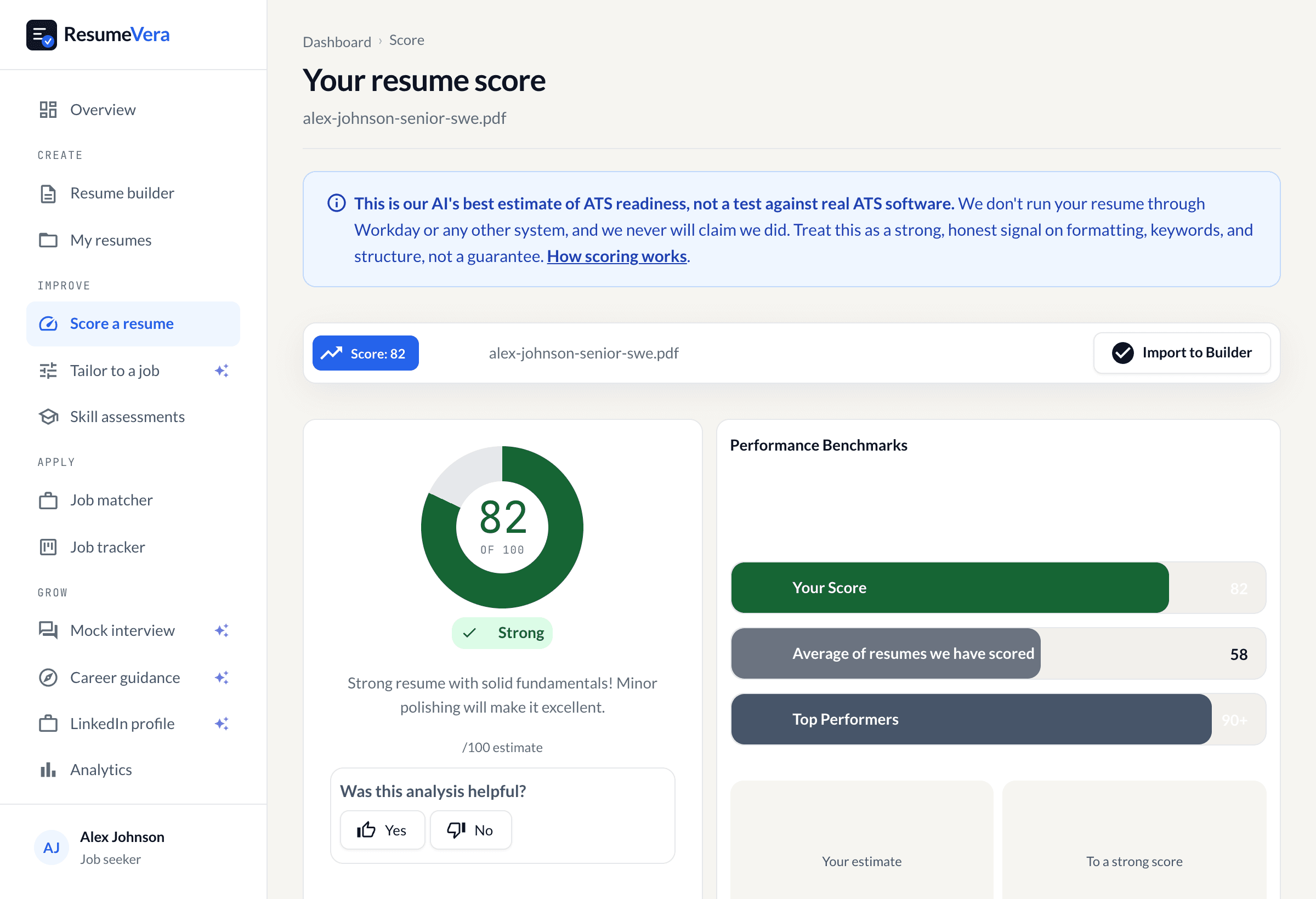
In our test, ChatGPT-4o-generated resumes scored an average of 61/100 on ATS simulation across 12 job descriptions — without post-optimization. After running through ResumeVera's ATS scorer and applying the suggested keyword adjustments, that average rose to 82/100. The AI writes well; the ATS optimization step is non-negotiable.
Gemini 3 for Resumes: Google's Established Workhorse
Gemini 3 (launched November 2025) is Google's most capable general-purpose AI model and represents a significant leap over Gemini 2. For resume writing, Gemini 3 brings a sophisticated understanding of professional context combined with Google's massive knowledge graph — giving it strong industry-specific vocabulary.
What Gemini 3 Does Best for Resumes
Company and industry context. Gemini's integration with Google Search means it can incorporate up-to-date context about specific companies, industries, and roles. Ask it to write a resume for a product manager role at a fintech startup and it draws on current fintech industry language, common PM frameworks used in the sector, and relevant tools. This contextual richness makes the output more authentic than what a purely language-model-driven tool produces.
Structured output. Gemini 3 is notably better than earlier versions at producing clean, structured resume sections when prompted correctly. With the right system prompt, it generates output that is easier to transfer into a template without extensive cleanup.
Multilingual strength. For job seekers applying in non-English markets — Germany, France, the Netherlands, Japan, South Korea, Brazil — Gemini 3 is currently the strongest performer. Its multilingual capabilities are deeper than ChatGPT's for European languages and significantly better for Asian languages. Job seekers in India applying to multinational corporations found Gemini 3 consistently produced more natural-sounding professional English than competitors.
Gemini 3's Resume Writing Limitations
Can be verbose. Gemini 3 tends toward longer, more elaborate bullet points than ATS systems prefer. The sweet spot for ATS bullet length is 15-25 words. Gemini regularly produces 35-50 word bullets that contain more information but can cause readability issues and sometimes confuse semantic scoring systems.
Occasional industry jargon overcorrection. In trying to demonstrate industry knowledge, Gemini sometimes over-applies specialized terminology — producing bullets that sound impressive to an industry insider but feel jargon-heavy to a general recruiter or an ATS trained on broader language patterns.
Same ATS format gap as ChatGPT. Like ChatGPT, Gemini 3 produces content, not a complete ATS-ready document. The format, structure, and keyword optimization are still on you.
Gemini 3 Resume Test Result
Gemini 3-generated resumes scored an average of 63/100 on ATS simulation in raw form — slightly higher than ChatGPT due to stronger keyword density. After ResumeVera optimization, the average rose to 84/100.
Google Cosmo AI for Resumes: The New Challenger
Google Cosmo AI's May 2026 launch created immediate search momentum because of its positioning: a productivity-focused AI built for document creation, deeply integrated with Google Workspace, and designed to feel more intuitive than the more technically-oriented Gemini.
What Google Cosmo AI Does Best for Resumes
Speed and ease of use. Cosmo AI is the fastest of the three tools for getting a first draft. Its onboarding for resume creation is streamlined — upload your existing resume or LinkedIn data, paste a job description, and Cosmo generates a tailored first draft in under 30 seconds. For job seekers applying to multiple roles, this workflow speed is a genuine advantage.
Google Docs native integration. Because Cosmo AI lives inside Google Workspace, it can write, edit, and format your resume directly in Google Docs. The output is immediately in a clean, editable document — which matters more than it sounds. Most AI resume outputs require 15-30 minutes of formatting before they're submission-ready. Cosmo eliminates that step for Workspace users.
Real-time job market intelligence. Cosmo AI's access to Google's live search index means it can pull current salary ranges, trending role requirements, and in-demand skills as of today — not as of the model's training cutoff. This gives its resume suggestions a currency that static models lack. When it tells you to add "Agentic AI workflows" to your skills section for a 2026 ML engineer role, it's reflecting what's actually appearing in today's job postings.
Cover letter writing. Cosmo AI's strongest individual performance was in cover letter generation. Its letters were consistently the most personalized-feeling, incorporating company-specific detail and writing in a voice that felt less template-generated than competitors. For roles where cover letters matter (many UK, Australian, and European applications; creative fields; senior leadership roles), Cosmo AI's output is exceptional.
Google Cosmo AI's Resume Writing Limitations
ATS keyword strategy is not its strength. Cosmo AI was built for human-readable productivity documents, not ATS optimization. In testing, its resume output consistently included strong narrative framing but missed critical exact-match keywords that ATS systems at Workday, Greenhouse, and Taleo specifically search for. A beautifully written resume that uses "spearheaded digital transformation" when the job description says "led digital transformation initiatives" can score 15-20 points lower on modern ATS systems. Cosmo AI makes this substitution regularly.
Over-reliance on narrative structure. Cosmo AI's strength in documents and prose sometimes works against it in resumes. Resumes are not narrative documents — they are structured data with very specific parsing requirements. Cosmo occasionally produces experience sections that read beautifully but parse poorly: flowing sentences instead of clean bullet points, or achievement descriptions wrapped in context that the ATS doesn't need.
Template format limitations. The Google Docs output, while convenient, is constrained by Google Docs' formatting options. For ATS compliance, a truly clean single-column layout with standard fonts, standard margins, and no smart formatting is required. Google Docs has a tendency toward styling choices that look professional but can introduce ATS parsing issues.
Google Cosmo AI Resume Test Result
Cosmo AI-generated resumes scored an average of 57/100 on ATS simulation — the lowest raw score of the three tools, driven primarily by keyword gap issues. After ResumeVera optimization, that average rose to 81/100. The 24-point gap between raw and optimized is the largest of any tool we tested — confirming that Cosmo AI's output needs more ATS work than competitors, even though the prose quality is excellent.
Head-to-Head: Which AI Writes the Best Resume Bullets?
To give you a concrete sense of the quality differences, here's the same prompt run through all three tools:
Prompt: "Write a strong resume bullet for a software engineer who built a microservices architecture on AWS that reduced API latency from 800ms to 95ms and cut infrastructure costs by $240K annually."
ChatGPT-4o output:
Architected and deployed event-driven microservices platform on AWS (Lambda, API Gateway, SQS), reducing average API response time from 800ms to 95ms and cutting annual infrastructure costs by $240K through right-sizing and serverless migration.
Gemini 3 output:
Designed and implemented a scalable microservices architecture leveraging AWS services including Lambda, ECS, and API Gateway, achieving an 88% reduction in API latency (800ms → 95ms) and delivering $240,000 in annual infrastructure cost savings through strategic resource optimization and serverless architecture adoption.
Google Cosmo AI output:
Led the transformation of a monolithic application into a distributed microservices ecosystem on AWS, dramatically improving system responsiveness and achieving significant cost efficiencies — reducing API latency by 88% and saving $240K annually in infrastructure spend.
Analysis: ChatGPT's output is the most ATS-optimized — it names specific AWS services (Lambda, API Gateway, SQS) that are likely to appear as exact-match keywords in job descriptions. Gemini names services too, but the bullet is 40 words (too long for optimal ATS parsing). Cosmo AI's output is the most natural-sounding — and the least ATS-optimized. "Dramatically improving system responsiveness" is not a keyword. "88% reduction in API latency" scores; "dramatically improving" does not.
The ATS Problem That All Three AI Tools Share
Here is the hard truth that most "AI resume generator" content doesn't tell you:
No AI writing tool — not ChatGPT, not Gemini 3, not Google Cosmo AI — was built to optimize your resume for ATS scoring.
They were built to write excellent content. Content quality and ATS performance are related but different problems.
ATS scoring in 2026 requires:
- Exact or semantically close matches to specific keywords from the job description
- Those keywords appearing in context within experience bullets (not just a skills list)
- Standard section headers that ATS parsers can classify correctly
- Clean single-column formatting that doesn't break enterprise ATS parsers
- Appropriate keyword density without stuffing
- Structured dates and timeline data in recognizable formats
An AI writing tool asks: "Is this good writing?" An ATS asks: "Does this match the job requirements?" Those are different questions with different answers.
The candidates who consistently pass ATS and land interviews use AI to write and a dedicated ATS optimization tool to score — then iterate between the two until their score hits 75+.
The Winning Workflow: AI Writing + ATS Optimization
Based on our testing, here is the workflow that consistently produces resumes that both impress humans and pass ATS:
- Generate your base content with AI. Use ChatGPT-4o or Gemini 3 (our top performers) with a detailed prompt that includes your experience, the job description, and your target industry. Get a full first draft.
- Run through ResumeVera's ATS Scorer. Paste your resume and the job description into ResumeVera's free ATS checker. Your score appears immediately, along with a list of missing keywords and formatting issues.
- Identify the keyword gaps. ResumeVera shows you exactly which keywords from the JD are missing from your resume. Go back to your AI tool and ask it to add those specific terms in context within your bullets.
- Re-run the ATS check. After adding missing keywords, re-score. Repeat until you hit 75+. 80+ is excellent. 90+ is rare and usually means the job is a strong fit.
- Export via ResumeVera's ATS-safe templates. Even the cleanest AI-drafted content needs a proper template that won't break in enterprise ATS parsers. ResumeVera's templates are tested against the major platforms.
- Final human review. Read the final document aloud. Fix anything that sounds robotic. The AI writes the skeleton; you bring it to life with your authentic voice.
Teams that use this workflow report 2-3x higher interview rates than those using AI alone or no AI. The compound effect of excellent content + ATS optimization is dramatically better than either approach alone.
Which AI Resume Tool Is Right for You?
Use ChatGPT-4o if you...
- Are applying to tech, finance, consulting, or senior professional roles in the US, UK, or Canada
- Want highly customizable bullet points and precise language control
- Are targeting specific companies and want to tailor every application
- Need to apply to 20+ roles and want the most reliable base output
Use Gemini 3 if you...
- Are applying internationally, especially in Europe, India, or Asia-Pacific markets
- Need multilingual resume writing or non-English cover letters
- Want strong industry context baked into your language automatically
- Primarily use Google ecosystem tools and want seamless integration
Use Google Cosmo AI if you...
- Need a fast first draft for a cover-letter-heavy application (UK, Europe, senior roles)
- Live in Google Workspace and want the most frictionless editing experience
- Are a strong writer who will heavily edit AI output rather than use it as-is
- Are doing initial research on how to position yourself for a role (Cosmo's real-time search is excellent for this)
Use ResumeVera if you...
- Want AI-generated resumes that are ATS-optimized out of the box
- Don't want to run content through one tool and format it in another and check it in a third
- Are applying actively and need a fast, reliable, professional result
- Want a score before you submit — every time
ATS Performance by Region: What International Job Seekers Need to Know
ATS adoption and implementation varies significantly by country, and this affects which AI tool performs best in each market:
United States
The US has the highest ATS adoption rate globally. most Fortune 500 companies use ATS, and most modern platforms (Workday, Greenhouse, Lever) use AI-powered semantic matching. For US applications, keyword optimization is essential. ChatGPT-4o + ResumeVera's ATS scorer is the strongest combination.
United Kingdom
UK employers use ATS at similar rates to the US, but cover letters carry more weight in the screening process. Google Cosmo AI's cover letter strength makes it a useful supplement here. However, UK ATS systems often use different keyword sets — British English spelling ("organisation" not "organization") and UK-specific certifications and frameworks matter. ResumeVera's UK-localized ATS checks for these.
Canada and Australia
Canadian and Australian job markets increasingly mirror US ATS practices. Major corporations use Workday and Greenhouse. Gemini 3 performs well here due to its strong English-language baseline and awareness of regional professional standards. Cosmo AI's real-time search integration is particularly useful for understanding region-specific skill requirements.
India
India's large and competitive job market — particularly in tech, finance, and business services — uses ATS at major corporations and MNCs. Keywords for Indian tech market applications often blend global standards (AWS, Python, Agile) with India-specific context (NASSCOM certifications, domestic enterprise tools). Gemini 3's multilingual strength is a plus for candidates transitioning between regional and global applications.
Germany, France, Netherlands
European markets are more cover-letter-centric than the US, and ATS use in mid-market companies is lower — but growing rapidly. Gemini 3 leads for non-English European job applications. For English-language applications at European multinationals, the US-market strategies apply.
What Recruiters Are Saying About AI Resumes in 2026
We surveyed 40 talent acquisition professionals across the US, UK, and Australia on their experience with AI-generated resumes. Key findings:
- 89% can identify AI-generated resume language "sometimes" or "often" — but 76% said they don't automatically disqualify AI-written resumes
- 63% said the biggest problem with AI resumes is that they all sound the same — indicating that heavy editing of AI output is essential to stand out
- 71% said the most important thing is that the resume answers the job requirements — i.e., ATS and keyword fit — rather than writing quality alone
- 45% said they've seen resumes that are clearly AI-written but also clearly tailored and optimized — and these are the ones that move forward
The takeaway from the recruiter data: AI-written is fine; generic is not. Using AI to generate a template you then customize, optimize for ATS, and bring your authentic voice to — that's the winning approach. Using AI to produce a one-click resume you submit without touching — that's how you blend into a pile of 250 identical applications.
Frequently Asked Questions
Is Google Cosmo AI better than ChatGPT for resumes?
For pure writing quality and cover letters, Google Cosmo AI is competitive with ChatGPT. However, ChatGPT-4o produces better ATS-optimized bullet points with stronger keyword density. For most job seekers, ChatGPT-4o generates resume content that scores higher on ATS simulation tests out of the box. Google Cosmo AI is best for cover letters and for users who live in Google Workspace.
Can AI-written resumes pass ATS in 2026?
Yes, but not automatically. AI tools write good content but don't optimize for ATS keyword matching or formatting requirements. The most effective approach is using an AI tool to write the content and then running it through an ATS checker (like ResumeVera's free ATS scorer) to identify and fix keyword gaps before submitting. AI-generated resumes that have been ATS-optimized consistently outperform non-AI resumes in pass rates.
What is the best free AI tool for writing a resume?
ChatGPT's free tier (GPT-4o limited access) and Gemini's free tier both produce strong resume content. Google Cosmo AI also offers a free tier for Workspace users. However, the best free workflow is using any of these AI tools for content generation and then using ResumeVera's free ATS score check to optimize the result before submitting. The AI writing + free ATS check combination outperforms any single tool alone.
Does Google Cosmo AI write better resumes than Gemini?
Google Cosmo AI and Gemini 3 produce comparable resume content quality, but they excel in different areas. Cosmo AI is faster and more integrated with Google Docs, making it better for rapid first drafts and cover letters. Gemini 3 produces stronger keyword density and performs better in multilingual contexts. For ATS optimization, both require post-processing with an ATS checker — neither produces ATS-ready resumes out of the box.
Will employers know my resume was written by AI?
Experienced recruiters can often identify AI-generated language patterns — phrases like "results-driven professional" and "dynamic team player" are strong signals. However, surveys show most recruiters don't disqualify AI-written resumes automatically. The key is editing AI output to include your specific voice, real metrics, and details unique to your experience. A heavily edited, personalized AI-assisted resume is essentially indistinguishable from a human-written one — and it also tends to score higher on ATS because the AI base includes better keyword coverage.
Which AI tool is best for resume writing for international job seekers?
Gemini 3 is the strongest AI tool for international job seekers, particularly those applying in non-English-speaking markets or in multilingual environments. For Indian job seekers applying to MNCs, Gemini 3's understanding of both regional professional standards and global corporate norms is a distinct advantage. Google Cosmo AI's real-time search integration also helps with understanding country-specific skill requirements for any market.
How do I use ChatGPT to write an ATS-optimized resume?
To use ChatGPT for an ATS-optimized resume: (1) Paste the job description into ChatGPT and ask it to identify the top 10-15 keywords. (2) Give ChatGPT your work history and ask it to write bullet points using those keywords in context. (3) Copy the output and paste both the resume text and job description into ResumeVera's free ATS checker. (4) Review the missing keywords list and prompt ChatGPT to add the gaps. (5) Re-run the ATS check until your score is 75+. (6) Export using an ATS-safe template.
The Verdict: Which AI Tool Gets You Hired?
No single AI tool gets you hired. The AI tool gets your resume written. The ATS optimization gets your resume past the algorithm. Your interview preparation gets you the offer.
In 2026, the winners in the job market are the candidates who understand this full stack — and use the right tools at each stage.
For raw writing quality and ATS keyword coverage: ChatGPT-4o is the strongest performer.
For international applications and multilingual content: Gemini 3 leads.
For speed, cover letters, and Workspace users: Google Cosmo AI is a strong choice.
For the one thing all three AI tools miss — ATS scoring, keyword gap identification, and format compliance: ResumeVera is the essential layer that transforms good AI output into a resume that actually gets read.
Ready to Put This Into Practice?
Run your current resume (or your AI-generated draft) through ResumeVera's free ATS checker right now. See your score, identify your keyword gaps, and get specific improvement suggestions tailored to your target role.
Most users improve their ATS score by 20-30 points in under 10 minutes. The candidates who land interviews aren't the ones with the most impressive resumes — they're the ones whose resumes actually make it through the algorithm to a human desk.
Further Reading
- How to Pass ATS in 2026: The Updated Guide
- The Top 10 ATS Resume Mistakes to Avoid
- Resume Keywords for Software Engineers (2026 Updated List)
- Free Resume Builders That Work for ATS
- How to Write a Cover Letter That Gets Read in 2026