US Visa Changes in 2026: The Wage-Weighted H-1B and What It Means for Job Seekers
Job Search · ResumeVera Editorial · June 14, 2026 · 15 min read

Introduction: The 2026 Immigration Hard Pivot
International students navigating the United States job market in 2026 are facing a fundamentally altered landscape. The era of the randomized, unpredictable H-1B lottery has officially ended. With the implementation of sweeping new Department of Homeland Security (DHS) regulations, employers are now operating within a system designed specifically to prioritize higher-paid, highly skilled talent over entry-level applicants.
However, headlines focusing solely on visa restrictions miss the broader economic reality: US technology companies, financial institutions, and healthcare networks are still facing critical shortages in advanced engineering, artificial intelligence, and data infrastructure roles. The jobs exist, and the willingness to sponsor exists. What has changed is the barrier to entry. Employers are no longer willing to sponsor "average" candidates. To secure a role in 2026, international students must pair a sophisticated understanding of immigration policy with an aggressive, algorithmically optimized approach to their employability.
This comprehensive guide breaks down the exact mechanics of the 2026 visa changes, the psychology behind employer sponsorship hesitancy, and the rigorous Applicant Tracking System (ATS) optimization strategies required to position yourself in the top 1% of the candidate pool.
Part 1: Deconstructing the 2026 Visa Policy Updates
To navigate the job market effectively, candidates must understand the concrete shifts in USCIS and Department of State policies. When you understand the financial and regulatory friction employers face, you can better position yourself as a candidate worth the effort. Do not rely on social media rumors; the following are the verified structural changes defining the FY2027 cap season and beyond.
1. The Wage-Weighted H-1B Lottery System
Effective February 2026, USCIS finalized the transition from a purely random selection process to a wage-level weighted system. Under the previous beneficiary-centric model, every unique candidate had an equal chance of selection. Now, selection odds are mathematically tied to the Department of Labor's Occupational Employment Statistics (OES) wage levels.
Level IV (Expert) Wage Offers: Receive four entries in the selection pool.
Level III (Experienced) Wage Offers: Receive three entries in the selection pool.
Level II (Qualified) Wage Offers: Receive two entries in the selection pool.
Level I (Entry) Wage Offers: Receive a single entry in the selection pool.
The Employer Impact: This drastically shifts employer preference. If a company spends the legal fees to petition for a Level I candidate, their chances of actually securing the visa are statistically minimal. Therefore, companies are consolidating their hiring efforts toward candidates who possess the advanced skills necessary to justify a Level III or Level IV salary immediately upon graduation. (Source: Federal Register / USCIS Policy Updates)
2. The USCIS Stabilization Act & Premium Processing Hikes
The cost of hiring an international worker has increased significantly. The USCIS Stabilization Act triggered inflation adjustments across the board in March 2026. The premium processing fee for Form I-129 (which includes H-1B petitions) increased from $2,805 to $2,965. Furthermore, the fee for Form I-765 (used for OPT and STEM OPT Employment Authorization Documents) rose to $1,780. When combined with corporate immigration attorney fees (which typically range from $5,000 to $10,000 per candidate), employers are making a minimum $10,000 to $15,000 upfront investment just to enter a candidate into the system. (Source: USCIS H-1B Electronic Registration)
3. The $100,000 Consular Fee and Visa Bond Realities
Much fear has been generated by news of a $100,000 supplemental fee and a $15,000 "Visa Bond." It is critical to separate fact from panic. The $100,000 fee applies specifically to certain corporate transfers and highly specialized H-1B petitions requiring complex consular processing; it generally does not apply to standard change-of-status petitions for F-1 students transitioning to H-1B from OPT. Similarly, the $15,000 Visa Bond rule primarily targets high-overstay tourist categories, exempting F, M, and J student visas. However, these policies have created a "chilling effect," leading to stricter financial and academic background checks and longer processing times at embassies worldwide. (Source: U.S. Department of State - Student Visas)
4. Expansion of Stateside Visa Renewals
A positive development for 2026 is the expansion of the domestic visa renewal pilot program. Certain H-1B holders can now renew their visas without leaving the United States, circumventing the massive backlogs at consulates in India and China. Employers view this highly favorably, as it eliminates the risk of key engineers getting "stuck" abroad during administrative processing (221g) for weeks or months.
Part 2: The "Sponsorship Premium" and Employer Psychology
Because of the wage-weighted lottery and mounting processing fees, companies in 2026 apply what industry experts call the "Sponsorship Premium." To justify hiring you over a domestic candidate, you cannot just be as good as the competition—you must be demonstrably, undeniably better.
When an Engineering Manager or HR Director looks at an international candidate's profile, they are performing a subconscious risk-reward calculation. They know that hiring you involves legal paperwork, timeline uncertainty, and a financial premium. To offset that risk, your resume must communicate immediate, outsized ROI (Return on Investment).
Many students make the critical error of spending months tracking visa subreddits, debating policy nuances, and worrying about lotteries, while entirely neglecting the one variable they have 100% control over: their professional narrative. Employers prioritize demonstrated skills, measurable results, and immediate deployability.
Part 3: Beating the Algorithms – The 2026 ATS Mandate
Before a human recruiter even considers your visa status, software evaluates your resume. Because companies receive thousands of applications for a single requisition, Applicant Tracking Systems (ATS) act as ruthless algorithmic gatekeepers. If your resume is rejected by the ATS parsing engine, your OPT eligibility, your master's degree, and your technical skills simply do not matter.
The "Canva Deficit" and the Failure of Aesthetic Resumes
One of the most pervasive traps for junior talent is the reliance on aesthetic, graphic-heavy resume templates from visual design platforms. While these templates look beautiful to the human eye, they are catastrophic for machine reading. Independent testing in 2026 shows that multi-column, heavily formatted templates fail basic ATS parsing at an alarming rate.
Modern ATS engines read documents strictly from top to bottom, left to right. When an ATS encounters floating text boxes, complex multi-column layouts, or graphics-as-text elements, it scrambles the text extraction sequence. For instance, an ATS attempting to parse a dual-column layout frequently reads straight horizontally, conflating a job title on the left with a graduation date on the right, rendering the professional history entirely incoherent. Furthermore, any information housed within visual graphics—such as skill rating bars, icons, or embedded logos—will simply return a null value. If your skills are visually represented by "four out of five stars" instead of plain text, the ATS assumes you have no skills at all.
Architectural Mandates for the ATS-Compliant Resume
To survive automated screening and facilitate the "15-Second Test" conducted by human recruiters, your resume must adhere to exceptionally strict, minimalist architectural guidelines. A modern layout expects a structure focused entirely on clean data extraction, much like a premium SaaS dashboard (think of the clean, high-contrast aesthetics of Stripe, Vercel, or Linear).
Strict Single-Column Formatting: Never use columns. Your contact info, summary, experience, and education should flow in a single, uninterrupted vertical hierarchy.
Standard, Web-Safe Typography: Utilize clean sans-serif or serif fonts (e.g., Inter, Manrope, Arial, Calibri, Garamond). Complex typography causes OCR (Optical Character Recognition) failures.
Universally Recognized Headers: Do not try to be clever with titles like "My Professional Journey" or "Tech Footprint." Use standard data keys: "Experience", "Education", "Projects", and "Technical Skills".
Absolute Temporal Consistency: Date formatting must be uniform (e.g., "Aug 2024 - Present" or "08/2024 - Present"). Misaligned dates result in temporal parsing failures, making it appear as though you lack the required years of experience.
Zero Visual Clutter: Completely remove tables, text boxes, skill rating bars, icons, and embedded logos. Let the white space and typography do the heavy lifting.
Part 4: Formulating High-ROI Resume Bullet Points
Employers need to justify placing you in a Level III or IV wage bracket to improve your lottery odds. Vague, passive descriptions of daily tasks ("Worked on frontend web development" or "Handled database queries") signal an entry-level candidate. To project seniority and immediate value, you must frame your experience using a rigid, mathematical formula:
Action Verb + Task & Core Skill = Quantifiable Business Outcome
Recruiters in 2026 are highly skeptical of candidates who simply provide a detached, comma-separated list of proficiencies. They want clear evidence that you can apply those tools in a production environment to generate measurable results (e.g., reducing costs, increasing speed, scaling infrastructure, or driving revenue).
Engineering & Development Examples
Weak Statement (Fails to Justify Sponsorship)Optimized Statement (Demonstrates High-Tier Value)Worked on frontend web development.Architected responsive UI components using React, Next.js, and Material UI, reducing client-side page load times by 40% and improving Core Web Vitals.Helped process data streams.Designed real-time event-driven pipelines utilizing Apache Kafka and AWS Kinesis, processing 10M+ daily events with sub-second latency and zero data loss.Built a system to score resumes.Developed an AI-powered parsing engine leveraging OpenAI LLMs and RAG architecture, improving automated data extraction accuracy by 25% for HR clients.Maintained cloud servers.Orchestrated scalable microservices using Docker and Kubernetes on AWS, cutting infrastructure provisioning time by 60% through automated CI/CD pipelines.
Part 5: High-Demand Tech Stacks for 2026 Sponsorship
In a wage-weighted environment, specialized technical skills provide the highest leverage. Generalist IT roles are increasingly filled by domestic candidates or outsourced. International candidates must demonstrate deep proficiency in the modern, cloud-native infrastructures and AI integrations that companies are actively spending millions to implement.
Event-Driven Architecture & Real-Time Data: The shift from batch processing to real-time analytics is accelerating. Candidates who can build distributed, fault-tolerant systems using Apache Kafka, RabbitMQ, and Flink are considered critical hires. Demonstrating the ability to handle high-throughput, low-latency streaming pipelines positions you far above standard CRUD developers.
Advanced AI Implementation & LLMs: Companies are moving beyond simple API calls and are actively building bespoke internal AI tools. Skills in Retrieval-Augmented Generation (RAG), vector databases (Pinecone, Weaviate), fine-tuning models, and integrating automated reasoning agents into existing SaaS products are the most heavily sponsored skillsets in the 2026 market.
Modern Full-Stack & Cloud-Native Development: Employers want engineers who can own features end-to-end. Mastery of robust frameworks like Next.js for server-side rendering, combined with sophisticated component libraries (like Material UI or Tailwind), and deployed on cloud edges (Vercel, AWS) demonstrates product-minded engineering.
Cybersecurity & Cloud Compliance: With data privacy regulations expanding globally, specialists in Zero Trust architectures, identity access management (IAM), and securing distributed cloud environments command premium salaries that easily clear Level III/IV wage requirements.
Part 6: Beyond the Resume – "Quiet Hiring" and LinkedIn Optimization
To understand how to optimize your digital footprint, you must understand how technical recruiters are actually sourcing talent in 2026. Public job boards (like standard LinkedIn "Easy Apply" postings) are currently inundated with mass-produced, syntactically perfect, AI-generated spam resumes. The ease with which automated tools allow candidates to apply to hundreds of roles has resulted in an unmanageable volume of noise.
Consequently, recruiters have fundamentally shifted their methodologies toward "Quiet Hiring." Instead of relying heavily on inbound applications, recruiters actively utilize AI-powered search agents (like LinkedIn Recruiter Pro's semantic search) to mine professional networking platforms for passive candidates. They search for highly specific boolean strings, monitor who consistently shows technical expertise, and reach out privately.
If you are only applying to public job postings, you are effectively invisible to where the actual high-tier hiring activity is taking place. Your LinkedIn profile must act as a 24/7 inbound marketing landing page for your career.
The Keyword-Rich Headline: Do not use default headlines like "Master's Student at University X." Use prime real estate to state your value: "Data Engineer | Apache Kafka & Real-Time Streaming | AWS Certified | Actively Seeking 2026 Opportunities".
The "About" Section as a Pitch: Write a 3-paragraph executive summary detailing your current technical focus, the scale of data/systems you are accustomed to handling, and your immediate career objectives.
Showcase Deployed Projects: In 2026, GitHub links are good, but live, deployed projects are better. Embed links to your SaaS side-projects, data visualization dashboards, or technical blog posts directly in the "Featured" section of your profile.
Optimize for Recruiter Searches: Ensure the "Skills" section of your LinkedIn perfectly mirrors the high-value technologies listed on your ATS resume. Recruiters filter heavily by these specific tags.
Part 7: The F-1 to H-1B Roadmap – A Strategic Timeline
Success for an international student requires treating the visa and employment journey as a multi-year project, not a final-semester scramble. Below is the ideal roadmap for maximizing your chances of securing a wage-weighted H-1B sponsorship.
Phase 1: Day 1 to Month 6 (Foundation & Upskilling)
Do not wait until graduation to understand the market. Immediately identify the specific niches within your field (e.g., Event-driven data engineering, AI product management) that command Level III wages. Begin building a portfolio of complex, integrated projects that mirror enterprise architecture. Standard "To-Do List" or "Weather App" projects will not differentiate you.
Phase 2: Month 6 to Month 12 (CPT & Internships)
Securing a Curricular Practical Training (CPT) internship is critical. Many Fortune 500 companies and top-tier tech firms use internships as extended interviews, converting interns directly to full-time hires and entering them into the H-1B lottery prior to their graduation. Leverage university career fairs, alumni networks, and targeted cold outreach on LinkedIn to secure these roles.
Phase 3: Month 12 to Month 18 (OPT Preparation & Networking)
Nine months before graduation, your ATS resume should be perfected. Begin the application process for Post-Completion Optional Practical Training (OPT). During this phase, networking transitions from casual to strategic. You should be seeking informational interviews with senior engineers and hiring managers. Remember: a referral bypasses the ATS and guarantees human eyes on your resume.
Phase 4: Post-Graduation (The STEM OPT Leverage)
If your degree qualifies for the 24-month STEM OPT extension, you effectively give your employer three total attempts at the wage-weighted H-1B lottery (the initial 12 months of OPT, plus the 24-month extension). This massive reduction in risk is your strongest negotiating chip. When discussing sponsorship during final interview rounds, clearly articulate that you possess 36 months of uninterrupted work authorization, allowing you to deliver immediate ROI while the company navigates the lottery over a multi-year horizon.
Conclusion
The 2026 US visa landscape is undeniably steeper, structurally complex, and financially demanding for employers. However, a system that filters aggressively also rewards absolute competence disproportionately. By understanding the mechanics of the new wage-weighted H-1B lottery, you can empathize with the employer's hiring friction and position yourself as the solution to their talent shortage.
Relying on aesthetic resumes, generic AI-generated bullet points, and public job boards is a recipe for rejection. By utilizing rigorous ATS optimization, focusing heavily on modern, scalable technical skills like Next.js, Kafka, and LLM integrations, and building a proactive, inbound-focused digital footprint, international students can successfully bridge the gap between graduation and long-term, highly-compensated employment in the United States.
Written and checked by ResumeVera Editorial. How we research and review
Get free ATS tips every week
Actionable resume and ATS tips, when we publish them. No spam. Unsubscribe any time.
Related Articles

How long are people actually staying at their jobs now? What the newest BLS tenure data says
Every two years the federal government asks a very specific question: how long have you been with your current employer. The newest answer, released in September 2026, shows median tenure ticking up after a two year low, a sharp gap by age and industry, and a short tenure share that is actually falling. Here is what the data shows, and what it means for how you handle more than one short stint on a resume.
Read More

Is your raise actually keeping up with prices in 2026? What the wage data says
Three federal data sources answer the "am I getting ahead" question differently depending on how you ask it. Job switchers are clearly outrunning inflation. People who stay in their current job are barely breaking even. Here is what the real earnings report, the Employment Cost Index, and the Atlanta Fed's wage tracker each actually measure, and what to do with the gap between them.
Read More

How long does it actually take to find a job in 2026? What the federal data says
The median unemployed job seeker in 2026 has been searching for about eleven weeks. The average is more than double that, and the gap between the two numbers is the whole story. We checked the federal data on how long searches actually run, how that compares with past downturns, and what it means for planning your own.
Read More
Try it
Check this against your own resume
The post above is general. Your file is not. The checker reads it the way a parser would and tells you which of these points it actually breaks.
Check your resume free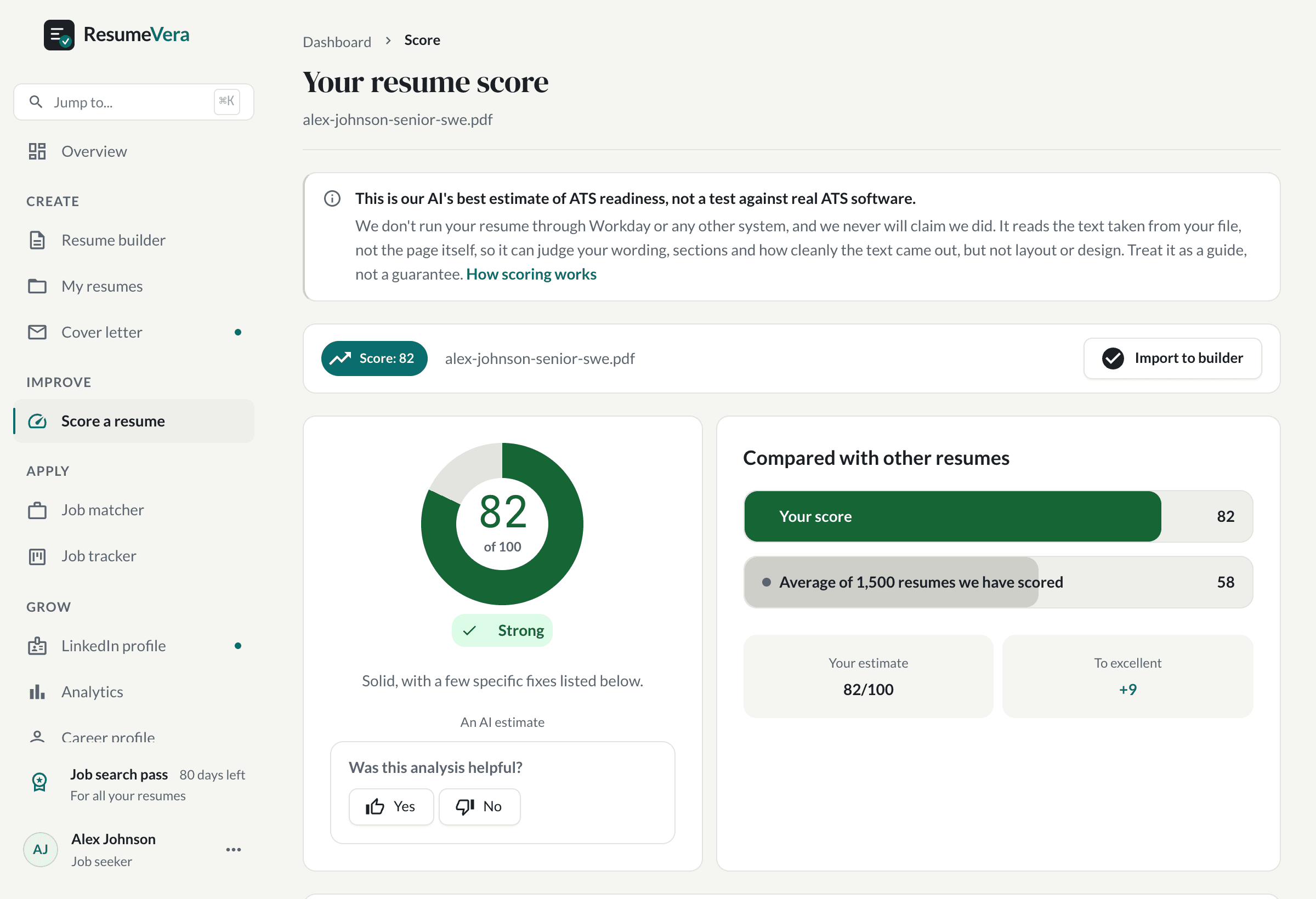
The real score page, with a sample resume and sample scores.
Now check it against your own resume
An honest resume score in seconds. No account, no card.