Government jobs guide India 2026
Government job resume and biodata format for India
For most government roles, the application form IS the resume. Here is what every section requires, and what gets applications rejected.
The ResumeVera team
Written from the recruiting bodies' own published formats and notifications, not from third-hand summaries.
Updated Oct 7, 2026
12 min

Section 01
Government job types: which format each requires
Not all government jobs use the same application format. Know the category before preparing your documents.
Preparing for engineering PSU recruitment through GATE specifically? See our complete PSU recruitment through GATE guide for the full process, a PSU-by-PSU snapshot, and the biodata format PSUs expect.
| 01 | Central Government Services (Group A/B/C/D) Recruited via UPSC (IAS, IFS, IPS, CDS, NDA, CAPF), SSC (CGL, CHSL, MTS, GD Constable), and RRB (Railways). The application form IS the resume for these. There is no separate resume submission. You fill a structured form with personal particulars, educational qualifications, and experience in a prescribed format. |
| 02 | Central Public Sector Enterprises (CPSEs / PSUs) CPSEs come under the Department of Public Enterprises. Engineering PSUs like ONGC, BHEL, NTPC, GAIL, and Coal India hire mainly through GATE scores, while finance roles use CA/CMA/MBA routes. Each PSU has its own online application portal with a structured form. For the full GATE-to-PSU process and a PSU-by-PSU breakdown, see our dedicated guide above. |
| 03 | Public Sector Banks (PSBs) SBI recruits through its own notifications, while Bank of Baroda, PNB, Canara Bank, and other nationalised banks hire via IBPS for Probationary Officers (PO), Clerical, and Specialist Officer cadres. The application is an online form with your academic and personal details, not a traditional resume. |
| 04 | State Government Services Each state has its own Public Service Commission (MPSC, TNPSC, KPSC, BPSC, RPSC, etc.). Application format varies by state. Always download the official notification PDF for the specific post you are applying for. |
Section 02
Government biodata / application form: required sections
Every government application form, whether online or physical, asks for these sections in this exact order.
| 01 | 1. Personal Particulars (Header) Full name (as per Class 10 certificate), Father's name, Mother's name, Date of birth (DD/MM/YYYY), Gender, Nationality (Indian), Category (General / OBC-NCL / SC / ST / EWS), Caste certificate number (if applicable), Religion, Permanent address, Correspondence address, Mobile number, Email ID. |
| 02 | 2. Educational Qualifications (Chronological, latest first) For each qualification: Examination name → Board/University → Year of passing → Maximum marks → Marks obtained → Percentage → Division (First/Second/Third) → Subjects. Note: Indian government forms require BOTH marks obtained AND percentage. Calculate carefully. Division is based on aggregate percentage (First = 60%+). |
| 03 | 3. Employment / Work Experience (if any) Organisation name, Designation, Nature of appointment (Regular/Contract/Temporary), Date of joining (DD/MM/YYYY), Date of leaving or "Still Working", Basic pay/scale, Reasons for leaving. For Central Government employees: Pay matrix level and Cell number. |
| 04 | 4. Technical Qualifications / Certifications For engineering PSU applications: GATE score and year, GATE discipline, GATE rank (All India). For finance roles: CA/CMA/CS registration number, examination pass certificate dates. For computer-related roles: O-Level / A-Level / B-Level certification from NIELIT (formerly DOEACC). |
| 05 | 5. Declaration Every government application ends with a signed declaration: "I hereby declare that all the information given above is true and correct to the best of my knowledge and belief. I understand that in the event of any information being found false or incorrect, my candidature/appointment is liable to be cancelled/terminated." Followed by Place, Date, Signature. |
Section 03
Who this guide is for
This guide is written for candidates preparing resumes, biodata, and document packs for PSU, SSC, GATE PSU, and government interviews. The goal is simple: create a formal, document-consistent profile that matches official application details. It is structured for readers who want direct examples, recruiter-friendly wording, and India-specific decisions rather than generic career advice.
| 01 | How to use this guide Read the format first, adapt the examples to your own background, then use the checklist and FAQs before submitting your government job resume. |
Section 04
Government job resume step-by-step playbook
Use this order to move from blank page to publish-ready application material. Each step is designed to improve recruiter readability and application-system clarity.
For each step, use specific evidence for your target reader: role, company, exam, portal, city, tools, documents and measurable outcomes where possible.
| 01 | 1. Personal details when required |
| 02 | 2. Education List degree, institution, year, and marks/CGPA only when they strengthen the application or are required by the process. |
| 03 | 3. Exam details |
| 04 | 4. Experience Convert responsibilities into evidence: task handled, tools or process used, team/client context, and result. Even short internships can show credible exposure. |
| 05 | 5. Projects For each project, include the problem, tools used, your contribution, and a measurable result or clear output. Add links only when the work is clean and viewable. |
| 06 | 6. Certifications Include certifications that support the target role. Mention platform/body and year, but do not let certificates replace real project or work evidence. |
| 07 | 7. Documents Match names, dates, marks, categories, and certificate details exactly with official documents. In government or exam processes, consistency matters more than design. |
Section 05
India and global application guidance
Hiring expectations change by market. Indian applications often include portal keywords, campus or exam processes, CTC language, document checks, and local role-title variations. Global applications usually expect tighter privacy, fewer personal details, and stronger proof of role fit.
| 01 | Government and PSU processes may require biodata-style details that private-sector resumes avoid. |
| 02 | Names, dates, category, marks, and document details must match official certificates exactly. |
| 03 | Use plain formatting and avoid informal wording. |
Section 06
Government job resume examples you can adapt
Use these examples as patterns, not as copy-paste text. The best application content sounds specific to your work and includes evidence that an interviewer can verify.
| 01 | GATE-qualified Mechanical Engineer with project work in thermal systems, CAD, and maintenance reliability. |
| 02 | Document checklist: admit card, ID proof, mark sheets, caste/EWS/PwD certificate if applicable, experience certificates. |
Section 07
Shortlist visibility checklist
Use this checklist before publishing, uploading, or sending your application. It helps recruiters and the people reviewing your application see your fit quickly without forcing unnatural keyword repetition.
| 01 | Lead with the target role or process The first screen should make it obvious why this government job resume is relevant and what outcome it supports. |
| 02 | Use exact but truthful keywords Mirror role, portal, exam, or company terms only when they genuinely match your background. |
| 03 | Add evidence after every major claim Use numbers, tools, documents, projects, clients, coursework, or outcomes so the content feels verifiable. |
| 04 | Keep formatting predictable Use standard headings and simple layouts so recruiters and upload systems do not have to guess where information lives. |
| 05 | Check the final version against the application instructions If the employer, portal, or exam body asks for a specific format, follow that over generic resume advice. |
Section 08
Official references and source notes
This guide is original ResumeVera guidance. The references below were used to keep the advice aligned with official documentation and platform rules.
| 01 | UPSC official website Official reference point for Civil Services notifications, DAF, and examination updates. Reference: https://www.upsc.gov.in/ |
| 02 | DigiLocker Useful official reference for digital documents used in Indian applications and interviews. Reference: https://www.digilocker.gov.in/ |
Pro tips
Do these
Always use your name exactly as it appears in Class 10 board certificate: no nicknames
Check the age limit eligibility on notification date, not application close date
Category certificate (OBC/SC/ST/EWS) must be issued by a competent authority in prescribed format
Calculate percentage yourself, many forms reject auto-calculated percentages with decimal errors
Upload scanned documents as per specified file size and format (usually JPG/PDF, 50–500 KB)
Keep certified copies of all certificates; original verification happens at document round
Check which GATE years each PSU accepts in its own notification; PSU validity is shorter than the validity GATE offers for M.Tech admissions
Track application status on the official PSU / exam body portal, not third-party sites
Customize the first 3 lines for the exact role, company, exam, or portal instead of using the same version everywhere.
Add one proof point for every major claim: number, scope, document, tool, project, client type, or result.
Read the page aloud once; if a sentence sounds like generic advice, replace it with a concrete example.
Avoid these
Delete these
Using a Western-style resume format for UPSC/SSC: these require prescribed Performa only
Mismatched name between 10th certificate, Aadhaar, and application form
Incorrect percentage calculation (many forms require 2-decimal accuracy)
Wrong OBC certificate: must be NCL (Non-Creamy Layer), not general OBC certificate
Missing declaration section or undated signature
Uploading photos that don't meet specifications (background colour, file size, date)
Not checking domicile/residence requirements for state government jobs
Applying without reading the full notification PDF: age limits, qualifications, and dates vary by post
Using repeated keywords instead of useful examples, scripts, and proof.
Submitting without checking the latest employer, portal, or exam instructions.
Copying examples word-for-word instead of replacing them with your own truthful details.
Keywords
Keywords by category
Use these in your resume and profile to improve search visibility.
GATE-based PSU Engineering roles
Banking / IBPS roles
UPSC Civil Services
PSU Finance roles (CA/CMA)
Core Phrases
Common Question Phrases
India-Specific Terms
Put this into a resume
Building and editing are free, and free PDFs carry a small watermark.
Check my resume freeQuestions
Frequently asked questions
How this guide is maintained
We review this guide every quarter and after any change to the hiring rules or portal behaviour it describes. It was last reviewed on October 7, 2026. Figures come from named sources, shown beside the number. Where we are estimating rather than measuring, we say so.
Career resources
More career guides
Browse all our India-focused resume and career guides.
View all career guides →Try it
Check the guide against your own file
Everything above is general. Your resume is not. Paste it in and the checker tells you which of these points your file actually breaks.
Check your resume free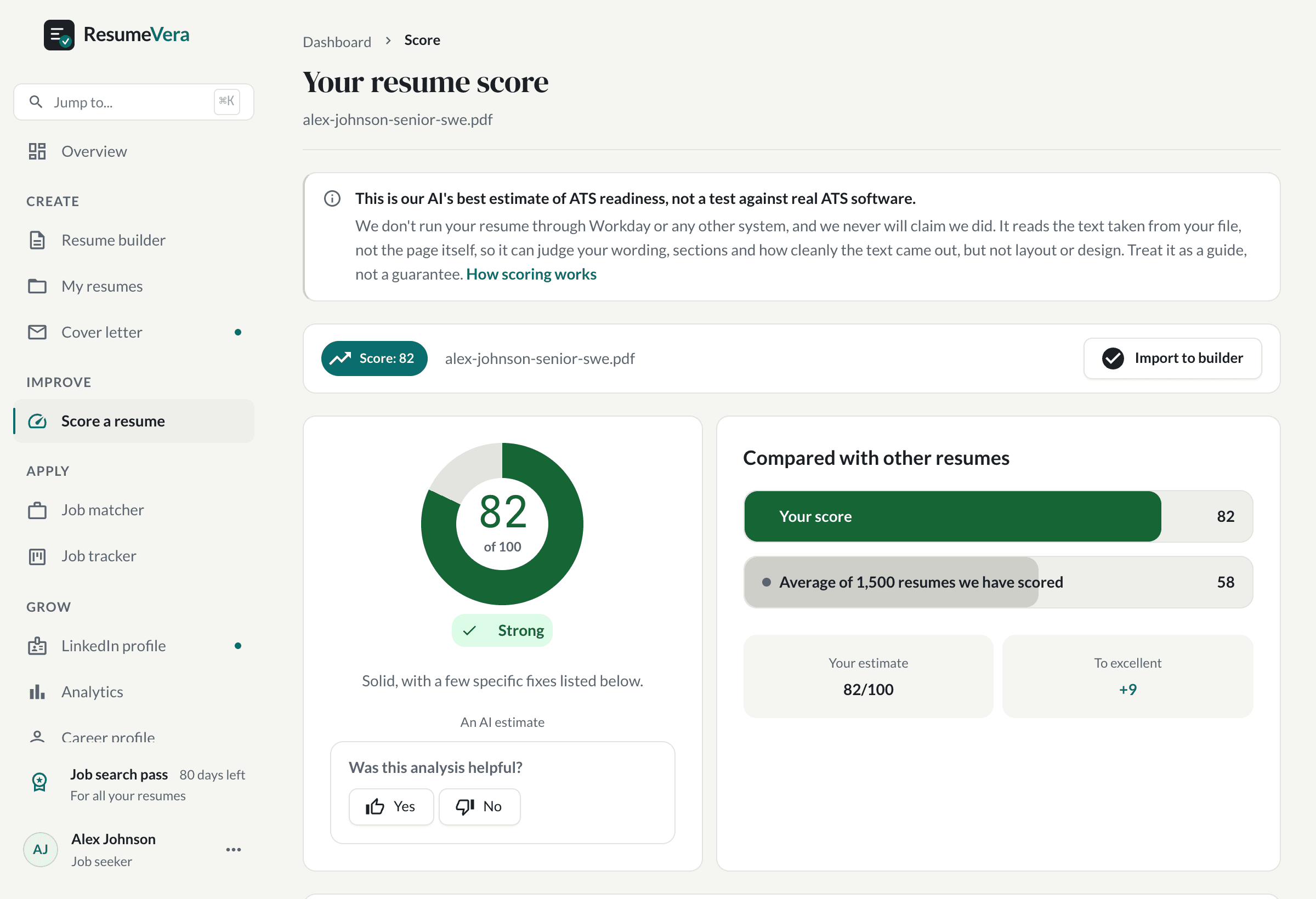
The real score page, with a sample resume and sample scores.
Is your resume ATS ready?
Run a free ATS score check and get specific improvements in seconds.