Agile & Scrum Methodology
The most widely adopted project management framework, powering teams across technology, healthcare, finance, and beyond. Master Agile and Scrum to unlock high-demand career opportunities with competitive salaries.
$0
Avg. Scrum Master Salary
0%
Projected Job Growth
0%
Organizations Using Agile
Roles that use Agile & Scrum Methodology: Career Guide, Salaries & Resume Tips, and what they pay
Median annual wage, national, May 2025
- $102,320*
- $102,320
- $166,790*
- $135,980
- $135,980*
- $104,300
* BLS has no code for that exact title, so it is counted under a broader occupation. The role page says which. Source: BLS OEWS. These are the roles' wages, not a premium for the skill: no published source measures what one skill adds on its own.
Market Demand
Demand & Salary Data
24%
Growth Rate
$
+$15,000
Avg. Salary Impact
35,000+
Job Openings
Top Industries
Learning Path
Skill Levels
Beginner
Understand Agile values and principles, basic Scrum roles, events, and artifacts. Can participate effectively in sprint ceremonies and write user stories.
Intermediate
Facilitate Scrum events, manage product backlogs, track velocity and burndown metrics. Earned CSM or PSM I certification and can lead sprint planning and retrospectives.
Advanced
Drive Agile transformations at the organizational level, coach multiple teams, implement scaled frameworks like SAFe or LeSS. Experienced in enterprise Agile coaching and change management.
Section 01
What Is Agile & Scrum?
Agile is a project management and product development philosophy that emphasizes iterative progress, collaboration, and flexibility. Born from the Agile Manifesto published in 2001, it was originally designed as a response to the rigid, sequential nature of traditional Waterfall development. Today, Agile principles have expanded far beyond software engineering, transforming how organizations in healthcare, finance, marketing, education, and government deliver value to their customers and stakeholders.
At its core, Agile prioritizes individuals and interactions over processes and tools, working software (or deliverables) over comprehensive documentation, customer collaboration over contract negotiation, and responding to change over following a rigid plan. These four values guide every Agile framework, whether it is Scrum, Kanban, Lean, SAFe, or Extreme Programming (XP).
Scrum is the most popular implementation of Agile, used by approximately 66% of organizations that practice Agile methodologies. Scrum provides a lightweight yet structured framework built around fixed-length iterations called sprints, typically lasting two to four weeks. Each sprint produces a potentially shippable product increment, ensuring that teams deliver value continuously rather than waiting months or years for a final release.
The growing adoption of Agile and Scrum has created enormous demand for professionals who understand these frameworks. As of 2026, Scrum Master positions are projected to grow by 24%, significantly outpacing the average for all occupations. With an average salary of $126,800 per year according to Glassdoor, Agile expertise is not only a career differentiator but also a pathway to higher earning potential across multiple industries and roles.
Section 02
The Scrum Framework: Roles, Events & Artifacts
The Scrum framework is built on three foundational pillars: transparency, inspection, and adaptation. These pillars ensure that every team member has visibility into the work being done, regularly evaluates progress, and adjusts their approach based on what they learn. Understanding the core components of Scrum is essential for anyone pursuing a career in Agile project management.
Scrum Roles
Scrum defines three accountabilities within a Scrum Team. The Product Owner is responsible for maximizing the value of the product by managing and prioritizing the Product Backlog. They represent stakeholder interests and make critical decisions about what features and improvements to pursue. The Scrum Master serves as a servant-leader who facilitates Scrum events, removes impediments, and coaches the team on Agile best practices. The Developers (the development team) are the cross-functional professionals who do the actual work of delivering product increments each sprint.
Scrum Events
Scrum prescribes five key events that create regularity and minimize the need for undefined meetings. Sprint Planning kicks off each sprint by defining the Sprint Goal and selecting backlog items. The Daily Scrum (or daily standup) is a 15-minute time-boxed event where developers synchronize their work. The Sprint Review is held at the end of the sprint to inspect the increment and gather feedback. The Sprint Retrospective allows the team to reflect on their process and identify improvements. The overarching Sprint itself is a time-boxed container event that encompasses all other events.
Scrum Artifacts
Scrum artifacts provide transparency and opportunities for inspection. The Product Backlog is an ordered list of everything that might be needed in the product. The Sprint Backlog contains the items selected for the current sprint plus a plan for delivering them. The Increment is the sum of all completed backlog items during a sprint, meeting the team's Definition of Done.
Product Owner
Manages backlog and maximizes product value
Scrum Master
Facilitates events, removes impediments, coaches the team
Development Team
Cross-functional professionals delivering sprint increments
Sprint Planning
Defines sprint goal and selects backlog items
Daily Scrum
15-minute daily synchronization meeting
Sprint Review & Retrospective
Inspect increment and improve processes
Section 03
Agile & Scrum Career Paths and Salaries
The career landscape for Agile and Scrum professionals is remarkably diverse and financially rewarding. As organizations across virtually every industry embrace Agile transformation, the demand for skilled practitioners continues to surge. According to the latest data, Scrum Master positions are projected to grow by 24% by 2026, a rate that far exceeds the national average for all occupations. This growth is fueled by a notable shortage of qualified Agile leadership professionals.
The Scrum Master role is often the most recognizable entry point into Agile careers. As of 2026, the average Scrum Master salary stands at $126,800 per year according to Glassdoor, with a range spanning from $94,700 at the entry level to over $160,000 for experienced practitioners at top-tier organizations. Senior Scrum Masters and those working at major technology companies can earn well above this range, particularly when bonuses and equity compensation are factored in.
Agile Project Managers represent another high-demand career path, with an average salary of approximately $110,659 as of March 2026. These professionals combine traditional project management skills with Agile methodology expertise, making them invaluable to organizations navigating complex transformation initiatives. Product Owners, Agile Coaches, and Release Train Engineers (in SAFe environments) are additional roles that command premium salaries.
What makes Agile careers especially attractive is their versatility. While technology remains the largest employer of Agile professionals, adoption is rapidly expanding into healthcare, financial services, marketing and advertising, manufacturing, and government agencies. This cross-industry demand means that Agile skills are highly transferable, giving professionals the flexibility to move between sectors without starting over. Whether you are a software developer looking to move into leadership or a project manager seeking to modernize your approach, Agile and Scrum certifications and experience can significantly increase your earning potential by an average of $15,000 or more annually.
Scrum Master
Avg. $126,800/year (range $94,700–$160,000+)
Agile Project Manager
Avg. $110,659/year
Product Owner
Avg. $115,000–$140,000/year
Agile Coach
Avg. $135,000–$170,000/year
Release Train Engineer (SAFe)
Avg. $140,000–$175,000/year
Section 04
Agile & Scrum Certifications
Earning a recognized Agile or Scrum certification is one of the most effective ways to validate your expertise, stand out in a competitive job market, and command higher compensation. Certified Agile professionals consistently earn more than their non-certified counterparts, with salary premiums averaging $15,000 or more annually. Several certification bodies offer credentials that cater to different experience levels and career goals.
The Certified ScrumMaster (CSM) from Scrum Alliance is the most widely recognized entry-level Scrum certification. It requires completing a two-day training course taught by a Certified Scrum Trainer (CST) and passing an online exam. The CSM demonstrates foundational knowledge of Scrum principles and is ideal for professionals beginning their Agile journey. For those seeking advancement, the Advanced Certified ScrumMaster (A-CSM) and Certified Scrum Professional (CSP-SM) offer progressive credentials that validate deeper expertise.
The Professional Scrum Master (PSM) certifications from Scrum.org offer three tiers: PSM I, PSM II, and PSM III. Unlike the CSM, PSM certifications do not require mandatory training courses, allowing experienced practitioners to demonstrate their knowledge directly through rigorous exams. PSM certifications are respected for their emphasis on practical understanding over attendance-based learning.
For enterprise-scale Agile adoption, the SAFe Agilist (SA) and SAFe Scrum Master (SSM) certifications from Scaled Agile are essential. SAFe certifications are particularly valued in large organizations implementing the Scaled Agile Framework across multiple teams and departments. The PMI Agile Certified Practitioner (PMI-ACP) from the Project Management Institute is another excellent choice, especially for project managers who want to demonstrate Agile competency alongside their PMP credentials.
When choosing a certification path, consider your current experience level, career goals, and the preferences of employers in your target industry. Many professionals find value in holding multiple certifications that complement each other and demonstrate breadth of knowledge across different Agile frameworks and scaling approaches.
Certified ScrumMaster (CSM)
Scrum Alliance — best entry-level certification
Professional Scrum Master (PSM I/II/III)
Scrum.org — rigorous exam-based certification
SAFe Scrum Master (SSM)
Scaled Agile — enterprise-scale Agile
PMI Agile Certified Practitioner (PMI-ACP)
PMI — broad Agile knowledge
SAFe Agilist (SA)
Scaled Agile — leadership-level certification
ICAgile Certified Professional (ICP)
ICAgile — learning-path-based approach
Section 05
How to Showcase Agile & Scrum Skills on Your Resume
Effectively showcasing your Agile and Scrum expertise on your resume can be the difference between landing an interview and being overlooked. Hiring managers and applicant tracking systems (ATS) are specifically scanning for Agile-related keywords, quantifiable achievements, and evidence of practical experience. Here is how to present your Agile skills in the most compelling and impactful way possible.
Lead with results, not just responsibilities. Instead of writing generic statements like "Participated in Agile ceremonies," quantify your impact. For example: "Facilitated Scrum ceremonies for a cross-functional team of 9, reducing sprint cycle time by 22% and improving on-time delivery from 74% to 93% over six months." Numbers and percentages make your contributions tangible and memorable to recruiters.
Use the right keywords strategically. Incorporate terms like Scrum, Kanban, Sprint Planning, Backlog Grooming, Daily Standup, Sprint Retrospective, User Stories, Story Points, Velocity, Burndown Charts, Continuous Improvement, and Agile Transformation throughout your resume. Place these keywords naturally in your professional summary, work experience bullet points, and skills section. ATS systems rank resumes based on keyword matches, so comprehensive coverage across all resume sections is critical.
Highlight your certifications prominently. Create a dedicated "Certifications" section near the top of your resume and list credentials like CSM, PSM, SAFe, or PMI-ACP with the issuing organization and year earned. Certified professionals are 35% more likely to receive interview callbacks according to hiring data, so make these credentials easy to find at a glance.
Demonstrate cross-functional collaboration. Agile is fundamentally about teamwork. Describe how you worked with product owners, developers, QA engineers, designers, and stakeholders to deliver value. Mention specific tools you have used such as Jira, Confluence, Azure DevOps, Monday.com, or Trello to manage Agile workflows. Demonstrating proficiency with industry-standard tools shows that you can hit the ground running in a new role without extensive onboarding or training.
Tailor your resume for each application. Review the job description carefully and mirror the specific Agile terminology and frameworks mentioned. If a position emphasizes SAFe, highlight your enterprise-level Agile experience. If it focuses on Kanban, discuss your experience with flow-based management and WIP limits. ResumeVera's AI-powered resume analyzer can help you identify gaps between your resume and specific job descriptions, ensuring your Agile expertise is presented in the most relevant context for each opportunity.
Section 06
Agile Beyond Software: Industry Applications
While Agile and Scrum originated in the software development world, their principles have proven remarkably effective across a wide range of industries. This cross-industry adoption is a major driver of the 24% projected job growth for Scrum Masters and Agile professionals, and it represents an enormous opportunity for practitioners willing to apply their skills in non-traditional settings.
Healthcare organizations are adopting Agile to improve patient care delivery, streamline clinical workflows, and accelerate the development of health technology solutions. Hospitals and health systems use Scrum to manage electronic health record (EHR) implementations, coordinate care improvement initiatives, and respond rapidly to public health challenges. Agile's emphasis on iterative improvement and cross-functional collaboration aligns naturally with healthcare's focus on continuous quality improvement and patient outcomes.
Financial services firms, including banks, insurance companies, and fintech startups, leverage Agile to accelerate product development, improve regulatory compliance processes, and enhance customer experiences. Major financial institutions like JPMorgan Chase, Capital One, and ING have undergone large-scale Agile transformations, creating thousands of positions for Scrum Masters and Agile Coaches in the process.
Marketing and advertising teams use Agile to manage campaign development, content creation, and brand strategy with greater speed and adaptability. Agile marketing teams typically run two-week sprints focused on specific campaign deliverables, using Kanban boards to visualize work in progress and daily standups to maintain alignment across creative, analytics, and strategy functions.
Manufacturing and supply chain organizations apply Agile principles to product development, process optimization, and supply chain resilience planning. Lean-Agile approaches help manufacturing teams reduce waste, respond to market changes faster, and improve collaboration between engineering, production, and quality assurance departments.
Government agencies at the federal, state, and local levels are increasingly mandating Agile approaches for IT modernization projects. The U.S. Digital Service and 18F have championed Agile adoption across government, creating demand for Agile professionals who understand both the methodology and the unique challenges of public sector work, including procurement regulations and stakeholder management in complex organizational hierarchies.
Related Roles
Roles That Use This Skill
Explore resume examples for roles that commonly require this skill.
Questions
Frequently asked questions
Skill Guides
Explore More Skills
Browse all our in-demand skill guides with demand data and learning paths.
View All SkillsProve it
Claiming a skill and demonstrating one are different things
A timed assessment puts a result behind the word on your resume. Question count and duration are shown up front, and percentiles stay hidden until a domain has enough attempts to mean anything.
Join the waitlist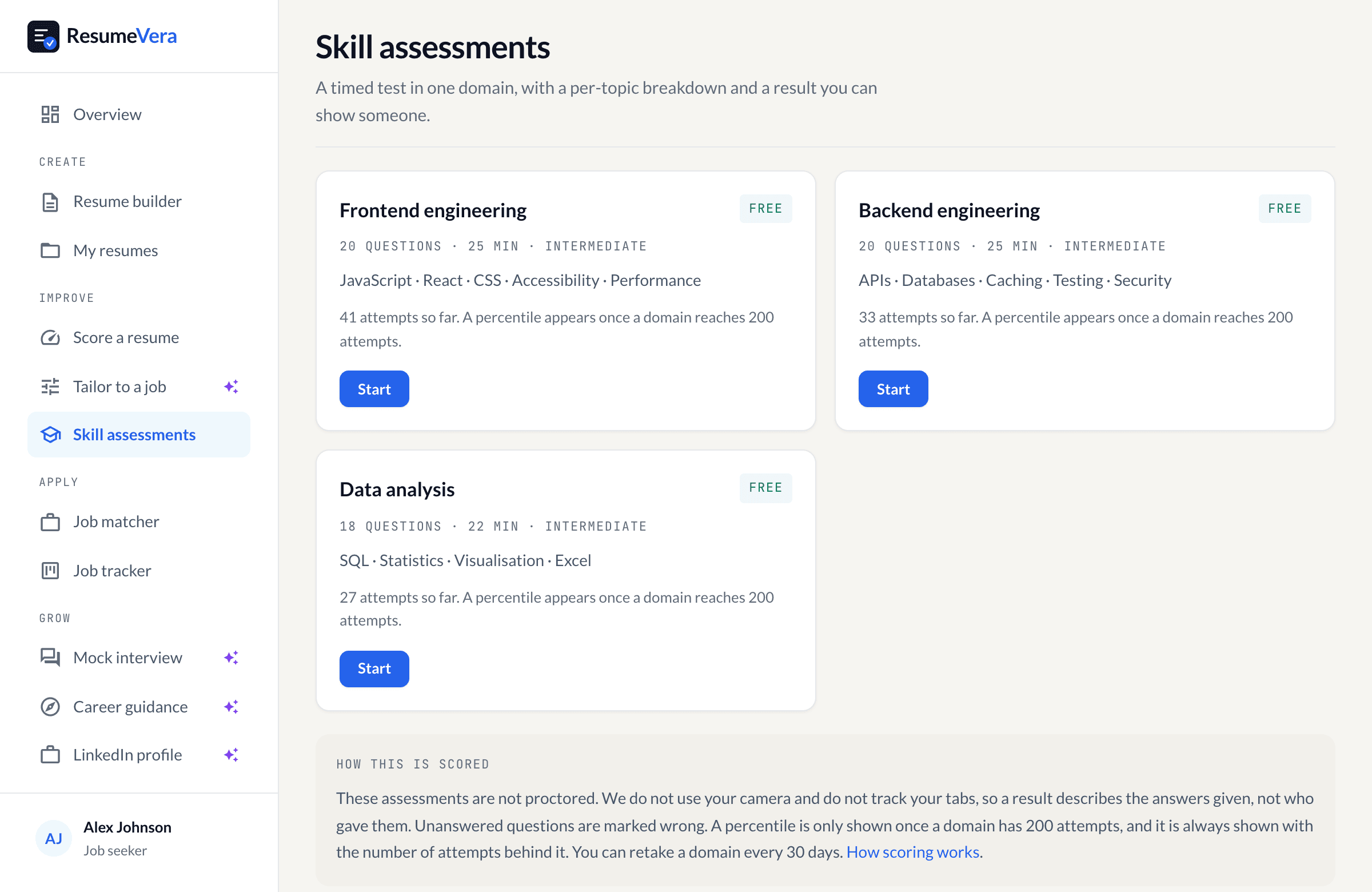
The real list. Percentiles stay hidden until a domain has enough attempts to mean anything.
Is your resume ATS-ready?
Run a free ATS score check and get specific improvements in under 60 seconds.