Communication Skills
Communication is the most in-demand skill across nearly 2 million job postings. From verbal clarity to written persuasion, mastering communication unlocks higher salaries, leadership roles, and career mobility in every industry.
#1
Most requested skill in job postings (2025)
0%
Average salary premium for strong communicators
0+
Annual job openings in communication roles
Roles that use Communication Skills, and what they pay
Median annual wage, national, May 2025
- $166,790
- $149,280
- $72,080
- $76,910
- $76,590
- $166,790*
* BLS has no code for that exact title, so it is counted under a broader occupation. The role page says which. Source: BLS OEWS. These are the roles' wages, not a premium for the skill: no published source measures what one skill adds on its own.
Market Demand
Demand & Salary Data
10% (2022-2032, BLS)
Growth Rate
$
+15-25% salary premium
Avg. Salary Impact
104,800+ annually
Job Openings
Top Industries
Learning Path
Skill Levels
Beginner
You can write clear emails, participate in team meetings, and convey basic information to colleagues. You understand the importance of active listening and can follow structured communication templates for common workplace scenarios.
Intermediate
You confidently deliver presentations, lead team discussions, and write persuasive proposals. You adapt your communication style to different audiences, handle difficult conversations professionally, and can synthesize complex information into clear summaries for stakeholders.
Advanced
You are a strategic communicator who can influence executive decision-making, negotiate high-stakes deals, and craft organizational messaging. You mentor others on communication best practices, manage crisis communications, and drive alignment across cross-functional teams.
Section 01
Why Communication Skills Matter More Than Ever in 2026
Communication has been crowned the single most in-demand skill in the modern job market, appearing in nearly 2 million job postings analyzed in late 2024 alone. According to HR Dive, employers consistently rank communication above every technical competency when screening candidates, and that trend has only intensified as remote, hybrid, and AI-augmented work environments become the norm.
The reason is straightforward: as artificial intelligence automates routine tasks, the uniquely human ability to persuade, negotiate, empathize, and collaborate becomes the differentiator that machines cannot replicate. LinkedIn's 2026 workforce data shows that soft skills now account for seven of the ten fastest-growing skills globally, with written clarity and leadership communication listed as top risers.
For job seekers, this means that a well-crafted resume highlighting communication proficiency is no longer a nice-to-have, it is a prerequisite. Hiring managers report that candidates who demonstrate strong communication skills during interviews are 30% more likely to receive offers, regardless of their technical background. Whether you are an engineer explaining architecture decisions, a marketer pitching campaign strategies, or an operations manager coordinating cross-functional teams, communication is the thread that ties performance to recognition.
The Bureau of Labor Statistics projects a 10% growth rate for media and communication occupations from 2022 to 2032, significantly faster than the average for all occupations. Entry-level roles in communications start between $35,000 and $50,000, while mid-career professionals with specialized digital skills can earn $55,000 to $85,000 or more. In high-paying sectors like technology and finance, the salary premium for strong communicators can exceed 20% above industry medians.
Section 02
Core Communication Skills Employers Look For
Understanding what employers mean by "communication skills" is essential for tailoring your resume and interview performance. The term encompasses several distinct competencies, each valued differently depending on the role and industry.
Verbal Communication is the ability to articulate ideas clearly in conversations, meetings, and presentations. Employers look for candidates who can explain complex concepts to non-technical audiences, facilitate productive discussions, and deliver compelling pitches. In sales and client-facing roles, verbal communication directly correlates with revenue generation, making it a top-tier skill for business development professionals.
Written Communication covers everything from emails and reports to proposals and documentation. In 2026, with distributed teams relying heavily on Slack, email, and project management tools, the ability to write concisely and persuasively is more critical than ever. Technical writers, content strategists, and business analysts all depend on exceptional written skills to succeed.
Active Listening is frequently underestimated but consistently cited by leadership coaches as the foundation of effective communication. Active listeners build stronger relationships, resolve conflicts faster, and make better decisions because they fully understand the perspectives of their colleagues, clients, and stakeholders.
Nonverbal Communication includes body language, tone of voice, and visual presentation skills. Even in virtual environments, maintaining eye contact with the camera, using purposeful gestures, and controlling vocal tone can dramatically improve how your message is received. Studies show that up to 55% of communication is nonverbal, making this an area where small improvements yield outsized results.
Cross-Cultural Communication has become indispensable as global teams become the standard. Professionals who can navigate cultural nuances, adapt their style for international stakeholders, and foster inclusive dialogue are in high demand at multinational corporations and remote-first companies alike.
Section 03
How to Showcase Communication Skills on Your Resume
Simply listing "communication skills" in a skills section is not enough to impress hiring managers who review hundreds of resumes. The most effective approach is to weave evidence of your communication abilities throughout your entire resume using quantifiable achievements and action-oriented language.
Use Power Verbs: Start bullet points with verbs that signal communication competence: "Presented," "Negotiated," "Authored," "Facilitated," "Collaborated," "Persuaded," "Briefed," and "Coordinated" all convey different facets of communication skill. For example, "Presented quarterly business reviews to C-suite executives, resulting in $2M additional budget allocation" tells a much stronger story than "Good communication skills."
Quantify Your Impact: Whenever possible, attach numbers to your communication achievements. How many people attended your presentations? What was the outcome of the proposal you wrote? Did your internal communications campaign increase employee engagement scores? Metrics transform vague claims into credible proof points that hiring managers trust.
Tailor to the Job Description: Analyze each job posting for specific communication requirements. If the role emphasizes stakeholder management, highlight experiences where you managed relationships with executives, clients, or cross-functional partners. If the position requires technical writing, showcase documentation projects, SOPs, or knowledge base articles you created.
Leverage Your Summary Statement: Your resume summary is prime real estate for establishing communication credibility upfront. A statement like "Results-driven marketing manager with 7 years of experience crafting data-driven narratives that increased campaign ROI by 40%" immediately positions you as someone who communicates with purpose and measurable impact.
Include Relevant Certifications: Certifications in public speaking, business writing, conflict resolution, or specific communication frameworks like Crucial Conversations or Toastmasters demonstrate investment in this skill area. ResumeVera's resume builder makes it easy to organize these credentials in a dedicated section that catches recruiter attention.
Section 04
Communication Skills Across Different Industries
While communication is universally valued, the specific expectations and applications vary significantly by industry. Understanding these nuances helps you position your skills effectively for your target sector.
Technology: In tech, communication bridges the gap between technical teams and business stakeholders. Software engineers who can explain architectural decisions to product managers, write clear technical documentation, and present sprint demos effectively are promoted faster than equally skilled peers who struggle to articulate their work. The rise of AI has made communication even more critical, as teams must collaborate to define requirements, evaluate outputs, and translate machine-generated insights into actionable strategies.
Healthcare: Patient communication, interdisciplinary team coordination, and regulatory documentation are the pillars of healthcare communication. Medical professionals who communicate empathetically with patients while maintaining clinical precision see better outcomes and higher patient satisfaction scores. Health informatics roles also require the ability to translate data into narratives that drive clinical decision-making.
Finance & Banking: Financial professionals must communicate complex data, risk assessments, and market analyses to clients who may not have a financial background. Relationship managers, financial advisors, and investment analysts all rely on clear, jargon-free communication to build trust and retain clients. The median annual wage for communication-proficient finance professionals can surpass peers by more than 20%.
Marketing & Advertising: This is perhaps the most communication-intensive field, where copywriting, brand storytelling, client presentations, and campaign briefings are daily activities. Digital communications roles in marketing frequently offer starting salaries 15-25% above traditional public relations positions, reflecting the market's premium on technical communication skills combined with creative storytelling.
Education & Training: Educators, corporate trainers, and instructional designers depend on communication to transfer knowledge effectively. The ability to simplify complex topics, engage diverse audiences, and create compelling learning materials is central to success in this sector.
Section 05
Building Communication Skills: A Practical Roadmap
Developing strong communication skills is a journey that combines structured learning with deliberate practice. Unlike purely technical skills that can be acquired through courses alone, communication improves most when practiced in real-world contexts with feedback loops.
Start with Self-Assessment: Before investing in training, evaluate your current strengths and gaps. Record yourself in a meeting or presentation and review it critically. Ask trusted colleagues for honest feedback on your written and verbal communication. Many professionals discover blind spots they were not aware of, such as filler words, unclear email structure, or a tendency to dominate conversations without inviting input.
Invest in Structured Learning: Enroll in courses that address your specific gaps. Platforms like Coursera, LinkedIn Learning, and Udemy offer specialized programs in business writing, public speaking, negotiation, and cross-cultural communication. For public speaking specifically, joining Toastmasters International provides a supportive environment with structured feedback from peers.
Practice Daily: Treat every email, meeting, and conversation as an opportunity to refine your skills. Before sending an important email, read it aloud to check for clarity and tone. Before a presentation, rehearse in front of a mirror or with a colleague. Set a weekly goal, such as asking one thoughtful question in every meeting, to build habits incrementally.
Seek Mentorship: Identify a leader in your organization whose communication style you admire and ask them to mentor you. Observe how they structure arguments, handle pushback, and adjust their style for different audiences. Many executives are willing to share their communication strategies with motivated professionals, and this kind of observational learning accelerates growth faster than any course.
Embrace Feedback: After presentations, client calls, or important written deliverables, actively solicit feedback. Create a simple framework: What worked well? What could be clearer? What should I do differently next time? Over time, this habit transforms feedback from something uncomfortable into a powerful growth engine that continuously sharpens your communication edge.
Section 06
The Future of Communication in an AI-Driven Workplace
As AI transforms how we work, communication skills are not diminishing in importance; they are becoming the most valuable differentiator in the labor market. The World Economic Forum's Future of Jobs Report 2025 confirms that as AI handles increasingly routine tasks, the skills that machines cannot replicate, including communication, conflict resolution, leadership, and cross-cultural fluency, are commanding a higher premium.
AI as a Communication Amplifier: Forward-thinking professionals are using AI tools like ChatGPT, Grammarly, and Jasper to draft, edit, and refine their communications. However, the human judgment required to determine the right message, tone, audience, and timing remains irreplaceable. Professionals who can leverage AI to handle first drafts while adding strategic human insight to the final output will be the most productive communicators of the next decade.
Remote and Hybrid Communication: With remote work now a permanent fixture for millions of professionals, asynchronous communication skills have become essential. The ability to write clear, context-rich messages that do not require follow-up clarification saves organizations thousands of hours annually. Similarly, running effective virtual meetings, maintaining engagement through video calls, and building rapport without in-person interaction are skills that separate high performers from the rest.
Data Storytelling: As organizations become increasingly data-driven, the ability to translate numbers into narratives that drive action is one of the hottest communication sub-skills in 2026. Data storytelling combines analytical thinking with persuasive communication, enabling professionals to influence decisions at every level of the organization. Roles that blend data analysis with communication, such as business intelligence analysts and product managers, often command salaries 20-30% above pure technical positions.
Preparing Your Resume for the Future: To stay competitive, continuously update your resume with examples that demonstrate modern communication competencies: virtual facilitation, AI-assisted content creation, data storytelling, and cross-cultural collaboration. ResumeVera's free resume analyzer can help you identify gaps in how your communication skills are presented and suggest improvements tailored to your target role.
Related Roles
Roles That Use This Skill
Explore resume examples for roles that commonly require this skill.
Questions
Frequently asked questions
Skill Guides
Explore More Skills
Browse all our in-demand skill guides with demand data and learning paths.
View All SkillsProve it
Claiming a skill and demonstrating one are different things
A timed assessment puts a result behind the word on your resume. Question count and duration are shown up front, and percentiles stay hidden until a domain has enough attempts to mean anything.
Join the waitlist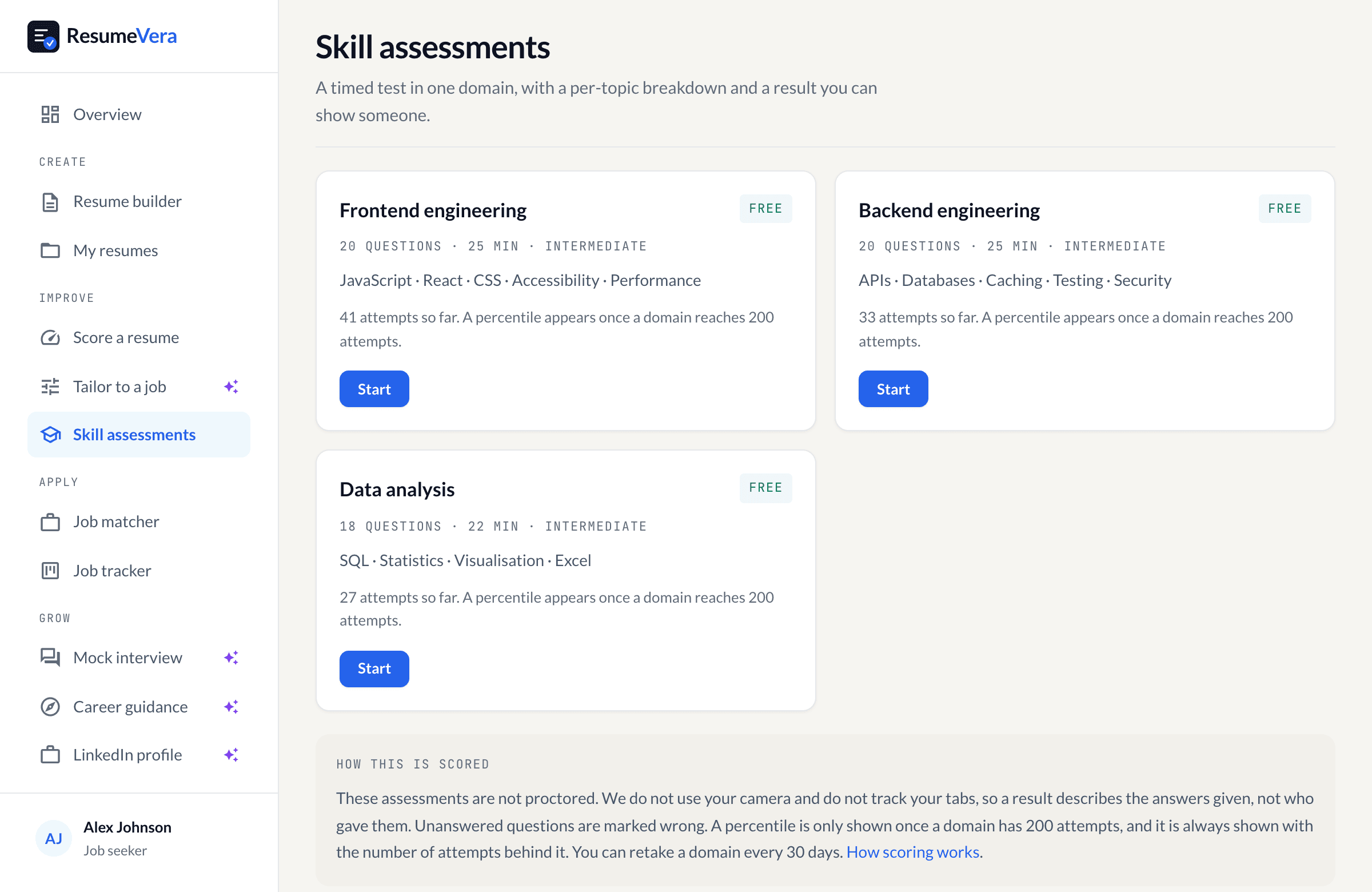
The real list. Percentiles stay hidden until a domain has enough attempts to mean anything.
Is your resume ATS-ready?
Run a free ATS score check and get specific improvements in under 60 seconds.