Data Analysis
Data analysis is one of the fastest-growing career fields with 34% projected job growth through 2034. The average data analyst salary has jumped to $111,000 in 2026, and the global analytics market is projected to reach $104 billion by year-end.
0%
Projected job growth for data professionals (2024-2034)
$0K
Average data analyst salary in 2026
$0B
Global data analytics market size (2026)
Roles that use Data Analysis, and what they pay
Median annual wage, national, May 2025
- $105,650*
- $101,860*
- $166,790*
- $166,790
- $105,770
* BLS has no code for that exact title, so it is counted under a broader occupation. The role page says which. Source: BLS OEWS. These are the roles' wages, not a premium for the skill: no published source measures what one skill adds on its own.
Market Demand
Demand & Salary Data
34% (2024-2034, BLS)
Growth Rate
$
+$20K salary increase since 2025
Avg. Salary Impact
Top 15% of in-demand tech roles
Job Openings
Top Industries
Learning Path
Skill Levels
Beginner
You can work with spreadsheets in Excel or Google Sheets, create basic pivot tables, and interpret simple charts. You understand fundamental statistics concepts like mean, median, and standard deviation, and can clean small datasets for analysis.
Intermediate
You write SQL queries to extract and manipulate data from relational databases, build dashboards in Tableau or Power BI, and perform statistical analyses using Python or R. You can identify trends, create compelling visualizations, and present data-driven recommendations to stakeholders.
Advanced
You design and implement end-to-end analytics pipelines, build predictive models using machine learning, and drive strategic business decisions through advanced statistical analysis. You mentor junior analysts, define data governance standards, and translate complex analytical findings into executive-level narratives.
Section 01
Why Data Analysis Skills Are Essential in 2026
The demand for data analysis skills has reached an inflection point in 2026. The U.S. Bureau of Labor Statistics projects that job openings for data professionals will grow by 34% between 2024 and 2034, making it one of the fastest-growing career fields in the economy. This is not just a tech sector phenomenon; finance, healthcare, marketing, e-commerce, and supply chain management are all competing fiercely for professionals who can turn raw data into actionable insights.
The salary trajectory tells the story of this demand clearly. Data analyst salaries have increased by $20,000 since early 2025, with the current average at $111,000. For comparison, data scientists command approximately $155,000, illustrating the premium placed on advanced analytical skills. The global data analytics market is projected to reach $104.39 billion by the end of 2026, growing at a massive annual rate of 21.5%, which means the organizations investing in analytics need the human talent to match their technology investments.
Robert Half's 2025 In-Demand Technology Roles report ranked data analysts among the top 15% of in-demand positions, and the demand has only accelerated. Companies across every sector now recognize that data-driven decision-making is not optional but essential for competitive survival. From optimizing marketing spend to predicting patient outcomes, from managing inventory to detecting fraud, data analysis underpins the most critical business functions.
For job seekers, this creates an exceptional opportunity. The combination of high demand, rising salaries, and a relatively accessible learning curve (compared to fields like machine learning engineering) makes data analysis one of the best career investments available in 2026. Whether you are entering the workforce, transitioning from another field, or upskilling in your current role, developing data analysis competency will dramatically improve your career trajectory.
Section 02
The Most In-Demand Data Analysis Skills
The data analysis landscape in 2026 is defined by a clear hierarchy of technical skills, each serving a specific function in the analyst's toolkit. Job posting analysis reveals exactly what employers prioritize when hiring data professionals.
SQL (Structured Query Language): SQL remains the foundational skill for data analysts, referenced in the majority of job postings. The ability to write complex queries involving joins, subqueries, window functions, and CTEs (Common Table Expressions) is considered non-negotiable for any data role. SQL is the language that connects analysts to the databases where business data lives, making it the first skill every aspiring analyst should master.
Microsoft Excel: Despite the proliferation of advanced tools, Excel appears in 41.3% of data analyst job postings. Advanced Excel skills, including VLOOKUP/XLOOKUP, pivot tables, Power Query, conditional formatting, and basic VBA macros, remain essential for quick analysis, ad-hoc reporting, and stakeholder communication. Many hiring managers use Excel proficiency tests during interviews.
Data Visualization (Tableau and Power BI): Tableau (28.1%) and Power BI (24.7%) are the most in-demand visualization tools in 2026. The ability to create interactive dashboards, design clear visual narratives, and build self-service analytics platforms that empower business users to explore data independently is a skill that directly impacts salary and career progression. Analysts who can tell stories with data visualizations earn significantly more than those who deliver only raw numbers.
Python and R: Statistical programming skills using Python (pandas, NumPy, scikit-learn, matplotlib) or R enable analysts to handle larger datasets, perform advanced statistical analyses, and build predictive models. Python has emerged as the dominant language due to its versatility and extensive library ecosystem. Analysts with Python skills typically command 15-20% higher salaries than Excel-only analysts.
Statistical Analysis and Machine Learning: Understanding probability, hypothesis testing, regression analysis, clustering, and basic machine learning concepts distinguishes data analysts who can provide strategic insights from those who only produce descriptive reports. Job posting analysis shows that 69.3% of positions seek domain experts with specialized skills in these areas, indicating that depth of knowledge is increasingly valued over breadth.
Section 03
How to Showcase Data Analysis Skills on Your Resume
Data analysis is a field where your resume can directly demonstrate the skills you claim to have. The best data analyst resumes use the same principles that define good analysis: clarity, precision, quantification, and actionable insight.
Create a Dedicated Technical Skills Section: List your tools and technologies in a structured format that is easy for both ATS systems and human reviewers to scan. Organize by category: Programming Languages (SQL, Python, R), Visualization Tools (Tableau, Power BI, Looker), Databases (PostgreSQL, MySQL, BigQuery, Snowflake), and Statistical Methods (regression, A/B testing, time series analysis). This section should appear near the top of your resume for data-focused roles.
Quantify Every Achievement: Data analysts should be the best at quantifying their own impact. Instead of writing "Analyzed sales data," write "Built automated sales dashboard in Tableau tracking $45M annual revenue across 12 regions, reducing reporting time by 80% and enabling real-time decision-making for VP of Sales." Every bullet point should answer: What did you analyze? What tool did you use? What was the business impact? How much time, money, or effort did it save?
Showcase Projects: If you are early in your career or transitioning into data analysis, include a "Projects" section highlighting personal or portfolio projects. Kaggle competitions, open-source data analysis notebooks, and self-directed projects using public datasets demonstrate practical skill even without formal work experience. Describe each project with the same rigor you would apply to professional experience: problem statement, methodology, tools used, and findings.
Highlight Domain Expertise: The job market data shows that 69.3% of data analyst positions seek domain experts rather than pure generalists. If you have deep knowledge of a specific industry, healthcare, finance, marketing, or supply chain, make it prominent. "Healthcare data analyst with 4 years of experience analyzing clinical trial data and building patient outcome prediction models" is far more compelling than "Data analyst with experience across multiple industries."
Include Certifications: Google Data Analytics Professional Certificate, IBM Data Analyst Professional Certificate, Microsoft Certified: Data Analyst Associate (Power BI), and Tableau Desktop Specialist are all resume boosters that validate your skills. Use ResumeVera's resume builder to create a structured resume that presents your data analysis portfolio in the most impactful format.
Section 04
Data Analysis Career Paths and Salary Progression
Data analysis offers one of the clearest and most rewarding career progression paths in the modern economy. Understanding the trajectory from entry-level analyst to senior data leader helps you plan your skill development and set realistic salary expectations.
Junior/Entry-Level Data Analyst ($55,000-$75,000): Entry-level analysts typically work with Excel and SQL, create basic reports and dashboards, and support senior analysts on larger projects. The focus at this stage is building technical proficiency and understanding business context. Most junior analysts spend 1-2 years at this level before advancing. Demand is strong, as companies need analysts who can handle the growing volume of data generated by digital operations.
Mid-Level Data Analyst ($80,000-$111,000): At the mid-level, analysts independently manage analysis projects, build and maintain dashboards, write complex SQL queries, and begin using Python or R for advanced analysis. They present findings to stakeholders and contribute to strategic decision-making. The average data analyst salary of $111,000 in 2026 reflects this mid-career sweet spot where technical skills and business acumen converge.
Senior Data Analyst ($110,000-$140,000): Senior analysts lead analysis teams, define analytics strategies, build predictive models, and serve as the primary data resource for business leaders. They mentor junior team members, establish data governance practices, and translate complex analytical findings into executive-level narratives that drive organizational strategy.
Data Scientist ($130,000-$155,000+): Many data analysts transition into data science by deepening their machine learning, statistical modeling, and programming skills. Glassdoor estimates the average U.S. data scientist salary at about $155,000 in 2026. Data scientists design and implement advanced models, run experiments, and develop AI-powered solutions.
Analytics Manager/Director ($140,000-$200,000+): Leadership roles in analytics combine technical expertise with team management, budget oversight, and strategic planning. Analytics directors define the data strategy for their organization, hire and develop talent, and serve as the bridge between technical teams and C-suite executives. These roles represent the peak earning potential for professionals who started in data analysis.
Section 05
Data Analysis Tools and Technologies in 2026
The data analysis toolkit continues to evolve rapidly, with AI-powered features transforming how analysts work. Staying current with the most in-demand tools is essential for maintaining competitive advantage in the job market.
SQL and Database Technologies: SQL remains the lingua franca of data analysis. Cloud data warehouses like Snowflake, Google BigQuery, Amazon Redshift, and Databricks have become the standard infrastructure for enterprise analytics, replacing traditional on-premise databases. Analysts who can write optimized queries against these platforms and understand concepts like partitioning, indexing, and query optimization are in high demand. Knowledge of dbt (data build tool) for transforming data within the warehouse is increasingly expected at the mid and senior levels.
Python Ecosystem: Python's dominance in data analysis continues to grow thanks to its rich library ecosystem. pandas for data manipulation, NumPy for numerical computing, matplotlib and seaborn for visualization, scikit-learn for machine learning, and Jupyter notebooks for interactive analysis form the core toolkit. In 2026, familiarity with Polars (a faster alternative to pandas) and AI-assisted coding tools is becoming a differentiator for advanced analysts.
Business Intelligence Platforms: Tableau and Power BI dominate the visualization landscape, but Looker (Google), Metabase, and Sigma Computing are gaining ground, particularly in cloud-native organizations. The trend is toward self-service analytics platforms that empower business users to explore data without analyst intervention, which means analysts are increasingly expected to design scalable dashboards and data models rather than produce one-off reports.
AI and Automation: AI is transforming data analysis from the ground up. Natural language querying allows stakeholders to ask questions of data in plain English. Automated anomaly detection flags unusual patterns without manual monitoring. AI-powered data cleaning reduces the time analysts spend on data preparation, which traditionally consumed 60-80% of their time. Analysts who embrace AI tools as productivity multipliers rather than viewing them as threats will be the most effective and highest-paid professionals in the field.
Cloud Platforms: Familiarity with at least one major cloud platform (AWS, Google Cloud, or Azure) is increasingly expected for data analysts. Understanding cloud storage, data pipelines, and serverless computing enables analysts to work with datasets at scale and collaborate effectively with data engineers and scientists. Cloud certifications from these providers add meaningful value to a data analyst resume.
Section 06
Breaking Into Data Analysis: A Complete Roadmap
Data analysis is one of the most accessible high-paying career paths because it rewards practical skill over formal credentials. Whether you are a recent graduate, a career changer, or a professional looking to upskill, here is a structured approach to building your data analysis career.
Phase 1: Foundations (Months 1-3): Start with Excel and SQL. Master pivot tables, VLOOKUP/XLOOKUP, conditional formulas, and data cleaning in Excel. Simultaneously, learn SQL through free platforms like SQLZoo, Mode Analytics, or DataCamp. Focus on SELECT statements, JOINs, GROUP BY, subqueries, and window functions. Complete at least 50 practice problems to build fluency. By the end of this phase, you should be able to analyze any structured dataset using Excel and extract data from relational databases using SQL.
Phase 2: Visualization and Statistics (Months 3-6): Learn either Tableau (more common in consulting and enterprises) or Power BI (dominant in Microsoft-centric organizations). Build 3-5 portfolio dashboards using public datasets from Kaggle, data.gov, or UCI Machine Learning Repository. Simultaneously, study descriptive statistics, probability, hypothesis testing, and basic regression analysis. These concepts are tested in most data analyst interviews and are essential for producing credible analysis.
Phase 3: Python and Advanced Analysis (Months 6-10): Learn Python with a focus on pandas, NumPy, and matplotlib. Build projects that combine data extraction (SQL), manipulation (Python), and visualization (Tableau/Power BI). This is where you transition from being a reporting analyst to a true analytical thinker who can conduct exploratory analysis, identify patterns, and build basic predictive models.
Phase 4: Portfolio and Job Search (Months 10-12): Create a portfolio of 5-8 projects that demonstrate your range of skills. Write up your methodology, findings, and business implications for each project. Obtain at least one certification (Google Data Analytics, Microsoft Power BI, or Tableau Desktop Specialist). Build your resume using ResumeVera's resume builder to present your skills, projects, and certifications in a format optimized for data analyst positions. Use the free resume analyzer to ensure your resume passes ATS screening and effectively communicates your analytical value.
Ongoing Growth: Data analysis is a field where continuous learning is not optional. Follow industry publications, join analytics communities, participate in Kaggle competitions, and stay current with emerging tools and techniques. The analysts who invest in continuous skill development are the ones who command the highest salaries and advance most quickly into leadership positions.
Related Roles
Roles That Use This Skill
Explore resume examples for roles that commonly require this skill.
Questions
Frequently asked questions
Skill Guides
Explore More Skills
Browse all our in-demand skill guides with demand data and learning paths.
View All SkillsProve it
Claiming a skill and demonstrating one are different things
A timed assessment puts a result behind the word on your resume. Question count and duration are shown up front, and percentiles stay hidden until a domain has enough attempts to mean anything.
Join the waitlist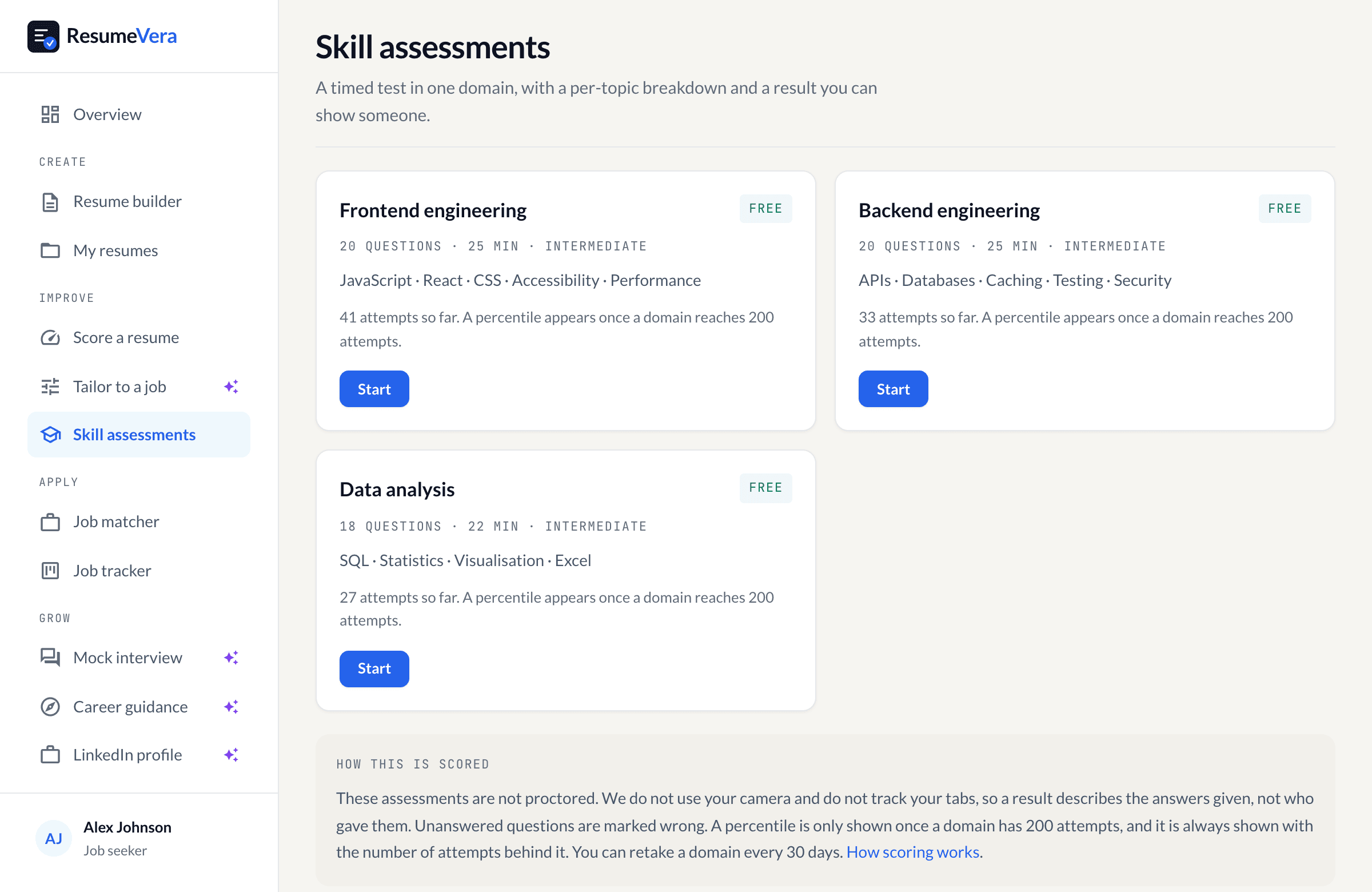
The real list. Percentiles stay hidden until a domain has enough attempts to mean anything.
Is your resume ATS-ready?
Run a free ATS score check and get specific improvements in under 60 seconds.