Node.js Backend Development
Build scalable, event-driven server-side applications with JavaScript and TypeScript. Node.js powers the backends of Netflix, LinkedIn, PayPal, and thousands of high-growth startups.
$0
Average Annual Salary
0+
US Job Openings
0%
Demand Growth Rate
Roles that use Node.js Backend Development, and what they pay
Median annual wage, national, May 2025
- $135,980
- $135,980*
- $135,980*
- $135,980*
- $135,980*
* BLS has no code for that exact title, so it is counted under a broader occupation. The role page says which. Source: BLS OEWS. These are the roles' wages, not a premium for the skill: no published source measures what one skill adds on its own.
Market Demand
Demand & Salary Data
23%
Growth Rate
$
+$18,000
Avg. Salary Impact
49,000+
Job Openings
Top Industries
Learning Path
Skill Levels
Beginner
Understand core JavaScript, basic Node.js runtime concepts, npm package management, building simple REST APIs with Express.js, and connecting to databases like MongoDB or PostgreSQL.
Intermediate
Build production-ready APIs with TypeScript and NestJS or Fastify, implement authentication and authorization, write comprehensive tests, use Docker for containerization, and deploy to cloud platforms.
Advanced
Design and implement microservices architectures, optimize performance at scale, implement CI/CD pipelines, manage distributed systems with message queues and event-driven patterns, and lead technical teams.
Section 01
What Is Node.js and Why Does It Matter?
Node.js is an open-source, cross-platform JavaScript runtime environment built on Chrome's V8 engine. It enables developers to execute JavaScript on the server side, creating a unified language experience across the entire web development stack. Since its creation by Ryan Dahl in 2009, Node.js has fundamentally transformed how modern web applications are built, deployed, and scaled.
At its core, Node.js uses an event-driven, non-blocking I/O model that makes it exceptionally efficient for handling concurrent connections. Unlike traditional server-side technologies that create a new thread for each incoming request, Node.js operates on a single-threaded event loop that can handle thousands of simultaneous connections with minimal overhead. This architecture makes it particularly well-suited for real-time applications, streaming services, and API-heavy backends.
In 2026, Node.js continues to dominate the backend development landscape. Companies like Netflix, LinkedIn, PayPal, Uber, and NASA rely on Node.js for mission-critical applications. Netflix reduced its startup time by 70% after migrating to Node.js, while PayPal saw a 35% decrease in average response time. The npm ecosystem, with over 2 million packages, remains the largest software registry in the world, giving developers access to an unparalleled library of tools and modules.
The rise of AI-integrated backends has further cemented Node.js as a critical skill. Modern applications increasingly require real-time communication between AI services, databases, and front-end interfaces, and Node.js's asynchronous architecture handles these workflows with remarkable efficiency. Whether you are building RESTful APIs, GraphQL servers, microservices architectures, or serverless functions, Node.js provides the foundation for modern backend development.
- Unified language stack — Use JavaScript or TypeScript across frontend and backend
- Massive ecosystem — Over 2 million npm packages available
- Enterprise adoption — Used by Fortune 500 companies worldwide
- Cloud-native — First-class support across AWS, Azure, and Google Cloud
Section 02
Why Node.js Skills Matter for Your Career in 2026
The demand for Node.js developers has surged significantly in recent years, driven by the growing need for scalable backend systems, real-time applications, and cloud-native architectures. According to Glassdoor, the average Node.js developer salary in the United States is $144,026 per year, with a range spanning from $103,000 for entry-level positions to $195,000 or more for senior engineers. LinkedIn currently lists over 49,000 active Node.js job openings across the US, reflecting the massive and sustained demand for this skill.
Several key trends are driving Node.js career growth in 2026. First, AI-integrated backends are becoming standard across industries. Companies are building intelligent APIs that connect machine learning models to user-facing applications, and Node.js's event-driven architecture is ideal for orchestrating these complex workflows. Second, the explosion of real-time applications — from collaborative tools to live streaming platforms — requires the kind of concurrent connection handling that Node.js excels at.
Cloud computing represents another major growth driver. All major cloud providers offer robust Node.js support for serverless computing, containerized deployments, and edge functions. AWS Lambda, Google Cloud Functions, and Azure Functions all treat Node.js as a first-class runtime, making it essential for developers working in cloud environments. The rise of edge computing with platforms like Cloudflare Workers and Vercel Edge Functions has further expanded Node.js's relevance.
Perhaps most importantly, TypeScript has become mandatory for Node.js developers in 2026. The combination of TypeScript's type safety with Node.js's runtime performance creates a powerful development experience that enterprise teams demand. Developers who can demonstrate proficiency in both TypeScript and Node.js command significantly higher salaries and have access to the most competitive positions. Senior Node.js developers with TypeScript expertise earn around $195,033 annually, placing them among the highest-paid backend specialists in the industry.
- High earning potential — Salaries range from $103K to $195K+ depending on experience
- Remote-friendly — Node.js roles are among the most remote-accessible in tech
- Rapid advancement — Strong Node.js skills can accelerate promotion to senior and lead roles
- Startup appeal — Node.js is the top choice for startup backends due to development speed
AI-integrated backend development
Fastest growing segment
Real-time application architecture
WebSocket and SSE expertise
Cloud-native and serverless computing
AWS, GCP, Azure
TypeScript-first development
Now considered mandatory
Microservices and API design
REST and GraphQL
Section 03
Essential Node.js Skills to Learn and Master
Building a strong Node.js skill set requires mastering a layered progression of technologies, patterns, and best practices. Whether you are just starting out or looking to advance to a senior role, understanding which skills to prioritize is critical for career success. Here is a comprehensive breakdown of the essential Node.js competencies that employers look for in 2026.
Core Runtime and Language Fundamentals form the foundation. You must deeply understand the Node.js event loop, asynchronous programming with Promises and async/await, streams and buffers, the module system (both CommonJS and ES modules), and error handling patterns. Mastery of JavaScript fundamentals including closures, prototypal inheritance, and functional programming concepts is assumed.
TypeScript proficiency is no longer optional. Modern Node.js development requires strong typing, interfaces, generics, decorators, and advanced type utilities. Employers expect candidates to write type-safe backend code, define API contracts with TypeScript interfaces, and leverage tools like ts-node and tsx for development workflows. Understanding TypeScript configuration, strict mode, and integration with build tools like esbuild or SWC is essential.
Framework expertise is equally important. The most in-demand frameworks include Express.js for lightweight APIs, NestJS for enterprise-grade applications with dependency injection and modular architecture, and Fastify for high-performance HTTP servers. Knowledge of middleware patterns, routing, request validation with libraries like Zod or Joi, and authentication using JWT and OAuth2 is expected across all frameworks.
On the database side, Node.js developers need experience with both SQL databases (PostgreSQL, MySQL) using ORMs like Prisma or Drizzle, and NoSQL databases (MongoDB, Redis, DynamoDB). Understanding query optimization, connection pooling, migrations, and data modeling patterns is critical for building production-grade applications.
- Event loop and async patterns — Promises, async/await, streams, workers
- TypeScript — Type-safe backend development with strict configuration
- API design — REST, GraphQL (Apollo Server), gRPC, and WebSockets
- Testing — Jest, Vitest, Supertest for integration testing, and load testing tools
- DevOps integration — Docker, CI/CD pipelines, Kubernetes, and monitoring with tools like Datadog or New Relic
- Security — OWASP best practices, input sanitization, rate limiting, CORS, and helmet.js
Section 04
How to Showcase Node.js Skills on Your Resume
Your resume is your first opportunity to demonstrate your Node.js expertise to hiring managers and applicant tracking systems (ATS). A well-crafted resume that strategically highlights your backend development skills can be the difference between landing an interview and being passed over. Here are detailed strategies for making your Node.js experience shine on your resume.
Lead with quantifiable achievements rather than listing responsibilities. Instead of writing "Built APIs using Node.js," write "Architected and deployed a Node.js microservices API handling 50,000+ requests per minute with 99.9% uptime, reducing response times by 40% through query optimization and Redis caching." Hiring managers want to see the impact of your work, not just the tools you used. Include metrics like response times, throughput, uptime percentages, cost savings, and team productivity improvements.
Structure your skills section strategically. Create clear categories that ATS systems can parse: list "Node.js" and "TypeScript" as primary skills, then organize supporting technologies into groups like Frameworks (Express.js, NestJS, Fastify), Databases (PostgreSQL, MongoDB, Redis), Cloud Services (AWS Lambda, EC2, S3), and DevOps (Docker, Kubernetes, GitHub Actions). This structure helps both automated systems and human reviewers quickly assess your technical breadth.
Include a projects section that demonstrates practical application. Describe the problem you solved, the Node.js architecture you designed, and the results you achieved. If you have open-source contributions to Node.js projects, npm packages you have published, or technical blog posts about Node.js topics, include these as they demonstrate thought leadership and community engagement.
Tailor your resume for each application. Review the job description carefully and mirror the specific Node.js technologies mentioned. If the role emphasizes NestJS, ensure your NestJS experience is prominently featured. If it focuses on serverless, highlight your AWS Lambda and cloud function experience. Use ResumeVera's AI-powered resume analyzer to identify gaps between your resume and target job descriptions, ensuring your Node.js skills are optimally positioned for each opportunity.
- Use action verbs — Architected, optimized, deployed, scaled, migrated, automated
- Include version numbers — Mention Node.js 20/22, TypeScript 5.x to show currency
- Highlight certifications — AWS Certified Developer, OpenJS Node.js certification
- Show progression — Demonstrate growth from individual contributor to technical leadership
Section 05
Industry Applications and Real-World Use Cases
Node.js has become the backbone of backend development across virtually every major industry. Understanding where and how Node.js is applied in production environments helps you position your skills for maximum career impact and demonstrates to employers that you understand the business value of the technology, not just its syntax.
Financial Technology (FinTech) is one of the largest adopters of Node.js. Companies like PayPal, Stripe, and Square use Node.js for payment processing APIs, real-time fraud detection systems, and customer-facing banking applications. The ability to handle thousands of concurrent transactions with low latency makes Node.js ideal for financial services. If you are targeting FinTech roles, emphasize your experience with secure API development, data encryption, compliance frameworks, and high-availability architectures.
E-commerce and Retail platforms rely heavily on Node.js for catalog management, shopping cart APIs, recommendation engines, and order processing systems. Companies like Walmart, eBay, and Groupon migrated to Node.js to handle peak traffic during events like Black Friday. Node.js's ability to serve server-rendered pages with frameworks like Next.js while simultaneously powering backend APIs makes it uniquely valuable in this sector.
Healthcare and Life Sciences increasingly use Node.js for patient portal backends, telemedicine platforms, and health data integration APIs. The need for HIPAA-compliant, real-time communication between healthcare providers and patients has driven adoption of Node.js-based WebSocket servers and secure API gateways. Developers with Node.js and healthcare compliance knowledge are in exceptionally high demand.
Media and Entertainment is another major sector. Netflix famously rebuilt its entire user interface platform on Node.js, and streaming services worldwide use it for content delivery APIs, real-time chat systems, and live event streaming backends. The gaming industry uses Node.js for multiplayer game servers, matchmaking systems, and in-game communication platforms.
Additional industries where Node.js skills are highly valued include:
- Cloud and SaaS — Multi-tenant application backends, API gateways, and webhook processing
- Internet of Things (IoT) — Device management APIs, real-time sensor data processing, and MQTT brokers
- Artificial Intelligence — API layers for ML model serving, data pipeline orchestration, and AI agent backends
- Logistics and Supply Chain — Real-time tracking systems, route optimization APIs, and inventory management
- Education Technology — Learning management systems, real-time collaboration tools, and assessment platforms
Section 06
Node.js Development Best Practices and Architecture Patterns
Writing production-grade Node.js applications requires more than just knowing the syntax. Employers value developers who understand architectural patterns, security best practices, performance optimization, and operational excellence. Demonstrating these competencies on your resume and in interviews sets you apart from junior candidates and positions you for senior-level roles.
Microservices architecture has become the dominant pattern for Node.js applications at scale. Rather than building monolithic servers, modern teams decompose applications into small, independently deployable services that communicate via REST APIs, message queues (RabbitMQ, Apache Kafka, AWS SQS), or gRPC. Understanding service discovery, circuit breaker patterns with libraries like opossum, distributed tracing with OpenTelemetry, and eventual consistency is essential for senior Node.js roles.
Security-first development is non-negotiable. Node.js developers must implement input validation and sanitization, parameterized database queries, rate limiting, CORS policies, Content Security Policy headers, and JWT-based authentication with proper token rotation. Familiarity with the OWASP Top 10 vulnerabilities and how to mitigate them in Node.js applications is an interview staple. Tools like helmet.js, express-rate-limit, and csurf should be part of every developer's toolkit.
Performance optimization separates good Node.js developers from great ones. This includes understanding the event loop and avoiding blocking operations, implementing caching strategies with Redis or in-memory caches, using worker threads for CPU-intensive tasks, optimizing database queries with proper indexing and connection pooling, and implementing response compression. Profiling tools like the built-in Node.js profiler, clinic.js, and 0x for flame graph generation are valuable skills to highlight.
Testing and quality assurance are critical for production systems. A comprehensive testing strategy includes unit tests with Jest or Vitest, integration tests with Supertest, end-to-end tests, contract testing for microservices, and load testing with tools like k6 or Artillery. Aim for meaningful code coverage, and implement continuous integration pipelines that run tests automatically on every commit.
- Clean architecture — Separation of concerns with controllers, services, and repositories
- Error handling — Centralized error middleware, structured logging with Winston or Pino
- Containerization — Multi-stage Docker builds, optimized Node.js images, health checks
- Monitoring — APM tools, custom metrics, alerting, and SLO/SLA tracking
- Documentation — OpenAPI/Swagger specs, API versioning, and changelog management
Related Roles
Roles That Use This Skill
Explore resume examples for roles that commonly require this skill.
Questions
Frequently asked questions
Skill Guides
Explore More Skills
Browse all our in-demand skill guides with demand data and learning paths.
View All SkillsProve it
Claiming a skill and demonstrating one are different things
A timed assessment puts a result behind the word on your resume. Question count and duration are shown up front, and percentiles stay hidden until a domain has enough attempts to mean anything.
Join the waitlist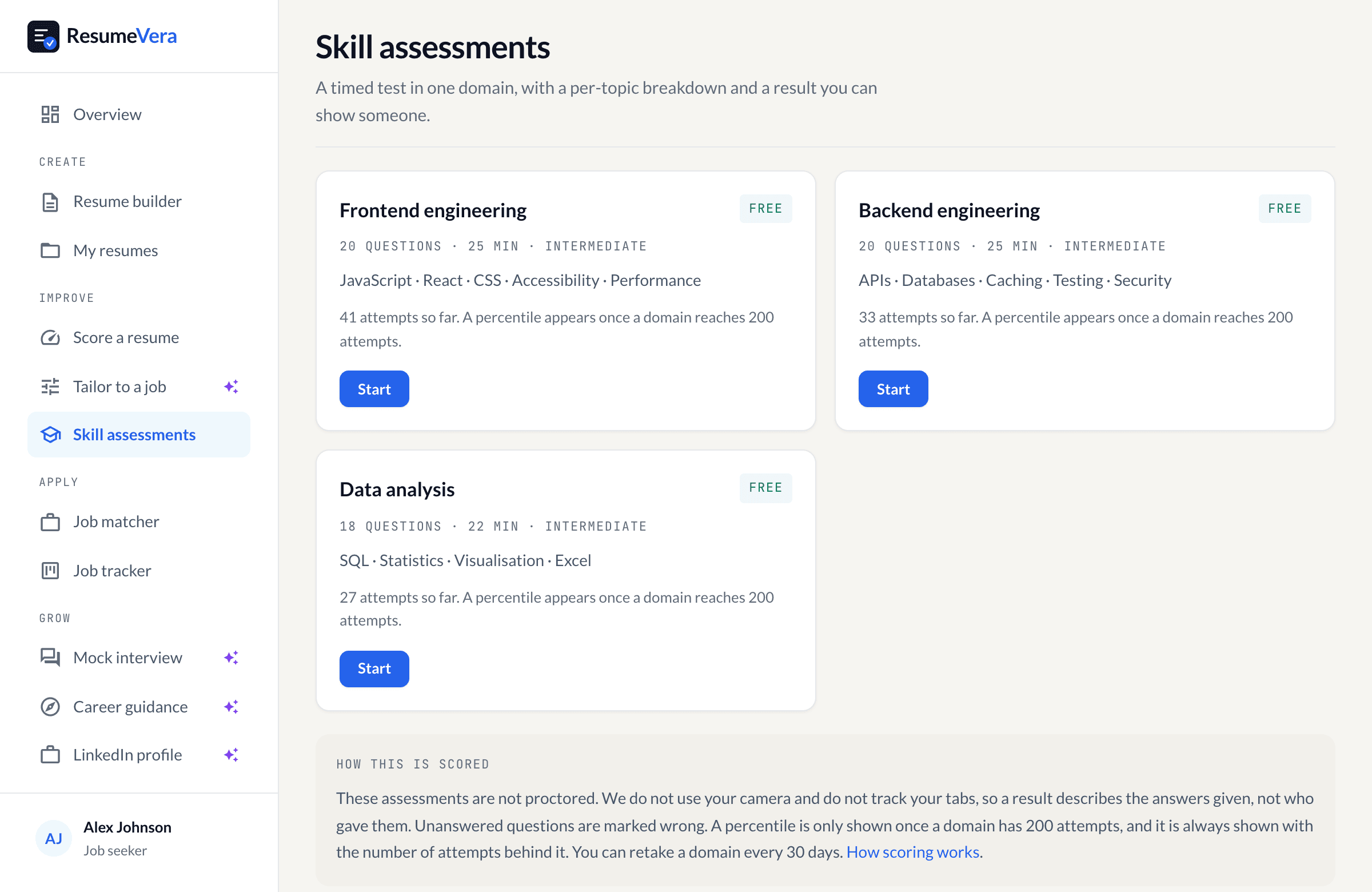
The real list. Percentiles stay hidden until a domain has enough attempts to mean anything.
Is your resume ATS-ready?
Run a free ATS score check and get specific improvements in under 60 seconds.