Project Management
With a global talent gap approaching 30 million by 2035, project management is one of the most critical and rewarding skill sets in the modern economy. PMP-certified professionals earn up to 44% more than non-certified peers.
0M
Global PM talent gap projected by 2035 (PMI)
$0K
Median total pay for project managers in 2026
0%
Salary premium for PMP certification holders
Roles that use Project Management, and what they pay
Median annual wage, national, May 2025
- $102,320
- $166,790*
- $105,770
- $101,860*
- $48,520
* BLS has no code for that exact title, so it is counted under a broader occupation. The role page says which. Source: BLS OEWS. These are the roles' wages, not a premium for the skill: no published source measures what one skill adds on its own.
Market Demand
Demand & Salary Data
7% (2023-2033, BLS)
Growth Rate
$
+33-44% with PMP certification
Avg. Salary Impact
77,000+ annually (US)
Job Openings
Top Industries
Learning Path
Skill Levels
Beginner
You can create basic project plans, track tasks using tools like Trello or Asana, and coordinate small team activities. You understand project lifecycle phases and can manage simple timelines and deliverables with guidance from senior team members.
Intermediate
You independently manage medium-complexity projects using Agile or Waterfall methodologies. You create detailed project schedules, manage budgets, run sprint ceremonies, mitigate risks proactively, and communicate status effectively to stakeholders at multiple levels.
Advanced
You lead program-level initiatives spanning multiple teams and budgets exceeding $1M. You define project management standards for your organization, mentor junior PMs, manage executive-level stakeholder relationships, and drive strategic alignment between project outcomes and business objectives.
Section 01
Why Project Management Skills Are in Critical Demand
The global demand for project management professionals has reached unprecedented levels. According to the Project Management Institute's latest Talent Gap report, up to 30 million new project professionals will be needed worldwide by 2035 to meet growing demand across every major industry. This is not a distant forecast; the shortage is already impacting organizations today, with 71% of companies reporting that their employees need more project management skills.
The project management workforce in 2025 is estimated at 40 million globally, already larger than the combined global totals of nurses and software developers. Yet the gap continues to widen as industries become increasingly project-oriented. Construction alone needs to close a talent gap of nearly 3 million project professionals, while information services and publishing organizations face 5.5 million new openings due to expansion and attrition.
For individual professionals, this supply-demand imbalance translates directly into career opportunity and earning power. The median total pay for a project manager in 2026 is $136,000, with salary ranges spanning from $104,000 to $183,000 per year depending on experience, industry, and certification status. Project manager employment is expected to increase by 7% from 2023 to 2033, faster than the average for all occupations.
The rise of AI and digital transformation has further amplified demand. Organizations need project managers who can lead AI implementation initiatives, manage cross-functional digital transformation programs, and navigate the complexity of technology-driven change. The World Economic Forum's Future of Jobs Report 2025 notes an 87% increase in demand for AI and big data skills alongside a 68% increase in demand for technological literacy, both of which are increasingly expected of modern project managers.
Section 02
Essential Project Management Skills for 2026
Modern project management extends far beyond Gantt charts and status reports. The most successful project managers in 2026 combine traditional PM discipline with technology fluency, emotional intelligence, and strategic thinking. Here are the core competencies that employers prioritize.
Agile and Scrum Methodology: Agile has become the dominant project management framework across technology, marketing, product development, and even construction. Proficiency in Scrum ceremonies (sprint planning, daily standups, retrospectives), Kanban boards, and iterative delivery is now considered a baseline expectation rather than a differentiator. Certified Scrum Masters and SAFe Agilists command premium salaries because they can scale Agile practices across enterprise organizations.
Risk Management: Identifying, assessing, and mitigating risks before they become problems is what separates good project managers from great ones. Employers value candidates who can build risk registers, conduct Monte Carlo simulations for schedule and cost risk, and develop contingency plans that protect project outcomes. In industries like construction, finance, and healthcare, risk management is often the primary reason organizations invest in dedicated PM talent.
Stakeholder Management: Projects fail more often due to misaligned expectations than technical issues. The ability to identify stakeholders, understand their interests, communicate appropriately, and manage competing priorities is consistently ranked as a top PM skill. This includes executive communication, client relationship management, and cross-functional team coordination.
Budget and Resource Management: Controlling project costs while optimizing team capacity requires both analytical skill and interpersonal judgment. Project managers who can forecast budgets accurately, track earned value, and make data-driven resource allocation decisions deliver measurably better outcomes. PMP-certified professionals demonstrate these competencies through rigorous examination, which is why certification holders earn a median salary 33% higher than non-certified peers.
AI and Technology Literacy: In 2026, project managers are expected to leverage AI tools for schedule optimization, risk prediction, resource forecasting, and automated reporting. Familiarity with project management platforms like Jira, Monday.com, Microsoft Project, and Smartsheet, combined with the ability to integrate AI-powered analytics, positions candidates at the cutting edge of the profession.
Section 03
How to Showcase Project Management on Your Resume
Project management is a results-driven discipline, and your resume should reflect that with concrete evidence of successful project delivery. Hiring managers and recruiters scanning PM resumes look for specific signals that predict on-the-job performance.
Lead with Metrics: Every project management bullet point should answer the question: "What was the measurable outcome?" Instead of writing "Managed a software development project," write "Led a 12-person cross-functional team to deliver a $2.4M platform migration 3 weeks ahead of schedule and 8% under budget." The specificity of team size, budget, timeline, and outcome tells a story that vague descriptions cannot.
Highlight Methodology Expertise: Explicitly name the frameworks you have used: Agile, Scrum, Kanban, Waterfall, Hybrid, SAFe, PRINCE2. If you have led Agile transformations, managed sprint velocities, or implemented new project management processes, these are high-value resume items. Create a dedicated "Methodologies" or "Tools & Frameworks" section to ensure ATS systems and human reviewers can quickly identify your PM toolkit.
Showcase Certifications Prominently: PMP, CAPM, CSM, SAFe, and PRINCE2 certifications are resume gold in project management. Place them in a visible certifications section and mention them in your summary. PMP holders earn approximately $130,000 annually in the United States compared to $90,000 for non-holders, a 44% premium that makes certification one of the highest-ROI career investments available.
Demonstrate Stakeholder Management: Include examples of managing up, presenting to executives, negotiating with vendors, and coordinating across departments. Phrases like "Presented monthly portfolio reviews to VP-level stakeholders," "Negotiated vendor contracts reducing costs by 15%," and "Coordinated deliverables across 5 departments and 3 time zones" demonstrate the interpersonal dimension of project management that differentiates senior PMs from task coordinators.
Use ResumeVera to Optimize: ResumeVera's resume builder includes templates specifically designed for project management professionals, with sections for certifications, methodologies, tools, and achievement-oriented experience descriptions. The free resume analyzer evaluates whether your PM resume effectively communicates your value proposition to both ATS systems and human reviewers.
Section 04
Project Management Certifications Worth Pursuing
In project management, certifications carry exceptional weight because they validate competencies through rigorous examination and continuing education requirements. The salary impact of PM certifications is among the highest of any professional credential.
PMP (Project Management Professional): The gold standard of project management certifications, offered by PMI. PMP holders earn a median salary 33-44% higher than non-certified professionals. The certification requires 36 months of project management experience (or 60 months without a degree), 35 hours of PM education, and passing a 180-question examination. In 2026, the PMP exam emphasizes predictive, agile, and hybrid approaches equally, reflecting the modern PM landscape.
CAPM (Certified Associate in Project Management): An entry-level certification ideal for professionals transitioning into project management. CAPM requires only 23 hours of PM education and no prior experience, making it accessible while still demonstrating commitment to the discipline. CAPM holders typically earn $65,000-$85,000 in their first PM role.
CSM (Certified Scrum Master): Offered by the Scrum Alliance, CSM is the most recognized Agile certification. It requires a 2-day training course and passing exam. Scrum Masters in 2026 earn $95,000-$130,000 depending on organization size and industry. The certification is particularly valuable in technology, fintech, and product development environments.
SAFe Agilist: For project managers working in large enterprises, the Scaled Agile Framework certification demonstrates the ability to implement Agile practices at scale across multiple teams and value streams. SAFe-certified professionals are in high demand at Fortune 500 companies undergoing digital transformation, with salaries ranging from $120,000 to $170,000.
PRINCE2: While more common in Europe, PRINCE2 certification is increasingly recognized globally. It provides a structured, process-driven approach to project management that complements Agile methodologies. PRINCE2 Practitioner certification is particularly valued in government, construction, and regulated industries where process compliance is essential.
When listing certifications on your resume, include the certification name, issuing body, year obtained, and credential ID if applicable. Place active certifications in a prominent position, either immediately after your summary or in a dedicated section above your work experience.
Section 05
Project Management Across Industries
Project management skills are universally transferable, but the application, tools, and expectations vary significantly by industry. Understanding these differences helps you position your experience for maximum impact when targeting specific sectors.
Information Technology: IT project management is the largest and fastest-growing segment, driven by software development, cloud migration, cybersecurity initiatives, and AI implementation programs. IT PMs typically work with Agile/Scrum methodologies, manage distributed teams across time zones, and coordinate between technical engineering teams and business stakeholders. The information services sector alone faces 5.5 million new PM openings due to expansion and attrition by 2030.
Construction: Construction project management is facing its own talent crisis, with nearly 3 million project professionals needed to close the industry's talent gap. Construction PMs manage complex logistics involving subcontractors, regulatory compliance, safety protocols, and multi-million-dollar budgets. The industry increasingly uses digital tools like BIM (Building Information Modeling) and drone-based progress monitoring, creating demand for PMs who combine traditional construction knowledge with technology fluency.
Healthcare: Healthcare project management encompasses everything from EMR system implementations to hospital construction, clinical trial management, and regulatory compliance programs. PMs in healthcare must navigate strict regulatory requirements (HIPAA, FDA) while managing stakeholders ranging from physicians and nurses to administrators and technology vendors. The complexity and stakes of healthcare projects command premium salaries.
Finance and Insurance: Financial services organizations rely on project managers to lead digital transformation initiatives, regulatory compliance programs, merger integration, and product launches. PMs in finance must understand risk management at both the project and organizational level, and they often work within highly structured governance frameworks. The finance sector is one of the highest-paying industries for project managers.
Manufacturing: Manufacturing PMs oversee new product development, production line optimization, supply chain improvement, and facility expansion projects. Lean Six Sigma methodology is particularly valued in this sector, and PMs who combine traditional project management with continuous improvement expertise can command top-tier compensation. The global shift toward smart manufacturing and Industry 4.0 is creating additional demand for technology-savvy manufacturing PMs.
Section 06
The Future of Project Management in the AI Era
Artificial intelligence is transforming project management from an administrative discipline into a strategic leadership function. Rather than replacing project managers, AI is automating the routine tasks that consumed much of a PM's time, allowing them to focus on the high-value activities that require human judgment: stakeholder alignment, team motivation, strategic decision-making, and complex problem-solving.
AI-Powered Project Tools: Modern PM platforms now include AI features for automated schedule optimization, predictive risk analysis, intelligent resource allocation, and natural language status reporting. Tools like Monday.com, Asana, and Jira are integrating AI assistants that can draft project plans, identify schedule conflicts, and flag potential risks before they materialize. Project managers who can effectively leverage these tools while maintaining the human oversight that AI cannot provide will be the most productive PMs of the next decade.
Data-Driven Decision Making: AI enables project managers to move from intuition-based decisions to data-driven strategies. Predictive analytics can forecast project completion dates with greater accuracy, identify resource bottlenecks before they impact delivery, and provide real-time dashboards that keep stakeholders informed without requiring manual status updates. PMs who can interpret and act on AI-generated insights will deliver better outcomes than those who rely solely on traditional methods.
The Human Edge: Despite AI's growing capabilities, the core competencies that define exceptional project managers remain deeply human. Leading diverse teams through uncertainty, navigating organizational politics, building trust with stakeholders, resolving conflicts, and inspiring teams to exceed expectations are skills that AI cannot replicate. The PMI emphasizes that future project managers will be "power skills" leaders who combine technical competency with emotional intelligence and strategic business acumen.
Career Implications: For professionals entering or advancing in project management, the message is clear: invest in both technical PM skills and human leadership capabilities. Pursue certifications that validate your competency, build experience across multiple industries and methodologies, and continuously develop your ability to leverage AI tools. The 30 million PM talent gap projected by 2035 represents an extraordinary career opportunity for those who prepare now. Start by ensuring your resume reflects both your technical PM expertise and your leadership capabilities using ResumeVera's resume builder.
Related Roles
Roles That Use This Skill
Explore resume examples for roles that commonly require this skill.
Questions
Frequently asked questions
Skill Guides
Explore More Skills
Browse all our in-demand skill guides with demand data and learning paths.
View All SkillsProve it
Claiming a skill and demonstrating one are different things
A timed assessment puts a result behind the word on your resume. Question count and duration are shown up front, and percentiles stay hidden until a domain has enough attempts to mean anything.
Join the waitlist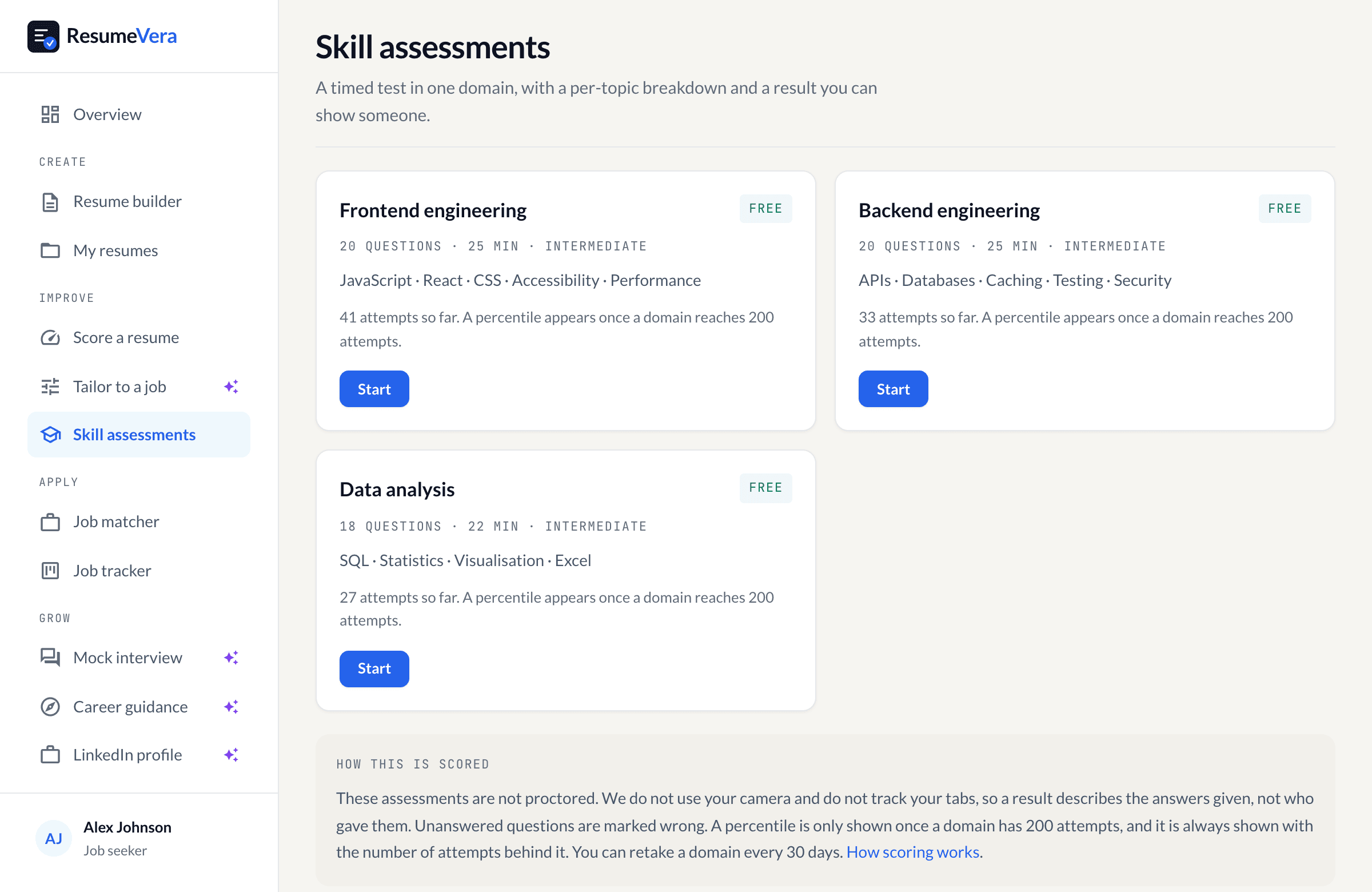
The real list. Percentiles stay hidden until a domain has enough attempts to mean anything.
Is your resume ATS-ready?
Run a free ATS score check and get specific improvements in under 60 seconds.