2026 Resume Trends: How to Beat the ATS and Quiet Hiring
ATS Optimization · ResumeVera Team · June 14, 2026 · 8 min read

Introduction: The New Paradigm of the 2026 Job Market
The global labor market in 2026 occupies a profoundly complex juncture.[1] Driven by the mass deployment of Artificial Intelligence and a cautious recalibration of macroeconomic conditions, the foundational paradigms of employment and talent acquisition have been thoroughly rewritten. We are currently navigating what industry analysts term an "invisible hiring freeze." This is an environment where companies maintain open job requisitions to project outward growth but are extremely hesitant to actually hire without absolute operational necessity.[2] For job seekers, this means the competition is fiercer than ever. The entry-level job market, for example, is experiencing stagnant hiring projections, with many employers rating the market as merely "fair".[3] Consequently, submitting a generic resume to a public job board is no longer a viable strategy. Your resume is no longer just a narrative document read by human eyes; it is a highly structured data packet designed primarily for machine consumption.[4] In this comprehensive guide, we will explore the critical 2026 resume trends, how to navigate Applicant Tracking Systems (ATS), and how to position yourself in an era dominated by algorithmic sourcing.
The Algorithmic Saturation and the Rise of "Quiet Hiring"
To understand how to optimize your resume, you must first understand how recruiters are actually sourcing talent in 2026. Public job boards are currently inundated with mass-produced, syntactically perfect, AI-written resumes.[5] The ease with which candidates can apply to hundreds of roles using automated tools has resulted in thousands of unqualified, hyper-optimized applications flooding every single open requisition. Because of this unmanageable volume of noise, recruiters have fundamentally shifted their methodologies. Instead of relying heavily on inbound applications, recruiters are actively utilizing AI-powered search agents to mine professional networking platforms for passive candidates—a phenomenon known as "Quiet Hiring".[5]
Quiet hiring occurs when organizations bypass public job postings entirely to avoid the unmanageable influx of applicants.[6] They search for candidates directly using specific keywords, monitor who consistently shows expertise in their field, and reach out privately to professionals who already present themselves as the solution to specific business problems.[5] This means if you are only applying to public job postings, you are effectively invisible to where the actual hiring activity is taking place.[5] Therefore, your resume and LinkedIn profile must be designed not just to sit in a database, but to perfectly align with the keywords and digital footprints these AI sourcing agents are actively looking for. Developing this visibility is now the most critical step in the modern job search process.[7]
The "Canva Deficit" and the Failure of Over-Designed Templates
One of the most significant pitfalls for modern job seekers is the reliance on aesthetic, graphic-heavy resume templates. Platforms like Canva boast over 260 million monthly active users, making it incredibly easy to create visually stunning documents.[8] However, Applicant Tracking Systems do not admire stylish designs; they are built specifically to extract raw text.[4] Independent testing shows that an alarming 72% of Canva resume templates fail basic ATS parsing.[8]
When a candidate submits a highly stylized resume, the ATS encounters floating text boxes, graphics-as-text elements, and complex multi-column layouts that completely scramble the text extraction sequence.[4] For instance, when an ATS attempts to parse a dual-column layout, it frequently reads straight across the page horizontally, conflating job titles with education dates and rendering the candidate's professional history entirely incoherent.[4] Furthermore, any critical information housed within visual graphics—such as icons, rating bars, or embedded company logos—will simply not be read by the software, leading to automatic rejection.[4] Unless you are handing a physical copy of your resume directly to a human at a networking event, you must abandon multi-column, heavily formatted templates. If you must use visual editors, you should strictly switch to one of their "Simple" single-column templates, remove all icons, and always verify your document with a plain-text copy-paste test before submission.[8]
Architectural Mandates for the 2026 ATS-Compliant Resume
To survive automated screening and facilitate the "15-Second Test" conducted by human recruiters who review the surviving documents, the 2026 resume must adhere to exceptionally strict architectural guidelines. A modern layout expects a structure focused entirely on impact, clarity, relevance, and scannability.[4] Below is a breakdown of the mandatory structural elements expected by employers this year.
| Structural Element | 2026 ATS Compliance Mandate | Consequences of Non-Compliance |
|---|---|---|
| Page Layout | Strict single-column formatting. | Text is scrambled across columns; history is rendered unreadable by parsing software. |
| Typography | Standard, web-safe, simple fonts (e.g., Arial, Calibri, Times New Roman). | Optical character recognition (OCR) failure resulting in blank data fields. |
| Section Headers | Universally recognized, standard titles (e.g., "Experience", "Education", "Skills"). | ATS fails to categorize information, missing entire blocks of relevant experience. |
| Date Formatting | Left-aligned dates with absolute stylistic consistency throughout the document. | Temporal parsing failure; the candidate appears to lack the required years of experience. |
| Visual Elements | Complete removal of tables, text boxes, skill rating bars, icons, and embedded logos. | Information housed within visuals is entirely ignored, leading to automatic rejection. |
As illustrated in the table above, predictability is your greatest asset. Do not try to be clever with titles like "My Journey" or "Professional Footprint," as the ATS will fail to categorize the information.[4] Additionally, utilize common, industry-standard job titles even if your previous company used quirky internal nomenclature.[4] The algorithm is looking for an exact match to the open requisition, and a mismatched job title is the easiest way to be filtered out of the system entirely.
Mastering the Top Third of Your Resume: The 15-Second Test
Because recruiters sort through incredibly high volumes of applications, the top third of your resume is the most critical real estate on the document. It must pass the "15-Second Test," making your target role and core skills immediately obvious to anyone scanning it.[4] Start with a clean header containing your professional contact details: your name, a single phone number, a professional email address, and your city and state.[4] Avoid including your full mailing address for privacy reasons, as it is no longer necessary.[4] Ensure any embedded links, such as your LinkedIn profile or portfolio, are fully functional and do not require a login.[4]
Crucially, the outdated "Objective" statement has been completely replaced. Instead, you must write a targeted 2-4 line professional summary that explicitly outlines your target role, experience level, core technical stack, and a distinct proof point of reliability or impact.[4] Following this summary, include a tightly curated "Core Skills" micro-section. This should be a concise list of 8-12 skills that naturally mirror the target job posting.[4] Avoid keyword stuffing at all costs. Adding massive, unstructured lists of skills or machine-like buzzwords to trick the ATS will result in immediate disqualification by both algorithms and human reviewers who recognize the tactic.[4]
Formulating Impactful, Skills-Verified Bullet Points
While employers universally emphasize skills-based hiring in 2026, they have grown deeply skeptical of candidates who simply provide a detached list of proficiencies.[4] Employers do not want a list of skills you claim to have; they want clear evidence that they can trust you will use them correctly to generate results.[4] Your work history must bridge the gap between theoretical knowledge and practical execution. Always use a reverse chronological format, as this is the easiest format for employers to validate quickly.[4] If you have seasonal or temporary roles, label them clearly as "Seasonal" or "Temporary" to prevent short employment stints from appearing as red flags to reviewers.[4]
When crafting your bullet points, you must abandon vague descriptions of your daily duties. Instead, utilize a rigid mathematical formula: Action Verb + Task & Skill = Measurable Result.[9] Recruiters increasingly want to see quantifiable outcomes rather than a passive list of responsibilities.[9] For example, instead of writing "Managed company database," you should write "Optimized SQL database queries (Task & Skill), reducing data retrieval times by 40% (Measurable Result)." By directly linking a technical proficiency to a quantifiable business outcome, you provide immediate, contextual proof of your competence. Furthermore, while AI tools are highly useful for brainstorming and structural editing, submitting generic, verbatim AI-generated verbiage is heavily penalized in the current market.[9] Authenticity and personalized materials will always stand out against the flood of automated applications.
High-Demand Sectors and Tailoring Your Career Narrative
Beyond structural formatting, the actual content of your resume must reflect the evolving demands of the modern workplace. In an era where AI agents are being integrated into daily operations across industries, companies are seeking human employees who possess the unique skills that machines cannot replicate.[10] This includes strategic leadership, complex problem-solving, emotional intelligence, and cross-functional collaboration. Whether you are aiming for a role in technology, healthcare, or finance, the way you frame your experience matters immensely.
- Artificial Intelligence and Cloud Architecture: If you are targeting specialized roles such as an AI Product Manager, Cloud Architect, or Cybersecurity Analyst, your resume must highlight continuous learning and specialized project deployments.[11] Certifications often carry massive weight in these fields because they demonstrate immediate, up-to-date proficiency in rapidly evolving tech stacks like AWS, Azure, and neural network optimization.[12]
- Healthcare and Bioinformatics: The modernization of major hospital networks has created an explosion of demand for healthcare data analysts and digital health professionals.[13] Resumes in this sector should heavily emphasize data privacy compliance, electronic health record (EHR) integrations, and specific analytical outcomes that improved patient care or operational efficiency.
- Renewable Energy and ESG Integration: Driven by global Environmental, Social, and Governance (ESG) mandates, engineering roles focused on solar, wind, and EV battery technology are incredibly lucrative.[14] Highlight project management, cross-disciplinary engineering, and measurable sustainability impacts in your bullet points to capture recruiter attention.
- Business Strategy and Analytics: For roles like Management Consultant or Financial Analyst, the focus should remain rigorously anchored on data-driven decision making and global scaling capabilities.[12] Employers are actively seeking candidates who can translate complex data sets into actionable business intelligence, driving tangible revenue growth.
Conclusion: Embracing the New Resume Paradigm
The resume landscape in 2026 is entirely unforgiving for those who rely on outdated strategies and generic applications. To succeed, you must view your resume not as a canvas for artistic expression, but as a precise, highly optimized tool designed to communicate clear, quantifiable value to both algorithms and human decision-makers. By avoiding complex formatting, utilizing standard typography, mastering the action-verb formula, and strategically aligning your skills with the actual demands of the market, you can significantly increase your chances of bypassing the ATS. In a labor market characterized by tight competition, an invisible hiring freeze, and algorithmic gatekeepers, clarity, authenticity, and strict adherence to structural mandates are your ultimate competitive advantages. Treat your resume as the foundation of your broader professional visibility, ensuring that when the quiet hiring recruiters utilize their sophisticated AI tools to find their next top performer, you are exactly what they discover.
Get Free ATS Tips Every Week
Actionable resume and ATS tips, when we publish them. No spam. Unsubscribe any time.
Related Articles

Shadow ATS Keywords: The Hidden Resume Terms Recruiters Search But Candidates Miss
A deep analysis of secondary and contextual resume keywords recruiters search for but candidates often miss, including title variants, adjacent tools, domain language, workflow terms, outcome metrics, and proof phrases that improve ATS and AI screening visibility.
Read More

The AI-Proof Resume: How to Write a Resume That Survives AI Screening in 2026
Most resumes are still written for old ATS keyword matching. In 2026, the stronger strategy is to build one resume that parses cleanly, ranks well in AI screening, convinces recruiters in a 30-second scan, and remains verifiable when hiring agents compare your resume against your public career footprint.
Read More

ATS Resume Optimization Guide 2026: Format, Keywords & Checklist
Everything you need to beat ATS in 2026 — how parsing and AI scoring actually work, 7 proven optimization strategies, platform-specific formatting tips for Greenhouse, Workday, and more, plus a printable checklist.
Read More
Try it
Check this against your own resume
The post above is general. Your file is not. The checker reads it the way a parser would and tells you which of these points it actually breaks.
Check your resume free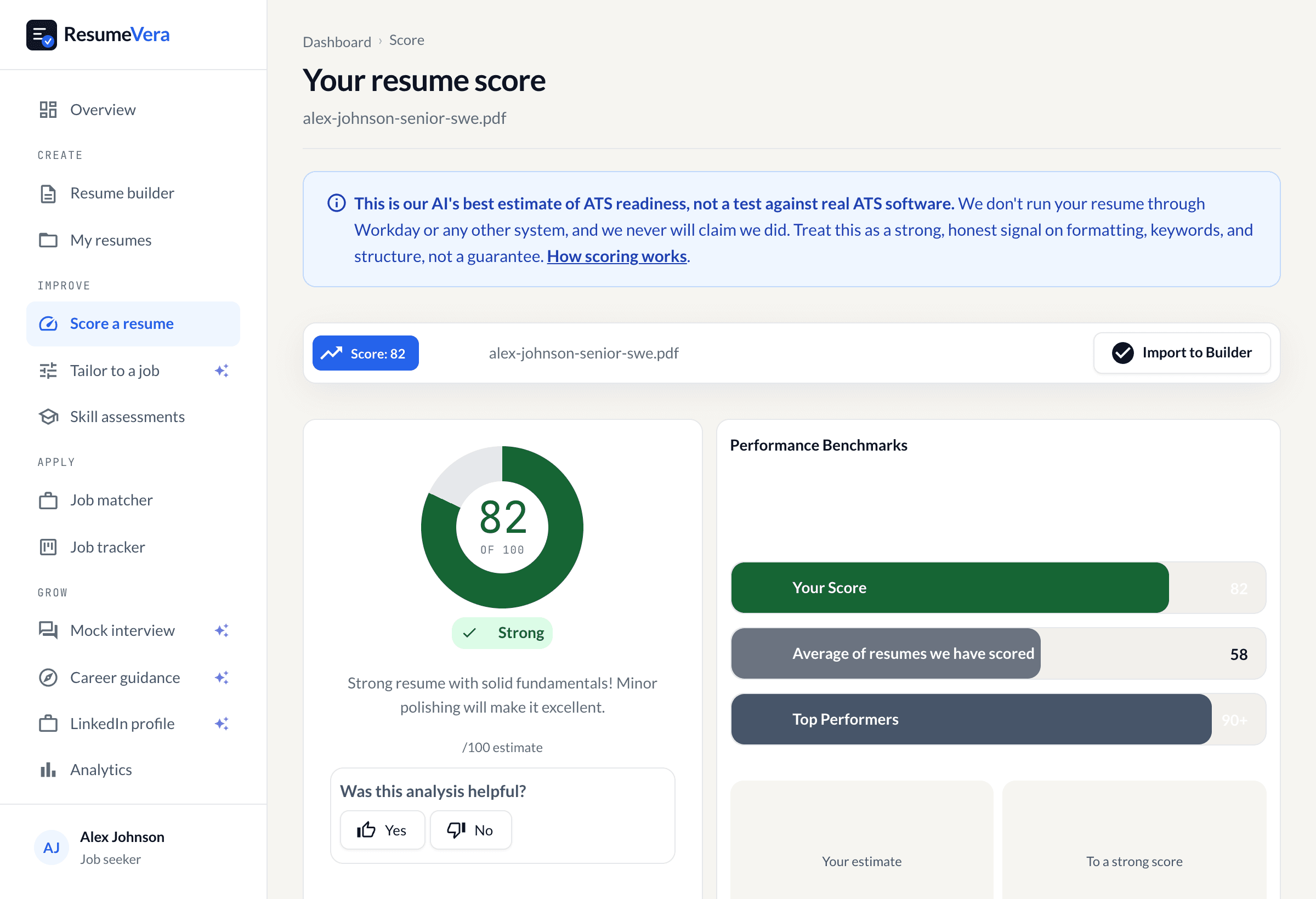
A sample resume in the real checker. The 82 and the sub-scores are what the scorer returns for it.
Now check it against your own resume
An honest, AI-estimated ATS score in 30 seconds. No account, no card.