Right now, millions of people are watching the FIFA World Cup 2026 — held across the United States, Canada, and Mexico — and debating the same thing scouts have debated for years: who is the best player on the pitch, and why?
The Netherlands' Cody Gakpo is one of the tournament's standout performers. Heading into the knockout stages, he already has 4 goals and 4 assists from 8 matches — numbers that light up dashboards at Liverpool FC's analytics department, at the KNVB (Royal Dutch Football Association), and at every rival scouting team with a screen. They are not watching him for his personality or his post-match smile. They are tracking his expected goals (xG), his sprint speed, his successful dribbles per 90 minutes, and his shot-on-target conversion rate.
Here is what nobody tells you at your job-search bootcamp: corporate recruiters and ATS algorithms work exactly the same way.
The parallel is almost eerie. A World Cup scout asks: "Can this player deliver measurable outcomes in high-pressure situations?" A recruiter's ATS asks: "Does this resume contain measurable outcomes aligned with our job description?" Same question. Different stadium.
What Is ATS and Why Does It Think Like a Talent Scout?
An Applicant Tracking System (ATS) is software that employers use to filter, rank, and manage incoming resumes before a human ever sees them. According to Jobscan's ATS research, 98% of Fortune 500 companies now use ATS software, and over 75% of all resumes are rejected by the algorithm before they reach a recruiter's desk.
The average corporate job posting on LinkedIn or Naukri receives between 100 and 300 applications within 72 hours of going live — a number that has surged with remote work normalizing cross-geography applications. No human team can meaningfully screen 250 resumes in two days. So the ATS does it first.
Sources: Jobscan, Glassdoor Research, LinkedIn Talent Solutions
The Scouting Report vs. the Resume: A Side-by-Side
Let's put the football scouting world and the hiring world directly next to each other. The similarities will change how you write your resume forever.
What Football Scouts Track
- Goals + assists per 90 minutes
- Expected Goals (xG) vs actual goals
- Pass completion percentage
- Sprint speed (km/h top speed)
- Duels won (aerial + ground)
- Distance covered per match
- High-pressure situations: did they perform?
What ATS + Recruiters Track
- Revenue generated or cost saved (₹ / $)
- Percentage improvements (efficiency, growth)
- Keyword match rate vs job description
- Years of relevant experience
- Team size managed
- Projects delivered on time
- Impact in high-stakes projects
Notice what is not on either list: personality, enthusiasm, or a vague sense of "passion for the role." Scouts do not recruit Gakpo because he seems keen. They recruit him because 4 goals and 4 assists in 8 World Cup 2026 matches — and his non-penalty xG numbers tracked by FBref's statistical database — tell a story no eye test can match. The number does the talking.
Your resume needs numbers to do the same talking.
Why Most Resumes Fail the ATS "Scout Test"
The single biggest reason qualified candidates get filtered out by ATS is not that their skills are wrong — it is that their achievements are written without measurable outcomes. Here is a real-world comparison:
| Generic (Fails ATS) | Metrics-Driven (Passes ATS + Impresses Recruiter) |
|---|---|
| "Managed sales team" | "Led a team of 8 SDRs, increasing quarterly pipeline by 43% to ₹2.1 Cr in Q3 2025" |
| "Worked on product launches" | "Co-led 3 product launches across 4 markets, achieving ₹4.8 Cr combined first-month revenue" |
| "Improved customer satisfaction" | "Redesigned support SOP; CSAT score improved from 72% to 91% within 90 days" |
| "Responsible for social media" | "Grew LinkedIn audience from 3,200 to 22,000 followers (+587%) in 8 months via daily content" |
| "Helped reduce costs" | "Identified inventory redundancy, reducing procurement spend by ₹38L annually" |
The left column describes duties. The right column describes scoutable outcomes. A World Cup scout watching a match does not write "plays forward." They write "0.62 xG per 90, 74% dribble success, top sprint speed 34.7 km/h." Your resume needs the same specificity.
The ATS Keyword System: Your Scouting Database Match
Beyond metrics, ATS software parses your resume for keyword alignment with the job description. This is the equivalent of a scout checking whether a player's profile matches the tactical system the coach runs. A possession-heavy manager like Pep Guardiola is not going to scout a traditional target striker — the profile does not fit the system, no matter how talented the player is.
Similarly, if a job description says "stakeholder management, cross-functional collaboration, OKR setting" and your resume says "worked with teams on goals," the system sees a mismatch and moves on.
How to Run a Keyword Match Like a Scout
- Copy the job description into a text editor
- Highlight every skill, tool, and outcome word (e.g. "SQL", "stakeholder reporting", "P&L ownership")
- Check each one against your resume — does the exact phrase appear?
- Mirror, don't stuff. Use the keyword in a natural sentence tied to a real achievement
- Run your resume through an ATS checker before submitting
Pro Tip from the Scouting Playbook: Cody Gakpo is listed as a "wide forward" in UEFA databases — not "winger" or "attacker." If a scout searches "wide forward," he appears. If the taxonomy is wrong, he disappears. Same with your resume keywords. Use the exact terminology the industry uses, not your internal company jargon.
The xG Model for Your Resume: Quantifying Potential, Not Just Output
In modern football analytics, Expected Goals (xG) measures the quality of chances a player creates or converts — not just goals scored. A striker who scores 8 goals from an xG of 4.2 is outperforming their model. A striker who scores 8 goals from an xG of 11.5 is underperforming.
Resume xG is a concept you can apply to your own achievements: highlight moments where you outperformed expectations. Did you deliver a project in half the expected timeline? Did you exceed your sales target by 2x? Did you build a team of 12 from a starting headcount of 3 in under a year? These are your "above-xG" moments — the ones that signal elite potential to a recruiter.
How to Find Your "Above-xG" Moments
- Think of a project where everyone expected it to fail or take longer — and you delivered anyway
- Recall a time you stepped into a broken situation and turned it around with specific results
- Identify initiatives where you did more with less — smaller budget, leaner team, tighter deadline
- Remember feedback from managers or clients that specifically praised your speed, quality, or impact
Write each of these as a bullet point using the CAR framework: Challenge → Action → Result. The result must include a number.
ATS Formatting: The Referee's Rules You Cannot Ignore
Even the most statistics-rich resume fails ATS if it is formatted incorrectly. Think of ATS formatting rules like the offside rule in football: it does not matter how brilliant your run was if you were a centimeter offside when the pass was played. The goal is disallowed.
| Formatting Rule | Why It Matters for ATS | What to Do |
|---|---|---|
| Standard section headings | ATS parses "Work Experience" but may miss "Career Story" | Use: Work Experience, Education, Skills, Summary |
| No tables or columns in body | Multi-column layouts scramble text extraction | Single-column body; table only if submitting PDF via email |
| Standard fonts | Custom fonts may render as symbols | Calibri, Arial, Times New Roman, Georgia |
| No headers/footers for key info | Many ATS skip header/footer zones entirely | Put contact info in the main body |
| File format | DOCX is safest; some ATS mangle .pages or .odt | Save as .docx unless PDF is explicitly requested |
| Acronym + full form | ATS matches what it sees; "SEO" ≠ "Search Engine Optimization" to some systems | Write "Search Engine Optimization (SEO)" on first use |
The Major ATS Platforms — and What Each One Prioritizes
Not all ATS systems are created equal. Workday behaves differently from Greenhouse, which behaves differently from Taleo. If you are applying to enterprise companies, understanding which system they use can give you an edge — the equivalent of a scout knowing which analytics provider a club uses before submitting their report.
| ATS Platform | Used By | Key Quirks to Know |
|---|---|---|
| Workday | Deloitte, Microsoft, Accenture, Walmart | Parses PDFs well; heavily keyword-dependent; does not always handle tables. Apply via the company portal, not LinkedIn Easy Apply. |
| Greenhouse | Airbnb, Stripe, Notion, Figma | Modern parser, handles PDFs cleanly. Scores keyword density and section completeness. Favors structured work history. |
| Taleo (Oracle) | IBM, HP, Bank of America, Infosys | Older system; struggles with complex formatting. Stick to plain, single-column Word docs. Strict keyword matching. |
| Lever | Netflix, Reddit, Spotify, Shopify | Better at reading narrative sections. Still keyword-sensitive. Handles PDFs and DOCX equally well. |
| iCIMS | FedEx, Johnson & Johnson, Lowe's | Conservative parser. Very sensitive to non-standard fonts and column layouts. Single-column DOCX safest. |
| SmartRecruiters | LinkedIn, Bosch, Skechers | Modern NLP-powered system; better at interpreting context. Still rewards keyword presence. |
How to find which ATS a company uses: Check the URL on their careers page job application — it usually includes the ATS domain name (e.g., "mycompany.wd1.myworkdayjobs.com" = Workday, "boards.greenhouse.io" = Greenhouse).
5 ATS Myths That Are Quietly Costing You Interviews
There is a lot of bad advice circulating about ATS. Here is what is actually true:
The Netherlands' Data-Driven Scouting Edge — and What It Teaches Us
The KNVB (Koninklijke Nederlandse Voetbalbond) — the Royal Dutch Football Association — is globally recognized for its investment in football analytics and player development. Their partnership with Stats Perform and use of GPS tracking and video analysis means Dutch national team selections are increasingly data-informed rather than purely eye-test based.
Ronald Koeman's 2026 World Cup squad reflects players whose data profiles match the tactical demands of the Dutch 4-3-3 system: high press intensity, quick vertical transitions, and width in attack. Gakpo's data fit the system. Weghorst's impact metrics off the bench fit a different role. Every player has a profile.
"In modern football, the scout's eye and the data analyst's model must agree before a player is signed. One without the other is incomplete." — Johan Cruyff Institute on modern scouting methodology
Your career equivalent: your resume must satisfy both the ATS data model (keyword match, metrics, format) and the human recruiter's instinct (narrative clarity, credibility, visual flow). One without the other loses you the match.
Step-by-Step: Rewrite Your Resume Like a Scouting Dossier
- Start with a "Player Profile" summary — 3–4 lines that state your role, your primary metrics, and your unique edge
- Lead every bullet with an action verb in past tense — "Drove," "Built," "Reduced," "Increased," "Launched"
- Every bullet must answer: so what? If it doesn't have a number or clear business outcome, rewrite it
- Tailor keywords per application — just as a scout adjusts the player brief per the manager's system, you adjust your resume per the JD
- Run an ATS compatibility check before submitting
Build a Resume That Passes Every Screen
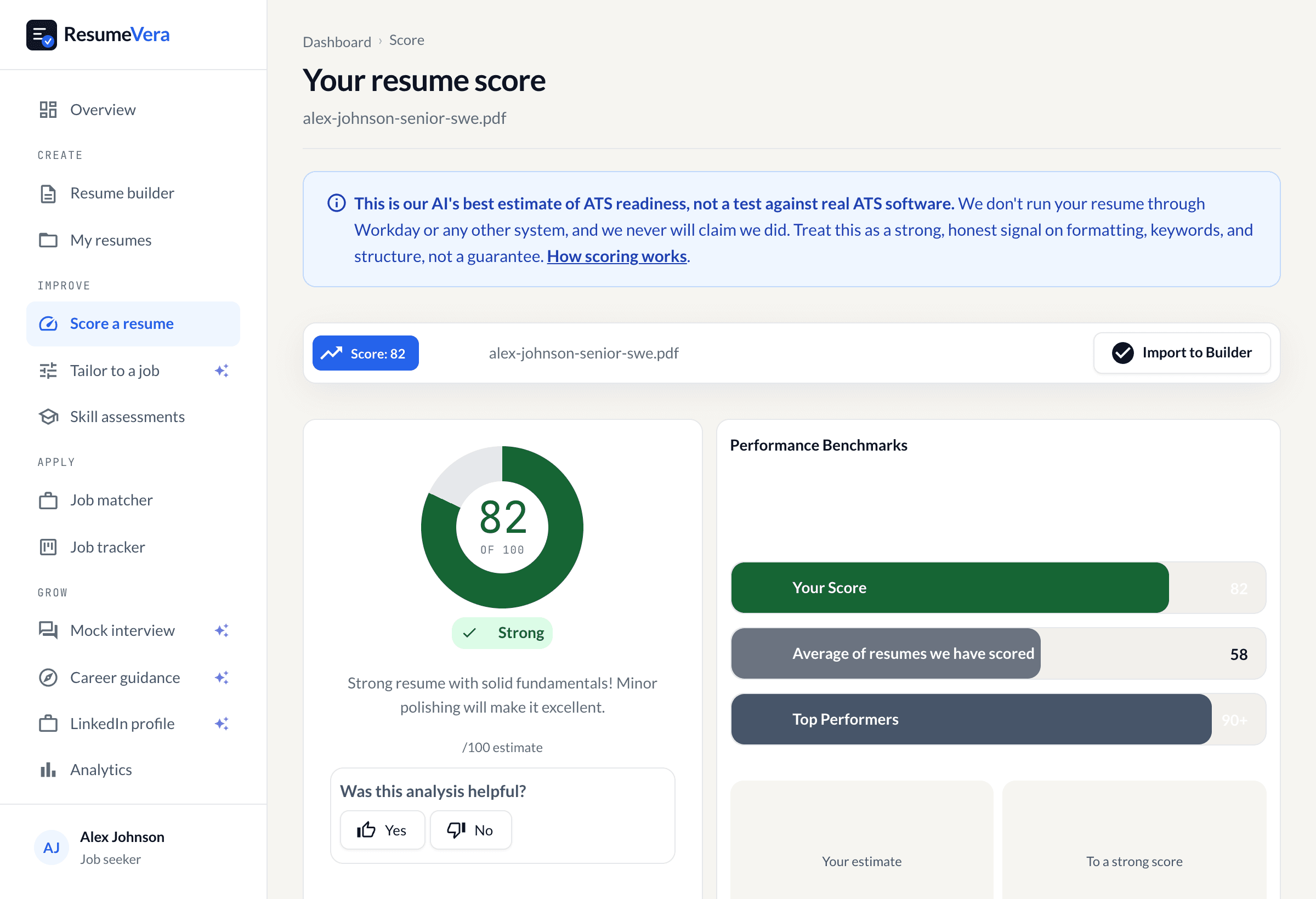
ResumeVera gives you everything a serious job seeker needs — from ATS scoring to AI resume building. Pick where you want to start.
Free to start · No credit card · Built for job seekers targeting top companies
The Bottom Line: Data Wins on the Pitch and in the Inbox
The FIFA World Cup 2026 has reminded the world that elite performance is measurable. Gakpo's market value at Liverpool is not based on his smile — it is based on his numbers. Weghorst's value to the national team is not sentiment — it is his conversion rate in high-leverage moments.
Your resume is your scouting dossier. If it does not contain the numbers, the keywords, and the formatted structure that the ATS expects, you will be filtered out before a human ever sees your file. Not because you are not qualified — but because your stats were not in the system.
Stop writing resumes. Start writing scouting reports.
References: Jobscan ATS Statistics 2024 | LinkedIn Talent Solutions Report | FBref Football Statistics | KNVB Official | Stats Perform Analytics