AI + cybersecurity: the safest high-paying career path of the next decade
Career Advice · ResumeVera Editorial · June 8, 2026 · 15 min read

If you are choosing a career path for the next decade, the combination of artificial intelligence and cybersecurity is one of the strongest bets available. AI is creating new products, new workflows, new infrastructure, and new attack surfaces at the same time. Every company adopting AI must eventually answer the same question: who will secure it?
That is why AI + cybersecurity is different from many other tech trends. It is not only a growth story. It is also a risk, compliance, trust, and business-continuity story. Companies can delay a design hire. They can pause experimental product roles. But when AI systems touch customer data, code, payments, identity, healthcare records, legal documents, or enterprise workflows, security becomes difficult to treat as optional.
Targeting AI security roles? Your resume must show both cybersecurity fundamentals and AI-era risk awareness: model security, cloud security, identity, data protection, governance, and incident response.
Direct answer: is AI + cybersecurity a safe high-paying career path?
AI + cybersecurity is one of the safer high-paying career paths because demand is being driven by two durable forces at once: rising cyber risk and rapid AI adoption. No career path is recession-proof, but this combination has stronger durability than many narrow AI roles because companies still need to protect systems, data, identity, and customer trust when budgets tighten. The U.S. Bureau of Labor Statistics projects information security analyst employment to grow 29% from 2024 to 2034, much faster than average, while the World Economic Forum lists AI and big data, networks and cybersecurity, and technological literacy among the fastest-rising skills. AI security sits at the intersection of all three.
Why this career path is safer than many other AI jobs
Some AI roles are vulnerable to hype cycles. A company may hire aggressively for AI experimentation, then cut roles if products do not produce revenue quickly. Cybersecurity behaves differently. Security demand is tied to risk, regulation, infrastructure, and customer trust. When AI expands the attack surface, security work expands with it.
- AI systems need protection: models, prompts, embeddings, APIs, training data, logs, plugins, agents, and user data all create security questions.
- Attackers use AI too: phishing, social engineering, malware analysis, vulnerability discovery, and fraud attempts are becoming faster and more personalized.
- Regulators are watching: organizations need AI governance, audit trails, data protection, and explainable risk controls.
- Boards care about cyber risk: breaches can affect revenue, valuation, reputation, legal exposure, and customer trust.
- AI adoption increases dependency: once a company embeds AI into operations, downtime, manipulation, data leakage, or model abuse becomes a business risk.
The data behind the demand
The U.S. Bureau of Labor Statistics reports a 2024 median pay of $124,910 per year for information security analysts and projects 29% employment growth from 2024 to 2034, with about 16,000 openings per year on average. Those projections sit alongside new security demands created by AI agents, model deployment, and enterprise AI governance.
CyberSeek's 2025 workforce data shows a cybersecurity supply-demand ratio of 74%, indicating a meaningful gap between employer demand and available talent. Its dataset also shows hundreds of thousands of postings across NICE cybersecurity work categories such as oversight and governance, implementation and operation, design and development, and protection and defense.
The World Economic Forum's Future of Jobs Report 2025 states that employers expect 39% of key job-market skills to change by 2030, with technological skills rising fastest. AI and big data lead the list, followed by networks and cybersecurity. That is the exact overlap where AI security careers sit.
ISC2's 2025 Cybersecurity Workforce Study adds the operational detail: 69% of cybersecurity respondents were already using, testing, or evaluating AI security tools, and 73% said AI would create more specialized cybersecurity skills. In other words, the field does not see AI only as a threat to jobs. It sees AI as a force reshaping what security professionals must know.
What is AI cybersecurity?
AI cybersecurity is the practice of securing AI systems and using AI responsibly inside cybersecurity operations. It includes two connected tracks:
| Track | What it means | Example work |
|---|---|---|
| Security for AI | Protecting models, data, agents, prompts, APIs, and AI workflows | Prevent prompt injection, secure model endpoints, review agent permissions, protect training data |
| AI for security | Using AI tools to improve cyber defense | Alert enrichment, phishing analysis, anomaly detection, log summarization, threat intelligence triage |
The highest-value careers will combine both. A professional who understands SOC operations and can also evaluate AI tool risk is more useful than someone who knows only generic AI vocabulary.
Best AI + cybersecurity roles for the next decade
| Role | Why it will grow | Core skills |
|---|---|---|
| AI Security Analyst | Companies need analysts who understand AI-related alerts, data leakage, prompt abuse, and automated threats | SOC, SIEM, phishing, AI risk, log analysis, incident response |
| Cloud Security Engineer for AI Systems | Most AI workloads run on cloud infrastructure with sensitive data and APIs | AWS, Azure, GCP, IAM, containers, network security, secrets management |
| Application Security Engineer - AI Products | AI apps introduce new injection, data exposure, and access-control risks | OWASP, API security, secure SDLC, threat modeling, LLM app security |
| AI Governance and Risk Specialist | Regulated industries need controls, documentation, audits, and policy alignment | GRC, NIST, ISO 27001, privacy, model risk, vendor risk |
| Threat Intelligence Analyst with AI Focus | Attackers use AI to scale phishing, fraud, and reconnaissance | Threat intel, OSINT, MITRE ATT&CK, malware basics, AI-enabled threat trends |
| Security Automation Engineer | SOC teams need automation without unsafe autonomous action | Python, SOAR, SIEM rules, APIs, playbooks, human-in-the-loop controls |
| AI Red Team Specialist | Companies need adversarial testing for models, agents, and AI apps | Prompt injection, model evaluation, appsec, abuse testing, policy bypass testing |
Skills you need for AI + cybersecurity
Foundation cybersecurity skills
- Networking fundamentals: TCP/IP, DNS, HTTP, TLS, VPN, firewalls
- Operating systems: Linux, Windows, permissions, logs, processes
- Security operations: SIEM, SOC workflows, alert triage, incident response
- Identity and access management: MFA, SSO, least privilege, IAM policies
- Cloud security: AWS IAM, Azure Entra ID, GCP IAM, storage security, logging
- Application security: OWASP Top 10, API security, secure coding basics
- Governance: NIST Cybersecurity Framework, ISO 27001, risk assessment, audit evidence
AI-specific security skills
- LLM basics: tokens, context windows, embeddings, vector databases, RAG
- Prompt injection and jailbreak testing
- Data leakage prevention in AI workflows
- Model and API access controls
- Agent permissions and tool-use boundaries
- AI output evaluation and hallucination risk
- AI governance, model risk, and vendor risk review
- Secure deployment patterns for LLM applications
Career multiplier skills
- Python scripting for automation
- Clear incident documentation
- Business risk communication
- Threat modeling
- Security metrics and reporting
- Cross-functional collaboration with engineering, legal, compliance, and product teams
Best certifications for AI + cybersecurity
Certifications are not a substitute for projects, but they help recruiters recognize your baseline readiness, including when they search their ATS for a certification name.
| Career stage | Useful certifications | Why they help |
|---|---|---|
| Beginner | CompTIA Security+, Google Cybersecurity Certificate, ISC2 Certified in Cybersecurity | Shows basic security vocabulary and commitment |
| SOC analyst | CompTIA CySA+, Microsoft SC-200, Splunk Core User | Matches monitoring, SIEM, and incident-analysis work |
| Cloud security | AWS Certified Security - Specialty, Google Professional Cloud Security Engineer, Microsoft SC-100 | Important for AI infrastructure and data-protection roles |
| Governance and risk | ISO 27001, CISA, CISM, CRISC | Useful for AI governance, audit, and risk roles |
| Advanced security | CISSP, OSCP, GIAC certifications | Signals depth for senior security, appsec, and red-team paths |
Portfolio projects that can get you interviews
The fastest way to break into AI cybersecurity is to build proof. Here are projects that signal real capability without needing a corporate security job first.
- Prompt injection lab: Build a small LLM app, document unsafe prompts, show mitigations, and explain residual risk.
- Secure RAG project: Create a document Q&A app with access controls, source citations, and data leakage tests.
- AI phishing analysis workflow: Use sample phishing emails, extract indicators, classify risk, and document escalation decisions.
- SOC alert summarizer: Build a Python workflow that summarizes sample logs but requires human approval before escalation.
- AI risk register: Create a risk register for an imaginary company deploying customer-support AI agents.
- Cloud AI workload hardening: Deploy a small AI API and document IAM, secrets, logging, rate limits, and network controls.
- Threat model for an AI agent: Map assets, trust boundaries, abuse cases, permissions, mitigations, and monitoring.
How to position this on your resume
AI security resumes must avoid two extremes: generic cybersecurity keywords with no AI relevance, and AI buzzwords with no security fundamentals. The best positioning combines both.
Resume summary example
Cybersecurity analyst with hands-on SOC, SIEM, vulnerability management, and cloud security experience, now focused on AI security workflows including prompt injection testing, AI data leakage controls, and human-in-the-loop alert enrichment. Skilled in Python, Microsoft Sentinel, AWS IAM, NIST CSF, and secure LLM application review.
Strong bullet examples
- Built a prompt injection testing checklist for an internal LLM support assistant, identifying 14 unsafe response paths and documenting mitigations for data leakage, policy bypass, and source-verification failures.
- Designed a human-in-the-loop AI alert summarization workflow for SOC analysts, reducing investigation note drafting time by 38% while preserving manual severity decisions and escalation approval.
- Reviewed IAM permissions for a cloud-hosted AI API, reducing excessive service-account access and adding audit logging for sensitive model and data-store interactions.
- Created an AI risk register aligned to NIST CSF and ISO 27001 control themes, covering model access, prompt injection, vendor risk, data retention, and incident response ownership.
AI + cybersecurity keywords for ATS
Use exact keywords when accurate. Recruiters search their ATS for specific terms, not vague descriptions.
- AI security
- LLM security
- Prompt injection
- AI governance
- Model risk management
- Data leakage prevention
- RAG security
- Vector database security
- AI red teaming
- Human-in-the-loop review
- SOC automation
- SIEM alert enrichment
- Threat modeling
- Cloud security
- IAM
- API security
- NIST Cybersecurity Framework
- ISO 27001
- Incident response
- Vulnerability management
Beginner roadmap: 6 months to AI security readiness
Month 1: Security fundamentals
Learn networking, Linux basics, Windows logs, authentication, phishing, malware basics, and the SOC workflow. Build small labs instead of only watching videos.
Month 2: SOC and SIEM practice
Work with sample logs, Splunk free training, Microsoft Sentinel learning paths, or open-source datasets. Practice writing alert notes and escalation summaries.
Month 3: Cloud and identity
Learn IAM, storage permissions, secrets management, audit logs, and least privilege. Many AI security problems come from ordinary cloud and identity mistakes, not exotic AI attacks.
Month 4: AI fundamentals
Learn how LLMs, embeddings, RAG, APIs, and agents work. You do not need to become a machine learning researcher. You need enough understanding to know where risk enters the workflow.
Month 5: AI security projects
Build one prompt injection lab, one secure RAG demo, and one AI risk register. Document everything clearly in GitHub or a portfolio page.
Month 6: Resume, applications, and interview prep
Tailor your resume for roles such as SOC Analyst, Junior Security Analyst, Cloud Security Analyst, GRC Analyst, Security Automation Analyst, or AI Security Analyst. Practice explaining tradeoffs: what AI can automate, what humans must review, and how to reduce risk.
Common mistakes to avoid
- Trying to learn advanced AI before learning basic networking and security.
- Listing "AI security" without a project, lab, or work example.
- Ignoring cloud IAM, which is central to AI system security.
- Thinking prompt engineering alone is enough for AI security.
- Overclaiming red-team expertise without appsec or threat-modeling depth.
- Writing security resumes with no numbers, no tools, and no incident examples.
- Forgetting governance, documentation, and business-risk communication.
Final takeaway
AI + cybersecurity is one of the rare career paths where growth, pay, resilience, and social importance reinforce each other. AI adoption creates new systems. New systems create new risks. New risks create demand for people who can secure them. If you build strong security fundamentals and add practical AI risk skills now, you position yourself for one of the most durable tech careers of the next decade.
The opportunity is real, but the resume has to show it clearly. Do not write "interested in AI cybersecurity." Show the tools, risks, controls, projects, and measurable outcomes that prove you are ready.
Sources
- U.S. Bureau of Labor Statistics: Information Security Analysts
- CyberSeek 2025 cybersecurity workforce data release
- World Economic Forum: Future of Jobs Report 2025 skills summary
- ISC2 2025 Cybersecurity Workforce Study
- NIST Cybersecurity Framework
- OWASP Top 10 for Large Language Model Applications
- CISA: Artificial Intelligence and Cybersecurity
Frequently asked questions
Is AI cybersecurity a good career?
Yes. AI cybersecurity combines two high-demand areas: AI adoption and cyber risk. It is especially strong for people who can understand security fundamentals, AI workflows, cloud infrastructure, and business risk.
Do I need machine learning expertise for AI cybersecurity?
You do not need advanced machine learning expertise for many AI cybersecurity roles. You need security fundamentals plus practical knowledge of LLMs, APIs, prompts, data leakage, RAG, access controls, and AI governance.
What is the best entry-level job for AI cybersecurity?
The best entry points are SOC analyst, junior cybersecurity analyst, cloud security analyst, GRC analyst, and security automation analyst roles. From there, add AI security projects and move toward AI security analyst or AI governance roles.
Which pays more: AI or cybersecurity?
Both can pay well, but the combination is especially valuable because companies need people who can secure AI systems, audit AI workflows, and use AI safely in security operations.
What projects should I build for AI security?
Build a prompt injection lab, secure RAG demo, AI risk register, SOC alert summarizer, phishing analysis workflow, cloud AI workload hardening project, or AI agent threat model.
What keywords should I use on an AI cybersecurity resume?
Use accurate terms such as AI security, LLM security, prompt injection, RAG security, AI governance, model risk, data leakage prevention, cloud security, IAM, API security, SIEM, incident response, and vulnerability management.
Written and checked by ResumeVera Editorial. How we research and review
Questions
Frequently asked questions
Get free ATS tips every week
Actionable resume and ATS tips, when we publish them. No spam. Unsubscribe any time.
Related Articles

The careers holding up best in a frozen job market
The 2026 job market is often described as frozen, and the label mostly fits. But frozen is an average, and averages hide where hiring is still happening. Using BLS growth projections and real wage data, here is where the jobs and the pay actually are right now.
Read More

Laid Off in 2026? Here's How to Rebuild Your Resume Fast
Getting laid off is disorienting, but the job market rewards people who move quickly and strategically. This practical guide walks you through rebuilding your resume, explaining gaps with confidence, and landing interviews within weeks of a layoff.
Read More

Should You Include a Photo on Your Resume in the United States?
Learn why including a photo on your resume is discouraged in the United States, the legal implications under EEOC and Title VII, how resume photo norms differ globally, and what personal information American recruiters actually expect to see in 2026.
Read More
Try it
Check this against your own resume
The post above is general. Your file is not. The checker reads it the way a parser would and tells you which of these points it actually breaks.
Check your resume free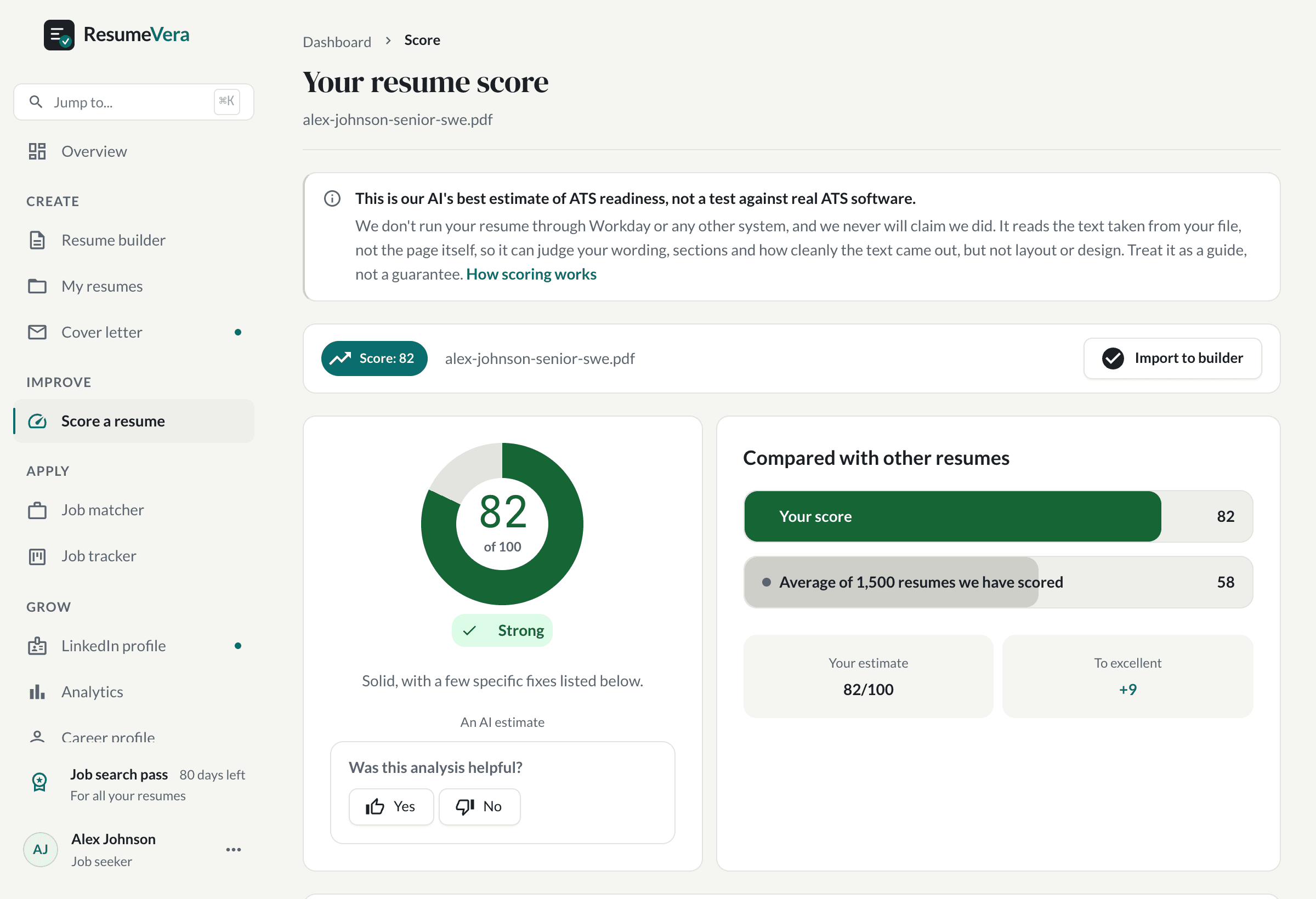
The real score page, with a sample resume and sample scores.
Now check it against your own resume
An honest resume score in seconds. No account, no card.