Written for the India job market, so salaries and formats follow Indian conventions. See the US version.
Lab Assistant Exam 2026: Resume Format & Interview Questions Guide
Interview Prep · ResumeVera Team · May 4, 2026 · 10 min read
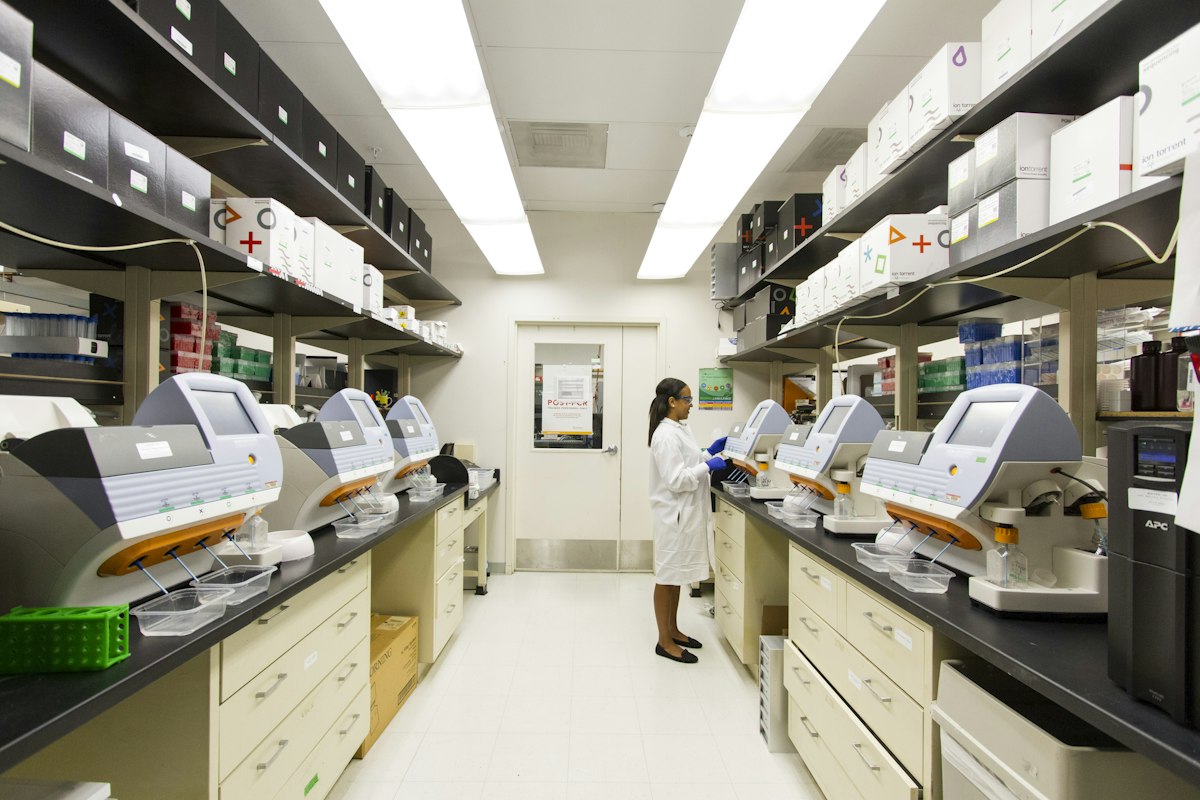
The Lab Assistant Exam 2026 is one of the most searched government medical recruitment pathways right now, especially after the RSSB Lab Assistant exam city intimation slip was released and candidates moved into the final phase of written preparation, document verification planning, and interview readiness. The Rajasthan Staff Selection Board has already released exam city slips for Lab Assistant Recruitment 2026, confirming that candidates are now entering the most practical stage of preparation. This is where many candidates make a mistake. They prepare for the written exam, but not for what comes after it.
That is where many candidates lose out. They study for the written test, but do not prepare their documents, biodata, or practical interview responses. In most government medical hiring workflows, written marks help you qualify, but document verification and practical screening determine whether you actually get selected. This guide is built for that stage. It covers what current 2026 Lab Assistant recruitment patterns actually look like, how to prepare a government-ready resume or biodata, what documents are commonly checked, and what interview questions candidates are most often asked in medical support roles.
How Lab Assistant recruitment works in 2026
Lab Assistant recruitment in 2026 is more structured than many candidates assume. Current recruitment cycles such as RSSB Lab Assistant 2026 show a consistent pattern: candidates first clear the written exam, then move into merit-based shortlisting and document verification. Some government and quasi-government medical roles stop at written exam plus document verification, while others, especially hospital-linked or outsourced medical roles, may also include a practical screening or short interview. This is why candidates should prepare beyond just written exam theory.
StageWhat gets evaluatedWhat most candidates missWritten ExamSubject knowledge and accuracyOver-focus on theory onlyMerit ShortlistingCutoff and category rankingAssuming written marks alone guarantee selectionDocument VerificationEligibility, originals, certificatesMissing or inconsistent documentsPractical / Interview RoundWorkflow, safety, communicationPoor practical answers and weak presentation
The exact process varies by department, but the pattern is clear: written performance gets attention, documentation gets trust, and practical clarity gets selection.
Do you really need a resume for a government Lab Assistant job?
Not always in the formal private-sector sense, but yes, a structured resume or biodata is still useful and often practical. In many government medical hiring workflows, candidates are officially screened through the application form, biodata sheet, and document file. But during document verification, walk-in recruitment, outsourced hospital placements, and panel review, a clean one-page resume helps present qualifications clearly and reduces friction during screening.
A resume is especially useful when:
You are attending walk-in or contractual hospital recruitment
You are appearing for outsourced medical staffing roles
You are carrying internship and lab experience beyond formal education
You want a cleaner document file for panel review
You may be asked to submit biodata during verification
In short, government hiring may not always require a resume by rule, but a clean resume or biodata often improves clarity, professionalism, and panel confidence.
Best resume format for Lab Assistant government jobs
Government medical hiring rewards clarity, compliance, and relevance. Your Lab Assistant resume should be simple, factual, and easy to verify. Do not use design-heavy templates, icons, graphics, or multi-column layouts. Government and hospital evaluators care far more about standardization and document clarity than visual design.
Your resume should include these sections in order:
Full Name
Phone Number and Professional Email
Address
Career Objective
Educational Qualifications
Technical Qualifications
Internship / Lab Experience
Skills
Certifications
Personal Details
This format works because it matches how government and hospital reviewers evaluate practical relevance and document consistency.
What to include in your Lab Assistant resume
Your resume should reflect practical medical-lab relevance, not generic job-seeker language.
Career Objective: A short statement aligned to laboratory support, diagnostic accuracy, and patient-safe workflow.
Educational Qualifications: 10th, 12th, DMLT, BMLT, B.Sc. MLT, or related qualification in reverse order.
Technical Qualifications: Sample handling, specimen prep, microscope use, sterilization, reagent prep, slide handling.
Internship / Experience: Pathology lab work, hospital internship, sample labeling, records, collection support.
Skills: Infection control, PPE use, sample safety, record maintenance, communication, discipline.
Certifications: DMLT, MLT, infection control, biomedical waste handling, pathology lab systems.
This is the format most aligned to how Lab Assistant and lab-support roles are practically evaluated in 2026.
Documents commonly checked in 2026
Document verification is one of the most common elimination stages in Lab Assistant recruitment. Current 2026 recruitment patterns consistently show that original documents are checked against eligibility, education, category, and identity. Candidates should carry originals, self-attested photocopies, and one clean backup set.
10th marksheet and certificate
12th marksheet and certificate
DMLT / BMLT / Degree certificate
Internship certificate
Aadhaar card
Government ID proof
Caste certificate if applicable
Community certificate if applicable
Passport-size photographs
Experience certificate if applicable
Self-attested photocopies
Original documents in one organized file
Most document verification failures happen because of poor organization, missing originals, or mismatched names, not because of low merit.
Top Lab Assistant interview questions in 2026
Not every recruitment cycle includes a formal interview, but many hospital-linked, outsourced, walk-in, and practical medical roles do include short screening interviews. Even where formal interviews are absent, candidates are often asked practical questions during document review or joining assessment. These questions usually test practical safety, workflow discipline, and reliability.
Tell us about yourself.
Why do you want to work as a Lab Assistant?
What are the responsibilities of a Lab Assistant?
How do you handle blood samples safely?
What is the difference between serum and plasma?
What is sterilization and why is it important?
How do you label and store samples?
What precautions do you follow in a pathology lab?
How do you handle contaminated material?
What is biomedical waste segregation?
How do you prepare a microscope slide?
What would you do if a sample is mislabeled?
How do you maintain lab records?
What PPE should be used during sample handling?
How do you respond to accidental exposure?
These are the most commonly repeated practical questions because they test whether you can work safely inside a real medical environment.
What interview panels actually assess
Panels usually do not expect polished corporate communication. They are usually checking whether you are safe, trainable, and dependable in a clinical setting.
What they assessWhat strong candidates showPractical awarenessClear understanding of lab basicsDisciplineStructured and process-oriented answersSafety awarenessUnderstands hygiene, PPE, contamination controlReliabilityCalm, accurate communicationTrainabilityOpen to protocol and supervision
That is why practical clarity usually performs better than memorized textbook answers.
Common mistakes candidates make
Using private-sector style resumes with irrelevant content
Carrying incomplete document sets
Giving theoretical instead of practical answers
Ignoring lab safety questions
Failing to explain internship work properly
Speaking vaguely about workflow and responsibilities
Government medical hiring is often less about sounding impressive and more about sounding dependable.
Final takeaway
Lab Assistant Exam 2026 is not just a written exam. It is a selection workflow. Most candidates prepare for marks. The stronger candidates prepare for selection. That means clear documentation, a structured resume, and practical interview readiness. Your score gets you shortlisted. Your preparation gets you selected.
Sources
Questions
Frequently asked questions
Get Free ATS Tips Every Week
Actionable resume and ATS tips, when we publish them. No spam. Unsubscribe any time.
Related Articles

How to Answer "Tell Me About Yourself" in Interviews (With 10 Examples)
Master the most common interview question with proven frameworks and real examples. Learn how to craft a compelling 60-second pitch that sets the right tone for your interview.
Read More

How to Explain Employment Gaps in Interviews (With Word-for-Word Scripts)
Employment gaps don't have to derail your job search. Learn honest, confident ways to address gaps in resumes and interviews with proven scripts that work.
Read More
Try it
Check this against your own resume
The post above is general. Your file is not. The checker reads it the way a parser would and tells you which of these points it actually breaks.
Check your resume free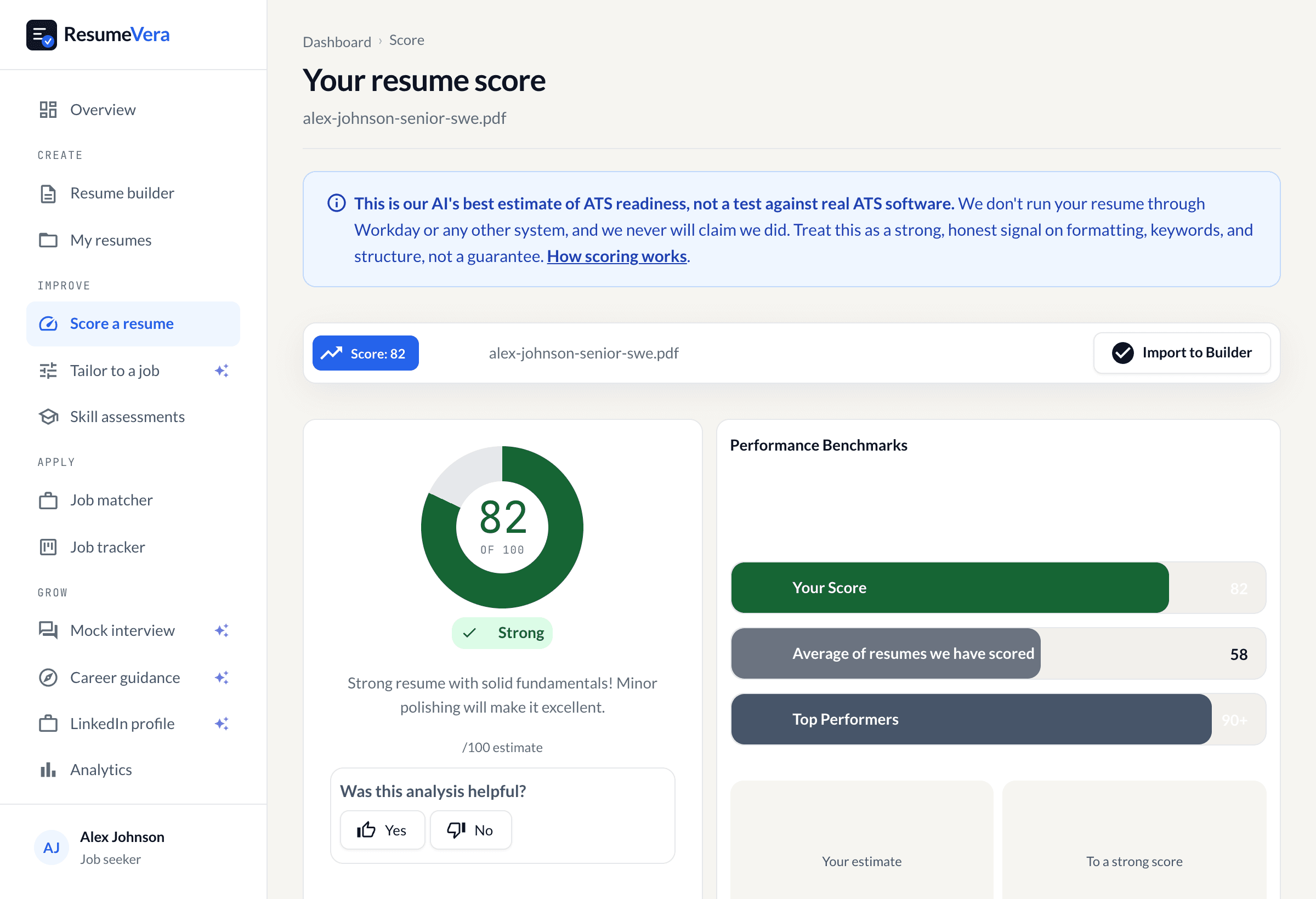
A sample resume in the real checker. The 82 and the sub-scores are what the scorer returns for it.
Now check it against your own resume
An honest, AI-estimated ATS score in 30 seconds. No account, no card.