Cybersecurity Skills
Protect organizations from evolving cyber threats and build a rewarding career in one of tech's fastest-growing fields. With 514,000+ open roles and average salaries exceeding $135,000, cybersecurity professionals are more critical than ever.
$0
Average Salary (2026)
0+
Open Positions in the US
0%
Projected Growth (2024-2034)
Roles that use Cybersecurity Skills: Career Guide, Salaries & Resume Tips (2026), and what they pay
Median annual wage, national, May 2025
- $129,180*
- $134,050
- $135,980*
- $135,980*
- $135,980
* BLS has no code for that exact title, so it is counted under a broader occupation. The role page says which. Source: BLS OEWS. These are the roles' wages, not a premium for the skill: no published source measures what one skill adds on its own.
Market Demand
Demand & Salary Data
29%
Growth Rate
$
+$25,000
Avg. Salary Impact
514,000+
Job Openings
Top Industries
Learning Path
Skill Levels
Beginner
Understand core security concepts including the CIA triad, common threat types, basic networking, and fundamental security tools. Able to monitor security alerts, follow incident response procedures, and assist with vulnerability scanning under supervision.
Intermediate
Proficient in SIEM platforms, vulnerability assessment, incident response, and cloud security fundamentals. Can independently investigate security incidents, write detection rules, conduct penetration tests, and implement security controls across enterprise environments.
Advanced
Expert-level knowledge in security architecture, threat hunting, advanced persistent threat detection, and security program leadership. Capable of designing enterprise security strategies, leading red/blue team exercises, managing compliance programs, and mentoring junior security professionals.
Section 01
What Is Cybersecurity?
Cybersecurity is the practice of protecting computer systems, networks, programs, and data from digital attacks, unauthorized access, damage, and theft. As organizations increasingly rely on digital infrastructure to conduct business, store sensitive information, and serve customers, the need for robust cybersecurity measures has become a foundational requirement across every industry.
At its core, cybersecurity encompasses a broad range of disciplines including network security, application security, information security, operational security, disaster recovery, and end-user education. Professionals in this field work to identify vulnerabilities before malicious actors can exploit them, implement defensive measures to safeguard critical assets, and respond swiftly when breaches occur to minimize damage and restore normal operations.
The cybersecurity landscape is constantly evolving as threat actors develop more sophisticated attack vectors. From ransomware campaigns that can cripple entire hospital systems to nation-state sponsored attacks targeting critical infrastructure, the stakes have never been higher. Modern cybersecurity professionals must contend with threats ranging from phishing and social engineering to advanced persistent threats (APTs), zero-day exploits, supply chain attacks, and AI-powered offensive tools.
In 2026, the cybersecurity field is characterized by a significant talent shortage, with an estimated 3.1 to 3.5 million roles remaining unfilled globally. This supply-demand imbalance, where the supply-demand ratio sits at approximately 74% meaning 26% of cybersecurity roles remain vacant, has driven salaries upward and created exceptional opportunities for professionals entering or advancing in the field. The average cybersecurity salary in the United States now stands at $135,969, with specialized roles commanding significantly higher compensation.
Section 02
Cybersecurity Career Paths and Salary Ranges
The cybersecurity field offers a diverse array of career paths, each with distinct responsibilities, required skill sets, and compensation levels. Understanding these pathways is essential for professionals looking to enter the field or advance their careers strategically. Whether you are drawn to offensive security, defensive operations, governance, or architecture, there is a cybersecurity career path that aligns with your interests and strengths.
Entry-Level Positions: Cybersecurity Analysts represent the most common entry point into the field, with salaries ranging from $78,000 to $114,000. In these roles, professionals monitor security systems, analyze alerts, investigate potential incidents, and help maintain an organization's security posture. Security Operations Center (SOC) analysts, junior penetration testers, and IT security specialists also fall into this tier, providing a solid foundation for career growth.
Mid-Level Positions: As professionals gain experience and specialized expertise, they can advance to roles such as Security Engineer, Incident Response Analyst, Threat Intelligence Analyst, or Security Consultant. These positions typically command salaries in the $109,300 to $162,500 range. Mid-level professionals are expected to design and implement security solutions, lead incident investigations, and contribute to security strategy development.
Senior and Leadership Positions: Senior Security Engineers earn approximately $162,000, while Security Architects command salaries between $150,000 and $225,000. Chief Information Security Officers (CISOs) and VP-level security leaders can earn well above $250,000, particularly at large enterprises and financial institutions. These roles require extensive experience, strategic thinking, and the ability to communicate security risks to executive leadership and board members.
Notably, 53% of employers are increasing starting pay for cybersecurity positions in 2026, reflecting the intense competition for qualified talent. The 12% year-over-year increase in job openings, now totaling 514,359 positions across the United States, further underscores the robust demand that continues to drive compensation upward across all experience levels.
Cybersecurity Analyst
$78,000-$114,000
Security Engineer
$109,300-$162,500
Senior Security Engineer
~$162,000
Security Architect
$150,000-$225,000
Penetration Tester
$95,000-$145,000
CISO / Security Director
$200,000-$350,000+
Section 03
Top Cybersecurity Certifications
Certifications play a pivotal role in the cybersecurity profession, serving as validated proof of expertise that employers actively seek when evaluating candidates. Unlike many other technology fields where practical experience alone may suffice, cybersecurity hiring managers frequently require or strongly prefer candidates who hold recognized industry certifications. Earning the right certifications can significantly accelerate your career progression and increase your earning potential.
CompTIA Security+ is widely regarded as the foundational cybersecurity certification and is often the first credential professionals pursue. It covers essential topics including threat management, cryptography, identity management, and security infrastructure. This vendor-neutral certification is approved by the U.S. Department of Defense for baseline security roles and serves as a prerequisite for many entry-level positions.
Certified Information Systems Security Professional (CISSP) is the gold standard for experienced cybersecurity professionals. Offered by (ISC)2, the CISSP covers eight domains of security knowledge and requires a minimum of five years of professional experience. CISSP holders earn an average salary premium of $25,000 or more compared to non-certified peers, making it one of the most valuable certifications in the technology sector.
Certified Ethical Hacker (CEH) focuses on offensive security techniques and is ideal for professionals pursuing penetration testing or red team roles. The certification teaches candidates to think like attackers, covering topics such as vulnerability assessment, system hacking, malware threats, and social engineering tactics.
Other highly valued certifications include CISM (Certified Information Security Manager) for security management professionals, CompTIA CySA+ for security analysts, OSCP (Offensive Security Certified Professional) for advanced penetration testers, and CCSP (Certified Cloud Security Professional) for cloud security specialists. Each certification targets specific career paths and experience levels, allowing professionals to build a certification roadmap aligned with their career goals.
CompTIA Security+
Entry-level, vendor-neutral foundation
CISSP
Gold standard for senior professionals
CEH (Certified Ethical Hacker)
Offensive security and penetration testing
CISM
Security management and governance
CompTIA CySA+
Security analytics and threat detection
OSCP
Hands-on penetration testing
CCSP
Cloud security specialization
Section 04
Essential Cybersecurity Skills and Tools
Building a successful career in cybersecurity requires mastering a combination of technical skills, analytical capabilities, and soft skills that enable you to protect organizations effectively. The cybersecurity skill set is broad and continually evolving as new threats emerge and defensive technologies advance. Here are the core competencies that employers look for when hiring cybersecurity professionals in 2026.
Network Security and Architecture: Understanding how networks function and how to secure them is fundamental to cybersecurity. This includes proficiency with firewalls, intrusion detection and prevention systems (IDS/IPS), VPNs, network segmentation, and protocols such as TCP/IP, DNS, and HTTP/HTTPS. Professionals must be able to design secure network architectures that minimize attack surfaces while maintaining operational efficiency.
Security Information and Event Management (SIEM): Proficiency with SIEM platforms such as Splunk, Microsoft Sentinel, IBM QRadar, and Elastic Security is essential for monitoring, detecting, and responding to security events. SIEM skills include writing correlation rules, tuning alerts to reduce false positives, creating dashboards for security metrics, and conducting log analysis to identify indicators of compromise.
Vulnerability Assessment and Penetration Testing: The ability to identify and evaluate security weaknesses using tools like Nessus, Qualys, Burp Suite, Metasploit, and Nmap is highly valued. Professionals must understand both automated scanning techniques and manual testing methodologies, including web application testing (OWASP Top 10), infrastructure testing, and social engineering assessments.
Cloud Security: As organizations migrate workloads to cloud platforms, expertise in securing AWS, Azure, and Google Cloud environments has become critical. This includes understanding identity and access management (IAM), security groups, encryption at rest and in transit, container security, and cloud-native security tools such as AWS GuardDuty, Azure Defender, and Google Security Command Center.
Scripting and Automation: Cybersecurity professionals who can write scripts in Python, Bash, PowerShell, or Go to automate security tasks hold a significant advantage. Automation skills enable professionals to build custom detection rules, automate incident response workflows, parse large datasets for threat hunting, and integrate security tools through APIs and orchestration platforms like SOAR.
Network Security
Firewalls, IDS/IPS, segmentation
SIEM Platforms
Splunk, Sentinel, QRadar
Vulnerability Assessment
Nessus, Qualys, Burp Suite
Cloud Security
AWS, Azure, GCP security
Scripting & Automation
Python, Bash, PowerShell
Incident Response
Forensics, containment, recovery
Identity & Access Management
Zero Trust, MFA, SSO
Threat Intelligence
MITRE ATT&CK, IOCs, TTPs
Section 05
The Evolving Threat Landscape in 2026
The cybersecurity threat landscape in 2026 has grown more complex and dangerous than ever before, driven by the proliferation of AI-powered attacks, increasingly sophisticated ransomware operations, and the expanding attack surface created by cloud adoption, IoT devices, and remote work infrastructure. Understanding the current threat environment is essential for cybersecurity professionals who must anticipate, detect, and respond to these evolving risks.
AI-Powered Attacks: Artificial intelligence has fundamentally changed the offensive capabilities available to threat actors. AI-generated phishing emails are now nearly indistinguishable from legitimate communications, deepfake technology is being used for voice and video-based social engineering attacks, and automated vulnerability discovery tools powered by machine learning can identify and exploit weaknesses faster than ever before. Cybersecurity professionals must leverage AI defensively as well, using machine learning models for anomaly detection, behavioral analysis, and automated threat response.
Ransomware Evolution: Ransomware attacks have evolved from simple encryption schemes to sophisticated multi-extortion campaigns. Modern ransomware groups exfiltrate sensitive data before encryption, threatening to publish it if ransoms are not paid. They also increasingly target supply chains, managed service providers, and critical infrastructure including healthcare systems, energy grids, and water treatment facilities. The average cost of a ransomware incident now exceeds $4.5 million when accounting for downtime, recovery, and reputational damage.
Supply Chain and Third-Party Risk: High-profile supply chain attacks have demonstrated that organizations are only as secure as their weakest vendor or supplier. Attacks targeting software supply chains, open-source dependencies, and managed service providers can cascade across thousands of downstream organizations simultaneously. Third-party risk management and software bill of materials (SBOM) analysis have become critical components of enterprise security programs.
Regulatory and Compliance Pressures: Governments worldwide are implementing stricter cybersecurity regulations, including the SEC's cybersecurity disclosure rules, the EU's NIS2 Directive, and updated NIST frameworks. Cybersecurity professionals must navigate an increasingly complex regulatory landscape while ensuring their organizations maintain compliance across multiple jurisdictions and industry standards such as SOC 2, ISO 27001, PCI DSS, and HIPAA.
Section 06
How to Showcase Cybersecurity Skills on Your Resume
Effectively presenting your cybersecurity skills on your resume is crucial for standing out in a competitive job market with over 514,000 open positions. While demand is high, employers are selective about candidates who can demonstrate genuine expertise, practical experience, and measurable impact. Here are proven strategies to make your cybersecurity resume compelling and ATS-friendly.
Quantify Your Impact: Whenever possible, include specific metrics that demonstrate the value you have delivered. Instead of writing "monitored security alerts," write "monitored and triaged 500+ daily security alerts, reducing mean time to detection (MTTD) by 40% through custom SIEM correlation rules." Quantifiable achievements such as reduction in incident response time, percentage of vulnerabilities remediated within SLA, or number of security assessments completed give hiring managers concrete evidence of your capabilities and help your resume pass through automated screening systems.
Highlight Certifications Prominently: Given the importance of certifications in cybersecurity hiring, ensure your credentials are prominently displayed. Create a dedicated certifications section near the top of your resume listing credentials such as CISSP, Security+, CEH, or OSCP along with their issue dates. Certifications can increase your salary by $25,000 or more and are frequently used as filtering criteria by both recruiters and applicant tracking systems.
Tailor Your Skills Section: Organize your technical skills into categories that align with the job description. Group skills under headings such as Security Tools, Cloud Platforms, Programming Languages, Frameworks, and Compliance Standards. Include specific tool names like Splunk, CrowdStrike, Wireshark, and Metasploit rather than generic terms, as recruiters and ATS systems search for these exact keywords when screening candidates.
Demonstrate Continuous Learning: The cybersecurity field evolves rapidly, and employers value candidates who stay current. Include relevant training, CTF (Capture the Flag) competition participation, home lab projects, open-source security tool contributions, and conference presentations. These demonstrate passion and proactive skill development beyond formal employment. Mention any threat research, published security advisories, or bug bounty program participation to further distinguish yourself from other candidates.
Use the Right Resume Format: For cybersecurity roles, a combination resume format works best, leading with a strong professional summary that highlights your years of experience, key specializations, and most relevant certifications. Follow this with a skills section organized by category, then detailed work experience entries that emphasize security-specific accomplishments. ResumeVera's AI-powered resume builder can help you optimize your cybersecurity resume for both ATS systems and human reviewers, ensuring your skills and experience are presented in the most impactful way possible.
Related Roles
Roles That Use This Skill
Explore resume examples for roles that commonly require this skill.
Questions
Frequently asked questions
Skill Guides
Explore More Skills
Browse all our in-demand skill guides with demand data and learning paths.
View All SkillsProve it
Claiming a skill and demonstrating one are different things
A timed assessment puts a result behind the word on your resume. Question count and duration are shown up front, and percentiles stay hidden until a domain has enough attempts to mean anything.
Join the waitlist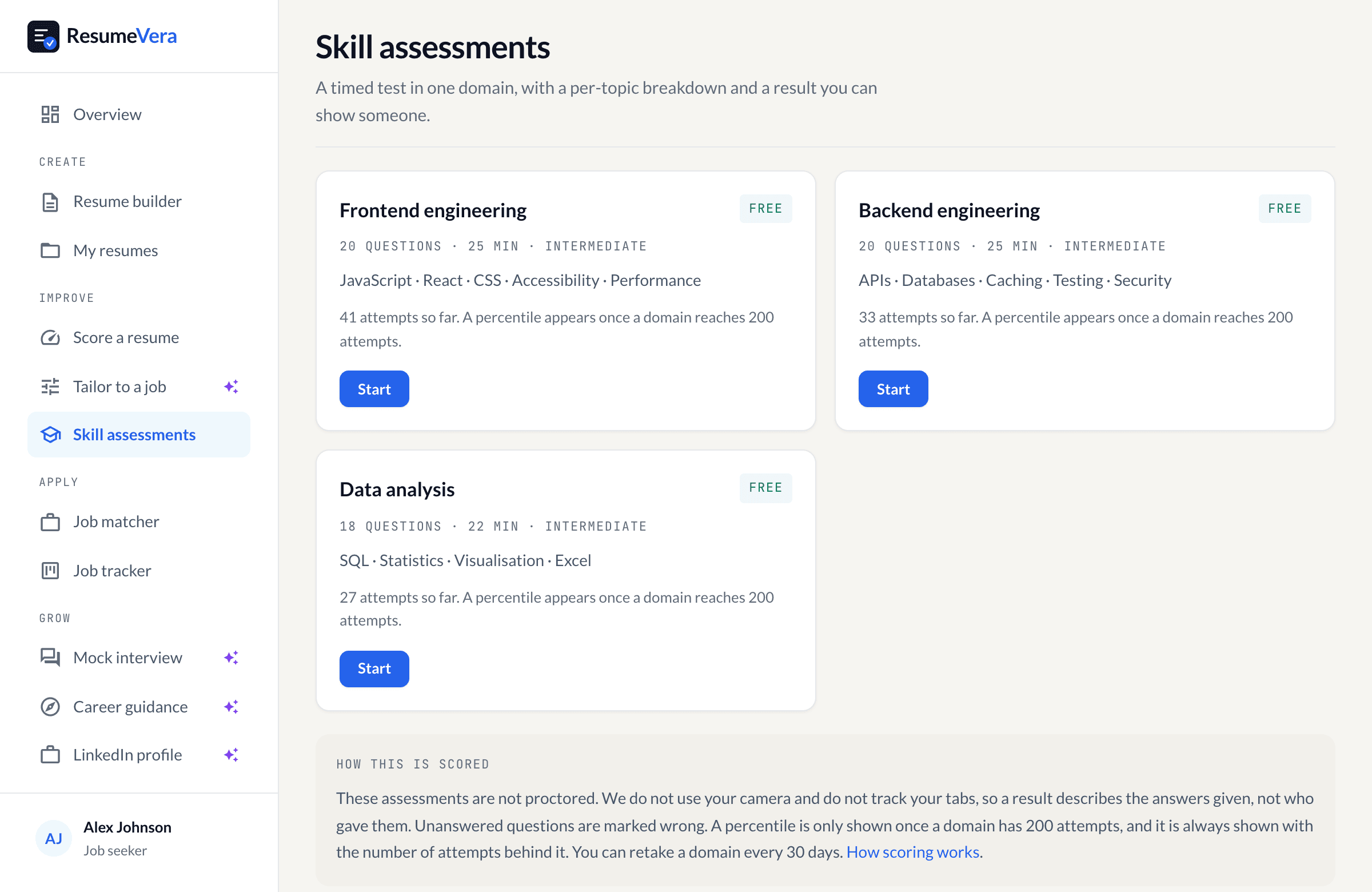
The real list. Percentiles stay hidden until a domain has enough attempts to mean anything.
Is your resume ATS-ready?
Run a free ATS score check and get specific improvements in under 60 seconds.