Cybersecurity analyst resume example
One page early, two once you have incident history worth detailing. Reverse chronological, no columns, no photo. Clearance and certifications are hard filters in US security hiring, so both belong above the fold.
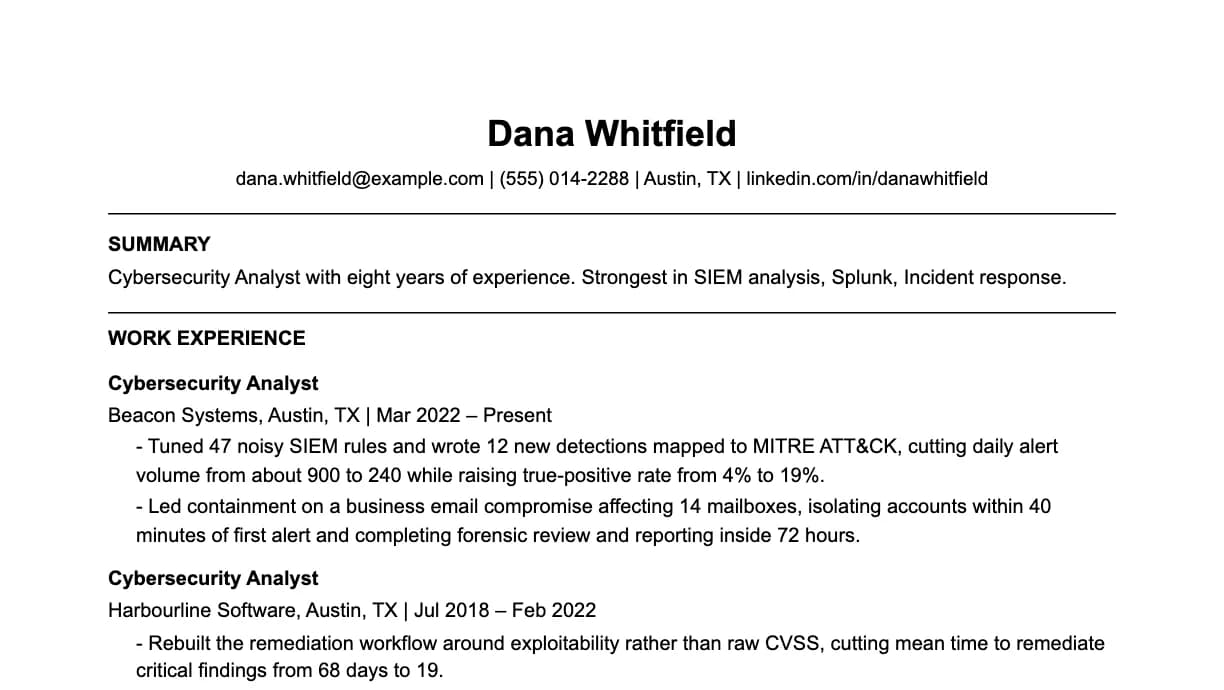
The bullets and skills are this page's own. The name, employer and dates are invented.
Most cybersecurity analyst resumes fail before a human ever reads them, they get filtered out by Applicant Tracking Systems before reaching a recruiter's desk. This guide covers exactly what ATS systems scan for in cybersecurity analyst roles, how to write bullet points that get callbacks, and which keywords you must include. Every example on this page is fictionalized, recruiter-informed, and written to show the level of specificity strong cybersecurity analyst candidates need.
Must-have skills for a cybersecurity analyst resume
These are the keywords ATS systems scan for in cybersecurity analyst job postings. Include every skill you genuinely have, missing even one commonly required keyword can drop your match score below the recruiter's threshold.
Pro tip: mirror the job description exactly
If the job description says "React.js" and you write "React", some ATS systems won't count it as a match. Copy the exact phrasing, acronyms, capitalization, and all, from the posting into your skills section and bullet points.
Strong cybersecurity analyst resume bullet examples
Every bullet below follows the same formula: strong action verb + what you did + quantified impact. Study the structure, then replace the numbers with your real achievements. Generic bullets like "responsible for X" are invisible to both ATS and recruiters, specificity is what gets you shortlisted.
Action
Start with Built, Reduced, Migrated, Designed, Optimized, Led.
Tools
Name the exact tool or method: SIEM analysis, Splunk, Incident response, Threat hunting.
Impact
End with a number: time saved, cost, volume, quality, or people served.
Cybersecurity Analyst - Detection engineering
01
Tuned 47 noisy SIEM rules and wrote 12 new detections mapped to MITRE ATT&CK, cutting daily alert volume from about 900 to 240 while raising true-positive rate from 4% to 19%.
Cybersecurity Analyst - Incident response
02
Led containment on a business email compromise affecting 14 mailboxes, isolating accounts within 40 minutes of first alert and completing forensic review and reporting inside 72 hours.
Cybersecurity Analyst - Vulnerability management
03
Rebuilt the remediation workflow around exploitability rather than raw CVSS, cutting mean time to remediate critical findings from 68 days to 19.
Cybersecurity Analyst - Phishing
04
Ran quarterly simulations across 2,400 employees and paired them with targeted training, reducing click rate from 18% to 5% over four campaigns.
Common mistake: weak action verbs
Avoid passive openers like "Responsible for", "Helped with", or "Worked on". These tell the recruiter nothing about your actual contribution. Replace them with ownership verbs: Built, Designed, Led, Reduced, Launched, Architected, Negotiated, Delivered. Then always end with a number.
The bullets above, in a finished resume
Rendered by the same exporter the builder uses, in an ATS-safe single-column template. No tables and no side columns, because that is what the format advice further down this page tells you to avoid.
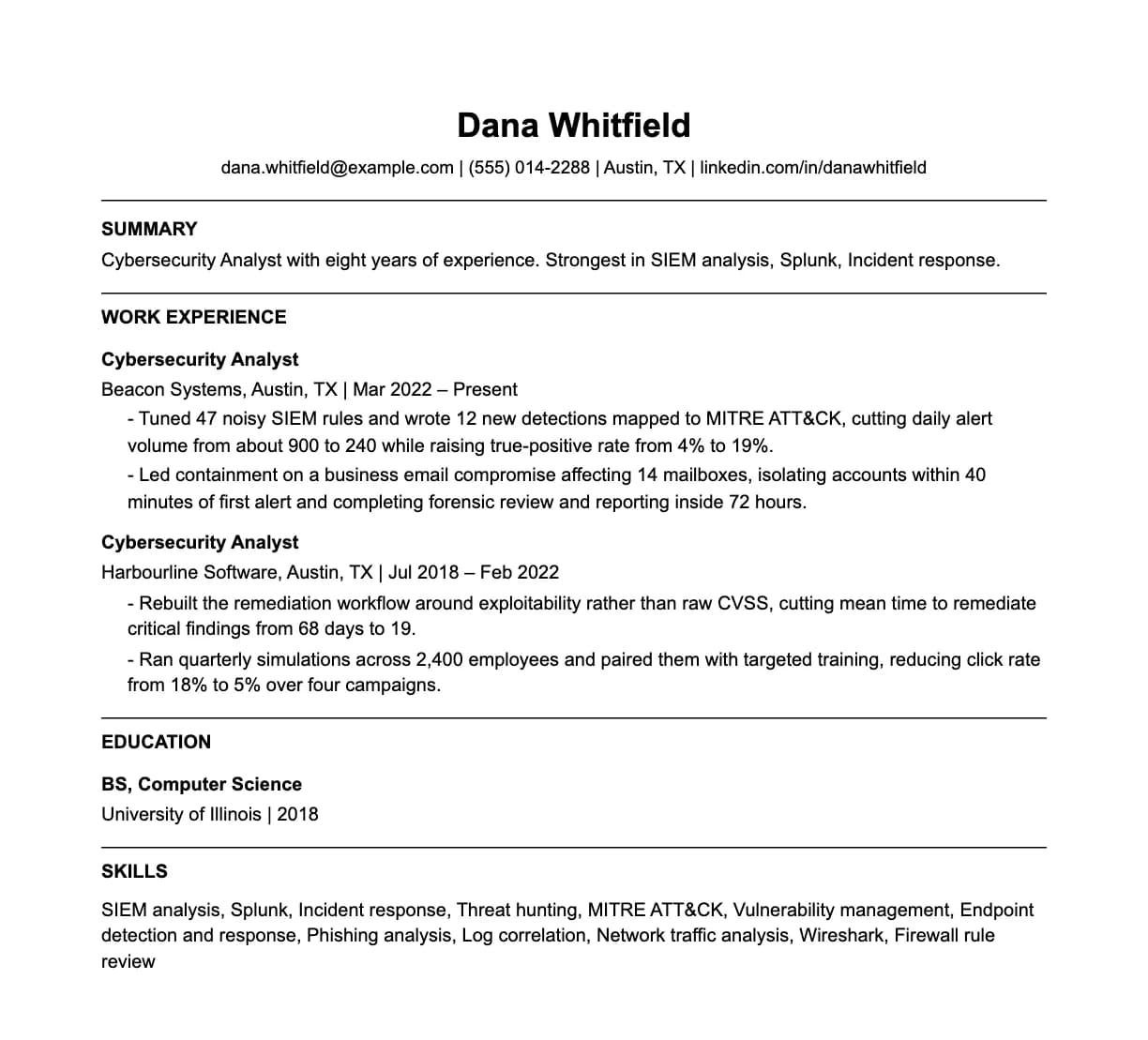
The bullets and skills are this page's own. The name, employer and dates are invented.
Cybersecurity Analyst resume writing guide
Three areas where most cybersecurity analyst resumes either win or lose against the competition. Read each section carefully, even one improvement here can meaningfully increase your response rate.
Alert quality beats alert volume
Anyone can say they monitored a SIEM. What a security hiring manager wants to know is whether you improved signal: how many rules you tuned, what happened to false positives, whether the queue got more workable because you were on it. Detection work mapped to a framework reads as maturity. Saying a detection covers a specific ATT&CK technique is concrete in a way that "created custom alerts" is not, and it is immediately checkable in conversation.
Clearances and certifications are filters, not decoration
If you hold an active US security clearance, put it in the header with the level and status: "Active Secret clearance." Many federal and defense-contractor postings screen on it before anything else, and recruiters search for the word. Certifications carry unusual weight in this field. Security+ satisfies DoD 8570 baseline requirements for many roles, and CISSP is a common filter for senior positions. List them with the year earned; put them below experience unless you are early enough in your career that they are the strongest thing you have.
Sections, in order
Contact with clearance if you have one, summary, experience, skills, certifications, education. Never name unpatched systems, specific internal hostnames or unresolved vulnerabilities from a current employer; discretion is part of what is being assessed. Leave out: a photo, your date of birth, marital status and your full street address. City and state only.
Cybersecurity Analyst salary in the United States
National figures for Information Security Analysts, the occupation BLS counts this job under. These are percentiles across everyone employed in it, not steps on a career ladder: half of all workers earn more than the median and half earn less. BLS calls this Information Security Analysts.
10th percentile
$75,090
Nine in ten earn more than this
Median
$129,180
Half earn more, half earn less
90th percentile
$199,850
One in ten earns more than this
Source: US Bureau of Labor Statistics, Occupational Employment and Wage Statistics (OEWS), national cross-industry estimates, May 2025, SOC 15-1212. Annual wages, excluding bonuses, equity and other non-wage compensation. Current release at bls.gov/oes.
See the full pay range, from the 10th to the 90th percentile, and pay by metro
How to use these numbers
They are national and cross-industry, so your city and sector move them a long way. Use the median as the anchor, name a specific number rather than a range, and justify it with the single most quantified achievement on your resume.
Cybersecurity Analyst resume format and structure
ATS systems parse your resume top-to-bottom. The order of your sections and how you label them directly affect your score. Use this structure:
Section 01
Contact Information
Name, professional email, phone, LinkedIn URL, and city/country. No photo, no date of birth, no full address. Keep it to 2 lines maximum.
Section 02
Professional Summary
2-3 sentences. Years of experience as a cybersecurity analyst, your primary specialty, and your single biggest quantified achievement. No fluff.
Section 03
Work Experience
Reverse-chronological order. Company name, your title, dates (month/year), location. 3–5 bullet points per role, each with a number. Most recent role gets the most bullets.
Section 04
Skills
List SIEM analysis, Splunk, Incident response, Threat hunting, MITRE ATT&CK, and other relevant tools. Group by category if you have 10+ skills. This section is scanned first by most ATS.
Section 05
Education
Degree, institution, graduation year. No GPA unless above 3.5 and within 3 years of graduation. Certifications go here or in a separate Certifications section.
Section 06
Optional Sections
Projects (essential for early-career), Certifications, Publications, Open Source, or Languages. Only include if genuinely adding signal.
Questions
Cybersecurity Analyst resume, frequently asked questions
Answers to the most common questions job seekers have when writing a cybersecurity analyst resume, covering format, keywords, length, and ATS optimization.
Resume examples for other roles
Need a guide for a different job title? Each page includes role-specific ATS keywords, real bullet examples, and a writing guide.
Build your cybersecurity analyst resume
Use our free tools to build, score, and optimize your resume for the specific job description you're applying to.
Sources and references
Where the skills, tooling and pay figures on this page come from.
From example to yours
Start from this, then make it yours
The builder takes an example like this one and lets you edit it in place. The score updates as you type, so you can see whether a change helped rather than guessing.
Open the builder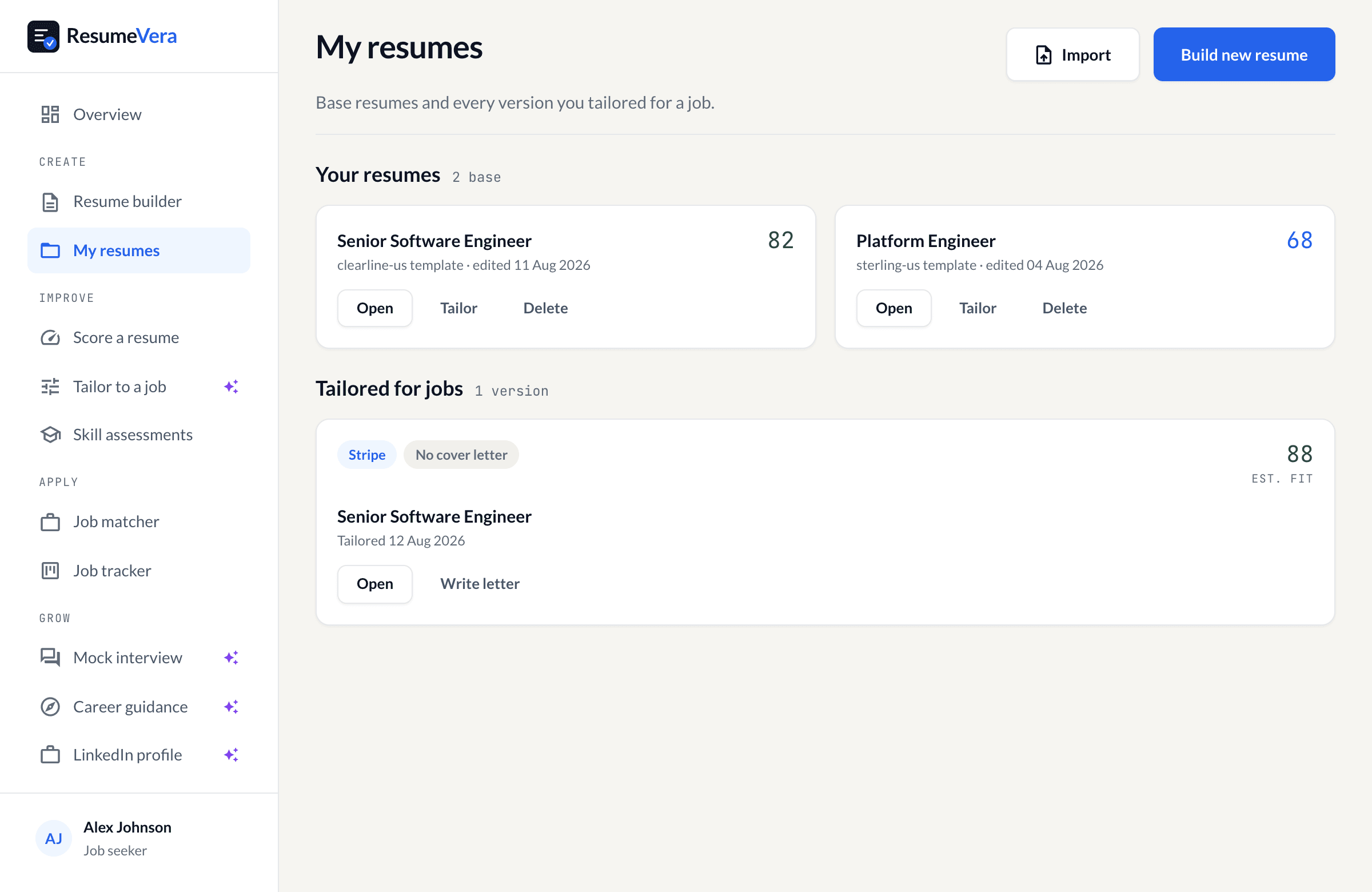
The real resume library, on a sample account with sample scores.
Build your cybersecurity analyst resume, free
Start from an example like this in the builder and watch the score move as you edit. Building, scoring and a watermarked export are free, with no card.