AI-Generated Resumes Are Everywhere: How to Stand Out in 2026
Resume Tips · ResumeVera Career Research Team · June 13, 2026 · 18 min read

Artificial intelligence has fundamentally changed how people apply for jobs. Resume builders, AI writing assistants, career copilots, and large language models now help millions of job seekers create resumes within minutes. While this technology has improved accessibility and efficiency, it has also created a new challenge for employers: many resumes are beginning to look the same.
Recruiters across industries report receiving increasing numbers of AI-assisted applications containing similar language, similar structures, and similar achievement statements. As a result, employers are becoming more selective and are placing greater emphasis on authenticity, measurable accomplishments, portfolios, communication skills, and evidence of real-world impact.
Key Takeaways
AI-generated resumes are becoming increasingly common across industries.
Recruiters care more about authenticity than whether AI was used.
ATS systems primarily evaluate relevance, skills, and keywords.
Measurable achievements outperform generic AI-generated content.
Portfolio projects, LinkedIn profiles, and proof of work are becoming more important.
Candidates who combine AI tools with authentic experience gain the greatest advantage.
Quick Answer
AI-generated resumes can help candidates improve formatting, grammar, and ATS optimization, but recruiters increasingly report that many AI-assisted resumes sound similar. The most successful candidates use AI as a productivity tool while ensuring their resumes contain genuine achievements, measurable impact, and role-specific customization.
Why This Topic Matters in 2026
The widespread adoption of AI tools has transformed recruitment. Job seekers can now generate tailored resumes in minutes, while employers use ATS platforms and AI-powered screening systems to process thousands of applications efficiently.
At the same time, recruiters report receiving more applications than ever before. The result is a highly competitive hiring environment where standing out requires more than polished formatting.
What Recruiters Are Seeing Right Now
One of the biggest hiring discussions in 2026 revolves around application quality. Recruiters increasingly report seeing:
Nearly identical professional summaries.
Repeated buzzwords and corporate language.
Generic achievement statements.
Applications optimized for algorithms rather than humans.
Resumes that lack specific evidence of impact.
Many hiring teams now spend additional time validating candidate experience through interviews, portfolios, LinkedIn profiles, assessments, and references.
The Rise of AI-Generated Resumes
AI-powered resume tools have become mainstream because they solve real problems.
They help candidates:
Improve grammar and readability.
Optimize for ATS systems.
Generate professional summaries.
Tailor resumes to job descriptions.
Highlight relevant skills.
However, because many candidates use similar prompts and tools, resumes often begin to resemble one another.
Traditional ResumeModern AI-Assisted ResumeWritten manuallyGenerated or refined using AIVariable qualityConsistently polishedUnique languageOften similar language patternsTime-consumingFaster creation processHuman-centric optimizationATS-focused optimization
Could AI Hiring Systems Prefer AI-Written Resumes?
One of the most fascinating hiring developments of 2026 comes from research into algorithmic hiring systems. Researchers studying AI-powered recruitment found evidence that some large language models may show a preference for resumes generated by the same model family used during evaluation.
In controlled experiments, AI-generated resumes received significantly higher shortlisting rates in some scenarios compared with equivalent human-written resumes. While the research is still evolving, it highlights how AI is influencing both sides of the hiring process.
The takeaway is not that AI guarantees success. Instead, it demonstrates that understanding how AI-driven hiring works is becoming increasingly important for job seekers.
What ATS Systems Actually Evaluate
A common misconception is that ATS platforms reject resumes simply because AI was used.
In reality, most ATS systems focus on:
Keyword relevance.
Job title alignment.
Skills matching.
Resume structure.
Formatting compatibility.
ATS platforms are generally designed to organize applications and improve recruiter efficiency rather than detect AI-generated content.
Why Many AI-Generated Resumes Fail
AI can create polished content, but polish alone does not guarantee results.
Common reasons AI-generated resumes fail include:
Generic summaries.
Lack of measurable achievements.
Overuse of buzzwords.
Poor customization.
Missing industry-specific details.
Weak evidence of business impact.
Recruiters are becoming increasingly skilled at identifying these patterns.
Generic vs High-Impact Resume Content
Generic AI ContentHigh-Impact ContentResults-driven professionalIncreased customer retention by 24% over 12 monthsExcellent communication skillsLed stakeholder presentations across 5 departmentsTeam playerCollaborated with cross-functional teams to reduce costs by 18%Strategic thinkerDesigned workflow improvements saving 120 hours quarterly
The Statistics Every Job Seeker Should Know
Organizations increasingly use AI throughout hiring workflows.
Resume screening remains one of the most common recruitment use cases for AI.
Recruiters report growing volumes of AI-assisted applications.
Skills-based hiring continues to expand across industries.
Employers increasingly combine AI screening with human evaluation.
The Skills Employers Value Most
SkillDemandAutomation RiskCommunicationVery HighLowCritical ThinkingVery HighLowProblem SolvingVery HighLowLeadershipHighLowAI LiteracyVery HighVery LowData AnalysisHighMediumCybersecurityVery HighLow
How to Use AI Without Looking Like Everyone Else
Start with your real achievements before using AI.
Use AI to improve clarity rather than invent content.
Quantify accomplishments with metrics.
Customize every application.
Include industry-specific terminology.
Highlight projects and outcomes.
Review every AI-generated suggestion critically.
Build Proof Beyond Your Resume
Recruiters increasingly evaluate candidates beyond resumes.
Consider strengthening:
LinkedIn profiles.
Portfolios.
Case studies.
Certifications.
GitHub repositories.
Professional content.
Project showcases.
Proof of work often differentiates candidates far more effectively than another polished summary section.
Related ResumeVera Resources
Final Thoughts
AI-generated resumes are not the problem. Generic resumes are. The candidates achieving the best results in 2026 are not avoiding AI—they are using it strategically while ensuring their applications remain authentic, measurable, and relevant.
As hiring evolves, success will depend on combining AI-assisted productivity with real achievements, strong communication skills, and clear evidence of value. Job seekers who master this balance will stand out regardless of how competitive the market becomes.
References
Get Free ATS Tips Every Week
Actionable resume and ATS tips, when we publish them. No spam. Unsubscribe any time.
Related Articles

Federal Resume vs Private Sector Resume: Key Differences Explained (2026)
Learn the major differences between federal and private sector resumes. Understand USAJOBS requirements, OPM formatting rules, specialized experience, KSAs, and common mistakes to avoid when applying for US government jobs.
Read More

Best Resume Format for US Jobs in 2026: The Complete Guide to Layouts, Sections, and ATS-Friendly Formatting
Discover the resume format preferred by US recruiters and ATS systems in 2026, including the optimal layout, correct section order, formatting best practices, and a detailed comparison of chronological, functional, and combination formats with real examples.
Read More

Can Recruiters Tell If Your Resume Was Written by ChatGPT?
Nearly 65% of job seekers now use AI to write resumes, but 49% of US hiring managers automatically reject resumes they identify as AI-generated. Learn exactly how recruiters spot ChatGPT resumes and how to make yours sound authentic while staying ATS-friendly.
Read More
Try it
Check this against your own resume
The post above is general. Your file is not. The checker reads it the way a parser would and tells you which of these points it actually breaks.
Check your resume free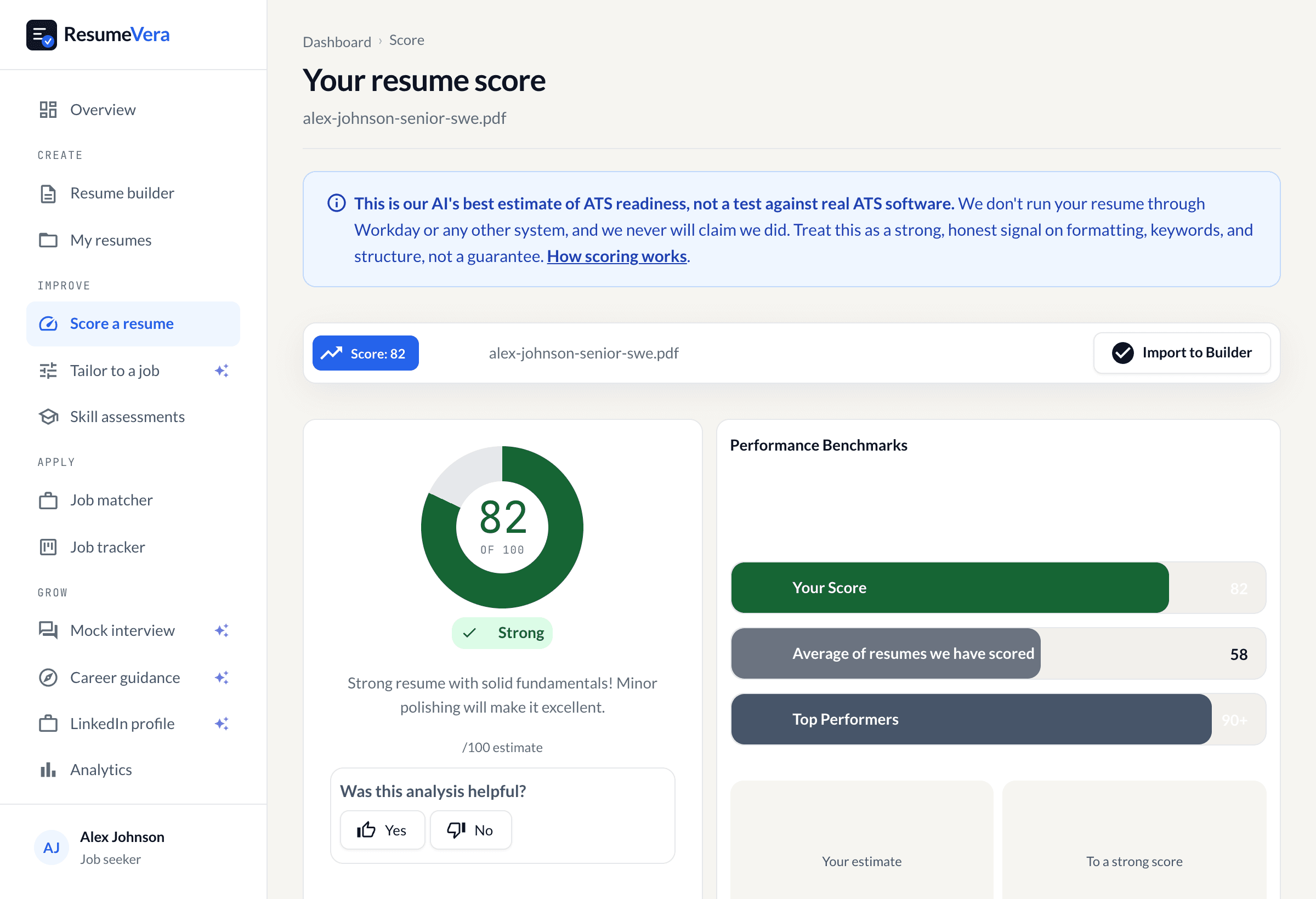
A sample resume in the real checker. The 82 and the sub-scores are what the scorer returns for it.
Now check it against your own resume
An honest, AI-estimated ATS score in 30 seconds. No account, no card.