Business Analyst Interview Questions 2026
22 real-world questions covering requirements elicitation, stakeholder management, Agile frameworks, data analysis, and process improvement.
Interview Questions
22 Questions with Answers
Click any question to reveal a detailed sample answer. Filter by category to focus your preparation.
Walk me through how you would gather requirements for a system you know nothing about.
Sample Answer
Start by understanding the business context: research the industry, company, and existing processes. Identify stakeholders using a stakeholder map (power-interest matrix). Conduct initial discovery interviews with key stakeholders to understand the current state, pain points, and desired outcomes. Use multiple elicitation techniques: one-on-one interviews for depth, workshops for consensus, document analysis for existing processes, observation for workflow understanding, and prototyping for validating assumptions. Document requirements using user stories with acceptance criteria, process flow diagrams, and data models. Validate requirements through structured walkthroughs with stakeholders. Prioritize using MoSCoW or WSJF. The key is asking 'why' behind every request to uncover real needs vs stated wants.
What is the difference between functional and non-functional requirements? Give examples.
Sample Answer
Functional requirements describe what the system should do: 'Users can reset their password via email verification' or 'The system generates monthly sales reports.' Non-functional requirements describe how the system should perform: performance (page load under 2 seconds), security (data encrypted at rest and in transit), scalability (support 10,000 concurrent users), availability (99.9% uptime), usability (WCAG 2.1 AA compliance), and maintainability (modular architecture). Non-functional requirements are often overlooked but cause the most production issues. Always capture them explicitly with measurable criteria. Use quality attribute scenarios to define non-functional requirements: stimulus, environment, response, and response measure.
How do you handle conflicting requirements from different stakeholders?
Sample Answer
First, understand each stakeholder's underlying need, not just their stated requirement. Often conflicts arise from different assumptions or perspectives on the same goal. Facilitate a joint session where stakeholders hear each other's reasoning. Use data to make the case: cost-benefit analysis, user research findings, or market data. Apply prioritization frameworks (MoSCoW, weighted scoring) with stakeholder input. If consensus is not possible, escalate to a decision-maker with a clear summary of options, trade-offs, and your recommendation. Document the decision and rationale. Key skill: reframe conflicts as shared problems to solve rather than positions to defend. Most conflicts resolve when stakeholders understand the 'why' behind competing needs.
Explain the Agile methodology. How does a BA's role differ in Agile vs Waterfall?
Sample Answer
Agile delivers software iteratively in short cycles (sprints), emphasizing collaboration, adaptability, and working software over comprehensive documentation. In Waterfall, the BA completes all requirements upfront in a detailed BRD before development begins. In Agile, the BA continuously grooms the backlog, writes user stories with acceptance criteria, participates in sprint planning, and refines requirements based on feedback each sprint. The BA acts as a bridge between the product owner and development team, translating business needs into actionable stories. Key shift: from writing comprehensive documents to facilitating conversations and maintaining a living backlog. The BA ensures the team builds the right thing, while the product owner decides what to build next.
What is a user story and how do you write effective acceptance criteria?
Sample Answer
A user story follows the format: 'As a [user type], I want [goal] so that [benefit].' This keeps focus on user value rather than technical implementation. Effective acceptance criteria are specific, testable, and define the boundaries of the story. Use the Given-When-Then format: 'Given I am a logged-in user, when I click Reset Password, then I receive an email with a reset link within 2 minutes.' Include happy paths, edge cases, and error scenarios. Acceptance criteria should be agreed upon by the BA, developer, and QA before development starts (the 'three amigos' practice). Common mistake: making criteria too vague ('the page should be fast') or too prescriptive ('use a React modal with a 300ms fade animation').
How do you prioritize a product backlog with 50+ items?
Sample Answer
Use a structured prioritization framework. MoSCoW categorizes items as Must-have, Should-have, Could-have, and Won't-have for this release. WSJF (Weighted Shortest Job First) from SAFe divides the cost of delay by job duration, favoring high-value, quick-to-implement items. RICE scores items on Reach, Impact, Confidence, and Effort. For each method: involve stakeholders in scoring to build buy-in. Group related items into themes or epics for easier evaluation. Consider dependencies: some items must precede others regardless of priority. Review and re-prioritize regularly as new information emerges. Document your prioritization rationale so stakeholders understand why their items are positioned where they are. Always prioritize ruthlessly: a focused backlog ships more value than a diluted one.
Describe a time you identified a requirement that stakeholders had missed.
Sample Answer
Use the STAR method: 'During a CRM implementation, stakeholders focused on sales pipeline features. Through process observation and data analysis, I discovered that 30% of sales team time was spent on manual data entry from emails into the CRM. No one had mentioned this because they considered it normal workflow. I proposed an email integration feature with automatic contact and activity logging. I quantified the impact: 6 hours per rep per week saved, which translated to a potential 15% increase in selling time. The feature was prioritized into the first release and became the most-used capability. This taught me to always observe actual workflows, not just ask about desired features, because users adapt to inefficiencies and stop seeing them.'
What is a RACI matrix and when would you use it?
Sample Answer
RACI defines roles for each task: Responsible (does the work), Accountable (owns the outcome, only one per task), Consulted (provides input), and Informed (kept updated). Use it to clarify ownership in cross-functional projects, prevent work from falling through cracks, and reduce confusion about who decides what. Create it during project kickoff with stakeholder input. Common issues: too many people as Responsible (diffused ownership), missing Accountable designation, or Consulted people blocking progress. Best practices: keep it simple, review when team composition changes, and ensure every critical activity has exactly one Accountable person. For Agile teams, RACI is particularly useful for clarifying the boundary between product owner, BA, and engineering lead responsibilities.
How do you create a business process model? What notation do you use?
Sample Answer
Use BPMN (Business Process Model and Notation) for detailed process documentation. Start by identifying the process boundaries (trigger and end state), actors (swim lanes), and activities. Map the current state (as-is) first through observation and interviews, then design the future state (to-be) incorporating improvements. Include decision gateways, parallel paths, and exception flows. For simpler processes, use flowcharts or value stream maps. Tools include Visio, Lucidchart, or Miro. Best practices: validate the model with actual process participants, keep it at the right level of detail (not too granular), and use consistent notation throughout. Process models are essential for gap analysis, identifying automation opportunities, and communicating changes to stakeholders.
How do you handle scope creep in a project?
Sample Answer
Prevention is better than cure: establish a clear scope statement with explicit boundaries and a formal change request process at project inception. When new requirements emerge, evaluate each through the change control process: what is the business value, what is the impact on timeline, budget, and existing scope? Present trade-offs to stakeholders: 'We can add this feature if we defer feature Y or extend the timeline by two weeks.' Document every scope change with its impact assessment and stakeholder approval. In Agile, scope creep is managed naturally through backlog prioritization: new items are added but must compete with existing priorities. The key is never saying a flat no; instead, quantify the impact and let stakeholders make informed trade-off decisions.
What is gap analysis and how do you conduct one?
Sample Answer
Gap analysis compares the current state (as-is) with the desired future state (to-be) to identify what needs to change. Steps: (1) Document the current state through process mapping, data analysis, and stakeholder interviews. (2) Define the desired future state based on business objectives and requirements. (3) Identify gaps categorized by type: process gaps, technology gaps, skill gaps, and data gaps. (4) Assess each gap's impact and effort to close. (5) Recommend solutions prioritized by business value. (6) Create an action plan with owners and timelines. Gap analysis is essential during system selection, process improvement, and digital transformation projects. Present findings visually using comparison tables or heat maps to make gaps tangible for stakeholders.
Explain how you would conduct a feasibility study for a new software project.
Sample Answer
Evaluate five dimensions: Technical feasibility (can we build it with available technology and expertise?), Economic feasibility (do the benefits outweigh the costs? Calculate ROI, NPV, payback period), Operational feasibility (will users adopt it? Does it align with organizational culture?), Schedule feasibility (can we deliver within the required timeframe?), and Legal/regulatory feasibility (compliance requirements, data privacy laws). For each dimension, assess risks and mitigation strategies. Gather data through vendor evaluations, proof of concepts, market research, and stakeholder interviews. Present findings with a clear recommendation: proceed, modify scope, or do not proceed, with supporting evidence for each option. Include assumptions and their sensitivity to change.
How do you validate that delivered software meets business requirements?
Sample Answer
Implement a multi-layered validation approach: User Acceptance Testing (UAT) where business users test real scenarios against acceptance criteria. Traceability matrix linking requirements to test cases ensures nothing is missed. Demo sessions during development (sprint reviews in Agile) for early feedback. Pilot or beta deployment with a subset of users before full rollout. Post-implementation review comparing actual outcomes to expected business benefits. Define clear pass/fail criteria before testing begins. Document defects with severity and priority for resolution. Do not just check if features work: verify they solve the original business problem. The most common failure is software that passes UAT but does not actually improve the business process it was designed to fix.
How do you manage stakeholder expectations throughout a project?
Sample Answer
Start by understanding each stakeholder's expectations, influence level, and communication preferences. Set realistic expectations early: be honest about constraints, risks, and trade-offs during kickoff. Provide regular status updates tailored to audience (executives want metrics and milestones, technical leads want details). Use demos and prototypes to make progress tangible. When expectations cannot be met, communicate early with alternative options and their trade-offs. Never surprise stakeholders with bad news; escalate risks proactively. Build trust through transparency, reliability, and following through on commitments. Document agreements and decisions in writing to prevent misremembering. The most successful BAs are trusted advisors who tell stakeholders what they need to hear, not what they want to hear.
What tools and techniques do you use for data analysis as a BA?
Sample Answer
SQL for querying databases and understanding data models. Excel or Google Sheets for quick analysis, pivot tables, and data validation. Visualization tools (Tableau, Power BI) for creating dashboards and presenting findings. Process mining tools (Celonis) for analyzing actual process flows from event logs. Wireframing tools (Figma, Balsamiq) for requirement visualization. Collaboration tools (Jira, Confluence) for managing requirements and documentation. Data modeling tools (ERD diagrams) for understanding data relationships. The key is matching the tool to the task: use SQL for complex data extraction, Excel for ad-hoc analysis, and visualization tools for stakeholder communication. BAs in 2026 increasingly use AI tools for meeting summarization, requirements drafting, and pattern recognition in large datasets.
Describe a project where you had to work with a difficult stakeholder.
Sample Answer
Choose a real example showing emotional intelligence and problem-solving. Structure with STAR: 'A senior director resisted a new CRM system, actively undermining adoption by instructing his team to continue using spreadsheets. Rather than escalating immediately, I scheduled a one-on-one meeting to understand his concerns. He was worried about losing custom reports he had built over years. I demonstrated how the new system could replicate and improve those reports with real-time data. I involved him as a beta tester and incorporated his feedback, which gave him ownership. He became the biggest advocate for the system, and his team's adoption rate went from lowest to highest. I learned that resistance usually signals an unaddressed concern, not obstinacy.'
How do you ensure quality in requirements documentation?
Sample Answer
Apply the SMART criteria: requirements should be Specific, Measurable, Achievable, Relevant, and Time-bound. Use structured reviews: peer review by another BA for consistency, technical review by developers for feasibility, and stakeholder review for accuracy. Maintain a glossary for consistent terminology. Use templates and standards for uniformity. Write requirements that are testable: if you cannot write a test case for a requirement, it is not clear enough. Avoid ambiguous language ('the system should be user-friendly') and use quantifiable criteria ('users can complete the task in under 3 clicks'). Implement version control for all documents. Cross-reference requirements with process models and data models for completeness. Regular backlog refinement in Agile ensures requirements stay current and clear.
What is your experience with data modeling? Explain ER diagrams.
Sample Answer
An Entity-Relationship (ER) diagram visually represents data structures and relationships in a system. Entities are objects (Customer, Order, Product) with attributes (name, email, price). Relationships define how entities relate: one-to-one (User to Profile), one-to-many (Customer to Orders), and many-to-many (Students to Courses, via a junction table). Cardinality notation shows minimum and maximum participation. ER diagrams are essential during requirements analysis to understand data requirements, validate business rules, and communicate with database developers. I create ER diagrams during the requirements phase to ensure all data requirements are captured and relationships are correctly defined. Tools include Lucidchart, draw.io, or database-specific tools like MySQL Workbench.
What salary range are you expecting for this BA role?
Sample Answer
Research market rates on Glassdoor, PayScale, and IIBA salary surveys. Business analysts in the US typically earn $65K-$90K for entry-level and $90K-$130K for senior roles, with variations by industry and location. Frame your response: 'Based on my experience in requirements management, Agile delivery, and domain expertise in [industry], I am targeting a range of X to Y. I am also interested in the overall package including professional development opportunities, certifications, and growth paths. I would love to understand more about your compensation structure.' IIBA certification (CBAP, CCBA) and domain expertise can command premium compensation.
Why are you interested in business analysis as a career?
Sample Answer
Connect your motivation to the core of the BA role. For example: 'I am drawn to business analysis because it sits at the intersection of business strategy and technology execution. I enjoy the challenge of translating ambiguous business problems into clear, actionable requirements that teams can build. What excites me most is seeing the tangible impact of good analysis: a requirement well-defined saves weeks of rework, and a process improvement can save an organization millions. In my career, I have found that the projects I am most proud of are ones where I uncovered a need nobody had articulated and turned it into a solution that transformed how people work.'
How do you approach digital transformation projects as a BA?
Sample Answer
Digital transformation requires understanding both the current business model and the target digital vision. Start with a maturity assessment: where is the organization today on the digital maturity spectrum? Map current processes before digitizing them (do not automate a broken process). Identify quick wins that demonstrate value early and build momentum. Focus on change management: 70% of digital transformations fail due to people and culture, not technology. Work with change management teams to plan training, communication, and adoption strategies. Use iterative delivery to show progress and incorporate feedback. Key BA activities include: stakeholder impact analysis, process redesign, data migration planning, integration mapping, and user journey mapping for the new digital experience.
How do you measure the success of a project from a business analysis perspective?
Sample Answer
Define success metrics during project initiation, not after delivery. Track across four dimensions: Business value (did we achieve the expected ROI, cost savings, or revenue increase?), User adoption (are users actually using the system? Measure adoption rate, training completion, and support ticket volume), Quality (defect rates, rework, and stakeholder satisfaction scores), and Process efficiency (did cycle times improve? Are manual steps eliminated?). Conduct a post-implementation review 3-6 months after launch comparing actual outcomes to projected benefits. Capture lessons learned for future projects. The most important measure is whether the original business problem was solved, not whether the software was delivered on time and on budget.
Preparation Tips
Interview Preparation Tips
Prepare examples of requirements documents, process models, or user stories you have created — having artifacts to discuss makes you stand out.
Know your elicitation techniques well: be ready to explain when you would use interviews vs workshops vs observation.
Practice case study responses: take a vague business problem and show your structured approach to defining requirements.
Brush up on Agile terminology and ceremonies: sprint planning, backlog refinement, retrospectives, and definition of done.
Understand the difference between business requirements, functional requirements, and technical specifications.
Research the company's industry and be prepared to discuss domain-specific challenges and regulations.
Avoid These
Common Mistakes to Avoid
Jumping to solutions without fully understanding the business problem and its root causes.
Writing requirements in isolation without validating with both business stakeholders and technical teams.
Not being able to explain your prioritization framework with concrete examples.
Ignoring non-functional requirements like performance, security, and scalability.
Over-documenting: writing 50-page BRDs when the team needs concise user stories with acceptance criteria.
Not preparing stories about handling difficult stakeholders, conflicting requirements, and scope changes.
Related Roles
Explore Other Interview Guides
Preparing for multiple roles? Check out interview questions for related positions.
Interview Guides
Explore More Interview Questions
Browse all our interview question guides with detailed answers and preparation tips.
View All Interview GuidesPractise
Reading questions is not the same as answering them
A mock interview generates its questions from this role and from your own resume, then tells you what a hiring manager would take from each answer.
Join the waitlist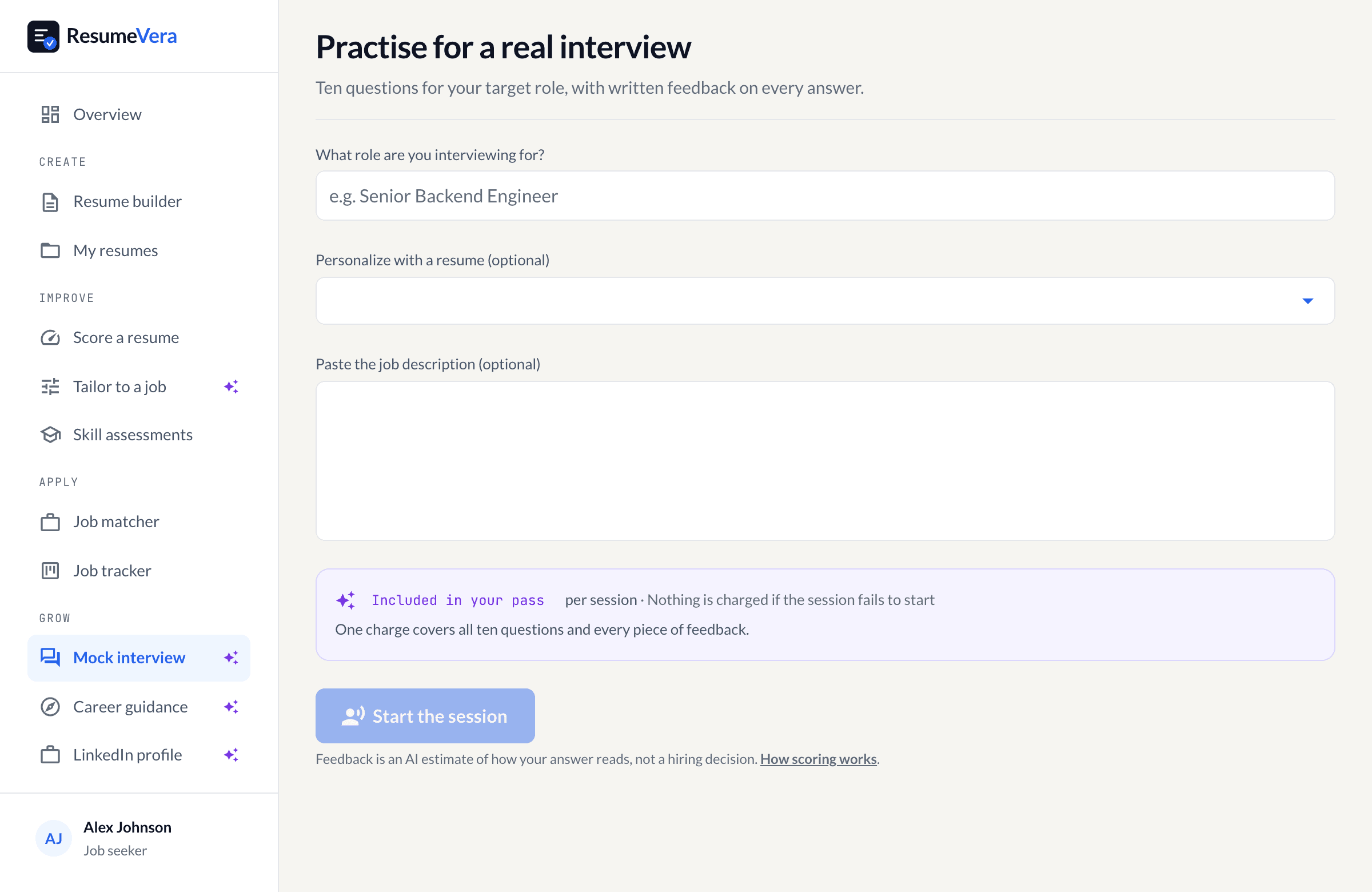
The real screen. Questions are generated from the role you pick and your own resume.
Is your resume ATS-ready?
Run a free ATS score check and get specific improvements in under 60 seconds.