Financial Analyst Interview Questions 2026
22 real-world questions covering DCF valuation, financial modeling, accounting fundamentals, Excel proficiency, and analytical case studies.
Interview Questions
22 Questions with Answers
Click any question to reveal a detailed sample answer. Filter by category to focus your preparation.
Walk me through a DCF analysis.
Sample Answer
A DCF (Discounted Cash Flow) values a company based on its projected future free cash flows discounted to present value. Steps: (1) Project free cash flows (FCF) for 5-10 years based on revenue growth, margins, capex, and working capital assumptions. (2) Calculate the terminal value using either the perpetuity growth method (FCF * (1+g) / (WACC-g)) or exit multiple method. (3) Discount all cash flows to present value using WACC (Weighted Average Cost of Capital). (4) Sum the present values to get enterprise value. (5) Subtract net debt and add cash to get equity value. (6) Divide by diluted shares for per-share value. (7) Run sensitivity analysis on key assumptions. DCF is most reliable for mature companies with predictable cash flows.
What are the three financial statements and how are they linked?
Sample Answer
The Income Statement shows revenue, expenses, and net income over a period. The Balance Sheet shows assets, liabilities, and equity at a point in time. The Cash Flow Statement shows cash inflows and outflows. They are linked: net income from the income statement flows to the cash flow statement as the starting point for operating cash flows and to retained earnings on the balance sheet. Capital expenditures on the cash flow statement increase PP&E on the balance sheet. Debt issuance appears in financing cash flows and on the balance sheet. The ending cash balance on the cash flow statement equals cash on the balance sheet. Understanding these linkages is fundamental to financial modeling and analysis.
How would you value a company that has no earnings?
Sample Answer
For unprofitable companies, traditional earnings-based methods do not apply. Alternative approaches: revenue multiples (EV/Revenue compared to profitable peers), user or subscriber-based valuations (common for tech startups), asset-based valuation (liquidation value for distressed companies), DCF with projected profitability (forecast when the company will become profitable and model long-term FCF), comparable transactions (what have similar companies been acquired for?), and venture capital method (work backward from expected exit value). Consider the stage: early-stage companies use risk-adjusted NPV or option pricing models. Always explain your choice of methodology and its limitations. Multiple methods provide a valuation range, not a single number.
Explain the difference between enterprise value and equity value.
Sample Answer
Enterprise value (EV) represents the total value of a company to all capital providers (debt holders, equity holders, preferred stockholders, minority interests). EV = Market Cap + Net Debt + Preferred Stock + Minority Interest. Equity value represents the value attributable only to common shareholders. The relationship: Equity Value = Enterprise Value - Net Debt - Preferred Stock - Minority Interest. Use EV-based multiples (EV/EBITDA, EV/Revenue) when comparing companies with different capital structures because EV is capital-structure-neutral. Use equity multiples (P/E ratio) when analyzing from a shareholder's perspective. A common mistake is comparing P/E ratios of companies with vastly different leverage, which makes direct comparison misleading.
What is WACC and how do you calculate it?
Sample Answer
WACC (Weighted Average Cost of Capital) represents the average rate of return required by all capital providers. Formula: WACC = (E/V * Re) + (D/V * Rd * (1-T)), where E = equity value, D = debt value, V = E + D, Re = cost of equity, Rd = cost of debt, T = tax rate. Calculate cost of equity using CAPM: Re = Risk-free rate + Beta * Equity Risk Premium. Cost of debt is the yield on existing debt or the rate at which the company can borrow. Beta measures the stock's volatility relative to the market. Use the company's target capital structure, not current. WACC is used as the discount rate in DCF analysis. A lower WACC increases the present value of future cash flows and thus the company valuation.
If revenue increases by 10%, how does that flow through the financial statements?
Sample Answer
Income Statement: revenue increases by 10%. If margins remain constant, COGS and operating expenses increase proportionally. Taxable income and net income increase. Cash Flow Statement: higher net income flows through, but working capital changes may offset some cash benefit (higher receivables and inventory from increased sales). Capex may need to increase if the revenue growth requires additional capacity. Balance Sheet: accounts receivable increases (more sales on credit), inventory may increase, retained earnings increase by net income minus dividends. Cash position depends on the net cash flow effect. The key insight is that revenue growth does not automatically mean proportional cash flow growth due to working capital and capex requirements. This is why free cash flow analysis is more important than earnings alone.
What are the most common valuation multiples and when do you use each?
Sample Answer
EV/EBITDA: most common for comparing companies, removes effects of capital structure, depreciation, and taxes. Typical range: 6-15x depending on industry. P/E ratio: quick equity valuation, useful for mature profitable companies, but misleading with different leverage. EV/Revenue: used for high-growth or unprofitable companies where earnings are not meaningful. P/B (Price to Book): used for banks and financial institutions where assets are marked to market. EV/EBIT: similar to EV/EBITDA but accounts for depreciation, better for capital-intensive businesses. PEG ratio: P/E divided by growth rate, adjusts for different growth rates. Always use multiples from comparable companies in the same industry, geography, and growth stage. Multiples provide relative value, not intrinsic value.
Explain working capital and why it matters.
Sample Answer
Working capital = Current Assets (cash, receivables, inventory) - Current Liabilities (payables, accrued expenses, short-term debt). It measures a company's short-term liquidity and operational efficiency. Positive working capital means the company can meet short-term obligations. Negative working capital can signal trouble or, in some business models (Amazon), efficient operations where customers pay before suppliers are paid. Changes in working capital affect free cash flow: increasing working capital consumes cash (you are investing in receivables and inventory), decreasing working capital generates cash. Working capital management (days sales outstanding, days inventory outstanding, days payable outstanding) directly impacts cash conversion cycle. Analysts focus on working capital trends to assess operational efficiency and cash flow predictability.
How do you build a financial model from scratch?
Sample Answer
Follow a structured approach: (1) Gather historical financials (3-5 years) and normalize for one-time items. (2) Build the income statement model: forecast revenue by segment, model cost structure, and project margins. (3) Build the balance sheet: project working capital based on days metrics, model PP&E with capex and depreciation schedules, and project debt based on the capital structure. (4) Build the cash flow statement: derive from income statement and balance sheet changes. (5) Add a debt schedule for interest calculations (creates circularity, solve with iteration). (6) Build scenario analysis and sensitivity tables. Best practices: color-code inputs (blue) vs formulas (black), avoid hardcoding, use consistent time periods, document assumptions, and add error checks. A good model is transparent, auditable, and tells a clear story about the business.
What is the difference between EBIT and EBITDA? When would you use each?
Sample Answer
EBIT (Earnings Before Interest and Taxes) reflects operating profitability including depreciation and amortization. EBITDA adds back D&A, approximating cash operating earnings. EBITDA is widely used for comparing companies with different capital expenditure levels, in debt covenants (debt/EBITDA ratios), and in LBO analysis. EBIT is better for capital-intensive industries where depreciation represents real economic wear on assets (manufacturing, airlines). Use EBITDA with caution: it can overstate cash generation for companies with high capex requirements, as it ignores the investment needed to maintain assets. Neither metric accounts for working capital changes or actual cash taxes. For a true cash measure, use free cash flow.
You notice a company's revenue is growing but cash flow is declining. What might explain this?
Sample Answer
Several scenarios could explain this divergence. Aggressive revenue recognition: booking revenue before cash is collected, inflating receivables. Growing working capital needs: rapid growth requiring more inventory and longer receivables collection. Increasing capex: investing heavily in capacity expansion to support growth. Declining margins: growing revenue through discounts or in lower-margin products. Acquisition-driven growth: revenue includes acquired companies but integration costs consume cash. Rising debt service: increased interest payments from leverage used to fund growth. To diagnose, analyze the cash flow statement components: operating cash flow vs net income, working capital changes, capex trends, and financing activities. This question tests your ability to think beyond the income statement and understand cash flow dynamics.
How do you analyze a company's creditworthiness?
Sample Answer
Evaluate across multiple dimensions: leverage ratios (Debt/EBITDA, Debt/Equity), coverage ratios (Interest Coverage = EBIT/Interest Expense, should be above 2-3x), liquidity ratios (Current Ratio, Quick Ratio), and cash flow metrics (FCF/Debt, DSCR). Review the debt maturity profile for refinancing risk. Assess business stability: revenue predictability, industry cyclicality, competitive position, and management quality. Compare against credit rating agency criteria (Moody's, S&P). Analyze covenant compliance and headroom. Review off-balance-sheet obligations (operating leases, pension liabilities, guarantees). Consider qualitative factors: industry outlook, regulatory risk, and management track record with capital allocation. Credit analysis requires a more conservative lens than equity analysis because debt holders care about downside protection, not upside potential.
What Excel functions are essential for financial modeling?
Sample Answer
Core functions: SUMPRODUCT for weighted calculations, INDEX/MATCH for flexible lookups (superior to VLOOKUP), IFERROR for error handling, OFFSET for dynamic ranges, CHOOSE for scenario switching, and NPV/IRR for investment analysis. Date functions: EOMONTH, YEARFRAC for accurate period calculations. Data validation and conditional formatting for model integrity. Keyboard shortcuts are equally important: F2 (edit cell), F4 (toggle absolute reference), Ctrl+[ (trace precedents), Alt+= (autosum). Advanced: data tables for sensitivity analysis, Goal Seek for solving, and Power Query for data transformation. Build models that are audit-friendly: consistent formulas across rows, clear input sections, and no circular references without explicit documentation. Speed in Excel is a differentiator in financial analyst interviews.
Tell me about a financial analysis project that influenced a business decision.
Sample Answer
Use the STAR method: 'I was asked to evaluate whether to lease or buy equipment for our manufacturing expansion. I built a comprehensive model comparing the total cost of ownership (purchase price, maintenance, depreciation tax benefits, residual value) against the lease cost (monthly payments, end-of-term options). I incorporated the time value of money using NPV analysis and modeled three scenarios (base, optimistic, pessimistic). The analysis showed that purchasing saved $1.2M over 7 years in the base case, but leasing was preferable if utilization dropped below 60%. I presented the findings to the CFO with a recommendation to purchase, including a break-even utilization analysis. The recommendation was accepted and validated by actual utilization rates in the first two years.'
What is the difference between a merger and an acquisition? What are the synergies?
Sample Answer
A merger combines two companies into a single entity (typically of similar size). An acquisition is one company purchasing another (the acquirer absorbs the target). Synergies are the additional value created by combining: revenue synergies (cross-selling, expanded market access, combined product offerings) and cost synergies (elimination of redundant functions, economies of scale, improved purchasing power). Cost synergies are more reliable and easier to quantify. Integration risks include cultural clashes, key talent departures, and technology integration challenges. Analyze synergies with conservative assumptions and a realistic timeline (12-36 months to realize). Common interview question: if the synergies are $500M, what is the maximum premium you should pay? Less than the present value of synergies, accounting for integration costs and risk.
How do you analyze a company's competitive advantage or moat?
Sample Answer
Use Porter's Five Forces and Warren Buffett's moat framework. Identify sources of competitive advantage: brand strength (pricing power), network effects (value increases with users), switching costs (high cost to change), cost advantages (economies of scale, proprietary technology), and regulatory barriers (licenses, patents). Quantify the moat: premium pricing sustained over time, market share stability, return on invested capital (ROIC) consistently above WACC, and customer retention rates. A wide moat allows companies to earn above-average returns sustainably. Evaluate moat durability: is it widening, stable, or narrowing? Technology disruption can rapidly erode traditional moats. Strong moats justify higher valuation multiples because of more predictable future earnings.
Explain the difference between accrual accounting and cash accounting.
Sample Answer
Accrual accounting recognizes revenue when earned and expenses when incurred, regardless of when cash changes hands. Cash accounting recognizes revenue when cash is received and expenses when cash is paid. Accrual provides a more accurate picture of a company's financial performance by matching revenues with the expenses incurred to generate them. For example, a company delivers goods in December but receives payment in January: accrual records the revenue in December, cash accounting in January. GAAP requires accrual accounting for public companies. The gap between accrual earnings and cash flow is important: a company can show profits on the income statement while running out of cash, which is why cash flow analysis is critical alongside earnings analysis.
How would you approach a company valuation in a volatile market?
Sample Answer
In volatile markets, adjust your approach: widen your valuation range to reflect uncertainty. Use multiple valuation methods and triangulate. In DCF, use a higher discount rate or apply a probability-weighted scenario analysis (bull, base, bear cases with assigned probabilities). Stress test key assumptions: what happens if revenue growth slows by 50%? For comparable analysis, look at historical trading ranges rather than spot multiples. Consider using normalized earnings (average over a cycle) rather than current earnings. Evaluate the company's financial flexibility: cash reserves, debt headroom, and cost flexibility. Market volatility often creates disconnects between price and intrinsic value, making fundamental analysis more valuable. Document your assumptions explicitly and show how different scenarios affect the valuation range.
What salary range are you expecting for this financial analyst role?
Sample Answer
Research market rates on Glassdoor, Robert Half salary guide, and Wall Street Oasis. Financial analysts in the US typically earn $55K-$80K for entry-level, $75K-$110K for mid-level, and $100K-$150K+ for senior roles, with significant variation by industry (investment banking pays more than corporate finance) and location. Frame your response: 'Based on my experience in financial modeling, valuation analysis, and my CFA progress, I am targeting total compensation in the range of X to Y. I am very interested in the growth trajectory this role offers and am open to discussing the full compensation package including base, bonus, and professional development support.'
Why do you want to work in finance?
Sample Answer
Connect your motivation to the analytical nature of the role. For example: 'I am drawn to finance because it combines quantitative analysis with strategic thinking to inform decisions that directly impact business performance. What excites me is the ability to look at data, build models, and uncover insights that help leadership allocate capital effectively. In my previous role, I identified a $3M cost-saving opportunity through variance analysis that no one had noticed, and seeing that analysis translate into real financial impact was incredibly rewarding. I thrive in environments where precision matters and decisions are data-driven. This role specifically interests me because of the exposure to valuation work and the opportunity to develop my financial modeling expertise.'
How do you handle tight deadlines with multiple deliverables in finance?
Sample Answer
Prioritize based on business impact and stakeholder urgency. For quarterly close analysis, board presentations take precedence over routine reporting. Use a structured approach: break large deliverables into components, estimate effort for each, and create a timeline working backward from deadlines. Identify dependencies and start with critical-path items. Communicate proactively if deadlines are at risk: propose scope adjustments or seek additional resources. Build reusable templates and models to reduce repetitive work. For recurring analysis, automate data extraction and formatting with Power Query, Python, or SQL. Maintain quality under pressure: a wrong number in a financial model is worse than a late delivery. I keep a buffer of 20% for unexpected requests and reviews.
What is sensitivity analysis and why is it important in financial modeling?
Sample Answer
Sensitivity analysis tests how changes in key assumptions affect the output (valuation, NPV, IRR). Create data tables showing how the result changes across a range of values for one variable (one-way) or two variables (two-way). For a DCF, the most sensitive inputs are typically the discount rate and terminal growth rate. Build tornado charts to show which assumptions have the greatest impact on the output. This is critical because: financial models are only as good as their assumptions, stakeholders need to understand the range of possible outcomes, and it identifies which assumptions deserve the most diligence. Always present valuations as a range, not a point estimate. Combine sensitivity analysis with scenario analysis (different assumption sets representing specific business conditions) for comprehensive risk assessment.
Preparation Tips
Interview Preparation Tips
Practice walking through a DCF from memory — this is the most common technical question and should be second nature.
Build financial models in Excel before your interview: three-statement models, DCF, and comparable company analysis.
Know your accounting fundamentals cold: how the three financial statements link and what drives each line item.
Prepare to discuss current market conditions and recent deals in your target industry.
Practice mental math: quick approximations of percentages, growth rates, and basic calculations without a calculator.
If pursuing CFA or have completed levels, be ready to discuss how the curriculum applies to practical analysis.
Avoid These
Common Mistakes to Avoid
Not being able to walk through a DCF or three-statement model confidently without notes.
Focusing on formulas without explaining the business logic and assumptions behind the numbers.
Ignoring sensitivity analysis: presenting a single valuation number without discussing the range and key drivers.
Not knowing current market conditions, recent transactions, or industry trends relevant to the role.
Weak Excel skills: financial analyst interviews often include Excel-based modeling tests.
Failing to connect financial analysis to business decision-making and strategic implications.
Related Roles
Explore Other Interview Guides
Preparing for multiple roles? Check out interview questions for related positions.
Interview Guides
Explore More Interview Questions
Browse all our interview question guides with detailed answers and preparation tips.
View All Interview GuidesPractise
Reading questions is not the same as answering them
A mock interview generates its questions from this role and from your own resume, then tells you what a hiring manager would take from each answer.
Join the waitlist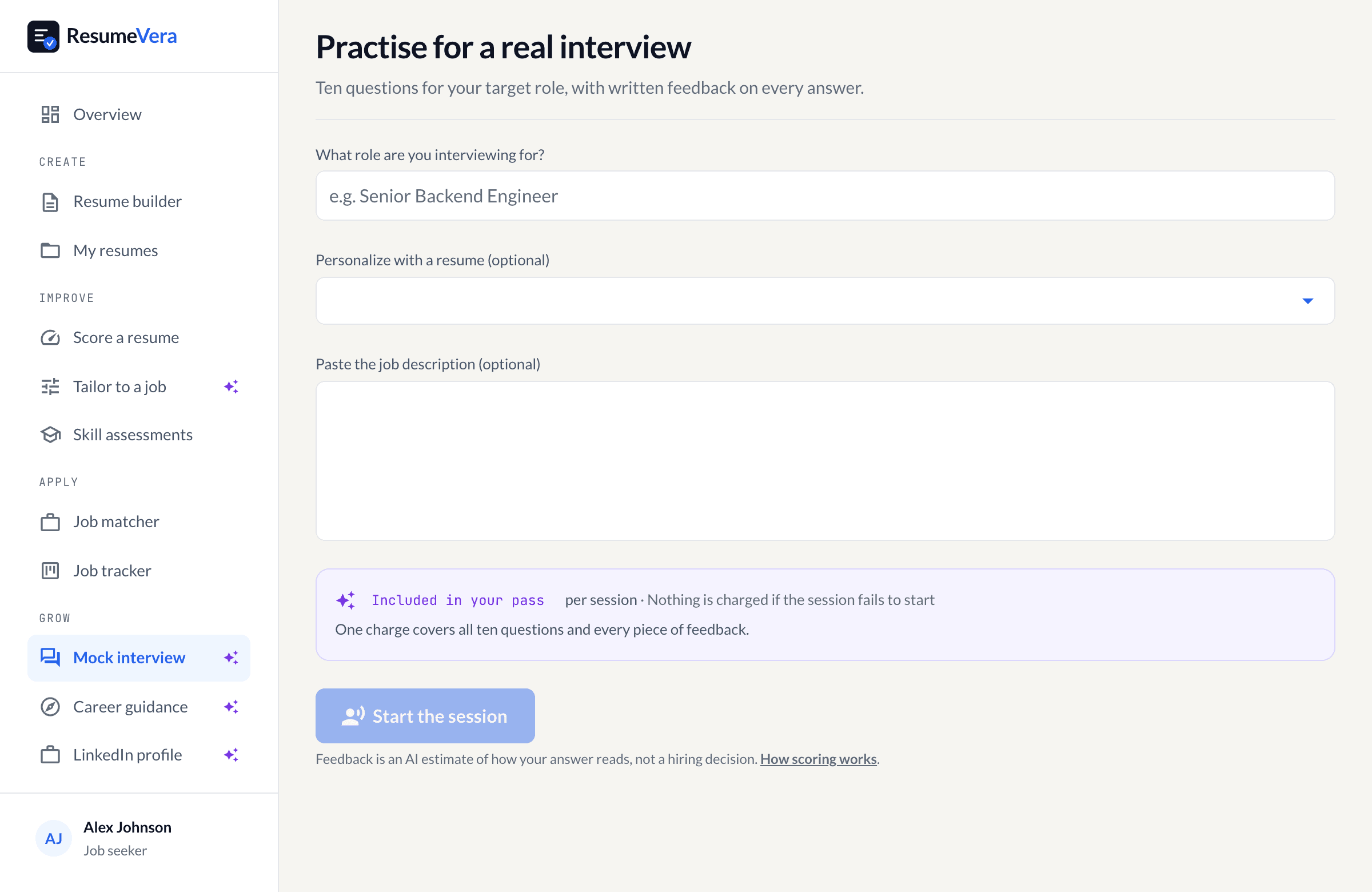
The real screen. Questions are generated from the role you pick and your own resume.
Is your resume ATS-ready?
Run a free ATS score check and get specific improvements in under 60 seconds.