Product Manager Interview Questions 2026
22 real questions from FAANG and top startups covering product sense, metrics, strategy, execution, and the new AI product design round.
Interview Questions
22 Questions with Answers
Click any question to reveal a detailed sample answer. Filter by category to focus your preparation.
How would you improve Instagram Stories?
Sample Answer
Start by clarifying the goal: are we optimizing for creator engagement, viewer retention, or monetization? Define the target user segment. Analyze current pain points: story creation friction, discoverability, and engagement drop-off. Propose 3-4 ideas ranked by impact and feasibility. For example, AI-powered story templates that adapt to content type could reduce creation time by 40%. Collaborative stories between friends could increase engagement. Always define success metrics (stories created per user, completion rate, time spent) and discuss how you would validate with an A/B test before full rollout.
Your product's daily active users dropped 10% this week. How would you investigate?
Sample Answer
First, verify the data: is this a real drop or a measurement issue? Check analytics instrumentation and compare multiple data sources. Then segment: is the drop across all users or specific cohorts (new vs returning, mobile vs web, geography)? Check for external factors (holiday, competitor launch, app store ranking change). Review recent releases for bugs or UX regressions. Analyze the user funnel to identify where drop-off is occurring. Check server-side metrics for performance issues. Prioritize hypotheses by likelihood and testability. Present findings with data, not speculation. The key framework is: verify, segment, hypothesize, investigate, act.
How would you prioritize features for the next quarter's roadmap?
Sample Answer
Use a structured framework like RICE (Reach, Impact, Confidence, Effort) or ICE (Impact, Confidence, Ease). Start by aligning with company-level OKRs and the product vision. Gather inputs from user research, customer feedback, sales team insights, and competitive analysis. Score each feature on impact to key metrics, technical effort, strategic alignment, and dependency considerations. Present the roadmap with clear trade-offs: what you are doing, what you are not doing, and why. Include quick wins alongside longer-term bets. Communicate the prioritization rationale transparently to stakeholders, and build in buffer for unexpected urgent work.
Design a product for elderly people to manage their medications.
Sample Answer
Start with user research: interview elderly users and caregivers to understand pain points. Key needs include medication reminders, dosage tracking, refill alerts, and caregiver notifications. Design constraints: large fonts, high contrast, simple navigation, voice control, and minimal steps. Core features for MVP: daily medication schedule with visual pill identification, smart reminders that escalate (notification to alarm to caregiver alert), and one-tap confirmation. Success metrics: medication adherence rate, missed dose reduction, caregiver peace of mind (NPS). Consider integration with pharmacies for auto-refills and doctors for prescription updates. Discuss accessibility requirements and regulatory considerations.
Two metrics are conflicting: increasing ad revenue is decreasing user satisfaction. What do you do?
Sample Answer
This is the classic tension in product management. First, quantify both sides: how much revenue per additional ad, and how much does satisfaction drop (measured by NPS, retention, session duration)? Model the long-term impact: short-term revenue gains from aggressive ads often cause long-term user churn that destroys more value. Explore solutions that align both metrics: native ads that add value, frequency capping, premium ad-free tier, or better ad targeting that improves relevance. Set guardrail metrics: if user satisfaction drops below X threshold, automatically reduce ad load. Present the analysis as a framework for the trade-off, not just a single recommendation.
Tell me about a time you launched a product that failed. What did you learn?
Sample Answer
Choose a real example and be honest about the failure. Structure your answer: describe the product and its goals, what signals you missed, when you realized it was not working, and what you did about it. For example: 'We launched a social feature that had strong qualitative feedback in user research but only 3% adoption in production. The gap was that research participants said they wanted social features, but their behavior showed they valued privacy. I learned to validate with behavioral data, not just stated preferences, and now I always run small-scale experiments before committing engineering resources to full builds.'
How would you measure the success of Google Maps?
Sample Answer
Define success across multiple dimensions. Primary metrics: monthly active users, navigation sessions started, and search-to-navigation conversion rate. Engagement: average session duration, number of sessions per user per week, and feature adoption rates (Street View, reviews, saved places). Quality: routing accuracy (predicted vs actual travel time), search relevance, and map data freshness. Business: ad click-through rate for local business listings, Google Cloud Maps API revenue, and competitive market share vs Apple Maps and Waze. Use a metric hierarchy: north star metric (navigation sessions completed successfully) supported by input metrics that the team can directly influence.
How do you make decisions when you have strong opinions but limited data?
Sample Answer
Use a structured approach: start with what you know and identify what you are assuming. Seek proxies and analogies from similar products or markets. Consult domain experts and experienced colleagues for informed opinions. Make your assumptions explicit and define what data would change your mind. Use the 'reversible vs irreversible' framework: for reversible decisions, bias toward action and learn from results. For irreversible decisions, invest more time in analysis. Document your reasoning so you can evaluate your decision-making process regardless of the outcome. Strong opinions loosely held is the operating model.
You are the PM for a B2B SaaS product. Your largest customer wants a custom feature that does not align with your product vision. How do you handle this?
Sample Answer
Do not immediately say yes or no. Understand the underlying problem: what job is the customer trying to do? Often their proposed solution is not the best way to solve their actual need. Assess the business impact: what revenue is at risk, and could this feature benefit other customers? If the feature truly misaligns with your vision, explore alternatives: can you solve their need through configuration, integrations, or an API? If you must decline, be transparent about your product direction and offer to help them find a workaround. If the feature could generalize, consider building a version that fits your vision while solving their core need.
Explain A/B testing to a non-technical stakeholder.
Sample Answer
A/B testing is like a taste test. We show half our users the current version and half a new version, then measure which one performs better. It removes guessing from product decisions. For example, we might test two different checkout button colors and see which one leads to more purchases. We run it long enough to be statistically confident the difference is real, not random luck. This way, we make decisions based on what users actually do, not what we think they will do. We use A/B tests for anything from minor UI changes to major feature launches to reduce risk and validate our assumptions.
How would you build a product strategy for entering a new market?
Sample Answer
Follow a systematic framework: start with market sizing (TAM, SAM, SOM) and growth trajectory. Conduct competitive analysis to understand the landscape and identify gaps. Define your differentiation: what unique value do you bring that incumbents cannot easily replicate? Validate assumptions with customer discovery interviews in the target market. Start with a beachhead segment: the smallest addressable market where you can win decisively. Define your go-to-market strategy, pricing model, and distribution channels. Set stage-gated milestones with clear success criteria for continuing investment. Build a financial model showing path to profitability. Plan for localization if entering international markets.
How do you work with engineering teams to deliver products on time?
Sample Answer
Build trust through transparency and respect for engineering expertise. Write clear, well-scoped PRDs with acceptance criteria and design specs before engineering starts. Involve engineers early in the ideation phase so they can flag technical constraints and suggest creative solutions. Use sprint planning and standups to track progress and unblock issues quickly. When scope creep threatens timelines, make trade-off decisions quickly and communicate to stakeholders. If deadlines are at risk, present options: reduce scope, extend timeline, or add resources. Never surprise your team or leadership with missed deadlines; raise risks early and propose mitigation plans.
What is your favorite product and what would you change about it?
Sample Answer
Pick a product you genuinely use and understand deeply. Structure your response: why you love it (specific value it provides), one key area for improvement (backed by user need, not personal preference), and how you would implement the change. For example: 'Notion is my favorite product because it collapses five tools into one workspace. However, its mobile experience is clunky for quick capture. I would add a lightweight quick-note widget that syncs to a daily inbox page, reducing the friction from 4 taps to 1. I would measure success by mobile DAU and notes created per mobile session.' Show product taste and structured thinking.
How do you handle disagreements with your design or engineering counterparts?
Sample Answer
Start by assuming good intent and understanding their perspective fully. Reframe the disagreement around shared goals: what is best for the user and the business? Use data when available, but acknowledge when it is a judgment call. If you disagree on UX, propose user testing to let users decide. If you disagree on technical approach, understand the engineering trade-offs you might be missing. Escalate only as a last resort, and when you do, present both perspectives fairly. After a decision is made, commit fully regardless of whose idea won. Document the decision and rationale for future reference. Strong PM-engineer relationships are built through healthy disagreements resolved respectfully.
How would you design an AI feature for a food delivery app?
Sample Answer
Start with user pain points: decision fatigue when browsing restaurants, inaccurate delivery time estimates, and reordering friction. Propose an AI-powered 'smart recommendations' feature that learns from order history, time of day, weather, and dietary preferences. It would show a personalized 'For You' feed with 3-5 restaurant suggestions and predicted favorites. Define success metrics: recommendation click-through rate, order conversion from recommendations, and repeat order frequency. Address risks: filter bubbles limiting discovery, recommendation quality in cold-start scenarios, and privacy concerns. Plan for A/B testing the algorithm against the existing browse experience. Consider edge cases like dietary restrictions and allergies.
What is your approach to user research?
Sample Answer
Use a mix of qualitative and quantitative methods based on the research question. For discovery: user interviews, diary studies, and contextual inquiry to understand needs and pain points. For validation: surveys, prototype testing, and A/B tests. For ongoing learning: analytics dashboards, session recordings, and NPS tracking. Key principles: talk to users regularly (weekly ideally), observe behavior rather than relying on stated preferences, recruit diverse participants, and synthesize findings into actionable insights. Common pitfall: confirmation bias where you only hear what supports your hypothesis. Build a research repository so insights compound over time and are accessible to the whole team.
Walk me through your product management process from idea to launch.
Sample Answer
My process follows six phases: Discovery (user research, competitive analysis, identifying opportunities), Definition (problem statement, success criteria, PRD with user stories), Design (wireframes, prototypes, design reviews with stakeholders), Development (sprint planning, daily standups, scope management), Testing (QA, beta testing, dogfooding), and Launch (go-to-market plan, rollout strategy, monitoring). Throughout each phase, I maintain alignment with stakeholders through regular check-ins and demos. Post-launch, I track metrics against success criteria and iterate based on user feedback. The process is not linear; I expect to loop back to earlier phases as we learn new information.
How would you monetize a free productivity app with 10 million users?
Sample Answer
Analyze the user base: what features do power users rely on, and what is their willingness to pay? Explore multiple models: freemium (limit storage, collaboration, or advanced features), subscription tiers (personal, team, enterprise), marketplace (templates, integrations), and usage-based pricing for API access. Avoid ads in productivity tools as they degrade the experience. Run pricing experiments with different feature gates and price points. Study competitors' monetization and positioning. Start with a generous free tier to maintain growth, then introduce paid features that align with the value users already receive. Set conversion rate targets (typically 2-5% for freemium) and track revenue per user.
What questions do you have for us?
Sample Answer
Ask thoughtful questions that demonstrate your product thinking: 'What is the biggest product challenge the team is facing right now?' 'How does the product team work with engineering and design day-to-day?' 'What does success look like for this role in the first 6 months?' 'How are product decisions made when data is limited?' 'What is the company's approach to technical debt vs new features?' These questions show you are evaluating the role thoughtfully and thinking about how you would operate on the team. Avoid questions about perks or information easily found on the website.
Why product management? What motivates you in this role?
Sample Answer
Connect your motivation to the core of the PM role: sitting at the intersection of business, technology, and user experience. Share a specific moment that crystallized your passion. For example: 'What drives me is turning ambiguous problems into clear solutions that users love. In my last role, I identified that 60% of customer support tickets stemmed from a single confusing workflow. Leading the redesign and seeing support volume drop by 45% while user satisfaction increased showed me the power of thoughtful product work. I love the intellectual challenge of balancing competing priorities and making decisions with imperfect information.'
Describe a time you had to say no to a stakeholder. How did you handle it?
Sample Answer
Frame it constructively: saying no to a request while saying yes to the underlying need. For example: 'Our VP of Sales wanted a custom dashboard feature for our top client, but it would have delayed our core roadmap by 6 weeks. I met with both the VP and the client to understand the specific data they needed. It turned out they could achieve 80% of their goal with our existing reporting API and a Looker integration. I connected them with our solutions engineer and documented the remaining gaps for future consideration. The VP appreciated the creative solution, and the client was satisfied. I learned that most stakeholder requests are really about solving a problem, not about the specific feature they propose.'
How do you balance short-term wins with long-term product vision?
Sample Answer
Allocate product capacity deliberately: a common split is 70% on strategic initiatives aligned with the long-term vision, 20% on iterative improvements and quick wins, and 10% on technical debt and infrastructure. Quick wins build credibility with stakeholders, maintain team momentum, and deliver incremental value. But they should not consume the majority of resources. Every quarter, re-evaluate: are quick wins actually moving metrics, or are they just activity? Use OKRs to connect short-term work to long-term outcomes. When facing pressure for short-term wins, quantify the opportunity cost of delaying strategic work. A clear product strategy makes these trade-off conversations much easier.
Preparation Tips
Interview Preparation Tips
Practice product sense questions using the CIRCLES framework: Comprehend, Identify, Report, Cut, List, Evaluate, Summarize.
Prepare 5-6 detailed stories from your experience covering product launches, failures, stakeholder conflicts, and data-driven decisions.
Study the company's product deeply before the interview: identify areas for improvement and come prepared with specific suggestions.
Practice metrics questions by defining success metrics for popular products — think in terms of north star, input, and guardrail metrics.
For design questions, always start with the user: define the target persona, their pain points, and the job they are trying to do.
Read product case studies and practice structuring your thinking out loud — PM interviews evaluate your thought process, not just your answers.
Avoid These
Common Mistakes to Avoid
Jumping into solutions without first clarifying the problem, user segment, and business objective.
Not defining measurable success metrics for proposed solutions — every feature should have clear KPIs.
Giving generic behavioral answers without specific quantified outcomes and learnings.
Ignoring technical feasibility and engineering trade-offs when proposing product ideas.
Over-relying on frameworks without showing genuine product intuition and creativity.
Not demonstrating empathy for users — PM interviews are ultimately about understanding user needs.
Related Roles
Explore Other Interview Guides
Preparing for multiple roles? Check out interview questions for related positions.
Interview Guides
Explore More Interview Questions
Browse all our interview question guides with detailed answers and preparation tips.
View All Interview GuidesPractise
Reading questions is not the same as answering them
A mock interview generates its questions from this role and from your own resume, then tells you what a hiring manager would take from each answer.
Join the waitlist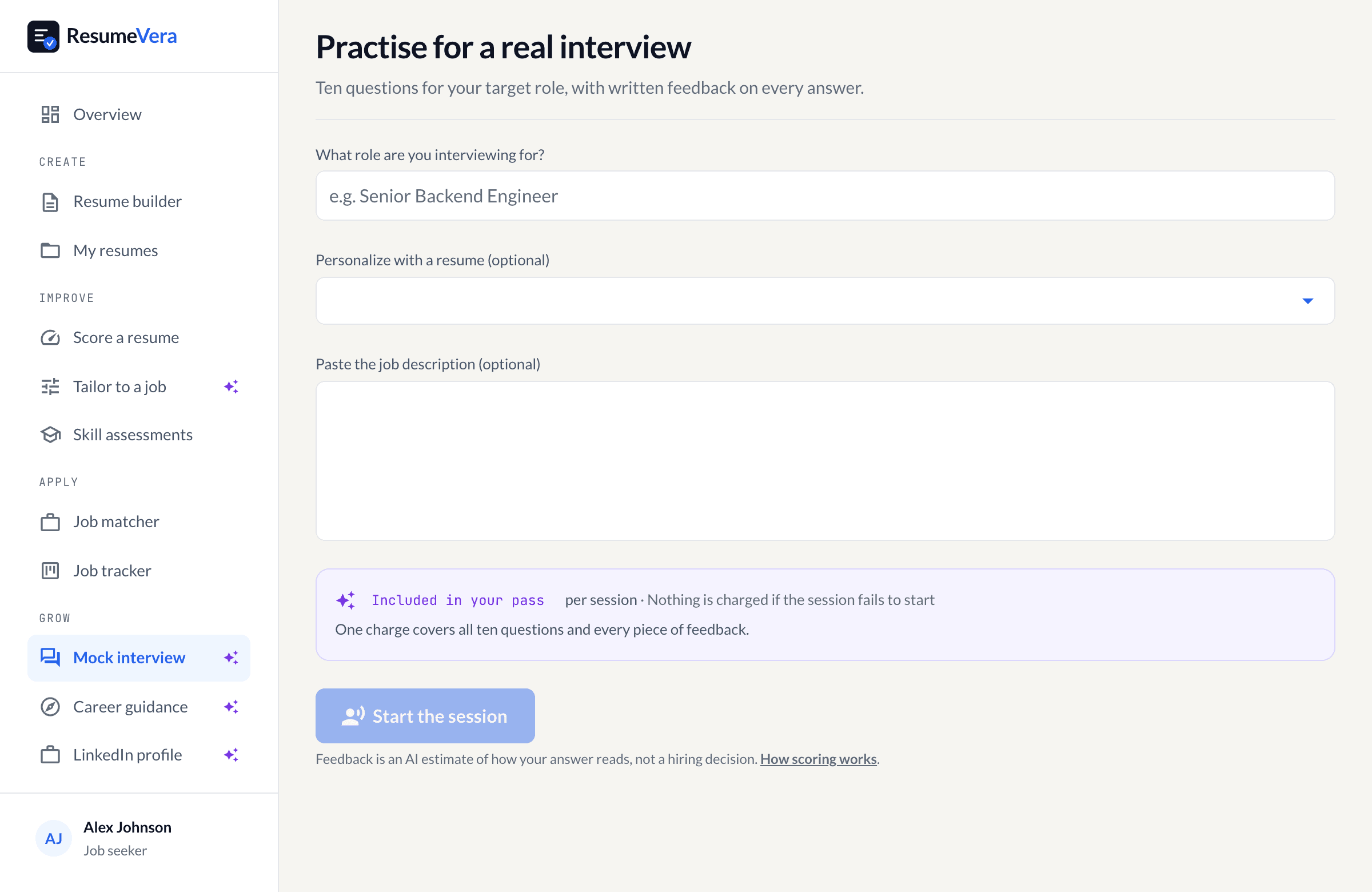
The real screen. Questions are generated from the role you pick and your own resume.
Is your resume ATS-ready?
Run a free ATS score check and get specific improvements in under 60 seconds.