Software Engineer Interview Questions 2026
25 real questions from top tech companies with detailed answers covering data structures, system design, behavioral rounds, and modern AI-fluency expectations.
Interview Questions
25 Questions with Answers
Click any question to reveal a detailed sample answer. Filter by category to focus your preparation.
Explain the difference between a stack and a queue. When would you use each?
Sample Answer
A stack follows Last-In-First-Out (LIFO) while a queue follows First-In-First-Out (FIFO). Use a stack for undo/redo operations, function call tracking, and expression parsing. Use a queue for task scheduling, BFS traversal, and message buffering. In practice, a stack is ideal when you need to reverse order or backtrack, while a queue is best when processing items in arrival order matters.
How would you detect a cycle in a linked list?
Sample Answer
Use Floyd's Tortoise and Hare algorithm: maintain two pointers, one moving one step and another moving two steps at a time. If there is a cycle, the fast pointer will eventually meet the slow pointer. This runs in O(n) time and O(1) space. To find the cycle's start node, reset one pointer to the head and advance both one step at a time until they meet again. This is significantly more efficient than using a hash set which requires O(n) extra space.
Design a URL shortening service like bit.ly.
Sample Answer
Start with requirements: generate short URLs, redirect to original URLs, handle high read traffic, and track analytics. Use a base-62 encoding scheme on an auto-incrementing ID or a hash function for URL generation. Store mappings in a key-value store like Redis for fast lookups with a relational database as the persistent store. Add a caching layer with LRU eviction, use consistent hashing for horizontal scaling, and implement rate limiting. For analytics, use an append-only log or event stream. Discuss trade-offs between hash collisions vs sequential IDs, and eventual consistency vs strong consistency.
What is the time complexity of common sorting algorithms and when would you choose each?
Sample Answer
QuickSort averages O(n log n) but degrades to O(n^2) in worst case; great for general-purpose sorting with good cache locality. MergeSort guarantees O(n log n) and is stable, making it ideal for linked lists or when stability matters. HeapSort is O(n log n) with O(1) space but poor cache performance. For nearly sorted data, Insertion Sort runs in O(n). TimSort, used in Python and Java, combines MergeSort and Insertion Sort and performs best on real-world data with natural runs. Choose based on data characteristics, stability needs, and memory constraints.
Explain the concept of database indexing. When should you add an index and when should you avoid it?
Sample Answer
A database index is a data structure (typically a B-tree or hash) that speeds up data retrieval at the cost of additional storage and slower writes. Add indexes on columns frequently used in WHERE clauses, JOIN conditions, and ORDER BY statements. Avoid indexing columns with low cardinality, tables with frequent writes and few reads, or very small tables where a full scan is faster. Composite indexes should follow the leftmost prefix rule. Monitor query execution plans using EXPLAIN to validate index effectiveness and watch for index bloat over time.
Design a real-time chat application that supports group messaging.
Sample Answer
Use WebSockets for persistent bidirectional connections. Each user connects to a WebSocket server; messages are published to a message broker like Redis Pub/Sub or Kafka. For group chats, maintain a membership table and fan out messages to all online members. Store messages in a database partitioned by conversation ID with pagination. Handle offline users with push notifications and message queuing. For horizontal scaling, use a load balancer with sticky sessions or a shared session store. Consider eventual consistency for read receipts and typing indicators. Add end-to-end encryption for security.
What are the SOLID principles? Give a practical example of the Single Responsibility Principle.
Sample Answer
SOLID stands for Single Responsibility, Open-Closed, Liskov Substitution, Interface Segregation, and Dependency Inversion. The Single Responsibility Principle states that a class should have only one reason to change. For example, instead of a User class that handles authentication, email sending, and database persistence, split it into UserAuthenticator, EmailService, and UserRepository. Each class has one clear responsibility, making the code easier to test, maintain, and extend without unintended side effects.
How does garbage collection work in JavaScript? What causes memory leaks?
Sample Answer
JavaScript uses mark-and-sweep garbage collection. The GC starts from root objects (global scope, stack references) and marks all reachable objects; unreachable objects are swept and freed. Common memory leak causes include: forgotten event listeners not being removed, closures retaining references to large objects, detached DOM nodes still referenced in JavaScript, global variables accumulating data, and timers (setInterval) not being cleared. Use Chrome DevTools Memory panel to take heap snapshots and identify retained objects. WeakRef and WeakMap help avoid accidental retention of objects.
Tell me about a time you had to make a difficult technical decision with incomplete information.
Sample Answer
Use the SOAR framework: Situation, Obstacle, Action, Result. Describe a specific scenario where you faced ambiguity, such as choosing between building a feature in-house vs using a third-party service under a tight deadline. Explain the trade-offs you evaluated (cost, time-to-market, maintainability, vendor lock-in), how you gathered input from stakeholders, and the decision framework you used. Share the outcome including metrics, and critically, what you learned and would do differently. Interviewers want to see structured decision-making, not perfect outcomes.
Describe a situation where you disagreed with your team's technical approach. How did you handle it?
Sample Answer
Start with the specific technical disagreement and why it mattered (performance, scalability, maintainability). Explain how you presented your alternative with data and evidence rather than opinion, such as benchmarks, proof of concepts, or case studies. Show that you listened to the team's perspective, found common ground, and reached a decision collaboratively. If you were overruled, demonstrate that you committed to the team's decision fully. End with the result and what it taught you about effective technical communication and picking your battles.
How do you handle a production outage at 2 AM?
Sample Answer
Follow an incident response framework: acknowledge the alert, assess severity and blast radius, communicate status to stakeholders via the incident channel, and work methodically through diagnosis. Start with recent deployments as the most likely cause, check monitoring dashboards and logs, and consider rollback if the root cause is not immediately clear. Document every action taken in a timeline. After resolution, conduct a blameless post-mortem identifying root cause, contributing factors, and preventive actions. The key is staying calm, communicating clearly, and prioritizing restoring service over finding the perfect fix.
What is the difference between SQL and NoSQL databases? When would you choose one over the other?
Sample Answer
SQL databases (PostgreSQL, MySQL) enforce schemas, support ACID transactions, and excel at complex queries with joins. NoSQL databases (MongoDB, DynamoDB, Redis) offer flexible schemas, horizontal scalability, and are optimized for specific access patterns. Choose SQL for applications with complex relationships, financial data requiring strong consistency, or when your query patterns are varied. Choose NoSQL when you need to scale writes massively, have well-defined access patterns, or work with semi-structured data like user profiles or event logs. Many modern systems use both (polyglot persistence).
Implement a function to find the longest common subsequence of two strings.
Sample Answer
Use dynamic programming with a 2D table where dp[i][j] represents the LCS length of the first i characters of string1 and first j characters of string2. If characters match, dp[i][j] = dp[i-1][j-1] + 1. Otherwise, dp[i][j] = max(dp[i-1][j], dp[i][j-1]). To reconstruct the actual subsequence, backtrack through the table. Time complexity is O(m*n) and space can be optimized to O(min(m,n)) using rolling arrays. This pattern appears frequently in diff algorithms, DNA sequence alignment, and version control systems.
Explain microservices vs monolithic architecture. What are the trade-offs?
Sample Answer
A monolith is a single deployable unit with shared memory and database, offering simplicity, easier debugging, and strong consistency. Microservices decompose the system into independently deployable services, each owning its data, enabling independent scaling, technology diversity, and team autonomy. Trade-offs include operational complexity (service discovery, distributed tracing, eventual consistency), network latency, and data consistency challenges. Start with a modular monolith and extract services at natural boundaries when team size, deployment frequency, or scaling requirements demand it. Premature microservices is a common anti-pattern that adds complexity without benefits.
How do you approach code reviews? What do you look for?
Sample Answer
Prioritize correctness first: does the code do what it claims? Then check for edge cases, error handling, and security concerns. Review naming clarity, function size, and separation of concerns for maintainability. Verify test coverage, especially for critical paths and edge cases. Look for potential performance issues at scale. Finally, assess consistency with existing codebase patterns. Give constructive feedback by explaining why, not just what to change. Distinguish between blocking issues and optional suggestions. The best code reviews are conversations, not gatekeeping.
A senior stakeholder wants a feature shipped in 2 weeks that your team estimates will take 6 weeks. How do you handle this?
Sample Answer
First, understand the business urgency behind the request. Then work with your team to identify what subset of the feature delivers the most business value and can be built in 2 weeks (MVP approach). Present the stakeholder with options: a scoped-down version in 2 weeks, the full feature in 6 weeks, or a phased approach. Use data to support your estimates, referencing similar past efforts. Be transparent about what gets cut and the technical debt implications of shortcuts. Document the agreed scope clearly. The goal is to find a solution that meets business needs without burning out the team or shipping something unreliable.
What is a REST API and how does it differ from GraphQL?
Sample Answer
REST uses resource-based URLs with HTTP methods (GET, POST, PUT, DELETE) and returns fixed data structures. GraphQL uses a single endpoint where clients specify exactly what data they need through queries. REST is simpler, well-cached by HTTP infrastructure, and sufficient for most CRUD apps. GraphQL excels when clients need flexible data fetching (mobile apps needing different data than web), reducing over-fetching and under-fetching. Trade-offs include GraphQL's complexity in caching, potential for expensive queries (N+1 problem), and the need for query complexity limits. Many teams use REST for public APIs and GraphQL for internal frontend consumption.
How do you ensure your code is testable and what testing strategies do you follow?
Sample Answer
Write code with dependency injection so external services can be mocked. Follow the testing pyramid: many unit tests (fast, isolated, testing business logic), fewer integration tests (testing component interactions and API contracts), and minimal end-to-end tests (critical user flows). Use TDD for complex logic where requirements are clear. Test edge cases, error paths, and boundary conditions. For frontend, test component behavior rather than implementation details using Testing Library patterns. Aim for meaningful coverage, not 100% line coverage. Critical business logic should have near-complete coverage; UI layout code less so.
Tell me about a project you are most proud of. What was your specific contribution?
Sample Answer
Choose a project that demonstrates technical depth and impact. Structure your answer: describe the problem and its business importance, your specific role and technical decisions, challenges you overcame, and measurable results (performance improvement, user adoption, revenue impact). Show the before and after. Mention what you would do differently with hindsight. Interviewers assess your ability to take ownership, think critically, and deliver results, not just execute assigned tasks. Quantify your impact where possible and explain how you collaborated with others.
Design a rate limiter for an API service.
Sample Answer
Start with requirements: per-user or per-IP limiting, fixed window vs sliding window, distributed system support. The token bucket algorithm allows bursty traffic while maintaining average rate limits. The sliding window counter provides more accurate rate limiting. For a distributed system, use Redis with atomic operations (INCR + EXPIRE) for the counter. Handle race conditions with Lua scripts for atomicity. Return proper HTTP 429 status codes with Retry-After headers. Consider different rate limits for different API endpoints and user tiers. Discuss trade-offs between accuracy, memory usage, and latency. Add monitoring to detect abuse patterns.
How do you stay current with technology? How do you evaluate new tools?
Sample Answer
Follow a systematic approach: subscribe to curated newsletters and blogs (not social media hype), read release notes of tools you use, and attend meetups or conferences selectively. When evaluating new tools, define the problem first, then assess adoption maturity (GitHub stars, community activity, corporate backing), documentation quality, migration path, and long-term maintenance risk. Build a small proof of concept before committing. Be skeptical of hype cycles and focus on tools that solve real problems your team faces. The best engineers are pragmatic adopters, not early adopters.
Explain how HTTPS works and why it matters for web applications.
Sample Answer
HTTPS uses TLS (Transport Layer Security) to encrypt communication between client and server. The process involves: the client initiates a TLS handshake, the server presents its SSL certificate (verified against trusted CAs), they negotiate an encryption algorithm and exchange keys using asymmetric encryption, then switch to faster symmetric encryption for data transfer. HTTPS prevents eavesdropping, man-in-the-middle attacks, and data tampering. It is essential for protecting user credentials, session tokens, and sensitive data. Modern browsers flag HTTP sites as insecure, and HTTPS is required for HTTP/2, service workers, and many Web APIs.
Your application's response time has doubled after a deployment. Walk me through your debugging process.
Sample Answer
Start with the most likely cause: compare the new deployment's changes against the previous version. Check APM tools (DataDog, New Relic) for slow endpoints and trace specific requests end-to-end. Examine database query performance using slow query logs. Check for N+1 queries, missing indexes, or increased payload sizes. Review CPU and memory metrics for resource contention. If the issue is not code-related, check infrastructure changes (scaling events, DNS changes, SSL certificate rotation). Use feature flags to isolate specific changes. If root cause is unclear, roll back first to restore service, then investigate in a staging environment.
What are your salary expectations for this role?
Sample Answer
Research the market rate for your experience level and location using sites like Levels.fyi, Glassdoor, and Blind. Frame your answer as a range based on total compensation, not just base salary. Say something like: 'Based on my research and experience, I am looking at a total compensation range of X to Y, but I am flexible and open to discussing the full package including equity, bonuses, and benefits.' Avoid giving a single number too early. If pressed, redirect by asking about their budget range first. Always negotiate from a position of data, not emotion.
Why are you leaving your current company?
Sample Answer
Frame your answer positively, focusing on what you are seeking rather than what you are escaping. For example: 'I have learned a tremendous amount at my current role, particularly in X and Y. I am now looking for opportunities to work on larger-scale systems and take on more technical leadership. This role aligns with my growth goals because of Z.' Avoid speaking negatively about your current employer, manager, or colleagues. If you were laid off, be honest but brief: 'My team was impacted by a restructuring. I see it as an opportunity to find a role that better matches my long-term career goals.'
Preparation Tips
Interview Preparation Tips
Practice coding on a whiteboard or shared editor, not just an IDE with autocomplete — interviewers want to see your raw problem-solving process.
For system design rounds, always start with requirements clarification and capacity estimation before jumping into architecture.
Prepare 5-6 behavioral stories using the SOAR method (Situation, Obstacle, Action, Result) that cover leadership, conflict, failure, and impact.
Study the specific tech stack of the company you are interviewing with — tailored preparation outperforms generic grinding.
Practice thinking out loud during coding problems — communication is evaluated as much as the solution.
Review your previous projects and be ready to discuss architecture decisions, trade-offs, and what you would do differently.
Spend at least 30% of your prep time on system design and behavioral rounds — these are where most candidates lose offers.
Avoid These
Common Mistakes to Avoid
Jumping straight into coding without clarifying requirements and edge cases first.
Over-engineering system design answers with unnecessary complexity instead of starting simple and iterating.
Giving vague behavioral answers without specific metrics, timelines, or outcomes.
Ignoring time and space complexity analysis when presenting solutions.
Not asking clarifying questions, which signals a lack of real-world problem-solving experience.
Spending too much time on LeetCode hard problems while neglecting system design and behavioral prep.
Related Roles
Explore Other Interview Guides
Preparing for multiple roles? Check out interview questions for related positions.
Interview Guides
Explore More Interview Questions
Browse all our interview question guides with detailed answers and preparation tips.
View All Interview GuidesPractise
Reading questions is not the same as answering them
A mock interview generates its questions from this role and from your own resume, then tells you what a hiring manager would take from each answer.
Join the waitlist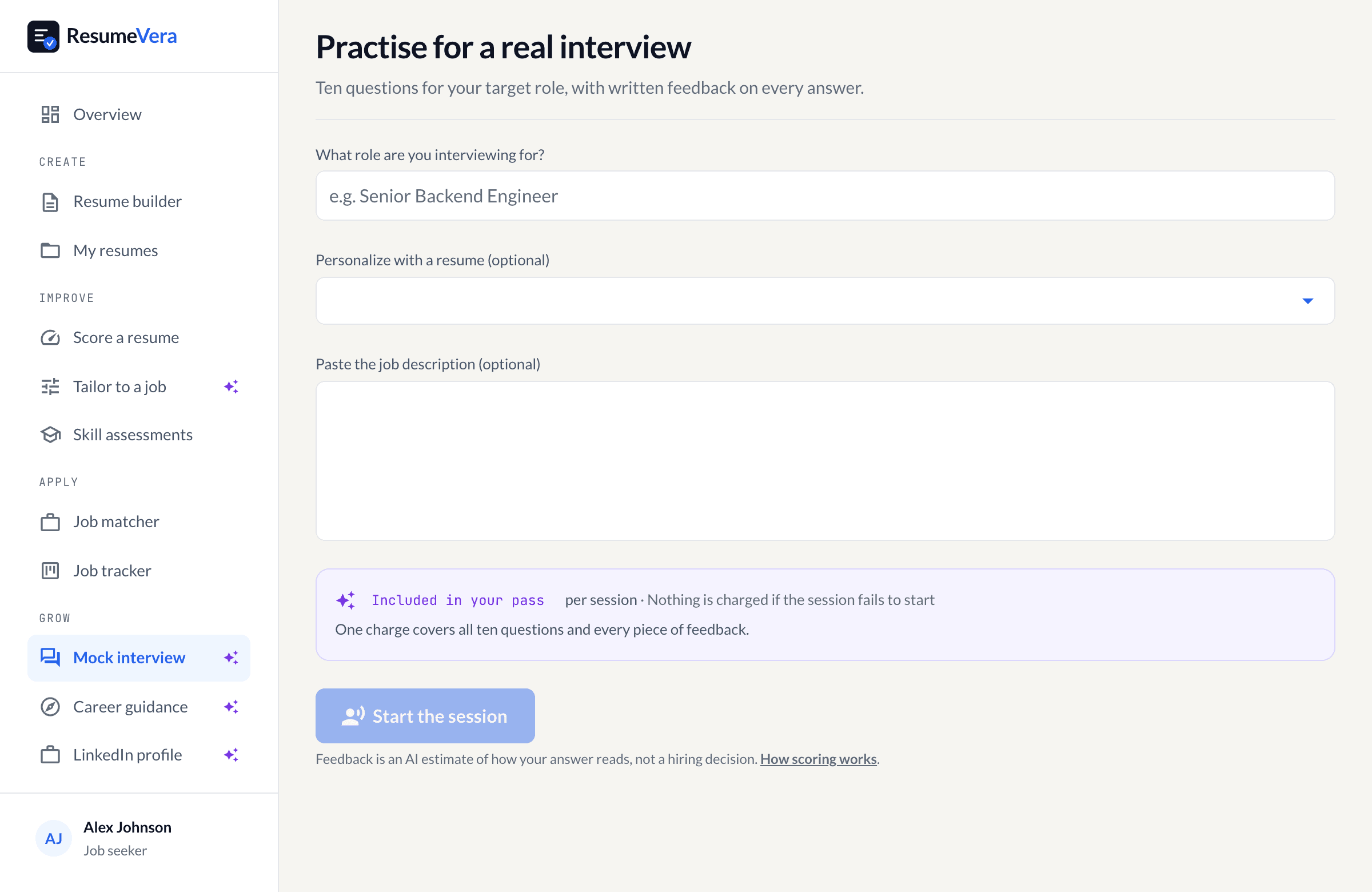
The real screen. Questions are generated from the role you pick and your own resume.
Is your resume ATS-ready?
Run a free ATS score check and get specific improvements in under 60 seconds.