Data Scientist Interview Questions 2026
22 real questions from top tech companies covering machine learning algorithms, statistical analysis, Python coding, and business case studies.
Interview Questions
22 Questions with Answers
Click any question to reveal a detailed sample answer. Filter by category to focus your preparation.
Explain the bias-variance tradeoff. How does it affect model selection?
Sample Answer
Bias is the error from overly simplistic assumptions (underfitting), while variance is the error from sensitivity to training data fluctuations (overfitting). High bias models (linear regression on non-linear data) consistently miss patterns. High variance models (deep decision trees) memorize training noise. The goal is to minimize total error (bias squared + variance + irreducible error). Regularization (L1/L2) reduces variance by constraining model complexity. Cross-validation helps find the sweet spot. Ensemble methods like Random Forest (reduces variance) and Boosting (reduces bias) explicitly address this tradeoff. Understanding this guides every model selection decision.
What is the difference between supervised, unsupervised, and reinforcement learning?
Sample Answer
Supervised learning uses labeled data to learn a mapping from inputs to outputs (classification, regression). Examples: spam detection, house price prediction. Unsupervised learning finds patterns in unlabeled data (clustering, dimensionality reduction). Examples: customer segmentation, anomaly detection. Reinforcement learning learns through trial and error, maximizing cumulative reward. Examples: game playing, robotics, recommendation systems. Semi-supervised learning combines labeled and unlabeled data, useful when labels are expensive to obtain. Self-supervised learning, used in modern LLMs, creates pseudo-labels from the data itself. Choose based on data availability, problem type, and business requirements.
How would you handle an imbalanced dataset where only 2% of cases are positive?
Sample Answer
First, evaluate if the imbalance matters for the business problem. Then apply multiple strategies: at the data level, use oversampling (SMOTE), undersampling, or a combination. At the algorithm level, use class weights to penalize misclassification of the minority class, or use algorithms inherently robust to imbalance (XGBoost with scale_pos_weight). At the evaluation level, use precision-recall AUC, F1-score, or Matthews Correlation Coefficient instead of accuracy. Consider cost-sensitive learning where false negatives have different business costs than false positives. For fraud detection with 2% positive rate, missing a fraud case costs far more than a false alarm, so optimize recall with acceptable precision thresholds.
Explain how a Random Forest works and when you would use it.
Sample Answer
Random Forest builds multiple decision trees on random subsets of the data (bagging) and random subsets of features, then aggregates predictions through voting (classification) or averaging (regression). This reduces variance and overfitting compared to a single decision tree. Key hyperparameters: n_estimators (number of trees), max_depth, min_samples_split, and max_features. Use Random Forest when you need a robust baseline with minimal tuning, feature importance rankings, or when dealing with mixed feature types. It handles missing values well and is resistant to outliers. Limitations: poor at extrapolation, can be slow for real-time inference, and less interpretable than single trees.
What is cross-validation and why is it important?
Sample Answer
Cross-validation evaluates model performance by splitting data into k folds, training on k-1 folds and testing on the remaining fold, repeating k times. This provides a more reliable performance estimate than a single train-test split. K-fold (typically k=5 or 10) is the standard approach. Stratified k-fold maintains class proportions in each fold, essential for imbalanced datasets. Time series data requires temporal cross-validation (walk-forward) to prevent data leakage. Leave-one-out CV is computationally expensive but useful for very small datasets. Cross-validation helps detect overfitting, compare models fairly, and tune hyperparameters. Never use test data during cross-validation.
Explain the difference between L1 and L2 regularization.
Sample Answer
L1 regularization (Lasso) adds the absolute value of coefficients as a penalty, producing sparse models by driving some coefficients to exactly zero, effectively performing feature selection. L2 regularization (Ridge) adds the squared coefficients as a penalty, shrinking all coefficients toward zero but rarely to exactly zero. Elastic Net combines both. Use L1 when you suspect many features are irrelevant and want automatic feature selection. Use L2 when all features are potentially useful and you want to prevent any single feature from dominating. The regularization strength (lambda) controls the bias-variance tradeoff. Tune it using cross-validation. In deep learning, L2 is called weight decay.
How do you detect and handle multicollinearity in regression models?
Sample Answer
Multicollinearity occurs when independent variables are highly correlated, inflating standard errors and making coefficients unreliable. Detect it using: correlation matrix (pairwise correlations above 0.8), Variance Inflation Factor (VIF above 5-10 indicates concern), and condition number. Handle it by: removing one of the correlated variables, combining them through PCA or domain-knowledge-driven feature engineering, using regularization (Ridge regression handles multicollinearity well), or switching to algorithms unaffected by it (tree-based models). Note that multicollinearity affects interpretability but not prediction accuracy for many models. Always consider the business context when deciding which variable to keep.
Design an ML system to detect fraudulent credit card transactions in real-time.
Sample Answer
Architecture: feature engineering pipeline extracting transaction velocity, amount deviation, merchant category, geographic anomalies, and behavioral patterns. Use a two-stage system: a fast rule-based filter for obvious fraud, followed by an ML model (gradient boosted trees or neural network) for scoring. Handle class imbalance with SMOTE and cost-sensitive learning. Deploy as a low-latency microservice with sub-100ms response time. Monitor for concept drift as fraud patterns evolve. Use a feedback loop where analyst decisions on flagged transactions update the training data. Key metrics: precision (minimize false blocks affecting customer experience) and recall (catch fraud). Include explainability for analyst review using SHAP values.
What is the Central Limit Theorem and why is it important?
Sample Answer
The Central Limit Theorem states that the sampling distribution of the sample mean approaches a normal distribution as the sample size increases, regardless of the population's distribution. This is important because it justifies using normal distribution-based statistical tests (t-tests, confidence intervals) even when the underlying data is not normally distributed, provided the sample size is large enough (typically n > 30). It underpins hypothesis testing, confidence interval construction, and many statistical methods used in data science. Limitations: it applies to the mean, not to all statistics, and convergence is slower for heavily skewed distributions requiring larger samples.
How would you evaluate a classification model? Explain precision, recall, and F1-score.
Sample Answer
Precision measures the proportion of positive predictions that are actually positive (TP / (TP + FP)). Recall measures the proportion of actual positives that are correctly identified (TP / (TP + FN)). F1-score is the harmonic mean of precision and recall, balancing both. Choose precision when false positives are costly (spam filtering: do not block legitimate emails). Choose recall when false negatives are costly (cancer screening: do not miss actual cases). Additionally, use ROC-AUC for overall model discrimination ability across all thresholds, PR-AUC for imbalanced datasets, and confusion matrices for detailed error analysis. Business context should always drive metric selection.
Explain gradient descent and its variants.
Sample Answer
Gradient descent optimizes model parameters by iteratively moving in the direction of steepest decrease of the loss function. Batch gradient descent computes gradients on the full dataset (slow but stable). Stochastic gradient descent (SGD) uses one sample at a time (noisy but fast). Mini-batch SGD (typically 32-256 samples) balances both. Adam optimizer combines momentum (exponential moving average of gradients) with adaptive learning rates per parameter, converging faster for most problems. Key hyperparameters: learning rate (too high diverges, too low gets stuck), batch size, and momentum. Learning rate schedules (cosine annealing, warm restarts) improve convergence. Gradient clipping prevents exploding gradients in deep networks.
Tell me about a time your model did not perform well in production. What did you do?
Sample Answer
Use the STAR method: describe the model, its production performance gap, root cause analysis, and resolution. For example: 'Our demand forecasting model showed 15% higher error in production than in testing. I investigated and found the training data had a subtle data leakage: future inventory data was included as a feature. I also discovered that production data had different missing value patterns than training data. I fixed the feature pipeline, added data validation checks, implemented monitoring for feature distribution drift, and retrained with proper temporal splits. Production error dropped to match test performance. I then established a model monitoring framework with automated alerts for performance degradation.'
What is feature engineering and what techniques do you use?
Sample Answer
Feature engineering transforms raw data into informative features that improve model performance. Techniques include: numerical transformations (log, polynomial, binning), encoding categorical variables (one-hot, target encoding, embedding), creating interaction features between variables, extracting temporal features (day of week, hour, holiday flags), text features (TF-IDF, word embeddings), and domain-specific features. Feature selection methods include filter (correlation, mutual information), wrapper (recursive feature elimination), and embedded (L1 regularization, tree feature importance). Automated feature engineering tools like Featuretools can accelerate the process. Good feature engineering often matters more than algorithm selection and is where domain expertise adds the most value.
How would you approach an A/B test for a new recommendation algorithm?
Sample Answer
Define the hypothesis: the new algorithm increases click-through rate by at least X%. Calculate required sample size based on current baseline CTR, minimum detectable effect, significance level (0.05), and power (0.80). Randomly assign users (not sessions) to control and treatment groups using consistent hashing. Run the test for at least 2 full business cycles to account for day-of-week effects. Monitor for sample ratio mismatch as a guardrail. Analyze primary metric (CTR) and secondary metrics (revenue, user satisfaction, diversity of recommendations). Check for novelty effects by analyzing trends over time. Segment results by user cohorts to ensure no group is negatively impacted. Only declare significance after the predetermined test duration.
Explain the concept of dimensionality reduction. When would you use PCA vs t-SNE?
Sample Answer
Dimensionality reduction reduces the number of features while preserving important information, combating the curse of dimensionality. PCA (Principal Component Analysis) is linear, fast, and preserves global structure by finding directions of maximum variance. Use PCA for preprocessing before modeling, noise reduction, and when interpretability matters (components can be traced back to original features). t-SNE is non-linear, designed for visualization of high-dimensional data in 2D or 3D, preserving local structure (similar points stay close). t-SNE is not suitable for preprocessing because it is non-parametric and stochastic. UMAP is a faster alternative to t-SNE that better preserves global structure. Choose based on your goal: modeling (PCA) vs visualization (t-SNE/UMAP).
How do you communicate complex ML results to business stakeholders?
Sample Answer
Lead with business impact, not methodology. Instead of explaining gradient boosting, say 'our model can predict 85% of churn cases two weeks in advance, allowing us to proactively reach out and retain $2M in annual revenue.' Use visualizations: ROI curves, before-and-after comparisons, and simple confusion matrix breakdowns (we catch 85 out of 100 fraud cases, with 10 false alarms). Explain trade-offs in business terms: 'We can catch more fraud but will block more legitimate transactions.' Avoid jargon but do not oversimplify to the point of being misleading. Prepare for follow-up questions about model reliability, edge cases, and failure modes. Always connect model performance to business KPIs.
What is data leakage and how do you prevent it?
Sample Answer
Data leakage occurs when information from outside the training dataset is used to create the model, leading to unrealistically high performance that does not generalize. Types include: target leakage (using features correlated with the target that would not be available at prediction time), temporal leakage (using future data to predict the past), and train-test contamination (test data influencing training). Prevent it by: always splitting data before any preprocessing, using temporal splits for time-series data, carefully reviewing feature definitions (would this feature be available at prediction time?), and validating with production-like data. A model that performs significantly worse in production than in testing almost always has data leakage.
Write a Python function to implement k-means clustering from scratch.
Sample Answer
The algorithm: (1) randomly initialize k centroids, (2) assign each point to the nearest centroid, (3) update centroids to the mean of assigned points, (4) repeat until convergence. Key implementation details: use Euclidean distance, handle empty clusters by re-initializing, and use k-means++ initialization for better starting points. Convergence check: stop when centroids move less than epsilon or after max iterations. Time complexity is O(n * k * d * i) where n is points, k is clusters, d is dimensions, i is iterations. For production, use scikit-learn's KMeans with n_init=10 for multiple random starts. Evaluate using silhouette score, elbow method, or domain-specific metrics.
How do you handle concept drift in production ML models?
Sample Answer
Concept drift occurs when the relationship between features and target changes over time. Detect it using: monitoring model performance metrics over time, statistical tests on feature distributions (Kolmogorov-Smirnov, Population Stability Index), and prediction distribution monitoring. Handle it through: regular model retraining on recent data (scheduled or triggered by drift detection), using online learning algorithms that update incrementally, ensemble methods with time-weighted models, and maintaining a human-in-the-loop for edge cases. Build automated pipelines that detect drift, trigger retraining, validate the new model against the current one, and deploy only if performance improves. Document all model versions and their training data windows for reproducibility.
What is your salary expectation for this data scientist role?
Sample Answer
Research market rates using Levels.fyi, Glassdoor, and industry reports. Data scientists in the US typically earn $100K-$150K for mid-level and $150K-$250K+ for senior roles, depending on location and company. Frame your response: 'Based on my experience with production ML systems, my skills in Python and deep learning, and market rates for this location and company tier, I am targeting total compensation in the range of X to Y. I am most interested in the role's impact and growth opportunities, and I am open to discussing the full package including base, bonus, equity, and benefits.' Let the employer share their range first when possible.
Where do you see the field of data science heading in the next 3-5 years?
Sample Answer
The field is evolving in several key directions: AI engineering is becoming as important as model building, with MLOps and deployment skills in high demand. Foundation models and LLMs are changing how we approach NLP and even tabular data problems. AutoML is democratizing basic modeling, making domain expertise and problem framing more valuable. Responsible AI (fairness, interpretability, privacy) is becoming a requirement, not an afterthought. Real-time ML inference is growing with edge computing. Data scientists who combine strong ML fundamentals with engineering skills, domain expertise, and ethical awareness will be most valuable. The role is bifurcating into ML engineer and analytics-focused paths.
Describe a situation where you had to choose between model accuracy and interpretability.
Sample Answer
Frame this with a real-world trade-off. For example: 'In a credit scoring project, our XGBoost model had 92% accuracy compared to 87% for logistic regression. However, regulatory requirements demanded explainable decisions. We chose logistic regression as the primary model for compliance, but used XGBoost as a challenger model for ongoing comparison. We also explored SHAP explanations for the XGBoost model and found that with proper documentation, the compliance team accepted it. The key lesson was that interpretability requirements should be gathered upfront as a design constraint, not treated as an afterthought. I now always ask about explainability needs in the project scoping phase.'
Preparation Tips
Interview Preparation Tips
Master the fundamentals: be ready to explain bias-variance tradeoff, regularization, and cross-validation from first principles.
Practice coding ML algorithms from scratch in Python — interviewers often ask you to implement gradient descent or k-means.
Prepare case studies where you can discuss the full ML lifecycle: problem framing, data collection, feature engineering, modeling, evaluation, and deployment.
Know when to use simple models vs complex ones — demonstrating pragmatism is more impressive than defaulting to deep learning.
Review probability and statistics concepts: Bayes theorem, hypothesis testing, confidence intervals, and common distributions.
Practice SQL for data manipulation — most data science interviews include at least one SQL coding round.
Avoid These
Common Mistakes to Avoid
Focusing too much on algorithms without discussing data quality, feature engineering, and business impact.
Not explaining the intuition behind methods — saying 'I used XGBoost' without explaining why it was appropriate.
Ignoring practical considerations like deployment, monitoring, and model maintenance in system design questions.
Overcomplicating solutions when a simple model would be more appropriate and maintainable.
Not asking clarifying questions about the business context, success metrics, and constraints before diving into solutions.
Neglecting to discuss model fairness, bias, and ethical implications when relevant.
Related Roles
Explore Other Interview Guides
Preparing for multiple roles? Check out interview questions for related positions.
Interview Guides
Explore More Interview Questions
Browse all our interview question guides with detailed answers and preparation tips.
View All Interview GuidesPractise
Reading questions is not the same as answering them
A mock interview generates its questions from this role and from your own resume, then tells you what a hiring manager would take from each answer.
Join the waitlist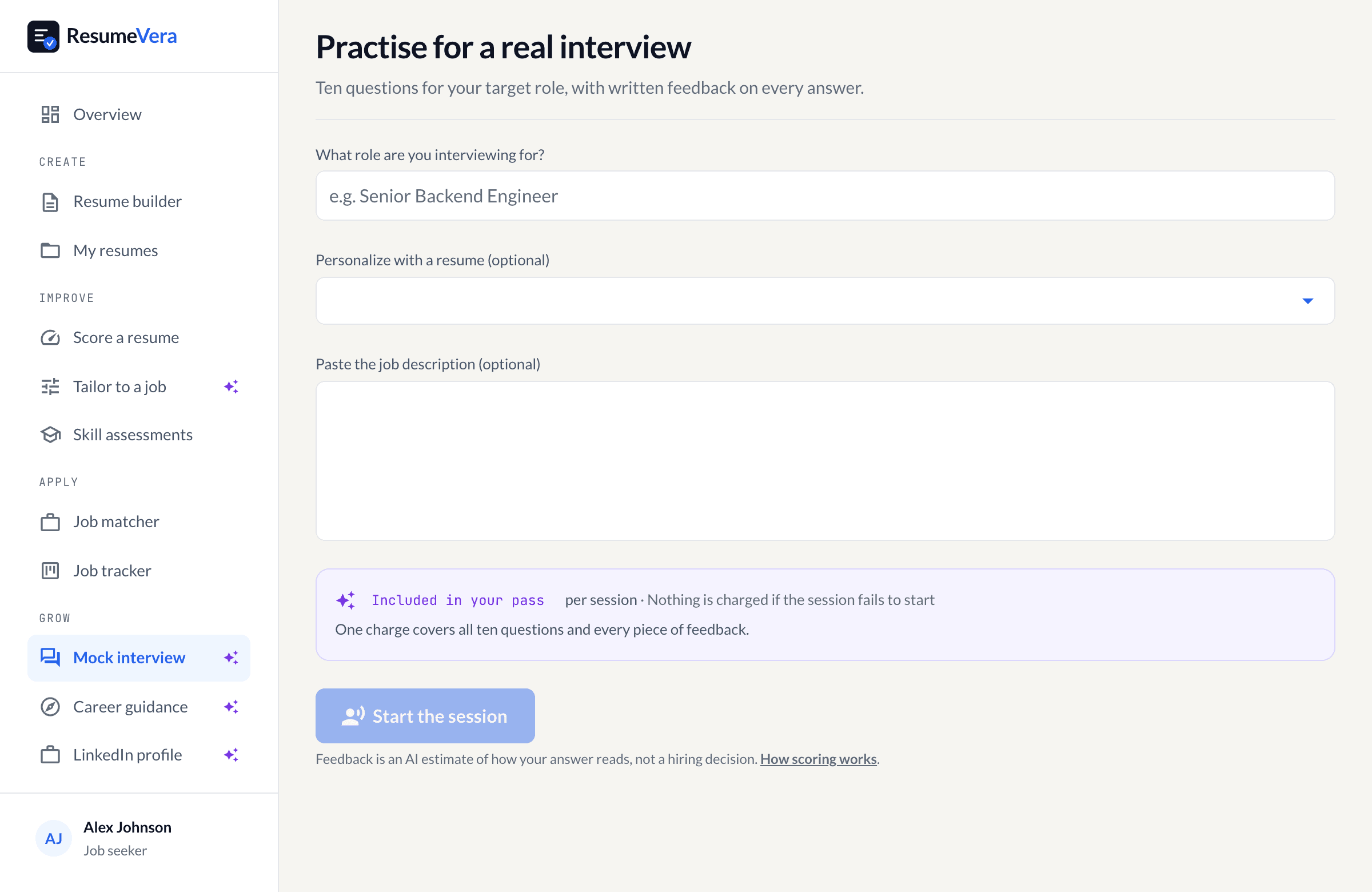
The real screen. Questions are generated from the role you pick and your own resume.
Is your resume ATS-ready?
Run a free ATS score check and get specific improvements in under 60 seconds.