Notice period buyout in India: calculation, tax rules & legal rights (2026)
Career Advice · ResumeVera Editorial · June 10, 2026 · 10 min read

Last Updated: October 2026 · 10 min read · By ResumeVera Team
Quick answers in this guide:
- How to calculate your exact notice period buyout amount
- Is the buyout taxed, and what does the 2017 ITAT ruling say?
- What happens if your new employer reimburses the buyout?
- Legal limits under state Shops and Establishments Acts
- 5 ways to legally reduce or eliminate your buyout amount
Notice period buyout is the amount an employee pays their employer to skip the remaining notice period and exit early. Also called notice pay in lieu or notice period waiver payment, it is one of the most misunderstood parts of switching jobs in India, particularly around how it is calculated and how it is taxed.
This guide explains the exact formula, the Income Tax Tribunal ruling that settles how notice pay recovered from salary is taxed, and the five strategies to reduce your buyout cost.
Calculate your exact buyout
Use our Notice Period Buyout Calculator to see the gross amount, the tax you no longer pay on it, and what it really costs you. Instant and free.
What is notice period buyout?
When an employee resigns, the employment contract specifies a notice period (typically 30, 60, or 90 days) during which the employee continues working to facilitate handover. If the employee wants to leave before the notice period ends, they pay the employer a buyout amount equal to the salary for the unserved days. This compensates the employer for the cost of finding and onboarding a replacement on shorter notice.
Notice period buyout is purely contractual. Indian labour law does not specify a standard formula or mandate buyout: the obligation and the calculation method come entirely from the employment agreement you signed.
Notice period buyout calculation formula
The standard formula used by most Indian companies is:
Buyout Amount = (Monthly CTC ÷ 26) × Days Remaining
The divisor 26 represents the average number of working days in a month (accounting for Sundays and public holidays). Some employment contracts specify 30 as the divisor (calendar days). Always check your appointment letter for the exact method your employer uses.
Step-by-step calculation example
Suppose your monthly CTC is ₹1,20,000, your notice period is 60 days, and you have served 10 days:
- Days remaining: 60 − 10 = 50 days
- Daily rate (÷ 26): ₹1,20,000 ÷ 26 = ₹4,615/day
- Gross buyout: ₹4,615 × 50 = ₹2,30,750
- If it is recovered from your final salary, you are not taxed on that ₹2,30,750 (see the ruling below). On a ₹14.4 lakh year under the new regime, that saves about ₹80,000 in tax in this example, because it brings taxable income under the ₹12 lakh rebate line.
- Real cost to you: about ₹1,50,000
Use the ResumeVera Notice Period Buyout Calculator to run this calculation with your exact CTC and regime.
What salary components are used?
Most employment agreements base the buyout on fixed gross monthly salary (Basic + HRA + Special Allowance). Variable pay, performance bonuses, and employer PF contributions are almost always excluded. If your appointment letter says "last drawn salary" or "monthly gross salary," it typically means the fixed components only. Confirm with your HR.
Is notice period buyout taxed?
It depends on who pays it and how. Here is how each scenario is treated.
Scenario 1: the buyout is recovered from your salary
This is the usual route: your employer deducts the buyout from your last salary or your full and final settlement. You are taxed only on the salary you actually received, not on the amount deducted.
The Income Tax Appellate Tribunal decided this in Nandinho Rebello v. DCIT (ITAT Ahmedabad, ITA No. 2378/Ahd/2013, order dated 18 April 2017). The employee's former employers had deducted notice pay from his salary. The tax officer taxed the full salary; the tribunal held that the deducted amount never became his income, so only the net salary received was taxable, and allowed his appeal.
Practical impact: the buyout lowers your taxable salary for the year, so its real cost is the gross amount minus the tax that salary would have carried. If your Form 16 still shows the full salary, raise it with your employer or a tax adviser before you file your return.
Reference: BCAJ case note: Nandinho Rebello v. DCIT, ITAT Ahmedabad (2017)
Scenario 2: you pay the buyout separately
If you pay your former employer from your own money after your salary has been paid in full, the 2017 ruling does not directly cover it, because it dealt with a deduction from salary. The Income Tax Act has no specific deduction for this payment. If the amount is large, ask a tax adviser how to treat it before filing.
Scenario 3: new employer reimburses the buyout
Many companies, especially in competitive sectors like IT, BFSI, and product startups, offer joining bonuses specifically to cover notice period buyout costs. This reimbursement is taxable as part of your salary from the new employer under Section 17 of the Income Tax Act, 1961.
Your new employer must:
- Include the reimbursement in your Form 16
- Deduct TDS on the amount
- Report it as salary income in your annual statement
Reference: Section 17: Income Tax Department, Government of India
Scenario 4: employer waives the notice period
If your employer agrees to relieve you immediately without requiring payment, there is no tax event. The waiver is a contractual accommodation and does not create taxable income in either party's hands.
Legal framework: what the law actually says
No statutory cap on notice period in India (central law)
India does not have a central law that caps notice periods in private employment. The obligation is entirely defined by your contract. This is why some senior executives have 3–6 month notice clauses. There is no law preventing it.
State Shops and Establishments Acts
Each state regulates commercial establishments under its own Shops and Establishments Act. These acts typically set the minimum notice an employer must give before terminating an employee. They do not cap what an employee owes on resignation.
State-specific minimums for employer-initiated termination (not resignation):
- Karnataka: 1 month for confirmed employees; 7 days for probation period employees
- Delhi: 30 days notice (or salary in lieu) from employer; 15 days from employee
- Maharashtra: 30 days for employees with under 1 year of service (Maharashtra Shops and Establishments Act, 2017)
- Telangana & Andhra Pradesh: 14 days for employer-initiated termination
Your employment contract can specify a longer notice period than the state minimum. It cannot specify a shorter one.
Reference: Notice Period Rules in India 2026: Karnataka HR Hub
The Industrial Employment (Standing Orders) Act, 1946
For companies with 100+ workers, the Industrial Employment (Standing Orders) Act governs the terms of employment. Standing orders must specify notice period requirements and must be certified by the relevant authority. Most IT and white-collar employers, however, are governed by state Shops and Establishments Acts rather than this central act.
Notice period buyout and your full & final settlement
The buyout amount is typically deducted from your Full & Final (F&F) settlement rather than paid separately. Your F&F includes:
- Unpaid salary for days worked in the last month
- Earned leave encashment
- Gratuity (if applicable; requires 5 years of service)
- Minus: Notice period buyout amount
If the buyout exceeds your F&F dues, your employer may ask you to pay the difference before releasing your relieving letter. This is legally enforceable under your contract, and employers can file a civil suit for recovery, though in practice most disputes are settled through negotiation.
Does notice period buyout affect PF?
No. PF contributions are based on the salary paid to you for actual days worked. The buyout is a deduction from your F&F, not a salary payment, so it does not reduce or affect your EPF balance or contributions.
However, if you leave before completing the notice period, your employer stops your payroll on the last working day. EPF contributions stop at the same point. Reference: EPFO Official FAQs: epfindia.gov.in
5 ways to reduce your notice period buyout
1. Negotiate an early release
Approach your manager before formally resigning. If your team has bandwidth or your replacement can be identified quickly, many employers will agree to a shorter notice period, especially if you frame it as mutual benefit. Get any verbal agreement confirmed in writing.
2. Get your new employer to cover it
In competitive markets, employers regularly offer joining bonuses structured to offset buyout costs. Raise this explicitly at the offer stage, before you sign, not after you have resigned. Ask: "Can you include a joining bonus to cover my notice period cost of ₹X?" Many HR teams have this as a standard lever.
3. Offset with earned leave
Accumulated earned leave can often be adjusted against your notice period, reducing the days remaining. If you have 20 days of earned leave and 50 days remaining on your notice, applying leaves reduces your obligation to 30 days. Check your HR policy. Not all employers allow this, and it must be formally approved.
4. Handover completion clause
Some employers waive the remaining notice period once handover is complete. If you have been diligent about documenting your work and training your successor, make the case that the business purpose of the notice period has been fulfilled. Put the request in writing.
5. Internal transfer
Moves within the same corporate group or between group companies often have notice waivers built into transfer policies. If your new role is at a subsidiary or partner company of your current employer, this may eliminate the buyout entirely.
Quick reference: buyout amounts by CTC (30 days remaining)
| Annual CTC | Monthly CTC | Daily Rate (÷26) | Gross Buyout (30 days) |
|---|---|---|---|
| ₹5L/year | ₹41,667 | ₹1,603 | ₹48,077 |
| ₹10L/year | ₹83,333 | ₹3,205 | ₹96,154 |
| ₹15L/year | ₹1,25,000 | ₹4,808 | ₹1,44,231 |
| ₹20L/year | ₹1,66,667 | ₹6,410 | ₹1,92,308 |
| ₹30L/year | ₹2,50,000 | ₹9,615 | ₹2,88,462 |
| ₹50L/year | ₹4,16,667 | ₹16,026 | ₹4,80,769 |
After sorting your notice period: ensure your resume is ready
A smooth notice period exit is only the first step in a successful job switch. Before you start applying to your next role, make sure your resume is a clean, single-column file that uses the same wording as the jobs you want, so recruiters searching their ATS can find you. Check your resume free →
Frequently asked questions
How is notice period buyout calculated in India?
The standard formula is: Buyout = (Monthly CTC ÷ 26) × Days Remaining. Some contracts use 30 (calendar days) as the divisor instead of 26 (working days). Always check your appointment letter for the exact method. Use the ResumeVera Notice Period Buyout Calculator to calculate your amount instantly with your exact salary.
Is notice period buyout taxed?
Not when it is recovered from your salary. In Nandinho Rebello v. DCIT (ITAT Ahmedabad, 2017), the tribunal held that notice pay deducted from salary never became the employee's income, so only the salary actually received is taxed. If you pay the buyout separately after leaving, that ruling does not directly cover it; ask a tax adviser.
What happens if my new employer pays my notice period buyout?
If your new employer reimburses the buyout as a joining bonus or allowance, the amount is taxable as part of your salary under Section 17 of the Income Tax Act. Your new employer must deduct TDS on this amount and report it in your Form 16.
Can I use my earned leave to reduce the notice period?
It depends on your employer's HR policy. Some employers allow earned leaves to be adjusted against the notice period, reducing the remaining days and thus the buyout amount. This requires written approval from HR. Leaves adjusted against notice are not encashed separately.
Is there a maximum notice period under Indian law?
There is no central law capping notice periods in private employment. Notice obligations are entirely contractual. State Shops and Establishments Acts set floors for employer-initiated termination (typically 30 days for confirmed employees), but these do not cap what an employee can be contractually required to serve or pay.
What if I leave without paying the buyout?
Your employer can withhold your Full & Final settlement, relieving letter, and experience letter. They can also file a civil suit for recovery of the unpaid buyout. Practically, most employers use the withholding of documents as leverage rather than litigation. Always settle the buyout or obtain a written waiver before your last working day.
Written and checked by ResumeVera Editorial. How we research and review
Questions
Frequently asked questions
Calculate your notice period buyout
Enter your monthly CTC, notice period length and days served to see the gross buyout, tax at your marginal rate and the net amount. Free.
Calculate my notice period buyoutGet free ATS tips every week
Actionable resume and ATS tips, when we publish them. No spam. Unsubscribe any time.
Related Articles

Leave Encashment on Resignation in India 2026: Tax Rules, ₹25L Exemption & Calculation
Leave encashment on resignation is taxable for private employees, but a ₹25 lakh lifetime exemption under Section 10(10AA) can make most of it tax-free. This guide covers the exact calculation, the CBDT notification that raised the limit, how the 10-month salary cap applies, and how to claim the exemption correctly.
Read More

CTC vs in-hand salary in India 2026: what's the difference and how to calculate both
CTC is what your employer spends on you. In-hand is what hits your bank account. Understanding every component of the gap between the two lets you evaluate offers accurately, negotiate smarter, and plan your finances correctly.
Read More

How to Calculate Salary Hike Percentage in India (2026): Formula, Tax Impact & Real Net Gain
A 20% salary hike on paper rarely means a 20% rise in take-home pay. This guide covers the exact formula to calculate salary hike percentage, how income tax erodes the headline number, what a real net gain looks like after tax, and how India's 2026 appraisal benchmarks compare across industries.
Read More
Try it
Check this against your own resume
The post above is general. Your file is not. The checker reads it the way a parser would and tells you which of these points it actually breaks.
Check your resume free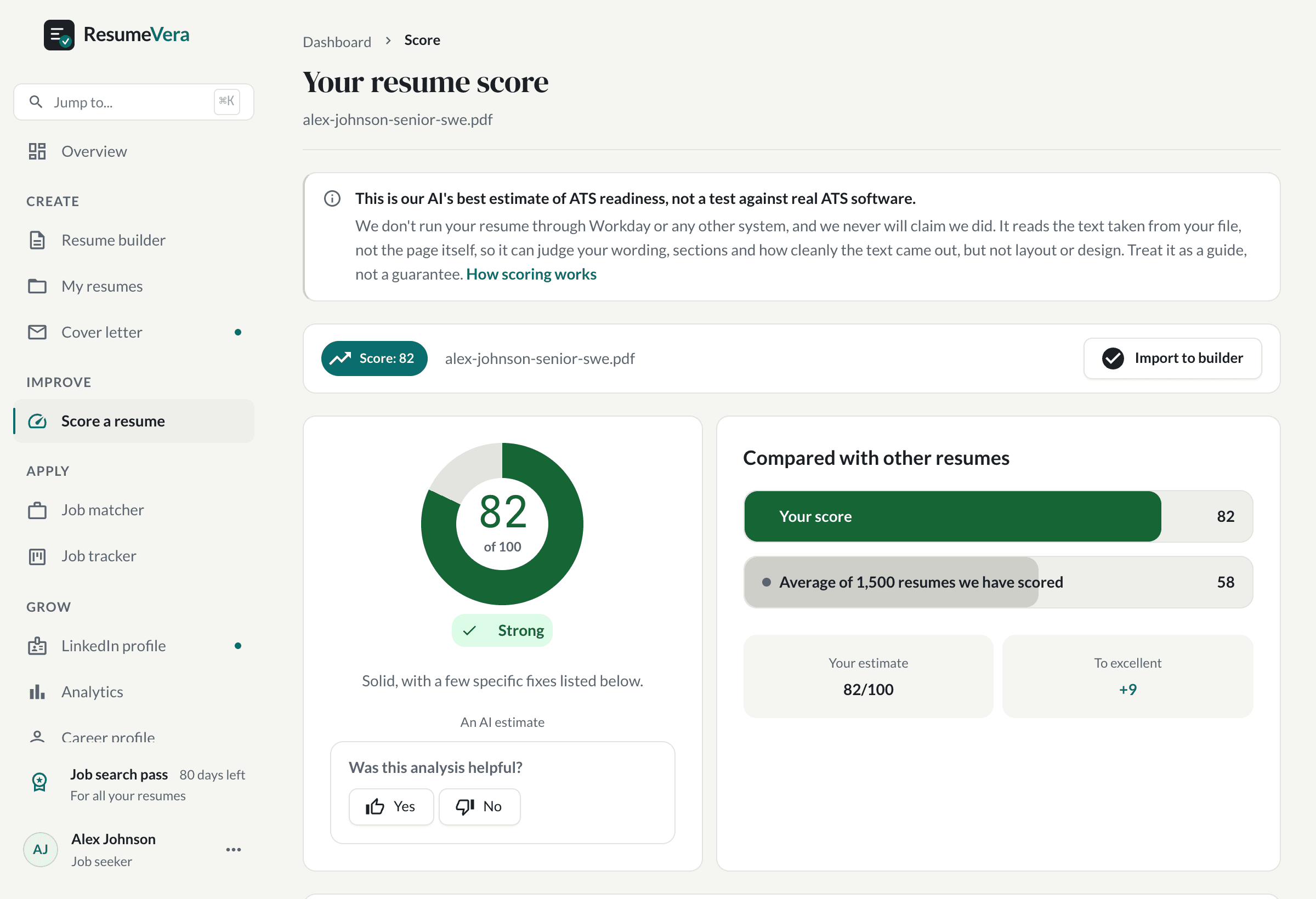
The real score page, with a sample resume and sample scores.
Now check it against your own resume
An honest resume score in seconds. No account, no card.