Written for the India job market, so salaries and formats follow Indian conventions. See the US version.
Career Growth
Experience letter format in India
Last reviewed: 4 October 2026. What goes in it, how it differs from a relieving letter, what the official sources say, and what to do if it is missing or wrong.
The ResumeVera editorial team
Resume and hiring research, reviewed against current employer guidance.
Updated 2026-10-04T14:04:29.848Z
16 min
Section 01
What an experience letter is, and what people call it
Last reviewed: 4 October 2026
An experience letter is a document from a former employer that confirms you worked there. People search for it under several names: experience certificate, experience letter, service certificate, employment certificate, work experience letter, and in some companies "relieving and experience letter" as a single document. In everyday Indian usage they overlap, so the first job is to find out which of them a new employer or a form actually asks for.
The new employer is usually asking for proof of three things: that the company existed and employed you, the period you worked (joining date and last working day), and the role you held. Some recruiters also want the nature of your duties, and a few public-sector recruiters want pay details. That is why the same letter can be fine for one application and incomplete for another.
This guide explains what the official sources we could read say about these letters, what is only common employer practice, how to ask for a letter and fix a wrong one, and how to write your resume honestly if the letter never arrives. It is a plain-language explainer, not legal advice. Rules and employer policies change, and your own appointment letter or contract matters more than any generic template.
Section 02
Experience letter, relieving letter and service certificate: the difference
No official source we read defines "relieving letter" or "experience letter" as a standard form. These are working terms used in HR practice. The table shows how they are usually understood, which is a description of practice and not a legal definition.
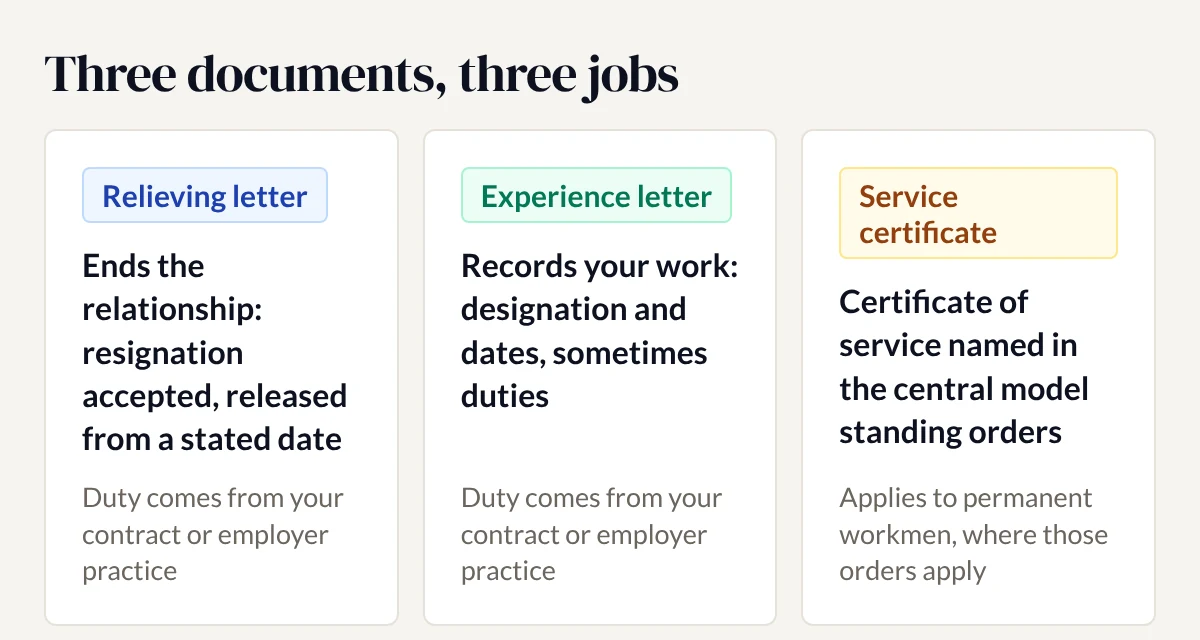
| Document | What it usually says | Source of the duty |
|---|---|---|
| Relieving letter | You have resigned, the resignation is accepted, and you stand released from the company from a stated date | Employer practice or your contract |
| Experience letter or certificate | You worked as [designation] from [date] to [date], sometimes with duties | Employer practice or your contract |
| Service certificate | A certificate of service, named in the Central model standing orders for permanent workmen | Model standing orders, where they apply |
| Appointment letter | The terms on which you were hired | OSH Code, section 6(1)(f), as quoted in the Code |
The practical difference is timing and purpose. A relieving letter is about the end of the relationship and is often issued once notice period, handover and asset return are complete. An experience letter is about the record of your work and is what a future employer reads. Many companies send one combined letter, and others send two separate ones. If a new employer asks for a "relieving letter" and you hold a combined "relieving and experience" letter, it normally serves both purposes, but confirm with the recruiter instead of assuming.
If you are still at the stage of resigning, our guide to the resignation letter format covers the first half of this process: resignation letter format in India.
Section 03
Is your employer required to give you an experience letter?
This is the question behind most searches, and the honest answer has layers. From the official sources we could fetch and read on 4 October 2026, we did not find a provision that says, in so many words, that every employer must issue an "experience letter" or a "relieving letter" to every employee. What we did find is narrower and worth knowing exactly.
What the Central model standing orders say
The Industrial Employment (Standing Orders) Central Rules, 1946, as published by the Ministry of Labour and Employment, carry Model Standing Orders for industrial establishments other than coal mines. Clause 16 reads: "Every permanent workman shall be entitled to a service certificate at the time of his dismissal, discharge or retirement from service." The Delhi Labour Department's copy of the same rules shows the same wording. Two points of care: the clause speaks of a permanent workman, and the wording as quoted names dismissal, discharge and retirement, not resignation. Whether a particular job, such as a software or office role, falls under these orders depends on the definitions and on whether the establishment is covered. Read the rules and ask the labour office; do not assume either way. Sources: Industrial Employment (Standing Orders) Central Rules, 1946 (Ministry of Labour and Employment) and Industrial Employment (Standing Orders) Central Rules, 1946 (Delhi Labour Department).
What the Industrial Relations Code says about standing orders
The Industrial Relations Code, 2020, section 28(1), applies its standing orders chapter to "every industrial establishment wherein three hundred or more than three hundred workers, are employed". Section 29 asks the Central Government to make model standing orders. The Code text we read does not itself contain a service certificate provision. The Ministry also published draft model standing orders for manufacturing, mining and service sectors in January 2021 for comments, and the press release we read does not mention service certificates. We did not review the draft text itself, so check the current notified model standing orders before relying on any of this. Sources: The Industrial Relations Code, 2020 (Ministry of Labour and Employment) and Draft Model Standing Orders press release (Ministry of Labour and Employment).
What the Labour Codes changed, and what they did not
The Press Information Bureau stated on 21 November 2025 that the four Labour Codes "are being made effective from 21st November 2025", rationalising 29 existing labour laws. A later PIB release of 25 November 2025 adds: "During transition, the relevant provisions of the existing labour Acts and their respective rules, regulations, notifications, standards, schemes, etc. will continue to remain in force." The Ministry's FAQ on the Labour Codes says that old rules will remain in force till new rules are finally notified, to the extent they are in line with the Codes. The Ministry's Annual Report 2025-26 says the rules under the four Codes were pre-published for comments on 30.12.2025. We could not confirm from the documents we read whether final rules have been notified since, so this is a point to re-check on labour.gov.in. Sources: PIB release of 21 November 2025, PIB release of 25 November 2025, FAQs on Labour Codes (Ministry of Labour and Employment) and Annual Report 2025-26 (Ministry of Labour and Employment).
On the appointment side, the Occupational Safety, Health and Working Conditions Code, 2020, section 6(1)(f) lists among the employer's duties to "issue a letter of appointment to every employee on his appointment in the establishment, with such information and in such form as may be prescribed". That is about the start of employment, not the end. The Ministry's Compliance Handbook for Employers also lists issuing appointment letters. Sources: The Occupational Safety, Health and Working Conditions Code, 2020 (Ministry of Labour and Employment) and Compliance Handbook for Employers Under the Four Labour Codes (Ministry of Labour and Employment).
State shops and establishments laws
Many private offices are governed by a state Shops and Establishments Act. These differ from state to state. On the Delhi Labour Department's page for the Delhi Shops and Establishments Act, 1954, we read the notice provisions in section 30 (one month's written notice from either side after three months of continuous employment) and found no experience certificate requirement. Your own state's Act and rules are the ones to check.
So what does that mean for you?
In plain terms: the law we could verify gives permanent workmen covered by the model standing orders a service certificate, and gives employees an appointment letter. Beyond that, whether you get a relieving letter or an experience letter is usually decided by your appointment letter, the company's HR policy and its practice. Most employers do issue them, because a new employer will ask for them, but you should not describe it to a recruiter or a labour officer as a statutory right unless you have checked that it applies to you.
Section 04
What an experience letter usually contains
There is no single prescribed format for private employers that we could find. What follows is what recruiters commonly look for, plus one official example of what a recruiting body asks for.
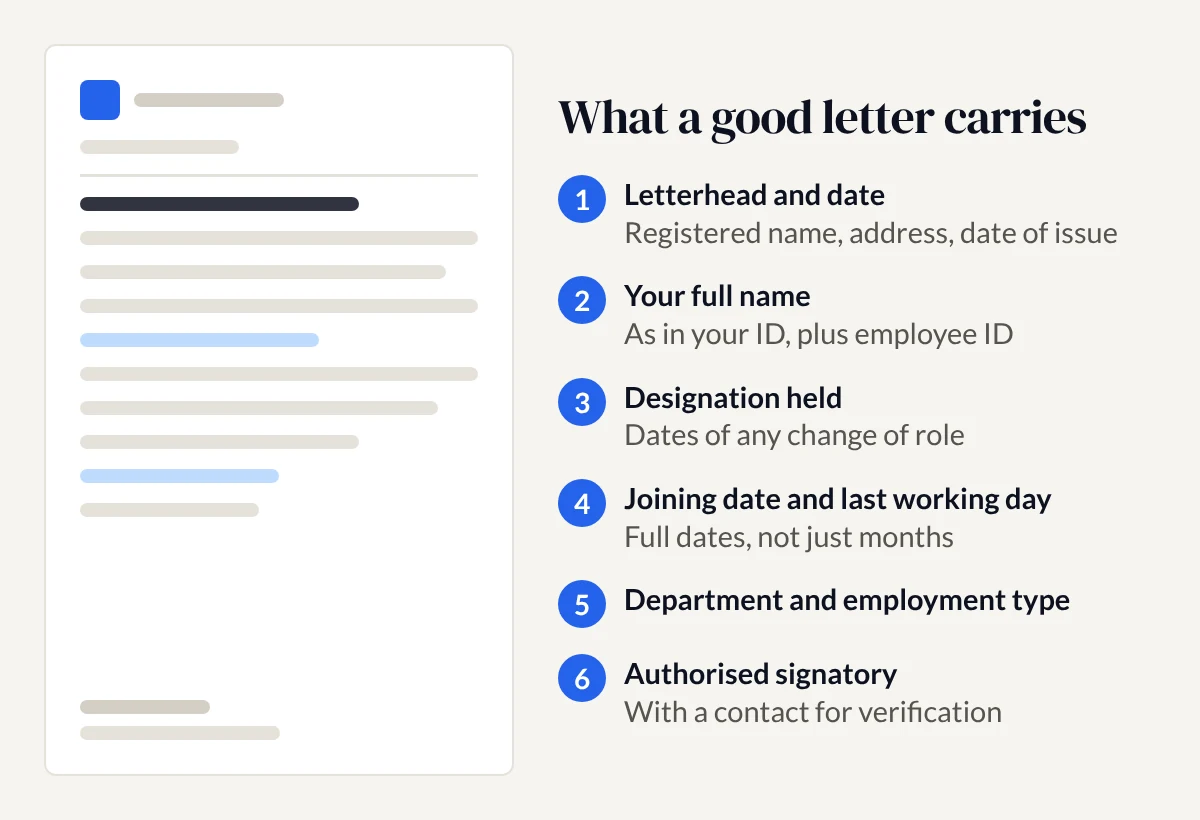
Core details most letters carry
- Company letterhead with the registered name and address, and a date of issue.
- Your full name, as in your ID documents, and your employee ID if there was one.
- Designation or designations held, with the dates of any promotion or change if you held more than one role.
- Date of joining and last working day, written as full dates, not just months.
- Department or team, and employment type if relevant (full-time, contract, intern).
- Signature, name and designation of an authorised signatory such as HR or a director, with a contact email or phone for verification.
Details that are optional and employer-specific
- A short line on your duties or the projects you worked on.
- A line on conduct or performance. Companies differ on whether they write this at all, and a neutral factual letter is common.
- Pay details. Many private employers leave these out. Some recruiters ask for them for verification, and your payslips or Form 16 can cover that.
What a recruiting body can ask for
For one example from the public sector, Union Public Service Commission Advertisement No. 11/2026 asks for certificates "in the prescribed proforma from the Head(s) of Organisation(s)/Department(s) for the entire experience claimed, clearly mentioning the duration of employment (date, month & year) indicating the basic pay and consolidated pay", and the nature of duties performed. It also says a certificate not in the prescribed proforma but containing all the details would be considered on merit. That applies to that advertisement only, but it shows why asking for dates, duties and, where needed, pay is reasonable. Always read the exact wording in the notice you are applying under. Source: Advertisement No. 11/2026 (Union Public Service Commission).
A letter that is only a few lines, accurate and signed, is better than a long letter with doubtful details. If your new employer needs more than the letter has, ask for an addendum rather than editing the original yourself.
Section 05
Experience letter format and sample templates
The two templates below are samples with [bracketed] fields, for understanding the shape of a letter and for HR teams or employees who want to propose wording. They are not legal documents, they are not an official form, and your employer's own format will normally prevail.
Sample A: experience letter with role and duties
[Company letterhead: company name, registered address, CIN or registration details if the company uses them]
Date: [DD Month YYYY]
Experience letter
To whom it may concern
This is to certify that [Full name] (Employee ID: [ID]) was employed with [Company name] as [Designation] in the [Department] department from [date of joining] to [last working day].
During this period, [he/she/they] was responsible for [two or three lines on duties, for example: managing X, working on Y]. [Optional: Conduct line chosen by the employer.]
[Optional: [He/She/They] resigned from the position, and the resignation was accepted with effect from [date].]
We wish [him/her/them] well in future endeavours.
For [Company name]
[Signature]
[Name of signatory], [Designation]
[Official email / phone for verification]
Sample B: short factual employment confirmation
Some employers prefer a minimal letter that states facts only. This is a reasonable thing to request if the company does not issue detailed experience letters.
[Company letterhead]
Date: [DD Month YYYY]
This is to confirm that [Full name] worked with [Company name] as [Designation] from [date of joining] to [last working day].
[Name], [Designation], [Contact]
Sample C: a polite email asking HR for the letter
Subject: Request for experience letter, [Full name], Employee ID [ID]
Dear [HR contact name],
I worked with [Company name] as [Designation] from [joining date] to [last working day]. I am writing to request my experience letter [and relieving letter] on company letterhead, showing my designation and the dates above. I need it for [new employer verification / a form] by [date]. Please let me know if any formality is pending from my side.
Thank you,
[Full name], [Personal email], [Phone]
Keep the email short and factual, send it from a channel you can retain, and keep a copy. If you want to review how to word the end of employment more broadly, see the guide to writing a resignation letter in India.
Section 06
Documents that prove your employment besides the letter
An experience letter is not the only evidence of your work history. If it is delayed, these documents can support your resume and any verification a new employer runs. Whether a given recruiter accepts them in place of a letter is the recruiter's decision.
| Document | What it shows | Where you get it |
|---|---|---|
| Appointment or offer letter | Employer, designation, start terms | Your own records |
| Payslips | Employer, months paid, designation if printed | Payroll portal or email |
| Form 16 | Employer's tax deduction and salary details for a year | Employer, as per Income Tax Department |
| EPF passbook | Establishment and contribution history under your UAN | EPFO Member portal |
Form 16
The Income Tax Department's page says that where tax has been deducted from salary under section 192, the employer is required to issue a TDS certificate in Form 16, and that it is required to be issued up to 15 June of the financial year following the one in which the tax was deducted. Check the Income Tax Department's pages for the current form name and rules, since the page we read did not discuss any change under the Income-tax Act, 2025. Source: Form 16 and Form 16A (Income Tax Department).
EPFO records and your date of exit
EPFO's information booklet for members says each member has a single permanent Universal Account Number (UAN) that stays with them through changes of employer. If your employer has not updated your date of exit, the booklet answers the question directly: "My employer has not updated my date of exit despite lapse of two months after leaving job. How can I update my date of exit?" The steps it lists are to visit the Member Unified Portal, log in with UAN, password and captcha, go to Manage, click Mark Exit, choose the PF account number, enter the date and reason of exit, request an OTP on your Aadhaar-linked mobile number, and update. The booklet carries no edition date, so check the portal for the current procedure. Source: Information booklet for the EPF members (EPFO).
Treat the EPF record as support for your employer and dates. Do not expect it to prove your designation.
Section 07
If your employer refuses or delays the letter
Work through these steps in order. They are practical steps, not a legal procedure, and the right route depends on your contract, your state and your employer.
- Check what your appointment letter and HR policy say. Look for clauses on notice period, handover, exit formalities and documents issued on exit. Many companies link the relieving letter to completing exit formalities.
- Complete what is within your control. Return assets, finish handover, submit the exit form, and clear any dues you accept. Keep acknowledgements.
- Ask in writing. Use the email in Sample C, address it to HR with your reporting manager in copy if appropriate, and ask for a date by which the letter will be issued.
- Follow up once, with dates. Quote your last working day and the date of your first request. Stay factual and polite.
- Escalate inside the company. HR head, the department head, or the grievance contact named in your policy or handbook.
- Keep dues and documents separate in your mind. The Code on Wages, section 17(2), states that where an employee is removed, dismissed, retrenched or has resigned, "the wages payable to him shall be paid within two working days" of that event. The Central model standing orders also speak of paying wages earned and other dues by the second working day after termination. We did not find an official source that makes the experience letter itself subject to the same timeline, so ask for a date instead of quoting a deadline. Sources: The Code on Wages, 2019 (Ministry of Labour and Employment) and Central Rules, 1946, Schedule I, clause 13.
- Use official grievance channels where they fit. For PF-related problems such as an unupdated exit date or wrong records, EPFO runs EPFiGMS, which it describes as "a customised portal of EPFO with an aim to redress grievances for the services provided by EPFO", open to PF members among others. For general public grievances to government bodies, the Government of India's CPGRAMS portal is an online platform to lodge them, with listed exclusions such as sub judice matters and government employees' service matters. Sources: EPFiGMS (EPFO) and CPGRAMS (Government of India).
- Contact your state labour office or a lawyer for disputes. Which authority handles a dispute depends on the employer, the sector and your state. The Ministry of Labour and Employment at labour.gov.in and your state labour department are the starting points. We cannot say whether your case is covered or what outcome to expect.
Avoid threats, public posts about the company, or any step that damages your own references. A calm paper trail serves you better if you later need to escalate.
Section 08
If the letter has wrong details
Errors are common: a wrong designation, a joining date that is a month off, a name spelling that does not match your PAN or Aadhaar, or a last working day that disagrees with your relieving letter. A mismatch can stall a background check, so fix it early.
- Compare against your own records. Appointment letter, promotion emails, payslips and the exit mail. Note exactly which line is wrong and which document proves the correct fact.
- Write to HR with evidence. List the incorrect item, the correct item and attach proof. Ask for a corrected letter, not a handwritten edit.
- Never alter the letter yourself. Changing a date or title on a company letter is not a correction, and it can lead to serious consequences if discovered. Ask the company to reissue it.
- Ask for the old copy to be marked superseded if the company can do that, so that two versions do not circulate.
- If the facts are disputed, for example the company says you joined later than you did, ask what record they rely on, and show yours. Escalate the same way as for a delayed letter.
- Tell the new employer early if verification will be delayed by a correction. Recruiters see this often and usually prefer being told.
Section 09
How to show your experience on a resume if the letter is missing
You can still write your work history accurately without the letter. The rule is simple: put on the resume only what you can support, and be ready to explain the gap in documents.
Build the entry from evidence
- Take the start and end dates from your appointment letter, payslips and exit email. If you only know the month, write the month and year.
- Take the designation from your appointment letter, promotion mail or payslip header.
- Cross-check the period against your EPF passbook if you had PF, and against Form 16 for the financial years.
- Write what you did in short, factual lines. Keep numbers only if you can back them up.
Example entry
Software Engineer, [Company name], [City]
[Mon YYYY] - [Mon YYYY]
- [What you built or ran, in one line]
- [Tools or systems used]
- [A result you can verify, if you have one]
Things to do and not do
- Do not round up or move dates to hide a gap. A resume that disagrees with records is more damaging than a short gap.
- Do not claim a relieving letter you do not hold. If an application form asks whether you have one, answer truthfully and say it is in process, if that is the case.
- Offer alternative proof in the interview: payslips, Form 16, EPF history, and a reference who can confirm your work.
- If the company has closed, list it as it was, with the dates, and keep a former manager or colleague as a reference who can confirm.
- Keep a clean role history if you were promoted: list the roles as separate lines with their own dates.
If you want a quick check of how your resume reads, the free resume checker gives an AI-estimated score and works without an account to start. It is an estimate, not a test by any employer's system. To restructure your work history, the AI resume builder can help you draft entries. For interview conversations about gaps and exits, see the interview preparation guide, and if you are comparing offers, the salary negotiation guide.
Section 10
Honest limits of this guide
This page is information, not legal, tax or HR advice. Several points depend on facts we cannot see: your contract, your employer's policy, your state, whether you count as a "workman" or "worker" under the relevant law, and how the Labour Codes and their rules have developed since we last checked.
- We read the official pages listed below on 4 October 2026 and describe them as they stood then. Some are dated before 2026, and the transition from the older Acts to the Labour Codes was still under way in the documents we read.
- Some official sites could not be fetched by our tools, and some pages loaded only partly, so a few provisions we wanted to quote are left as pointers. We chose to leave a gap rather than guess.
- Employer practice varies widely. A template is only a template.
- For the final word, read the Code or Rule itself, check labour.gov.in, and speak to your state labour office or a qualified professional for a dispute.
Section 11
Sources and references
Every legal or payroll statement above comes from an official page we fetched on 4 October 2026. Where a page was dated, we say so. Check each link for the current version before relying on it.
- Government Makes the Four Labour Codes effective to Simplify and Streamline Labour Laws (Press Information Bureau, 21 November 2025): Effective date of the four Labour Codes and the continuation of existing provisions during transition.
- Union Government's Four Labour Codes Simplify and Streamline Labour Laws (Press Information Bureau, 25 November 2025): Transition wording and the mention of mandatory appointment letters.
- The Code on Wages, 2019 (Ministry of Labour and Employment): Section 17(2): wages payable within two working days of removal, dismissal, retrenchment or resignation.
- The Occupational Safety, Health and Working Conditions Code, 2020 (Ministry of Labour and Employment): Section 6(1)(f): employer duty to issue a letter of appointment.
- The Industrial Relations Code, 2020 (Ministry of Labour and Employment): Section 28(1) standing orders for establishments of 300 or more workers; section 29 model standing orders.
- FAQs on Labour Codes (Ministry of Labour and Employment): Old rules remain in force till new rules are notified, to the extent they are in line with the Codes.
- Compliance Handbook for Employers Under the Four Labour Codes (Ministry of Labour and Employment, 2026): Appointment letter duty and the two working day wage timeline, as stated in the handbook.
- Industrial Employment (Standing Orders) Central Rules, 1946 (Ministry of Labour and Employment): Schedule I model standing orders: service certificate (clause 16) and payment of dues on termination (clause 13).
- Industrial Employment (Standing Orders) Central Rules, 1946 (Delhi Labour Department): Second official copy confirming the service certificate clause.
- Draft Model Standing Orders press release (Ministry of Labour and Employment, January 2021): Draft model standing orders for manufacturing, mining and service sectors were published for comments.
- Delhi Shops and Establishments Act, 1954 (Delhi Labour Department): Section 30 notice provisions; no experience certificate requirement found. State Acts differ.
- Annual Report 2025-26 (Ministry of Labour and Employment): Codes effective 21 November 2025; rules pre-published for comments on 30.12.2025.
- Information booklet for the EPF members (EPFO): UAN portability and the Mark Exit procedure if the employer has not updated the date of exit.
- EPFiGMS (EPFO): EPFO's grievance portal for PF members, pensioners and employers.
- Form 16 and Form 16A (Income Tax Department): Employer's duty to issue Form 16 and the 15 June date.
- Centralised Public Grievance Redress and Monitoring System, CPGRAMS (Government of India): General online grievance platform and its exclusions.
- Advertisement No. 11/2026 (Union Public Service Commission): Example of what a recruiting body asks an experience certificate to show.
- FAQs on Occupational Safety, Health and Working Conditions Code, 2020 (Ministry of Labour and Employment): Reviewed for appointment letter guidance; only a brief mention for fixed-term workers.
- Additional FAQs on Labour Codes, as on 16.03.2026 (Ministry of Labour and Employment): Reviewed; it has no FAQ on experience or service certificates.
Pro tips
Do these
Ask for your experience letter and relieving letter in writing before your last day, with a date by which you expect them.
Save your appointment letter, payslips, Form 16 and EPF details in a folder you control, not only on a company laptop.
Check the name, designation, joining date and last working day on the letter the day you receive it.
Ask for a corrected letter instead of editing a company document yourself.
Keep the combined relieving and experience letter if the company issues one, and ask a new employer whether it is enough.
Download your EPF passbook and confirm the exit date after you leave.
Read the exact wording of any recruitment notice about experience proof before you apply.
Keep one or two colleagues or managers who can confirm your role if a verification is needed.
Avoid these
Delete these
Assuming an experience letter is a legal right in every job, then quoting it as law to HR.
Waiting until after the last working day to ask for the letter.
Editing dates or designations on a letter yourself.
Leaving your last working day and the dates on your resume in disagreement.
Claiming a relieving letter you do not have in an application form.
Mixing up wages timelines with the letter timeline and quoting the wrong deadline.
Ignoring the EPF exit date, which can be fixed through the member portal.
Using a template as if it were an official form.
Sending angry or public complaints before a calm written request and follow-up.
Put this into a resume
Building and editing are free, and free PDFs carry a small watermark.
Check your resume for freeQuestions
Frequently asked questions
How this guide is maintained
We review this guide every quarter and after any change to the hiring rules or portal behaviour it describes. It was last reviewed on 2026-10-04T14:04:29.848Z. Figures come from named sources, shown beside the number. Where we are estimating rather than measuring, we say so.
By the numbers
2 working days
Time for paying wages after resignation, removal or dismissal, as stated in the Code on Wages, section 17(2)
https://www.labour.gov.in/static/uploads/2025/06/c328da14bbb15fc4ad571dc33e7a4ab3.pdf
21 Nov 2025
Date from which the four Labour Codes were made effective, per the Press Information Bureau
https://www.pib.gov.in/PressReleseDetailm.aspx?PRID=2192463®=3&lang=2
Try it
Check the guide against your own file
Everything above is general. Your resume is not. Paste it in and the checker tells you which of these points your file actually breaks.
Check your resume free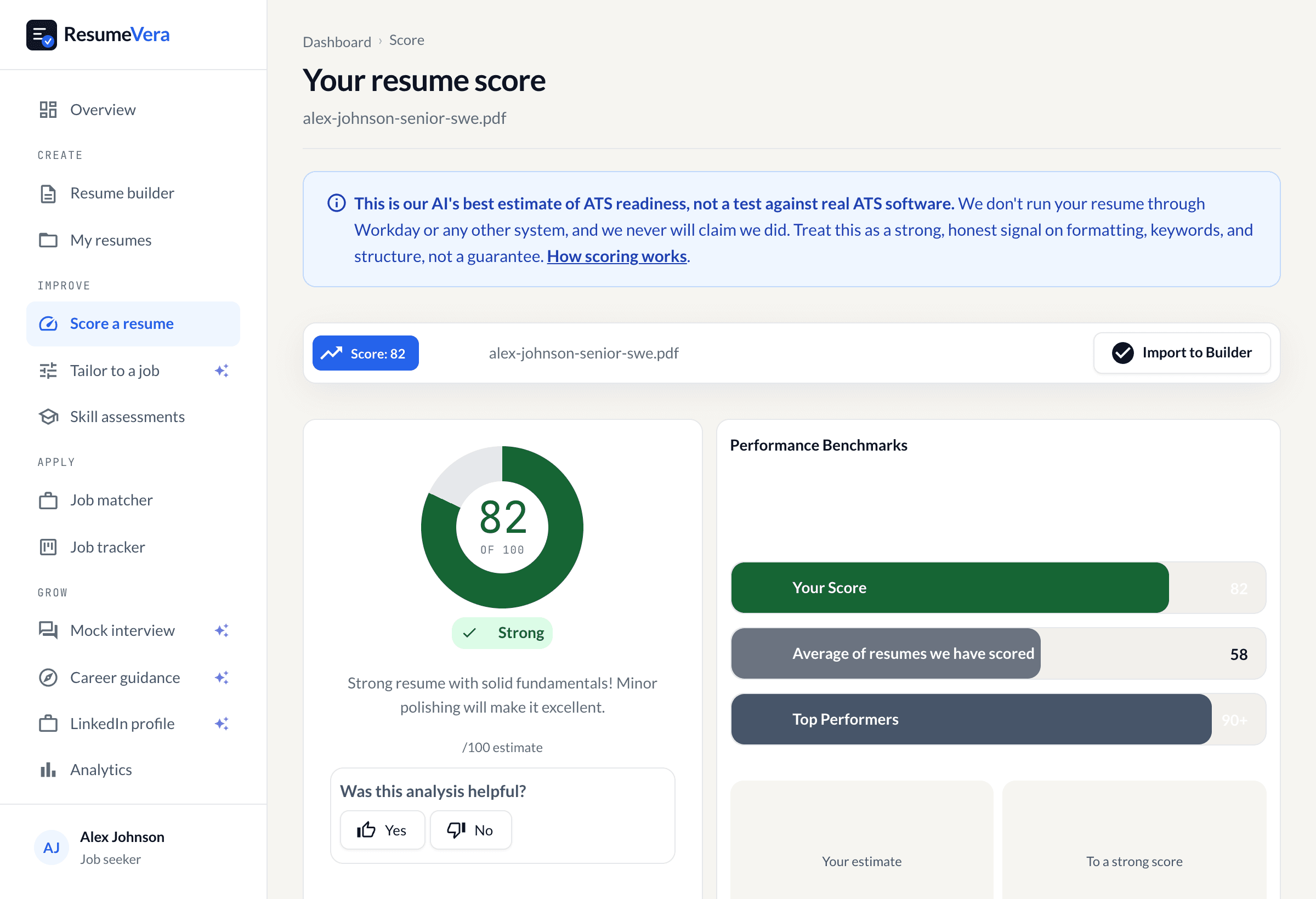
The real score page, with a sample resume and sample scores.
Is your resume ATS ready?
Run a free ATS score check and get specific improvements in seconds.