Interview guide India 2026
Interview preparation guide for India
From HR rounds to case interviews to Group Discussions: a complete playbook for Indian job seekers. Real STAR examples, exact scripts for tough questions, and GD strategy.
The ResumeVera team
Practical preparation guidance. It describes what interviewers commonly ask, and does not promise an outcome.
Updated Oct 7, 2026
12 min

Section 01
Types of interviews in India: what to expect
Different companies use different interview formats. Knowing what is coming lets you prepare the right way.
| 01 | HR / Behavioural Interview The most common round in India. Present at virtually every company. Covers: Tell me about yourself, why this company, strengths/weaknesses, where do you see yourself in 5 years, and critically: "What is your expected CTC?" Use the STAR method for situational questions. |
| 02 | Technical Interview Core of IT services (TCS, Infosys, Wipro): Data Structures, Algorithms, SQL, OOP concepts, system design basics. Product companies: LeetCode-style problems + system design. Core engineering PSU interviews: domain subject matter. Finance: accounting concepts, valuation, financial ratios. |
| 03 | Case Interview (Consulting) Used by MBB (McKinsey, BCG, Bain), Big 4 strategy, and some FMCG companies. Format: clarify the problem → structure a framework → analyse data → synthesise recommendation. Practise with Case in Point (book) and casepartner.me. Expect more than one case round for consulting roles. |
| 04 | Group Discussion (GD) Common at mass-hiring IT companies, banking (IBPS), and FMCG campus placements. The GD tests communication, logical reasoning, and leadership under pressure, not necessarily who speaks most. Tip: initiate OR summarise; both are high-visibility positions in a group. |
| 05 | Aptitude / Written Test Pre-screen for IT services (Infosys InfyTQ, TCS NQT), banking (IBPS PO), and PSUs. Tests: verbal ability, quantitative aptitude, logical reasoning, English comprehension. Most tests have a sectional cutoff. You must clear each section independently. |
Section 02
STAR method: real examples for India
STAR (Situation, Task, Action, Result) is the framework for every behavioural question. Use these as templates.
| 01 | Leadership / Taking Initiative Situation: Our project's testing phase was running 2 weeks behind schedule. Task: As tech lead, I needed to recover the timeline without additional headcount. Action: I reorganised the test case priority matrix, ran parallel testing tracks for independent modules, and conducted daily 15-minute standups to surface blockers early. Result: We released on time and reduced critical post-release defect rate by 40% versus the previous quarter. |
| 02 | Handling Failure / Learning from Mistakes Situation: I underestimated the complexity of a client migration project and gave a 2-week delivery estimate that proved to be off by 3 weeks. Task: Deliver the project while managing client expectations. Action: I immediately flagged the revised timeline with clear reasons, set up weekly progress calls, and delivered a phased release so the client could benefit from completed modules earlier. Result: The client acknowledged the communication and extended the relationship for the next project. |
| 03 | Conflict Resolution / Working Under Pressure Situation: Two team members had conflicting approaches to the product pricing model, creating deadlock during a tight planning cycle. Task: Resolve the disagreement and move forward. Action: I facilitated a structured session where both sides presented their data, identified the 2–3 core assumptions driving the disagreement, and proposed a pilot-then-evaluate approach. Result: The team aligned on a path forward within 48 hours. |
Section 03
HR questions: scripts and frameworks
These four questions appear in nearly every Indian interview. Use the framework for each; practice until the answer flows naturally.
| 01 | "Tell me about yourself" (2-minute structured answer) Formula: Current role + key achievement → previous experience + key skill → why this role. Keep it professional, not personal. "I am currently a Senior Analyst at Deloitte, where I led the GST compliance audit for 3 listed FMCG clients. Before that, I spent 2 years at ABC & Associates building my foundation in Ind AS. I am applying here because I want to move into advisory work, and EY's transactions team has the specific deal flow I want exposure to." |
| 02 | "What is your expected CTC?" Research your number before the interview (AmbitionBox, Glassdoor India). Give a range: "Based on my research and current market rates for this role in Bengaluru, I am looking for something in the ₹X–Y LPA range. That said, I am interested in the complete package and open to discussion." Never say "I am flexible" without an anchor. It signals lack of confidence. |
| 03 | "Why do you want to leave your current job?" Never criticise your current employer, manager, or colleagues. Frame it as a pull (attracted to the new opportunity) not a push (running from problems). "I have had a strong 3 years at my current organisation, but I feel I have reached the ceiling in terms of scale, the projects here cap at ₹50 crore. Your organisation works on enterprise deals that are 5–10× that size, and that is the calibre of work I want to grow into." |
| 04 | "Where do you see yourself in 5 years?" Show ambition aligned with the role, not a scripted "I want to be a manager". Connect your 5-year vision to the company's growth. "In 5 years, I see myself leading a team on complex client engagements, potentially building the vertical in a specific sector. I am attracted to the growth trajectory here because your expansion into Southeast Asia in the next 2 years creates leadership opportunities I could grow into." Avoid: "I want your job" (arrogant) or "I just want to learn" (vague). |
Section 04
Virtual interview setup: technical checklist
Virtual interviews (Zoom, Teams, Google Meet) are standard at most Indian companies now. A bad audio/video setup costs you the job before you answer a single question.
| 01 | Camera at eye level Laptop on a stack of books if needed. Looking down at a laptop camera makes you appear smaller and less confident. |
| 02 | Ring light or window lighting Face a window for natural lighting. Avoid backlit setups. Your face becomes a silhouette. |
| 03 | Wired earphones > Bluetooth > laptop mic In that order of audio quality. Wired eliminates Bluetooth dropouts. |
| 04 | Plain, uncluttered background Use a clean wall or an approved virtual background. Busy backgrounds distract the interviewer. |
| 05 | Log in 5 minutes early Test audio/video before the interviewer joins. Have a glass of water nearby. |
| 06 | Look at the camera, not the screen Makes eye contact feel real to the interviewer. When speaking, focus on the camera lens. |
Section 05
Who this guide is for
This guide is written for candidates preparing for HR, technical, GD, case, and virtual interview rounds in India. The goal is simple: prepare answer frameworks, evidence stories, salary scripts, and role-specific questions. It is structured for readers who want direct examples, recruiter-friendly wording, and India-specific decisions rather than generic career advice.
| 01 | How to use this guide Read the format first, adapt the examples to your own background, then use the checklist and FAQs before submitting your interview preparation. |
Section 06
Interview preparation step-by-step playbook
Use this order to move from blank page to publish-ready application material. Each step is designed to improve recruiter readability and application-system clarity.
For each step, use specific evidence for your target reader: role, company, exam, portal, city, tools, documents and measurable outcomes where possible.
| 01 | 1. Company research |
| 02 | 2. Resume story bank |
| 03 | 3. STAR answers Prepare short stories with situation, action, and result. Use numbers, scope, and specific decisions so answers sound real rather than memorized. |
| 04 | 4. Role fundamentals |
| 05 | 5. Expected CTC script Prepare numbers before the conversation: current fixed pay, variable pay, benefits, expected range, notice buyout, and the minimum offer you would accept. |
| 06 | 6. Questions to ask Prepare 2–3 specific questions about the role, team, or growth path. |
| 07 | 7. Follow-up note |
Section 07
India and global application guidance
Hiring expectations change by market. Indian applications often include portal keywords, campus or exam processes, CTC language, document checks, and local role-title variations. Global applications usually expect tighter privacy, fewer personal details, and stronger proof of role fit.
| 01 | Indian interviews often include expected CTC, notice period, relocation, family/location constraints, and joining-date questions. |
| 02 | Campus and BFSI processes may include GD or written tests before interviews. |
| 03 | For remote or global interviews, virtual setup and concise evidence stories matter more than memorized answers. |
Section 08
Interview preparation examples you can adapt
Use these examples as patterns, not as copy-paste text. The best application content sounds specific to your work and includes evidence that an interviewer can verify.
| 01 | STAR result: reduced weekly reporting time by 6 hours after automating Excel cleanup. |
| 02 | Expected CTC script: Based on the role scope and market range, I am looking at X-Y LPA, but I am open to discussing the complete offer. |
Section 09
Shortlist visibility checklist
Use this checklist before publishing, uploading, or sending your application. It helps recruiters and the people reviewing your application see your fit quickly without forcing unnatural keyword repetition.
| 01 | Lead with the target role or process The first screen should make it obvious why this interview preparation is relevant and what outcome it supports. |
| 02 | Use exact but truthful keywords Mirror role, portal, exam, or company terms only when they genuinely match your background. |
| 03 | Add evidence after every major claim Use numbers, tools, documents, projects, clients, coursework, or outcomes so the content feels verifiable. |
| 04 | Keep formatting predictable Use standard headings and simple layouts so recruiters and upload systems do not have to guess where information lives. |
| 05 | Check the final version against the application instructions If the employer, portal, or exam body asks for a specific format, follow that over generic resume advice. |
Section 10
Official references and source notes
This guide is original ResumeVera guidance. The references below were used to keep the advice aligned with official documentation and platform rules.
| 01 | IBPS official website Official reference point for PO/MT notifications, call letters, and interview-stage updates. Reference: https://www.ibps.in/ |
| 02 | TCS iON National Qualifier Test Official TCS iON reference for NQT-style campus and fresher hiring context. Reference: https://learning.tcsionhub.in/hub/national-qualifier-test/ |
Pro tips
Do these
Bring 3–4 printed copies of your resume to in-person interviews, as many Indian companies still collect them
Research the company's FY25/26 annual report, news, and recent product launches before the interview
Prepare 2–3 questions to ask the interviewer; not asking signals you are not genuinely interested
For GD: initiate OR summarise, both are high-visibility roles; don't just add filler points
Pause 2–3 seconds before answering complex questions; it signals thoughtfulness, not unpreparedness
Dress one level above what the company normally wears (business casual → business formal)
For case interviews: always ask clarifying questions before structuring. Never start immediately
After the interview, send a brief thank-you email within 24 hours, rare in India, instantly memorable
Customize the first 3 lines for the exact role, company, exam, or portal instead of using the same version everywhere.
Add one proof point for every major claim: number, scope, document, tool, project, client type, or result.
Read the page aloud once; if a sentence sounds like generic advice, replace it with a concrete example.
Avoid these
Delete these
Answering "Tell me about yourself" with your personal life or family background
Saying "I am flexible" when asked about expected CTC, always give a researched range
Criticising your current employer or manager in any answer
Not researching the company before the interview; a single specific observation makes a strong impression
Generic answers to behavioural questions without numbers or specific outcomes
In GD: interrupting others or monopolising the conversation, quality over quantity
Asking about salary or WFH policy in the first HR round
No questions for the interviewer at the end: signals low interest
Using repeated keywords instead of useful examples, scripts, and proof.
Submitting without checking the latest employer, portal, or exam instructions.
Copying examples word-for-word instead of replacing them with your own truthful details.
Keywords
Keywords by category
Use these in your resume and profile to improve search visibility.
Core Phrases
Common Question Phrases
India-Specific Terms
Put this into a resume
Building and editing are free, and free PDFs carry a small watermark.
Check my resume freeQuestions
Frequently asked questions
How this guide is maintained
We review this guide every quarter and after any change to the hiring rules or portal behaviour it describes. It was last reviewed on October 7, 2026. Figures come from named sources, shown beside the number. Where we are estimating rather than measuring, we say so.
Career resources
More career guides
Browse all our India-focused resume and career guides.
View all career guides →Try it
Check the guide against your own file
Everything above is general. Your resume is not. Paste it in and the checker tells you which of these points your file actually breaks.
Check your resume free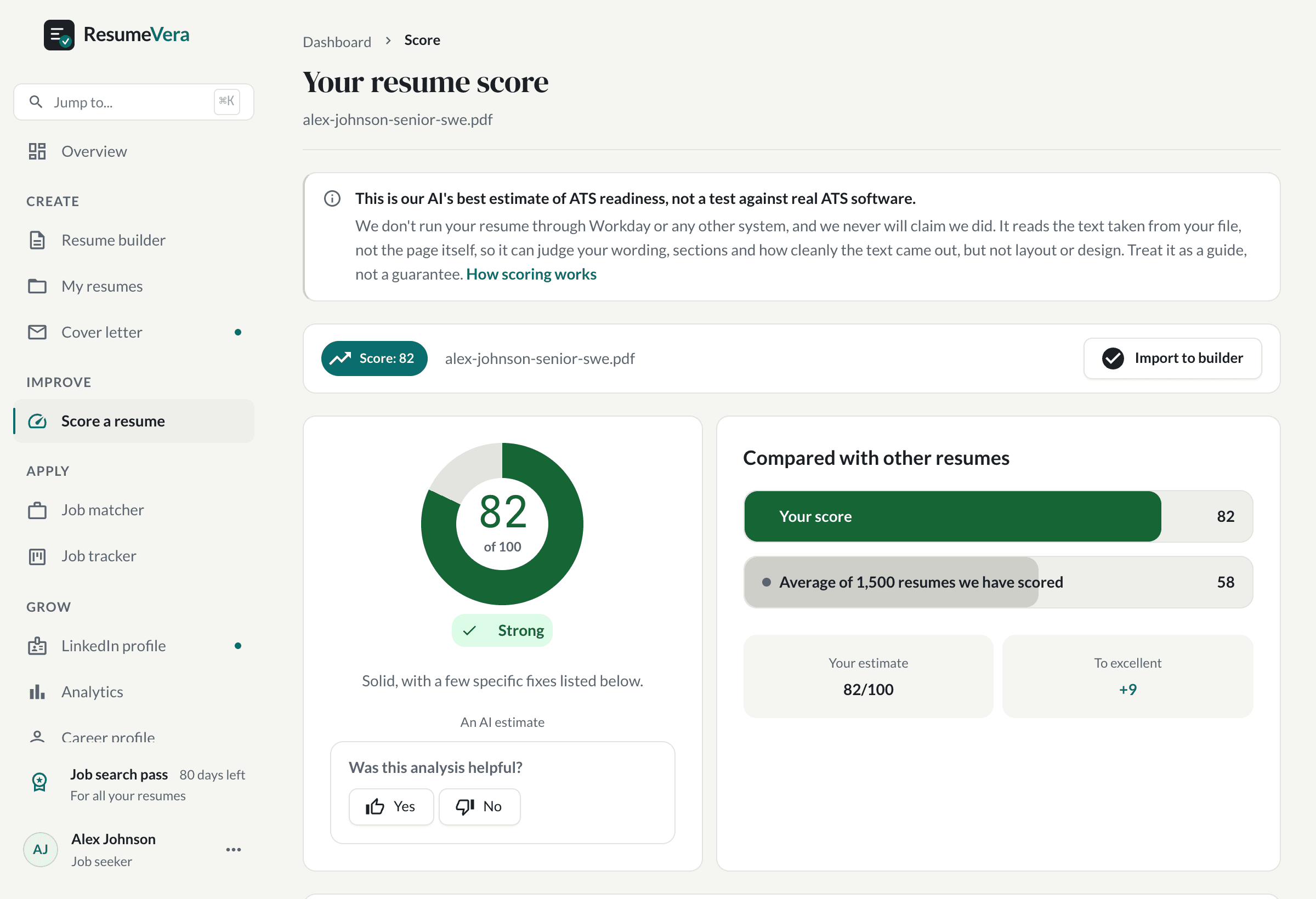
The real score page, with a sample resume and sample scores.
Is your resume ATS ready?
Run a free ATS score check and get specific improvements in seconds.