Salary guide India 2026
Salary negotiation in India: how to get more
Here is the complete playbook for negotiating your offer in India: CTC structure, negotiation scripts, and when to push back.
The ResumeVera team
Negotiation guidance. It sets out how the conversation usually runs, and cannot tell you what any employer will agree to.
Updated Oct 7, 2026
12 min

Section 01
Understanding your CTC components
CTC (Cost to Company) is NOT your take-home salary. Knowing each component helps you negotiate smarter and avoid being misled by inflated headline numbers.
Statutory figures in this list were checked on 7 October 2026. The EPF contribution rate is from the EPFO EPF scheme page. Gratuity eligibility is from section 53 of the Code on Social Security, 2020, the PIB release making the Labour Codes effective from 21 November 2025, and the PIB factsheet on the Code on Social Security, which states the one-year rule for fixed-term employees.
| 01 | Fixed Pay (Basic + HRA + Special Allowance) This is the guaranteed part of your CTC. Basic pay is usually the largest part of fixed pay and drives PF and gratuity calculations. HRA is set as a share of basic and is partly tax-exempt if you pay rent. Focus your negotiation primarily on fixed pay. Variable pay is not guaranteed. |
| 02 | Variable Pay / Performance Bonus Variable pay is the part of CTC that depends on performance targets. Always ask: "What percentage of employees actually achieve 100% target?". This tells you the real value. Variable pay is not a guaranteed component; negotiate more fixed pay whenever possible. |
| 03 | Joining Bonus (One-time) Common when you are leaving unvested ESOPs, a pending bonus, or a notice pay penalty at your current employer. You can ask: "I have a variable payout of approximately ₹X in Q1 at my current company. Could you help offset this via a joining bonus?" |
| 04 | Employer PF Contribution Employers contribute 12% of your basic pay plus dearness allowance to EPF, and you contribute the same 12% from your salary, according to the EPFO (source linked above this list). Part of the employer share goes to the pension scheme. The employer share is included in CTC but you cannot access it immediately. Tip: ask for a "CTC breakup" and check whether employer PF is included. It inflates the headline number but is locked away for years. |
| 05 | ESOPs / RSUs (Equity) Startups and product companies offer ESOPs. Most plans have a cliff before anything vests, then vest over several years. For early-stage startups, assume ESOPs are worth zero unless the company is late-stage / IPO-bound. Do not trade fixed pay for ESOPs unless you deeply understand the upside. |
| 06 | Gratuity Gratuity is now governed by the Code on Social Security, 2020, in force since 21 November 2025. It is generally paid only after at least five years of continuous service; fixed-term employees qualify after one year, on a pro rata basis (sources linked above this list). If included in CTC (most companies do), subtract it from headline CTC to get your actual annual take-home equivalent. |
Section 02
Step-by-step negotiation process
Most people negotiate at the wrong time or in the wrong way. Follow these steps to maximize your leverage.
| 01 | 1. Research your market salary FIRST Use AmbitionBox (India-specific, has median + P75 by company), Glassdoor India, Naukri Salary Insights, and Levels.fyi (for tech roles). Look at P50–P75 salary bands for your role, experience, and city. This is your anchor. Walk into negotiation knowing your number. |
| 02 | 2. Wait for the written offer before negotiating Do not negotiate verbally in the HR interview before getting the written offer letter. Once you receive the written offer, you have leverage, the company has already invested in you. It is easy to give a number too early, so hold it until then. |
| 03 | 3. Express enthusiasm FIRST, then negotiate Always start with: "I am genuinely excited about this opportunity and the team." Then: "Based on my research and current market rates, I was expecting something in the range of ₹X–Y. Is there flexibility on the offer?". This signals you want the job while anchoring higher. |
| 04 | 4. Give a range, not a single number Give a range where the bottom is your target. If you want ₹18 LPA, say "₹18–21 LPA". Expect the company to aim for the lower end of your range. Ranges also feel less confrontational than a single aggressive number. |
| 05 | 5. If base is fixed, negotiate everything else If the recruiter says base pay is non-negotiable (common at MNCs with salary bands), negotiate: joining bonus, variable pay %, sign-on benefits (laptop budget, relocation), and title/designation. These often have more flexibility than fixed pay. |
| 06 | 6. Get the final offer in writing before resigning Never resign your current job based on a verbal offer. Always wait for the written offer letter with all components clearly listed. Before submitting your resignation. Verbal rollbacks are rare but they happen. |
Section 03
Salary hikes in India: what to check
There is no official benchmark for salary hikes in India. Hikes vary by role, city, skills, and company, so check current salary data for your role before you negotiate.
| 01 | Job switch (private sector) Check AmbitionBox, Glassdoor India, and Naukri Salary Insights for your role and city. If the hike is too small to justify the disruption, negotiate or keep looking. |
| 02 | Internal promotion hike Internal promotion hikes are often capped by company policy. If your market value is higher, switching companies may be more effective. |
| 03 | Counter-offer (staying back) Counter-offers solve the immediate problem but rarely address the underlying reason you wanted to leave. |
| 04 | Fresher first salary: Market midpoint Negotiate based on competing offers. If you have two offers, you have leverage. |
Section 04
Word-for-word negotiation scripts
Use these scripts as starting points. Adapt the numbers but keep the tone, professional, enthusiastic, data-backed.
| 01 | Basic negotiation script "Thank you for the offer, I am very excited about the role and the team. I have done some research on market rates for this position in [city], and based on my experience with [specific skills], I was hoping for something in the ₹X–Y range. Is there any flexibility on the compensation?" Then STOP TALKING. Let them respond. |
| 02 | When they ask "What is your expected CTC?" "Based on my research for this role and my experience, I am looking for something in the range of ₹X–Y LPA, which aligns with market rates. That said, I am open to the full compensation package including variable, equity, and growth opportunities.". Never give a single number before they make an offer first. |
| 03 | Counter-offer response (if you get one from your current employer) "I appreciate the counter-offer and the recognition. However, my decision to explore this opportunity was not solely about compensation. I am looking for [specific thing: leadership opportunity / different tech stack / etc.]. Unless you can also address [that factor], I will be moving forward with my decision." This holds your ground professionally. |
Section 05
Who this guide is for
This guide is written for Indian professionals negotiating CTC, hike, joining bonus, variable pay, or counteroffers. The goal is simple: compare fixed pay, variable, benefits, tax impact, and negotiation timing. It is structured for readers who want direct examples, recruiter-friendly wording, and India-specific decisions rather than generic career advice.
| 01 | How to use this guide Read the format first, adapt the examples to your own background, then use the checklist and FAQs before submitting your salary negotiation. |
Section 06
Salary negotiation step-by-step playbook
Use this order to move from blank page to publish-ready application material. Each step is designed to improve recruiter readability and application-system clarity.
For each step, use specific evidence for your target reader: role, company, exam, portal, city, tools, documents and measurable outcomes where possible.
| 01 | 1. Current CTC breakup Prepare numbers before the conversation: current fixed pay, variable pay, benefits, expected range, notice buyout, and the minimum offer you would accept. |
| 02 | 2. Market range |
| 03 | 3. Anchor range |
| 04 | 4. Fixed vs variable |
| 05 | 5. Joining bonus |
| 06 | 6. Notice buyout |
| 07 | 7. Final email |
Section 07
India and global application guidance
Hiring expectations change by market. Indian applications often include portal keywords, campus or exam processes, CTC language, document checks, and local role-title variations. Global applications usually expect tighter privacy, fewer personal details, and stronger proof of role fit.
| 01 | In India, CTC can include fixed pay, variable pay, PF, gratuity, insurance, joining bonus, and retention components. |
| 02 | Always compare monthly in-hand and fixed pay, not only headline CTC. |
| 03 | Negotiate after selection signal or offer discussion, not at the first screening call. |
Section 08
Salary negotiation examples you can adapt
Use these examples as patterns, not as copy-paste text. The best application content sounds specific to your work and includes evidence that an interviewer can verify.
| 01 | If the offer is 18 LPA with 25% variable, compare it against a 16 LPA offer with 10% variable and better benefits. |
| 02 | Ask: Can we explore a joining bonus or fixed-pay adjustment if the base band is capped? |
Section 09
Shortlist visibility checklist
Use this checklist before publishing, uploading, or sending your application. It helps recruiters, job portals, and screening systems understand your fit quickly without forcing unnatural keyword repetition.
| 01 | Lead with the target role or process The first screen should make it obvious why this salary negotiation is relevant and what outcome it supports. |
| 02 | Use exact but truthful keywords Mirror role, portal, exam, or company terms only when they genuinely match your background. |
| 03 | Add evidence after every major claim Use numbers, tools, documents, projects, clients, coursework, or outcomes so the content feels verifiable. |
| 04 | Keep formatting predictable Use standard headings and simple layouts so recruiters and upload systems do not have to guess where information lives. |
| 05 | Check the final version against the application instructions If the employer, portal, or exam body asks for a specific format, follow that over generic resume advice. |
Pro tips
Do these
Practice your negotiation script out loud before the call; confidence matters
Research: AmbitionBox, Glassdoor India, Naukri Salary Insights, Levels.fyi (tech)
Negotiate after written offer, before signing. That is your maximum leverage window
Ask for 24–48 hours to review the offer; never negotiate immediately on the call
Express enthusiasm before asking for more; it signals you want the job
Ask for the full CTC breakup in writing before evaluating total compensation
Calculate take-home after deductions (PF, TDS) as well as gross CTC; in-hand salary can be well below CTC
Customize the first 3 lines for the exact role, company, exam, or portal instead of using the same version everywhere.
Add one proof point for every major claim: number, scope, document, tool, project, client type, or result.
Read the page aloud once; if a sentence sounds like generic advice, replace it with a concrete example.
Avoid these
Delete these
Giving your current salary too early, it anchors the offer downward
Accepting the first offer without any negotiation attempt
Saying "I need more money because of my personal expenses"; never personal reasons
Negotiating with multiple competing offers but sharing the exact numbers
Accepting a counter-offer from your current company without evaluating the root issue
Ignoring non-monetary components: title, WFH policy, annual leave, health cover
Demanding rather than asking: "I expect ₹25 LPA" vs "I was hoping for ₹25 LPA"
Resigning before the written offer letter is received and signed
Using repeated keywords instead of useful examples, scripts, and proof.
Submitting without checking the latest employer, portal, or exam instructions.
Copying examples word-for-word instead of replacing them with your own truthful details.
Keywords
Keywords by category
Use these in your resume and profile to improve search visibility.
Core Phrases
Common Question Phrases
India-Specific Terms
Put this into a resume
Building and editing are free, and free PDFs carry a small watermark.
Check my resume freeQuestions
Frequently asked questions
How this guide is maintained
We review this guide every quarter and after any change to the hiring rules or portal behaviour it describes. It was last reviewed on October 7, 2026. Figures come from named sources, shown beside the number. Where we are estimating rather than measuring, we say so.
Career resources
More career guides
Browse all our India-focused resume and career guides.
View all career guides →Try it
Check the guide against your own file
Everything above is general. Your resume is not. Paste it in and the checker tells you which of these points your file actually breaks.
Check your resume free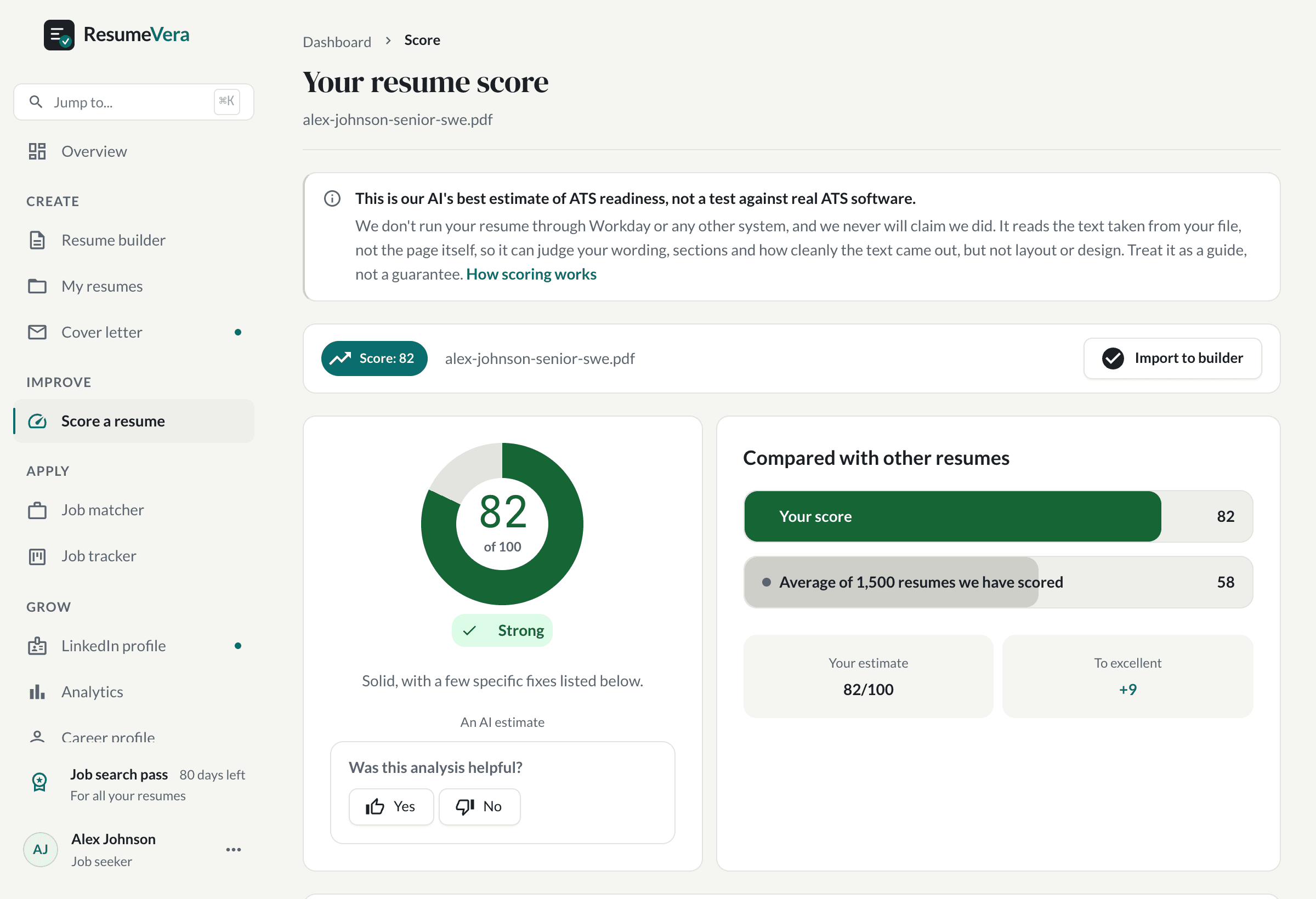
The real score page, with a sample resume and sample scores.
Is your resume ATS ready?
Run a free ATS score check and get specific improvements in seconds.