Written for the India job market, so salaries and formats follow Indian conventions. See the US version.
Career Growth
Full and final settlement in India
What gets paid when you leave, what the official sources say about time limits, and what to do if it is delayed.
The ResumeVera editorial team
Resume and hiring research, reviewed against current employer guidance.
Updated 2026-10-04T14:04:37.962Z
15 min
Section 01
What full and final settlement means, and what the law actually requires
Last reviewed: 4 October 2026. This page explains what official Indian government sources say about a full and final settlement (often written F&F) when you leave a job. It is not legal or tax advice. Your offer letter, appointment letter, company policy and the law that applies to your establishment decide your exact entitlement.
"Full and final settlement" is a payroll term, not a defined legal term in the statutes we reviewed. In practice it means the single statement and payment in which your employer closes your account: pay for the days you worked, any leave that is payable in cash, notice pay in either direction, gratuity or bonus where they apply, minus lawful deductions. Many employers also ask you to sign a "settlement acknowledgement" or "no dues" form. That form is employer practice, not something the law prescribes as a template, so read it before you sign.
The useful way to read this guide is to separate three layers. First, statutory rules such as the time within which wages must be paid after you leave. Second, statutory formulas such as gratuity. Third, contract and policy items such as notice pay, joining-bonus recovery and the leave encashment your policy allows. Always ask which layer a line on your F&F sheet comes from.
If you are still writing your resignation, see our resignation letter format for India. If you are planning your next salary, our CTC calculator helps you separate fixed pay from components that may not be paid out at exit.
Section 02
Which law applies in October 2026
This is the first thing to understand, because the older Acts and the new Labour Codes both appear in advice you will find online. The Press Information Bureau (PIB) release on the Labour Codes states that the four Labour Codes were made effective from 21 November 2025: the Code on Wages, 2019, the Industrial Relations Code, 2020, the Code on Social Security, 2020, and the Occupational Safety, Health and Working Conditions Code, 2020 (PIB release, Government makes the four Labour Codes effective). The same release says that during the transition, the relevant provisions of the existing labour Acts and their rules, regulations, notifications and schemes continue to remain in force.
The Ministry of Labour and Employment's FAQ document on the Codes says old rules remain in force until the new rules are finally notified under the Codes, to the extent they are in line with the Codes (FAQs on Labour Codes (Ministry of Labour and Employment)). A later Ministry document, "Additional FAQs on Labour Codes (as on 16.03.2026)", says gratuity based on the revised definition of wages applies with effect from 21 November 2025 (Additional FAQs on Labour Codes, as on 16.03.2026 (Ministry of Labour and Employment)).
What this page cannot know: which specific rules your state or sector currently applies, whether final rules have since been notified, and how your employer has chosen to implement the transition. Section numbers below are the Code section numbers as shown in the official texts we fetched. Check the current text on the Ministry of Labour and Employment website before relying on any one provision.
Section 03
The components of an F&F settlement
A typical settlement statement has earnings, recoveries and a net figure. Use this table as a checklist, then compare it to your own statement line by line.
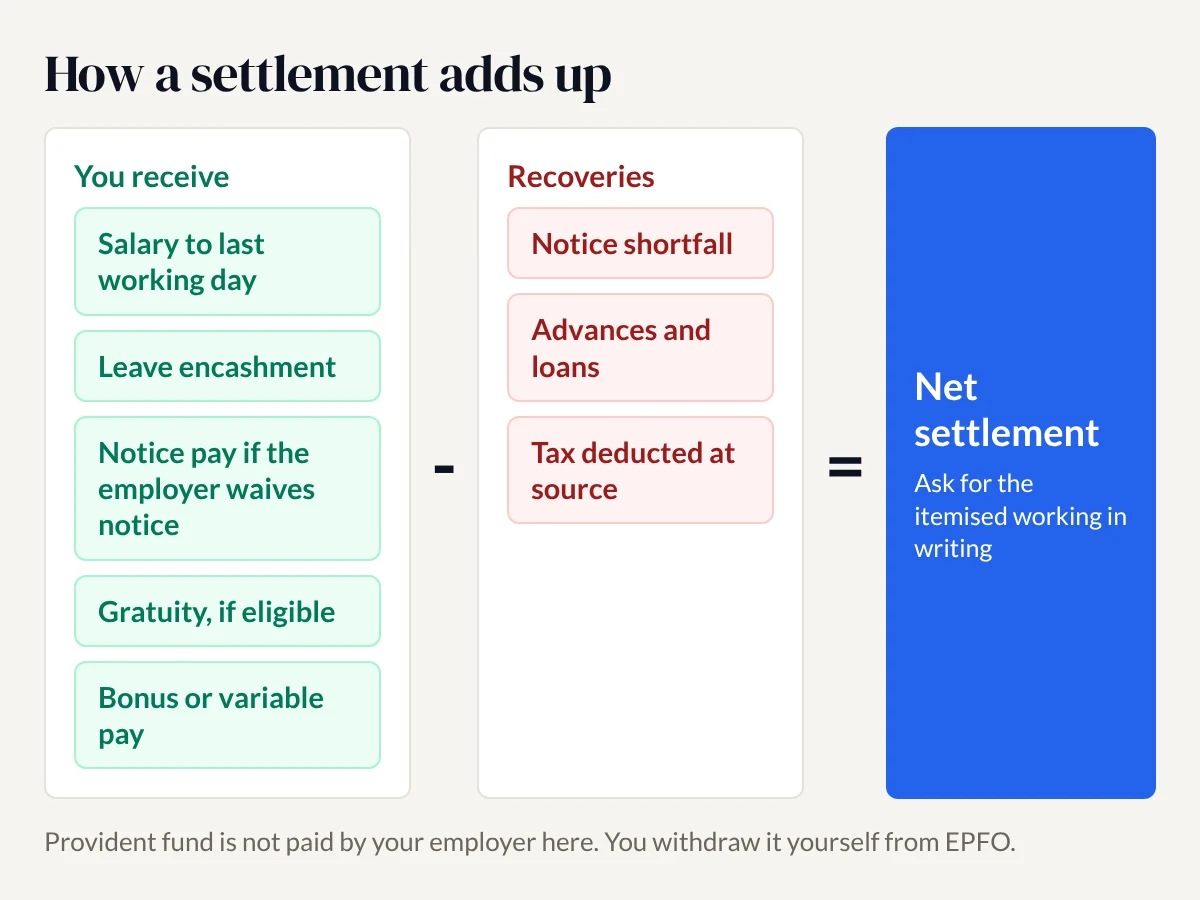
| Component | Direction | What decides it |
|---|---|---|
| Salary up to last working day | You receive | Wages due, Code on Wages |
| Leave encashment | You receive | Leave policy and contract |
| Notice pay (employer waives notice) | You receive | Contract, employer policy |
| Notice shortfall (you leave early) | Recovery | Contract, employer policy |
| Gratuity | You receive | Gratuity law, eligibility |
| Bonus or variable pay | You receive | Plan terms, applicable law |
| Advances, loans, fines, damage | Recovery | Authorised deductions only |
| Tax deducted at source | Recovery | Income-tax rules on salary |
Salary up to the last working day
This is the wage for days you actually worked in your final month. How a part month is computed (calendar days or a fixed divisor) is a payroll policy choice. For example, if your contract pays on calendar days, 12 days worked in a 30-day month is 12/30 of that month's pay. Ask your HR how your policy counts it, and ask for the working in writing.
Leave encashment, notice pay, gratuity and bonus
These are covered in the sections that follow, because each has a different source of authority. Provident fund (EPF) is not paid by your employer in the F&F: you withdraw it yourself from the EPFO, which is also covered below.
Section 04
Time limits: when must wages and other dues be paid after you leave?
This is the question most people search for, so the official answers are laid out by item. Each has a different source.
| Item | What the official source says | Source |
|---|---|---|
| Wages on separation | Within two working days of removal, dismissal or retrenchment; the Ministry handbook also names resignation | Code on Wages, section 17(2) |
| Gratuity | Within 30 days from the date it becomes payable | Compliance Handbook (Code on Social Security); old Act section 7 |
| EPF final settlement claim | A claim is required to be settled within 20 days (EPFO FAQ) | EPFO FAQ page |
Wages: two working days
The Ministry's Compliance Handbook for Employers under the four Labour Codes states that when an employee leaves, whether by resignation, dismissal or termination, the employer is required to pay all due wages within two working days (Compliance Handbook for Employers under the Four Labour Codes (Ministry of Labour and Employment)). The Code on Wages text, as published on the Ministry site, provides in section 17(2) that wages are due within two working days of removal, dismissal or retrenchment, and the PIB factsheet on the Code on Wages lists the same two working day rule for termination or resignation (The Code on Wages, 2019 (Ministry of Labour and Employment); PIB factsheet on the Code on Wages, 2019).
Section 17(3) of the Code lets the appropriate Government modify these timelines, so a state or sector rule may differ. Two working days refers to wages. It does not by itself say that every item on an F&F sheet, such as a performance bonus or leave encashment, must be settled in two days. Whether a given item counts as "wages" depends on the definition in the Code, which we cover next.
What counts as wages
Under the Code on Wages, wages include basic pay, dearness allowance and retaining allowance, and certain other remuneration is excluded. If the excluded items together exceed one-half of total remuneration, the excess is added back and treated as wages (section 2(y), Code on Wages). The Code on Social Security uses a similar definition that includes basic pay, dearness allowance and retaining allowance (The Code on Social Security, 2020 (Ministry of Labour and Employment)). So the way your CTC is split can change what the wage base is.
Gratuity and EPF timelines
The Compliance Handbook states that the employer shall pay gratuity within 30 days from the date it becomes payable. The earlier Payment of Gratuity Act, 1972, as published by the Ministry, also provides for payment within thirty days, with simple interest at rates specified by the Central Government if it is not paid (The Payment of Gratuity Act, 1972 (Ministry of Labour and Employment)). For EPF, the EPFO FAQ page states that a claim is required to be settled within 20 days, while the EPFO Citizens' Charter (issue date November 2022) lists 7 working days for PF final withdrawal (EPFO FAQ page; EPFO Citizens Charter). These two EPFO figures differ, and we cannot tell from the documents which is current, so treat both as service standards and check the current EPFO position when you claim.
Section 05
Deductions: what an employer may and may not take out
Under the Code on Wages, section 18(1) says there shall be no deductions from an employee's wages except those authorised under the Code. Section 18(2) lists authorised deductions, including fines, absence from duty, damage or loss, house accommodation, amenities, advances and loans, statutory levies and social security contributions. Section 18(3) caps the total deductions at fifty per cent of wages, and section 18(4) says an amount above that may be recovered in the manner prescribed (The Code on Wages, 2019). The PIB factsheet adds that the restriction on unauthorised deductions now applies to all employees regardless of salary level (PIB factsheet on the Code on Wages, 2019).
Section 19(4) caps fines at three per cent of the wages payable, and section 20(2) limits deductions for absence in proportion to the actual absence.
Notice shortfall, bond recovery and training cost
The sources we reviewed do not set a standard notice period, notice-pay formula or the validity of a service bond. Those come from your contract. We therefore cannot say whether a recovery of notice pay or a joining bonus is lawful in your case. If a deduction is not clearly authorised, ask HR to name the contract clause and the legal provision relied on, in writing.
Ask for a deduction breakup
Your right to a wage slip is also in the Code: section 50 says every employer shall issue wage slips in the prescribed form and manner. The PIB factsheet says wage slips are to be provided electronically or in physical form on or before wage payment. Use that to ask for an itemised F&F statement, not a single net figure.
Section 06
Gratuity at exit
Gratuity is a statutory benefit, but only if you are eligible. The Compliance Handbook states that, under the Code on Social Security, gratuity is payable on termination of employment after at least five years of continuous service for regular employees, and after one year for fixed-term employees, at 15 days' wages for each completed year of service, subject to the maximum notified by the Central Government (Compliance Handbook for Employers under the Four Labour Codes). The PIB factsheet on the Code on Social Security confirms the reduction of the fixed-term employee requirement from five years to one year (PIB factsheet on the Code on Social Security, 2020).
The Ministry's 16.03.2026 FAQs say gratuity based on the revised definition of wages applies from 21 November 2025, and that for service before and after that date, the employee is paid gratuity on the rate of wages last drawn (Additional FAQs on Labour Codes, as on 16.03.2026).
The earlier Payment of Gratuity Act, 1972 provides, among other things, that for each completed year of service or part exceeding six months, 15 days' wages at the last drawn rate are payable, and that gratuity may be wholly or partly forfeited for riotous or disorderly conduct, violence, or offences involving moral turpitude committed in the course of employment (The Payment of Gratuity Act, 1972). Whether that "part exceeding six months" rounding carries over to the Code is not something we could confirm from the pages we fetched, so check the current text.
How to check your own gratuity
- Count your continuous service and see which rule your employment type falls under.
- Find your last drawn wages as defined for gratuity, which may differ from gross pay.
- Check the maximum notified by the Central Government on the Ministry site.
- Ask the employer to show the calculation, and the date it considers gratuity payable.
We do not give a rupee formula here, because the method of converting your salary to a daily rate is set out in the law and rules, and we did not confirm the current wording.
Section 07
Leave encashment, notice pay and bonus
Leave encashment
Under the Occupational Safety, Health and Working Conditions Code, the Ministry's 16.03.2026 FAQs say a worker can carry forward up to 30 days of leave to the following calendar year, that there is no prescribed maximum limit for encashment, and that leave exceeding 30 days can be encashed at the end of the calendar year (Additional FAQs on Labour Codes, as on 16.03.2026). That document does not say how much unused leave is paid out at resignation. For that, your leave policy and contract apply, so check whether it is paid in cash on exit, and on which pay (basic only, or basic plus allowances).
Notice pay
Notice pay is a contractual item. If your employer asks you to leave without serving notice, the offer letter usually says whether pay in lieu is due. If you leave before the notice period ends, the employer may claim a shortfall under the contract. The statutes reviewed do not set a universal notice period for private-sector employees, so the letter decides. For retrenchment, the Handbook says compensation is 15 days' average pay for each completed year of continuous service under the Industrial Relations Code, and requires three months' prior notice in larger establishments of 300 or more workers.
Bonus and variable pay
Annual bonus, performance bonus and variable pay depend on the plan terms and on the law that applies to your establishment. We did not fetch a primary source stating when a bonus must be paid on exit, so do not assume that a pro-rata bonus is due or not due. Ask HR to point to the plan clause. Under the 1972 Gratuity Act definition, bonus is excluded from wages for gratuity purposes.
When you negotiate your next job, our salary negotiation guide for India covers how to ask about notice buyout and joining-bonus terms in writing.
Section 08
Tax: TDS on your final pay and Form 16
Your employer deducts tax at source on salary, and in your exit year part of your F&F may be taxable. The Income Tax Department describes Form 16 as the certificate of tax deducted at source on salary under section 203 of the Income-tax Act, 1961, provided by the employer and showing income, deductions and exemptions, and tax withheld (Return applicable, Form 16 (Income Tax Department e-filing portal)). The official Form 16 under rule 31(1)(a) has Part A, with tax deducted and deposited quarter by quarter, and Part B, with the salary breakup, and records the employment period from and to (Form No. 16 (Income Tax Department)).
Leave encashment and gratuity
The Income Tax Department's "Exempt Income" document describes tax treatment of gratuity under section 10(10) and of leave encashment under section 10(10AA): exemption depends on employee type and service, leave encashment is partly exempt for non-government employees on retirement or resignation up to a limit, and fully taxable if encashed during service (Exempt Income (Income Tax Department), dated January 2026). That document refers to the Income-tax Act, 1961. We did not confirm how the Income-tax Act, 2025 renumbers these provisions or what the current limits are, so verify the current limit on the department website instead of relying on a figure quoted online.
Two employers in one year
If you change jobs in a financial year, you may receive Form 16 from both employers. We did not confirm the precise current procedure for passing previous-employer income to the new employer, so ask the new employer's payroll team what documents it needs, and keep your Form 16 and final payslip safe. Compare the Form 16 to the tax statement in your account on the income tax portal before filing.
Section 09
EPF withdrawal after you leave
Your EPF is separate from the F&F cheque. You claim it from the EPFO through your Universal Account Number (UAN). The EPFO FAQ describes the UAN as a 12 digit number allotted to each subscriber that remains valid throughout your career, and notes the Composite Claim Form (Aadhaar) as a single page form for PF final withdrawal that can be filed online without employer attestation (EPFO FAQ page). A separate EPFO FAQ says final settlement claims (Form 19, 10C or 31) can be filed without employer attestation if the UAN is activated and KYC details are approved (EPFO FAQs (pmvbry.epfindia.gov.in)).
The waiting period changed, so read the date
The EPFO FAQ page, when we fetched it, still said that after resignation a member has to wait two months before withdrawing the PF amount. But the PIB release on the 238th Central Board of Trustees meeting, 13 October 2025, says the final settlement period was changed from the existing 2 months to 12 months, and the pension withdrawal period from 2 months to 36 months (PIB: Dr Mansukh Mandaviya chairs 238th meeting of the Central Board of Trustees, EPF). A related PIB release of 15 October 2025 describes the premature final settlement period as extended to 12 months, and says 25 per cent of contributions must be retained as minimum balance, with partial withdrawal for the rest (PIB: Ministry of Labour and Employment emphasizes benefits of EPFO reforms).
We could not confirm from an EPFO circular exactly how and from when these Board decisions are applied on the member portal. Before you plan your finances around your PF, log in to the unified member portal or call the EPFO helpline and read the current rule for your case. The older Form 19 instructions mention a two-month wait for resignation and attestation by the last employer, but that document is undated, so do not rely on it for the waiting period (Form 19 instructions (EPFO)).
Before you leave
- Activate your UAN and complete KYC (Aadhaar, PAN, bank account).
- Ask your employer to confirm that your date of exit has been recorded with the EPFO, because we could not confirm from the sources exactly what a claim requires.
- Keep your UAN, which the EPFO FAQ says remains valid throughout your career, and give it to your next employer.
Section 10
If your settlement is delayed: steps in order
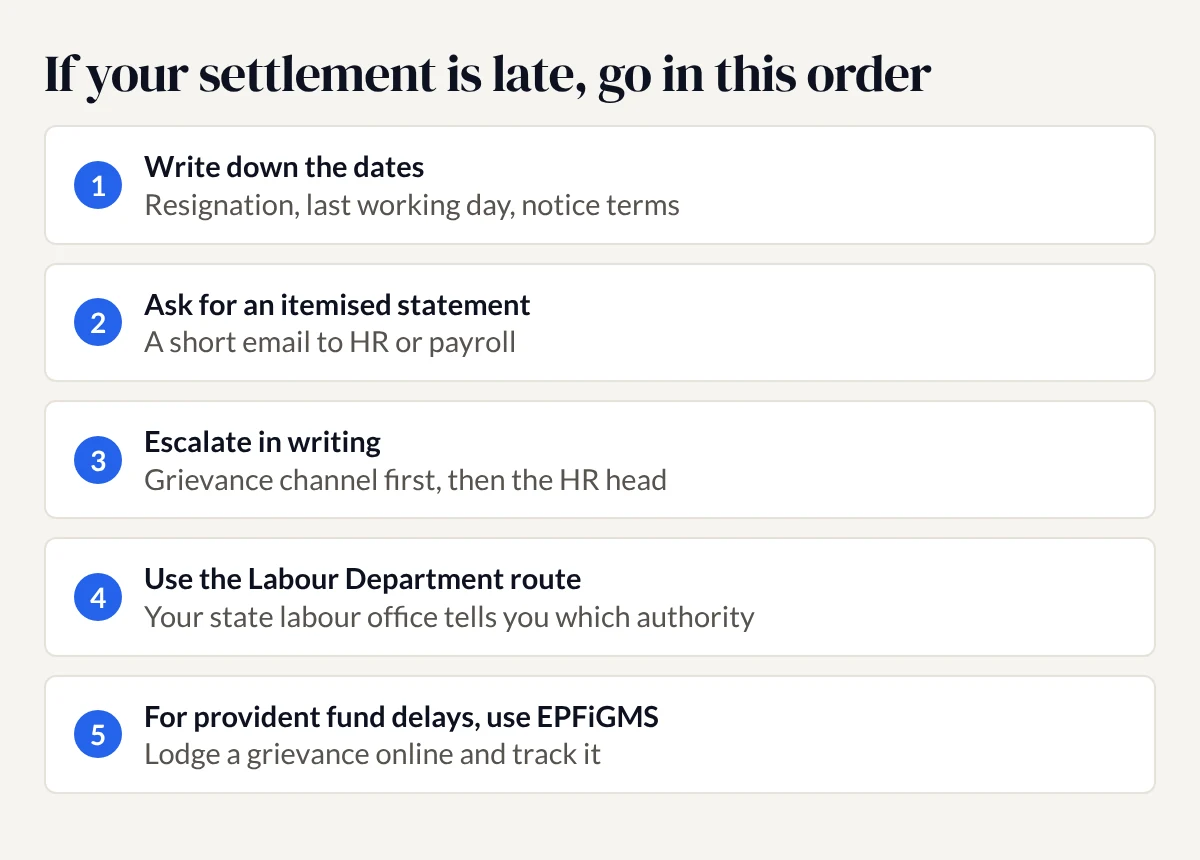
- Write down the dates. Your last working day, the date you resigned, the notice terms, and the date two working days after you left.
- Ask for an itemised statement. A short email to HR or payroll, with your employee ID, asking for the F&F calculation and expected payment date.
- Escalate in writing. Use the grievance channel in your policy, then the HR head, quoting the contract and the Code on Wages timeline.
- Use the Labour Department route. The Code on Wages, section 45, allows an application for unpaid wages within three years from the date the claim arises, and the authority may order compensation in addition to the claim, extending to ten times the claim determined. Applications can also be filed by the Inspector-cum-Facilitator (The Code on Wages, 2019). Which office you approach depends on your state and establishment, so contact your state labour office or check the Ministry site.
- For PF delays, use EPFiGMS. The EPFO FAQs say you can lodge a grievance online at epfigms.gov.in or approach the Regional PF Commissioner, and receive a unique registration number to track it (EPFO FAQs).
- For gratuity, the 1972 Act provides that disputes on the amount are decided by the controlling authority after inquiry and a hearing (The Payment of Gratuity Act, 1972). Ask your state labour office which authority is yours.
Sample email to HR (sample only, not a legal document)
Subject: Request for full and final settlement statement, [Employee ID], [Name]
Dear [HR contact name], my last working day was [date] after resignation on [date]. I have not yet received my full and final settlement. Please share an itemised statement showing salary, leave encashment, notice adjustments, gratuity if applicable, and each deduction with the clause relied on, and confirm the payment date. I also request my relieving letter and Form 16. Regards, [Name], [contact number].
Sample follow-up after the deadline (sample only)
Dear [HR head name], further to my email of [date], wages are due within two working days of separation under the Code on Wages as published by the Ministry of Labour and Employment. The payment is pending as of [date]. Please confirm payment by [date], failing which I will approach the labour authority. Regards, [Name].
Stay factual and keep the tone calm. A complaint is stronger when it is dated, itemised and polite. For your next move, our interview preparation guide and free resume checker can help while the settlement is in progress.
Section 11
Sources and references
Every legal and payroll statement on this page comes from an official government source we opened in this review, on 4 October 2026. Some pages are summaries or older documents, and we say so. Rules may have changed since, so use the links below for the final word.
- Government makes the four Labour Codes effective (PIB): effective date 21 November 2025, transition of old Acts
- Labour Codes effective, PIB release: same effective date and transition statement
- The Code on Wages, 2019 (Ministry of Labour and Employment): sections 2(y), 17, 18, 19, 20, 45, 50
- PIB factsheet: Code on Wages, 2019: two working days, deductions, wage slips
- The Code on Social Security, 2020 (Ministry of Labour and Employment): definition of wages
- PIB factsheet: Code on Social Security, 2020: fixed-term gratuity, EPF coverage
- Compliance Handbook for Employers under the Four Labour Codes: wages timeline, gratuity, retrenchment compensation
- FAQs on Labour Codes (Ministry of Labour and Employment): old rules continue until new rules notified
- Additional FAQs on Labour Codes, as on 16.03.2026: gratuity from 21.11.2025, leave encashment under OSH Code
- The Payment of Gratuity Act, 1972 (Ministry of Labour and Employment): gratuity rate, forfeiture, payment in thirty days
- Exempt Income (Income Tax Department): gratuity and leave encashment exemption, dated January 2026
- Form No. 16 (Income Tax Department): structure of Form 16
- Return applicable, Form 16 (Income Tax e-filing portal): what Form 16 is
- EPFO FAQ page: UAN, composite claim form, 20 days, two-month statement
- EPFO FAQs (pmvbry.epfindia.gov.in): claims without attestation, EPFiGMS
- Form 19 instructions (EPFO): older instructions, undated
- EPFO Citizens Charter (issue date November 2022): service standards
- PIB: 238th meeting of the Central Board of Trustees, EPF: final settlement period 12 months
- PIB: EPFO reforms, 15 October 2025: 25 per cent minimum balance, partial withdrawal
Pro tips
Do these
Ask for an itemised F&F statement, not only a net amount, and keep it.
Note your last working day and count two working days from it.
Compare each deduction with a contract clause before you sign any acknowledgement.
Activate your UAN and complete KYC before you resign, so your PF claim is not held up.
Keep your offer letter, resignation acceptance, relieving letter and final payslip together.
Check the date on every rule you read online, including this page.
Avoid these
Delete these
Signing a no-dues or full-and-final acknowledgement before you have checked the figures.
Assuming gratuity is payable regardless of your length of service.
Treating a blog's quoted tax limit or EPF waiting period as current without checking the official page.
Assuming notice pay or bonus recovery is always allowed, or never allowed, without reading the contract.
Forgetting to ask for Form 16 and the relieving letter along with the settlement.
Leaving your PF claim for later without confirming your date of exit is updated.
Put this into a resume
Building and editing are free, and free PDFs carry a small watermark.
Check your resume for freeQuestions
Frequently asked questions
How this guide is maintained
We review this guide every quarter and after any change to the hiring rules or portal behaviour it describes. It was last reviewed on 2026-10-04T14:04:37.962Z. Figures come from named sources, shown beside the number. Where we are estimating rather than measuring, we say so.
By the numbers
2 working days
Wages due after separation, Code on Wages section 17(2)
https://www.labour.gov.in/static/uploads/2025/06/c328da14bbb15fc4ad571dc33e7a4ab3.pdf
30 days
Gratuity payment period stated for the Code on Social Security
https://www.labour.gov.in/static/uploads/2026/02/83978455025732b99b0165def80ab171.pdf
Try it
Check the guide against your own file
Everything above is general. Your resume is not. Paste it in and the checker tells you which of these points your file actually breaks.
Check your resume free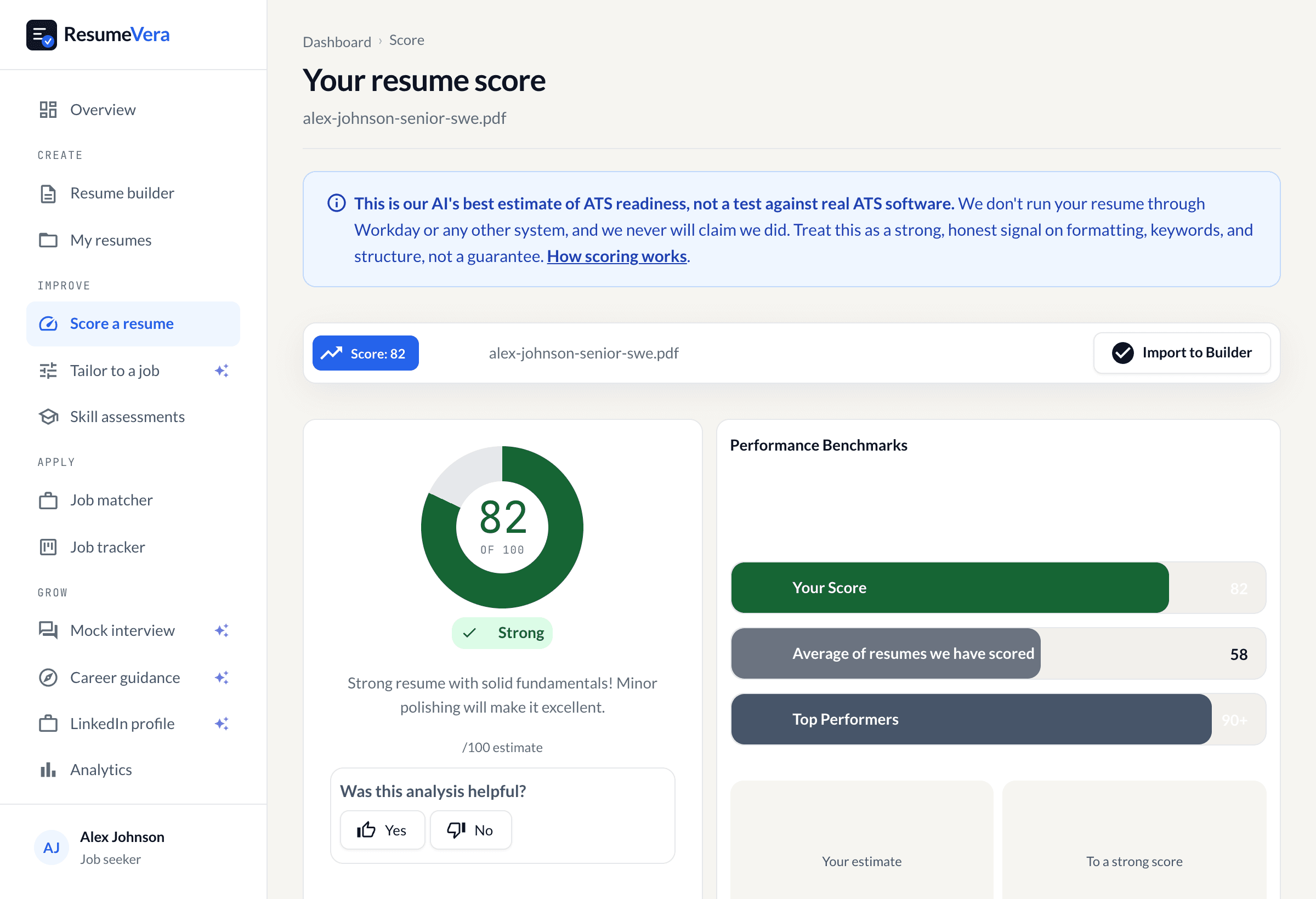
The real score page, with a sample resume and sample scores.
Is your resume ATS ready?
Run a free ATS score check and get specific improvements in seconds.