Written for the India job market, so salaries and formats follow Indian conventions. See the US version.
Workplace documents
Salary slip format in India
What the law says about wage slips, what each line means, and how to check a slip before you use it for a loan or a job.
The ResumeVera editorial team
Resume and hiring research, reviewed against current employer guidance.
Updated 2026-10-04T14:04:46.772Z
15 min
Section 01
What a salary slip is and what people call it
Last reviewed: 4 October 2026. This guide explains what the official sources say. It is not legal or tax advice, and your employment contract and employer policy decide the details for your job.
A salary slip is a statement your employer gives you for each pay period. It shows what you earned, what was deducted and what reached your bank account. In India you will see the same document called a payslip, a salary slip, a pay slip, a salary statement or, in the language of the labour law, a wage slip. They all mean the same thing for practical purposes: a month-wise record of pay.
People search for the format because the slip does far more than prove you were paid. Banks read it before approving a loan. A new employer may ask for the last few slips during background verification. You use it to check that the tax and provident fund (PF) lines are correct. And if there is ever a dispute about pay, it is your first piece of written evidence.
Below: the legal position, the parts of a slip, the PF, ESI, professional tax and TDS lines, a sample layout with [bracketed] fields, use in loans and job applications, and how to spot an edited slip. A free CTC calculator on this site can help you see how a package turns into take-home pay.
Section 02
Is a salary slip mandatory? What the law says
Short answer: yes, for most employers. The Code on Wages, 2019 says, in section 50(3), that every employer shall issue wage slips to the employees in such form and manner as may be prescribed (Code on Wages, 2019, Ministry of Labour and Employment). The same section says the requirement does not apply to an employer who employs not more than five persons for agriculture or domestic purposes.
The Press Information Bureau summary of the Code describes the duty in plain words: employers must furnish wage slips, electronically or in physical form, on or before wage payment (Code on Wages, 2019: key provisions, PIB, 23 November 2025).
What is law and what is employer practice
| Question | What the sources say | Who decides |
|---|---|---|
| Must a slip be issued? | Yes, section 50(3), with a small-employer carve-out | The Code |
| Paper or electronic? | Either, per the PIB summary | Employer |
| Exact fields and form? | "As may be prescribed" in the rules | Rules, then employer design |
| Logo, layout, colours? | Not set by the Code | Employer |
| Password-protected PDF? | Not addressed in the sources we read | Employer |
This is why slips from different companies look so different. The law requires that you get one and leaves the exact form to the rules. The page design is the employer's own.
Related duties in the same Code
- Display of a notice. Section 50(2) requires a notice at a prominent place in the establishment with the abstract of the Code, category-wise wage rates, the wage period, the day or date and time of payment and the name and address of the Inspector-cum-Facilitator.
- Mode of payment. Section 15 allows wages to be paid in coin or currency notes, by cheque, by crediting the employee's bank account or by electronic mode.
- Timing. Section 17 sets time limits. For wages paid by the month, they must be paid before the expiry of the seventh day of the next month. When an employee is removed, dismissed, retrenched or resigns, the wages payable are to be paid within two working days.
- Deductions. Section 18 lists the permitted kinds of deduction and says the total deducted in a wage period shall not exceed fifty per cent of the wages.
The Ministry of Labour and Employment also publishes a compliance handbook for employers under the four labour codes (Compliance Handbook for Employers Under the Four Labour Codes, Ministry of Labour and Employment, February 2026 upload). Read it for the employer-side view, and read the Code itself for the exact wording.
Section 03
Which law applies now: the status of the labour codes
You may still see older advice that quotes the Payment of Wages Act, 1936. The position changed in late 2025, so it helps to know what the official pages say and when they were written.
- The Ministry of Labour and Employment release dated 21 November 2025 states that the four Labour Codes became effective on that date: the Code on Wages, 2019, the Industrial Relations Code, 2020, the Code on Social Security, 2020 and the Occupational Safety, Health and Working Conditions Code, 2020 (Government Makes the Four Labour Codes effective, PIB, 21 November 2025).
- The Code on Wages, 2019 itself contains a repeal provision. The version on the Ministry's site lists the Payment of Wages Act, 1936, the Minimum Wages Act, 1948, the Payment of Bonus Act, 1965 and the Equal Remuneration Act, 1976 among the Acts repealed (Code on Wages, 2019).
- The Ministry's FAQs on the Labour Codes say that old rules remain in force until the final notification of new rules under the Code, to the extent they are in line with the Codes (FAQs on Labour Codes, Ministry of Labour and Employment, 2026 upload). The page is undated on its face, so check for a newer version.
- The Ministry's annual report for 2025-26 says the rules under the four codes were pre-published for comments on 30.12.2025 (Annual Report 2025-26, Ministry of Labour and Employment).
What we could not confirm: we could not load an official page that confirms the final notified wage slip form under the central rules, and state governments make their own rules for establishments in their sphere. So this page does not give a prescribed list of fields. Check the current rules on labour.gov.in and your state labour department website for the form in force for your employer.
Section 04
Components of a salary slip
Most slips have the same five blocks, whatever the design. Use this table as a checklist.
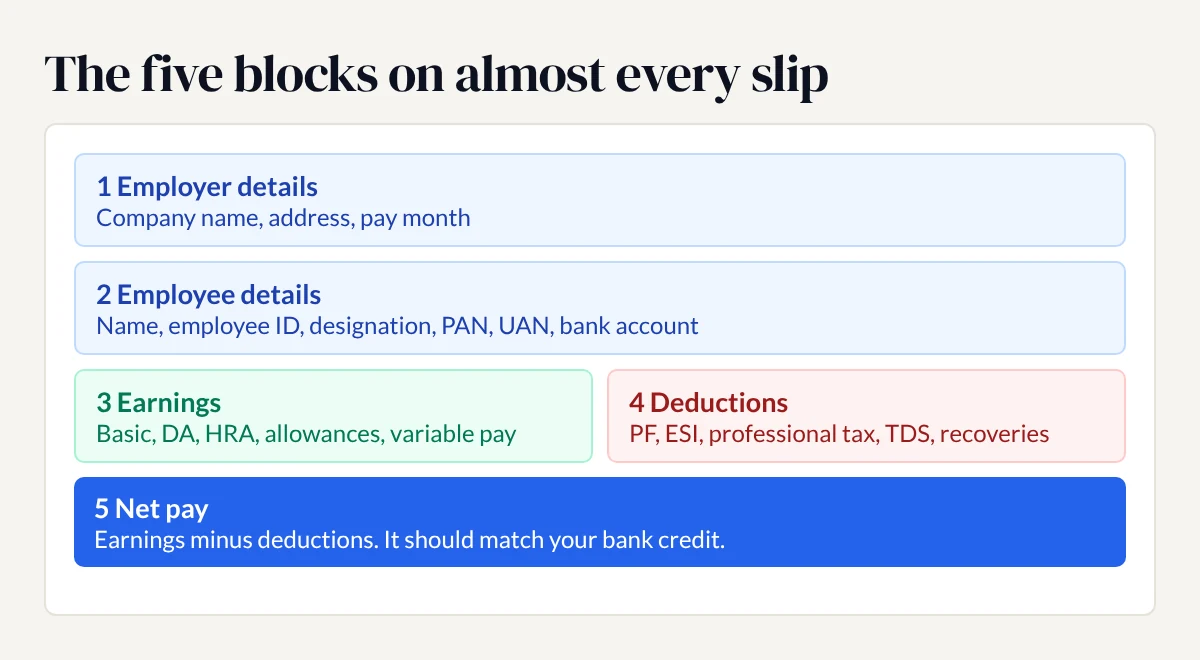
| Block | Typical lines | Check |
|---|---|---|
| Employer details | Company name, address, month | Matches your offer letter |
| Employee details | Name, employee ID, designation, PAN, UAN, bank account | PAN and UAN are yours |
| Earnings | Basic, DA, HRA, special allowance, bonus, arrears | Matches your pay structure |
| Deductions | PF, ESI, professional tax, TDS, loan or advance recovery | Each has a basis |
| Net pay | Gross earnings minus deductions | Equals the bank credit |
Header details
The top of the slip carries the pay period (for example "[Month Year]"), the days paid and any days of unpaid leave. Your PAN and UAN appear on many slips because tax and PF are tracked against them. If a field is wrong, ask your HR or payroll team to correct it, because a wrong PAN can lead to tax credit problems and a wrong UAN can leave PF contributions in the wrong place.
Earnings
Earnings usually start with basic pay, which is the anchor for several other numbers. Then come allowances such as dearness allowance (DA) where applicable, house rent allowance (HRA), conveyance, special or flexible allowance, and variable items such as bonus, incentive, overtime or arrears. Names differ by company. What matters is that each earning on the slip can be traced to your offer letter or appointment letter.
Deductions
Deductions are amounts taken out before you are paid. Statutory ones come from law: PF, ESI where it applies, professional tax where your state levies it, and income tax deducted at source (TDS). Others are by agreement, such as recovery of a salary advance or a loan. Section 18 of the Code on Wages limits the permitted kinds and the total (see the previous sections).
Net pay
Net pay, take-home pay or "net salary" is the figure that reaches your bank account. It is simply gross earnings minus total deductions. If your bank credit differs from the net figure, ask payroll why before you assume the slip is wrong.
Section 05
How to read earnings and deductions, with a worked method
You do not need payroll software to sanity-check a slip. Work through these steps with your offer letter and last slip open side by side.
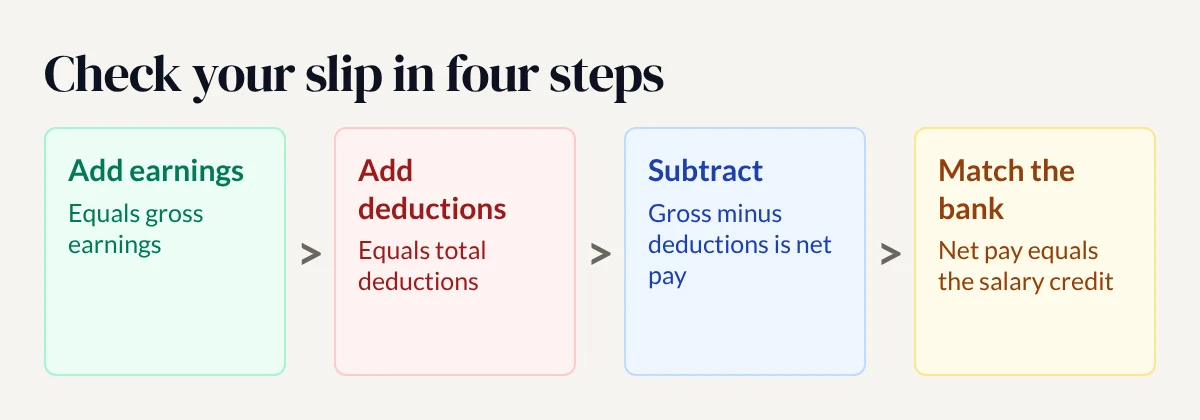
- Add the earnings. The total should equal the gross earnings figure printed on the slip.
- Add the deductions. The total should equal the total deductions figure.
- Subtract. Gross earnings minus total deductions should equal net pay.
- Compare with the bank. The salary credit in your account statement should match net pay.
- Test the PF line. Take the PF-wage base your employer uses (basic plus DA, per EPFO) and apply the rate described in the next section. If your line is lower, ask whether your employer contributes on a capped wage.
- Look at TDS month by month. It should not jump without a reason such as a bonus, arrears or a revised tax declaration.
Formula view with [bracketed] fields
- Gross earnings = [Basic] + [DA, if any] + [HRA] + [Other allowances] + [Variable pay or arrears]
- Total deductions = [Employee PF] + [ESI, if applicable] + [Professional tax, if applicable] + [TDS] + [Other recoveries]
- Net pay = Gross earnings minus Total deductions
The brackets are placeholders. We deliberately give no sample salary amounts, because no figure here is a norm for any role or city. To see how a package turns into take-home pay for your own numbers, use the CTC calculator.
CTC and the slip are different documents
Your offer letter usually states cost to company (CTC), which includes items the employer pays that never appear in your take-home, such as the employer share of PF. The slip shows the pay period's actual earnings and deductions. A slip will therefore not match your CTC divided by twelve, and that alone is not a red flag. Ask payroll for a breakup that reconciles the two.
The 50 per cent rule
The Code on Wages defines wages as basic pay, dearness allowance and retaining allowance, and says that if the payments in the excluded list exceed one half of all remuneration, the excess is added back to wages (section 2(y), Code on Wages, 2019). The Ministry's FAQs describe the same rule in plain language (FAQs on Labour Codes). Because benefits such as PF are calculated on wages, the basic and allowance split can change those lines. Ask HR how your structure treats this rule.
Section 06
PF, ESI, professional tax and TDS lines: where the rules sit
Each of these four lines has its own official source. We quote what the pages say as of our review date and point you to the page for the current position.
Provident fund (EPF)
The EPFO FAQs state that an employee contributes 12% of basic wages plus dearness allowance plus retaining allowance in EPF, and that the employer also pays 12% (Frequently Asked Questions, Employees' Provident Fund Organisation). EPFO's scheme page adds that the employee's entire contribution goes to EPF, while the employer's share is split between EPF, the Employees' Pension Scheme (EPS) and Employees' Deposit Linked Insurance (EDLI) (EPF Scheme, Employees' Provident Fund Organisation). That is why the employer PF line is not simply a second 12% in your passbook.
The FAQs also say employees drawing basic wages and dearness allowance up to Rs.15,000 are alone eligible to become members under that rule, and that members continue coverage if wages later rise. Your UAN is a single permanent number for your working life (Information booklet for EPF members, EPFO). Check your EPF passbook on the EPFO member portal to see whether the contributions shown on your slips actually reached your account.
ESI
The ESIC contribution page states that the employee's contribution rate (with effect from 01.07.2019) is 0.75% of wages and the employer's is 3.25% (ESIC Contribution, Employees' State Insurance Corporation). The coverage page states a wage limit for coverage of Rs.21,000 (Rs.25,000 for persons with disability) effective from 01.01.2017 (ESIC Coverage, Employees' State Insurance Corporation). Those pages carry old effective dates, so check ESIC for the current position. If your wages are above the limit applicable to you, you will see no ESI line.
Professional tax
Professional tax is a state levy, so there is no single national number. As one example of how states differ, the Karnataka professional tax portal shows a notice that PT for February 2026 is to be deducted at Rs. 300 instead of Rs. 200, citing a notification dated 15 April 2025 (Professional Tax employer page, Government of Karnataka). Telangana publishes its own schedule of slabs (Professional tax schedule, Commercial Taxes Department, Telangana). Find your state's schedule rather than relying on another state's. If you changed states, check that the line changed as well.
TDS on salary
Section 192 of the Income-tax Act, 1961 says that a person responsible for paying income chargeable under the head "Salaries" shall deduct income-tax at the time of payment, at the average rate computed on the estimated income of the employee (Section 192, Income-tax Act, 1961, Income Tax Department). The Income-tax Act, 2025 carries the same rule in section 392 for the tax year it applies to (Section 392, Income-tax Act, 2025, Income Tax Department). The Department's transition FAQs say income earned from 1 April 2026 onwards is governed by the Income-tax Act, 2025 (FAQs on Interplay and Transition to the Income-tax Act, 2025), and the PIB release of 1 February 2026 says the Act is to come into effect from 1 April 2026 (Income-tax Act, 2025 to come into effect from 1 April 2026, PIB).
The TDS line is an estimate spread through the year, which is why it can change after you submit proofs. Your tax is finally settled when you file your return. We do not explain tax slabs here, because they change; use the Income Tax Department website.
Form 16 and Form 26AS or Form 168
Form 16 is the certificate your employer issues for tax deducted on salary. The Department's page says Part A provides information on the tax deducted and Part B covers salary details such as allowances and deductions, and that it is required to be issued up to 15 June of the financial year following the one in which tax was deducted (Form 16 and Form 16A, Income Tax Department). That page describes the earlier Act's timing, so check the current rules for the Income-tax Act, 2025. You can cross-check the TDS shown on your slips against the tax statement on the Department's portal (earlier called Form 26AS; the Department's FAQ says Form 168 replaces it under the 2026 rules) and against your Annual Information Statement, which shows TDS entries and salary data (AIS, Annual Information Statement, Income Tax Department; Form 26AS annual tax statement, Income Tax Department; Form 168 FAQs, Income Tax Department).
Section 07
Sample salary slip layout with [bracketed] fields
This is a sample for understanding, not a legal document. It is not the prescribed form under any rules. Your employer's slip will differ, and that is normal.
Sample 1: standard slip layout
[Company name]
[Registered address]
Salary slip for [Month Year]
Employee details
- Employee name: [Full name]
- Employee ID: [ID]
- Designation and department: [Designation], [Department]
- Date of joining: [DD-MM-YYYY]
- PAN: [PAN]
- UAN: [UAN, if covered by EPF]
- Bank and account (last four digits): [Bank], [XXXX]
- Days in month: [N], days paid: [N], loss of pay days: [N]
Earnings
- Basic: [amount]
- Dearness allowance, if any: [amount]
- House rent allowance: [amount]
- Special or other allowance: [amount]
- Variable pay, bonus or arrears: [amount]
- Gross earnings: [total]
Deductions
- Employee PF: [amount]
- ESI, if applicable: [amount]
- Professional tax, if applicable: [amount]
- Income tax (TDS): [amount]
- Other recoveries (advance, loan): [amount]
- Total deductions: [total]
Net pay
- Net pay: [Gross earnings minus Total deductions]
- Net pay in words: [words]
- Paid on: [DD-MM-YYYY] by [bank transfer]
Employer contributions (for information)
- Employer PF: [amount]
- Employer ESI, if applicable: [amount]
Footer: "This is a system-generated slip" or [authorised signatory], plus [payroll contact].
Sample 2: request to HR for a missing or corrected slip
Subject: Request for salary slip for [Month Year]
Dear [HR or payroll contact name],
I have not received my salary slip for [Month Year] (employee ID [ID]). Please share it by email or through the payroll portal. [If correcting: The [field] on my slip for [Month Year] shows [value] but should be [value]. Please review and issue a corrected slip.] I need it for [loan application or tax filing] on or before [date].
Thank you,
[Your name], [Employee ID]
Keep this request and any reply. If your employer repeatedly does not provide slips, see the escalation steps later in this guide.
Section 08
Using salary slips for a loan
Lenders use slips to estimate regular income. The exact document list is the lender's own policy, not a statutory list, so always read the checklist on the lender's own page. As an example of what a public sector bank states, the State Bank of India personal loan page lists, for salaried applicants, six months' salary slips, the latest ITR or Form 16 if applicable, six months' salary account statement and documentary evidence of employment such as an employer ID card, service certificate or contract letter (SBI Personal Loan, State Bank of India). That page also sets eligibility conditions of its own. We do not repeat them because they are specific to that product and can change.
How to prepare
- Download clean originals. Use the PDF from the payroll portal or the email from HR, not a photo of a printout.
- Match the bank statement. The net pay on each slip should match a salary credit in your statement. A lender will compare them.
- Match the tax papers. TDS on your slips should broadly line up with Form 16 and the tax statement. If it does not, find out why before applying.
- Keep PAN and name consistent. Use the same spelling of your name across the slip, bank and ID documents.
- Ask for an employment letter if you need one. Some lenders want a letter in addition to slips. HR can issue it, but the law does not require a particular text.
If you changed jobs recently
Slips from a previous employer and a short history at the new one can complicate an application. Keep your previous slips, your relieving documents and your Form 16 from each employer. Our guide to the resignation letter format covers the exit side of the paperwork.
Whether a loan is approved is the lender's decision. A clean slip does not guarantee approval.
Section 09
Using salary slips in job applications and background checks
You will often be asked for your last three slips, or similar, after an offer. Employers or verification agencies use them to confirm your last drawn pay and employment. The number of slips asked for is the requesting company's policy, not a legal rule.
- Share what you are asked for, from your own records. Give genuine slips only. Never edit a figure, even to match an expected number.
- Do not put slips on your resume. A resume states roles and outcomes. Pay documents belong in the verification stage. If you want to tidy up your resume, try the free resume checker (the score is an AI estimate) or the AI resume builder.
- Be consistent with what you told the recruiter. If the slips show a fixed pay and variable pay structure, be ready to explain the breakup in the conversation. Our salary negotiation guide and salary hike calculator can help you prepare.
- If you cannot get a slip. Some employers withhold documents after resignation. Use bank statements and Form 16 as supporting evidence and explain honestly.
For help with the conversation itself, see our interview preparation guide.
Section 10
Spotting a fake or edited salary slip
Lenders, recruiters and verification agencies see edited slips often enough to look for patterns. This section is for people who receive slips and for employees who want to understand why consistency matters. It is not a how-to for producing one.
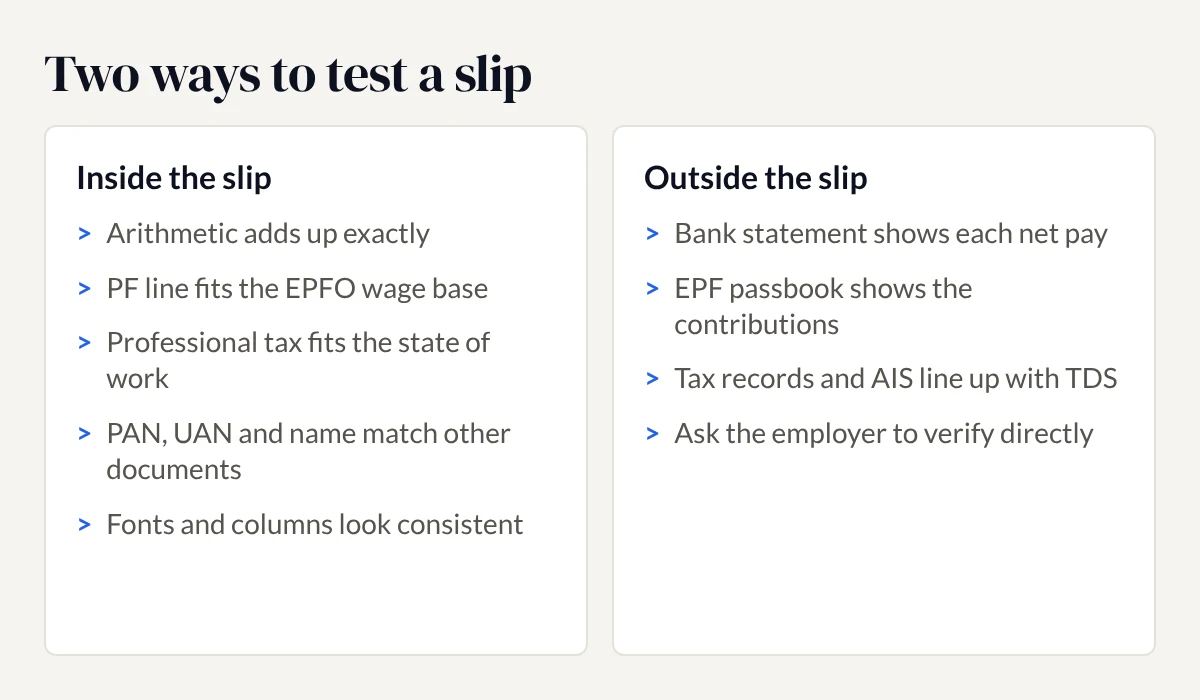
Internal consistency checks
- Arithmetic. Earnings, deductions and net pay should add up exactly.
- Statutory lines make sense. The PF line should follow the EPFO rule on its wage base (see above). A PF figure that fits no base needs an explanation.
- No state mismatch. Professional tax should be consistent with the state of work. Check that state's own schedule.
- Identifiers. PAN and UAN formats and the name should match other documents.
- Layout and fonts. Mixed fonts, misaligned columns or a figure that looks pasted over are warning signs, though a genuine slip can also look plain.
External checks
- Bank statement. Each net pay should match a salary credit from the employer's account name.
- EPF passbook. Contributions should appear in the member's passbook for the same months. EPFO says members can see their passbook after activating the UAN on the member portal (EPFO FAQs).
- Tax records. TDS on the slips should line up with the tax statement and AIS on the Income Tax portal, which the person can share from their own login (AIS, Income Tax Department).
- TDS certificate verification. The Department describes how to verify a TDS certificate through the TRACES portal using the deductee PAN, deductor TAN, financial year, quarter and return type (TDS Certificate Verification, Income Tax Department). That page describes Form 16A; for Form 16, compare Part A with the tax statement.
- Employer verification. The most reliable check is a direct confirmation from the employer's HR using contact details you found independently, not the ones printed on the slip.
Why you should never edit your own slip
The Bharatiya Nyaya Sanhita, 2023 has a section titled "Making a false document" (section 335), a section on forgery (section 336) and a section on a forged document or electronic record and using it as genuine (section 340), as the Act's arrangement of sections shows (Bharatiya Nyaya Sanhita, 2023, India Code). We could not load the full text of the penalty provisions, so we state no punishment. Read the Act or speak to a lawyer if you need the detail. Beyond the legal risk, edited pay documents get found through bank statements and tax records, and an offer or loan can be withdrawn.
Section 11
If your employer does not give you a slip, or the slip looks wrong
- Ask in writing. Email HR or payroll with your employee ID and the month (the sample request above works). Keep a copy.
- Check the portal. Many employers publish slips on a payroll or HR portal. Look in the documents or payslips section first.
- Collect your own evidence. Keep bank statements, your offer or appointment letter and any messages about pay.
- Check statutory lines independently. Use the EPFO member portal for PF and the Income Tax portal for TDS.
- Escalate inside the company. Write to the HR head or your manager if the first request is ignored.
- Use the official channels. The Code on Wages provides for an Inspector-cum-Facilitator and the notice board in every covered establishment names the one with jurisdiction (section 50(2)). The Ministry of Labour and Employment website (labour.gov.in) and your state labour department website are the places to find the current complaint route.
Whether you are covered, which rules apply to your employer and what remedy fits your situation depend on facts we cannot see. A labour office or a qualified professional is the right place for that.
Section 12
Sources and references
Every legal, tax and payroll point on this page comes from the official pages below, which we read on 4 October 2026. Some pages carry older dates. Where a page looked dated we say so in the text. Rules change, so confirm on the official page before you act.
- Code on Wages, 2019 (Ministry of Labour and Employment): Section 50 on wage slips, notice and registers, sections 15, 17, 18 and 2(y), and the repeal provision.
- Code on Wages, 2019 Safeguards Workers, Induces Growth, Empowers Women and Enhances Employment (PIB): Plain-language summary: wage slips on or before wage payment, electronically or in physical form.
- Government Makes the Four Labour Codes effective to Simplify and Streamline Labour Laws (PIB): The four Labour Codes effective from 21 November 2025.
- FAQs on Labour Codes (Ministry of Labour and Employment): Old rules continue until new rules are finally notified, to the extent in line with the Codes; the 50 per cent rule explained.
- Annual Report 2025-26 (Ministry of Labour and Employment): Codes effective from 21 November 2025; rules pre-published on 30.12.2025.
- Compliance Handbook for Employers Under the Four Labour Codes (Ministry of Labour and Employment): Employer-side overview of duties under the Codes.
- Section 192, Income-tax Act, 1961 (Income Tax Department): Employer must deduct tax on salary at the time of payment on estimated income.
- Section 392, Income-tax Act, 2025 (Income Tax Department): Equivalent provision under the 2025 Act.
- The Income-tax Act, 2025 to come into effect from 1st April, 2026 (PIB): Commencement date of the 2025 Act.
- FAQs on Interplay and Transition to the Income-tax Act, 2025 (Income Tax Department): Which Act governs which income, and tax year terminology.
- Form 16 and Form 16A (Income Tax Department): What Form 16 Parts A and B contain and the due date stated on the page.
- AIS, Annual Information Statement (Income Tax Department): AIS shows TDS information and salary data and how to view it.
- Online Form 26AS through TRACES (Income Tax Department): Annual tax statement, applicable to tax year 2026-27 onwards under the 2025 Act.
- Form 168 FAQs (Income Tax Department): Form 168 described as replacing Form 26AS under the 2026 rules.
- TDS Certificate Verification (Income Tax Department): Steps to verify a TDS certificate on TRACES.
- Frequently Asked Questions (Employees' Provident Fund Organisation): Contribution rate, wage ceiling for membership, UAN activation and passbook.
- EPF Scheme (Employees' Provident Fund Organisation): How the employee and employer shares are allocated.
- Information booklet for EPF members (EPFO): UAN is a single permanent number for the member.
- ESIC Contribution (Employees' State Insurance Corporation): ESI contribution rates and effective date shown on the page.
- ESIC Coverage (Employees' State Insurance Corporation): ESI coverage and wage limit stated on the page.
- Professional Tax employer page (Government of Karnataka): Example of state-specific professional tax notice.
- Professional tax schedule (Commercial Taxes Department, Telangana): Example of a state-published professional tax schedule.
- SBI Personal Loan (State Bank of India): Example of a lender's stated document list for salaried applicants.
- Bharatiya Nyaya Sanhita, 2023 (India Code): Titles of sections 335, 336 and 340 in the Act's arrangement of sections.
This page is general information, not legal or tax advice. Your contract and your employer's policy decide the details of your pay documents. For disputes, use labour.gov.in and your state labour office.
Pro tips
Do these
Download and back up each slip every month to a personal folder.
Compare net pay with your bank credit every month.
Check your EPF passbook and the tax statement on the Income Tax portal at least once a year.
Ask payroll for a written breakup that links your offer letter to the slip.
Read the lender's own document checklist before applying.
Keep Form 16 from every employer you have worked for.
Use the sample layout on this page only as a checklist.
Check labour.gov.in and your state labour department for the current rules.
Avoid these
Delete these
Treating one company's slip layout as the legal format for all employers.
Assuming CTC divided by twelve should equal net pay.
Ignoring a wrong PAN or UAN on the slip.
Not checking the EPF passbook against the PF lines on your slips.
Using another state's professional tax figure to judge your own slip.
Sending photos or screenshots instead of original PDFs to a lender.
Editing any figure on a slip, even a small one.
Leaving it too late to ask for old slips after you resign.
Put this into a resume
Building and editing are free, and free PDFs carry a small watermark.
Check your resume for freeQuestions
Frequently asked questions
How this guide is maintained
We review this guide every quarter and after any change to the hiring rules or portal behaviour it describes. It was last reviewed on 2026-10-04T14:04:46.772Z. Figures come from named sources, shown beside the number. Where we are estimating rather than measuring, we say so.
Try it
Check the guide against your own file
Everything above is general. Your resume is not. Paste it in and the checker tells you which of these points your file actually breaks.
Check your resume free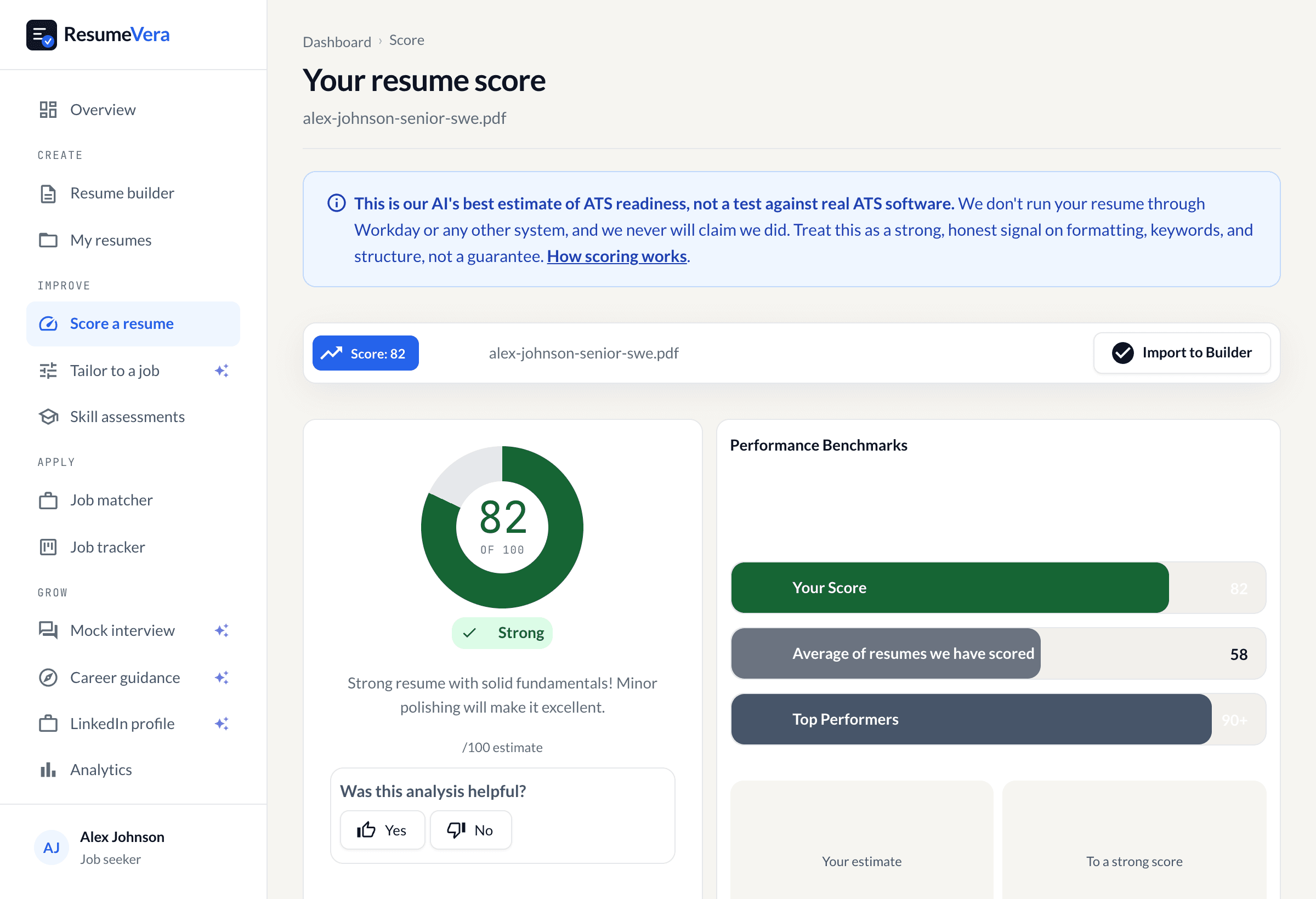
The real score page, with a sample resume and sample scores.
Is your resume ATS ready?
Run a free ATS score check and get specific improvements in seconds.