CTC breakup calculator (FY 2026-27)
See how your CTC splits into basic pay, HRA, EPF, gratuity and tax. Change the basic share, your city and your rent, and compare the new and old regime.
Last reviewed by the ResumeVera Editorial Team.
Only need the monthly figure? The take home salary calculator gives it in one step.
₹
Tax Regime (FY 2026-27)
Zero tax up to ₹12.75L gross · Standard deduction ₹75,000
Basic Salary(40% of CTC · ₹4,00,000/yr)
City Type (HRA calculation)
EPF Type
State (Professional Tax)
Monthly In-Hand Salary
₹75,730
₹9,08,760/yr · 0.0% effective tax rate
New regime saves ₹30,422/year (₹2,535 more per month)
Where Your CTC Goes
Take-home
EPF
Tax
Prof tax
Employer EPF
Gratuity
Gross CTC
₹10,00,000/yr
Basic (40%)
₹4,00,000/yr
HRA (50% of basic)
₹2,00,000/yr
Special Allowance
₹3,44,760/yr
Employer EPF (in CTC, not received)
−₹36,000/yr
Gratuity (in CTC, not received)
−₹19,240/yr
Gross Salary
₹9,44,760/yr
Employee EPF
−₹36,000/yr
Income Tax (TDS)✓ Zero, 87A rebate
Taxable: ₹8,69,760 · New regime
−₹0/yr
MONTHLY TAKE-HOME
₹9,08,760/yr
₹75,730
In-hand salary for common CTC values
FY 2026-27 · 40% basic · EPF capped · Maharashtra professional tax · metro HRA. Old regime assumes ₹20,000/month rent + ₹50,000 additional 80C + ₹25,000 health insurance.
| Annual CTC | Monthly Gross | New regime take-home | Old Regime Take-Home | Tax (New) |
|---|---|---|---|---|
| ₹5 LPA | ₹38,865 | ₹36,657Zero tax | ₹36,657 | New: +₹0/yr |
| ₹6 LPA | ₹46,638 | ₹44,030Zero tax | ₹44,030 | New: +₹0/yr |
| ₹7 LPA | ₹54,411 | ₹51,403Zero tax | ₹51,403 | New: +₹0/yr |
| ₹8 LPA | ₹62,384 | ₹59,176Zero tax | ₹59,176 | New: +₹0/yr |
| ₹10 LPA | ₹78,730 | ₹75,522Zero tax | ₹73,030 | New: +₹29,902/yr |
| ₹12 LPA | ₹95,076 | ₹91,868Zero tax | ₹85,837 | New: +₹72,366/yr |
| ₹15 LPA | ₹1,19,595 | ₹1,09,105 | ₹1,04,254 | New: +₹58,210/yr |
| ₹18 LPA | ₹1,44,114 | ₹1,29,563 | ₹1,20,811 | New: +₹1,05,026/yr |
| ₹20 LPA | ₹1,60,460 | ₹1,42,509 | ₹1,31,849 | New: +₹1,27,922/yr |
| ₹25 LPA | ₹2,01,325 | ₹1,73,397 | ₹1,59,444 | New: +₹1,67,435/yr |
| ₹30 LPA | ₹2,42,190 | ₹2,01,768 | ₹1,87,039 | New: +₹1,76,748/yr |
| ₹40 LPA | ₹3,23,920 | ₹2,57,999 | ₹2,42,230 | New: +₹1,89,228/yr |
| ₹50 LPA | ₹4,05,650 | ₹3,14,229 | ₹2,97,420 | New: +₹2,01,708/yr |
Every CTC from 3 to 50 LPA, month by month, is in the in-hand salary table. Weighing two offers? See how to compare job offers.
What is inside your CTC?
CTC (Cost to Company) is not your salary, it includes everything the employer spends on you. Here's where each rupee actually goes.
Basic salary
40–50% of CTC
Drives EPF, HRA, and gratuity. The anchor of every salary structure.
HRA (House Rent Allowance)
20–25% of CTC
Partly tax-exempt in old regime when you pay rent. 50% of basic in metros, 40% elsewhere.
Special allowance
20–30% of CTC
Fully taxable. Absorbs whatever's left after all other components.
Employer EPF
3–5% of CTC
12% of basic (or ₹3,000/mo at the wage ceiling). Part of CTC but never touches your salary account.
Gratuity
1–2% of CTC
4.81% of basic. Paid as lump sum after 5+ years. Part of CTC, not monthly income.
Why ₹10 lakh CTC gives ₹75,730 a month in hand, not ₹83,333
With the calculator's defaults (basic at 40% of CTC, PF on the ₹25,000 monthly wage ceiling, new regime, no professional tax): employer EPF of ₹36,000 a year and gratuity of ₹19,240 a year come to ₹55,240 that sits inside CTC but never reaches your account, leaving gross salary of ₹9,44,760. Taxable income is ₹8,69,760 after the ₹75,000 standard deduction, so income tax is ₹0 (the rebate covers taxable income up to ₹12 lakh). Your own EPF of ₹36,000 comes off next, which leaves ₹9,08,760 a year, or ₹75,730 a month. These are the same figures the calculator shows for ₹10 lakh.
New regime vs old regime, FY 2026-27
New regime is the default from FY 2024-25. Which one leaves you more depends on your deductions, so the calculator works out both.
| Feature | New regime (default) | Old Regime |
|---|---|---|
| Standard Deduction | ₹75,000 | ₹50,000 |
| Tax-free gross salary | ₹12.75L (salaried) | ~₹5.5L (basic deductions) |
| 87A Rebate | ₹60,000 (for income ≤ ₹12L) | ₹12,500 (for income ≤ ₹5L) |
| HRA Exemption | ❌ Not available | ✓ Available if rent is paid |
| 80C Deduction | ❌ Not available | ✓ Up to ₹1,50,000 |
| 80D Health Insurance | ❌ Not available | ✓ Up to ₹25,000–₹50,000 |
| Home Loan Interest (24b) | ❌ Not available | ✓ Up to ₹2,00,000 |
| Better for | Most salaried employees | High earners with large deductions |
Income tax slabs, FY 2026-27 (AY 2027-28)
Budget 2026 retained all slabs unchanged.
New regime (default)
Up to ₹4L
Nil
₹4L – ₹8L
5%
₹8L – ₹12L
10%
₹12L – ₹16L
15%
₹16L – ₹20L
20%
₹20L – ₹24L
25%
Above ₹24L
30%
✓ Zero tax up to ₹12.75L gross (SD ₹75K + 87A rebate)
Old regime
Up to ₹2.5L
Nil
₹2.5L – ₹5L
5%
₹5L – ₹10L
20%
Above ₹10L
30%
80C (₹1.5L) + HRA + 80D available. Can win when those deductions are large; compare both in the calculator above.
4% Health & Education Cess on tax + surcharge. Surcharge applies above ₹50L income.
How we calculate
Every figure on this page, including the worked example and the table, comes from one function. These are the rules it applies.
- Basic pay is the share of CTC you set with the slider, 40% by default. Many employers use 40% to 50%; your offer letter has the real figure.
- HRA is 50% of basic in a metro and 40% elsewhere. It only lowers tax in the old regime, and only when you pay rent: the exemption is the least of the HRA, 50% or 40% of basic, and rent minus 10% of basic.
- Employer and employee EPF are each 12% of basic. "Capped" takes basic only up to the ₹25,000 monthly wage ceiling, so at most ₹3,000 a month each; "uncapped" takes 12% of your full basic, which some employers do.
- Gratuity is set aside at 4.81% of basic. The Payment of Gratuity Act pays fifteen days of wages for each year of service, with a month counted as 26 working days: 15 ÷ 26 ÷ 12 is 4.81% of basic a month. It is part of CTC but is only paid when you leave after five years of continuous service.
- Gross salary is CTC minus employer EPF and gratuity.
- New regime: taxable income is gross salary minus the ₹75,000 standard deduction, taxed at the FY 2026-27 slabs. The rebate under section 156 of the Income-tax Act, 2025 (section 87A of the 1961 Act) takes tax to zero up to ₹12 lakh of taxable income, with marginal relief just above it. Surcharge starts above ₹50 lakh, and 4% cess is added to the total.
- Old regime: a ₹50,000 standard deduction, the HRA exemption, section 80C up to ₹1,50,000 (your EPF counts towards it), section 80D up to ₹50,000, and professional tax.
- In-hand pay is gross salary minus your own EPF, professional tax and income tax, divided by 12.
- Not included: variable pay and bonuses, employer NPS, ESIC, meal cards and other perquisites. If your offer has them, your in-hand will differ.
Last reviewed by the ResumeVera Editorial Team.
Sources
The rates, ceilings and formulas above come from these official pages. We check them when the rules change and at least once a year.
- Income Tax Department: tax slabs for salaried individuals, new regime slabs under section 115BAC, the ₹75,000 standard deduction and the rebate up to ₹12 lakh of taxable income
- EPFO: FAQs on the revised wage ceiling (S.O. 5109(E), 17 September 2026), 12% contributions on wages up to ₹25,000 a month, up from ₹15,000
- EPFO: Employees’ Provident Fund scheme, how the employee and employer shares are split between EPF and EPS
- Ministry of Labour and Employment: the Payment of Gratuity Act, 1972, section 4(2), fifteen days’ wages for each completed year, with a month counted as 26 working days
Questions
Frequently asked questions
Real answers to the most searched salary questions in India.
The other half
The number matters once you have the offer
Getting there is the rest of it. The checker reads your resume the way a parser would and names what it cannot find.
Check your resume free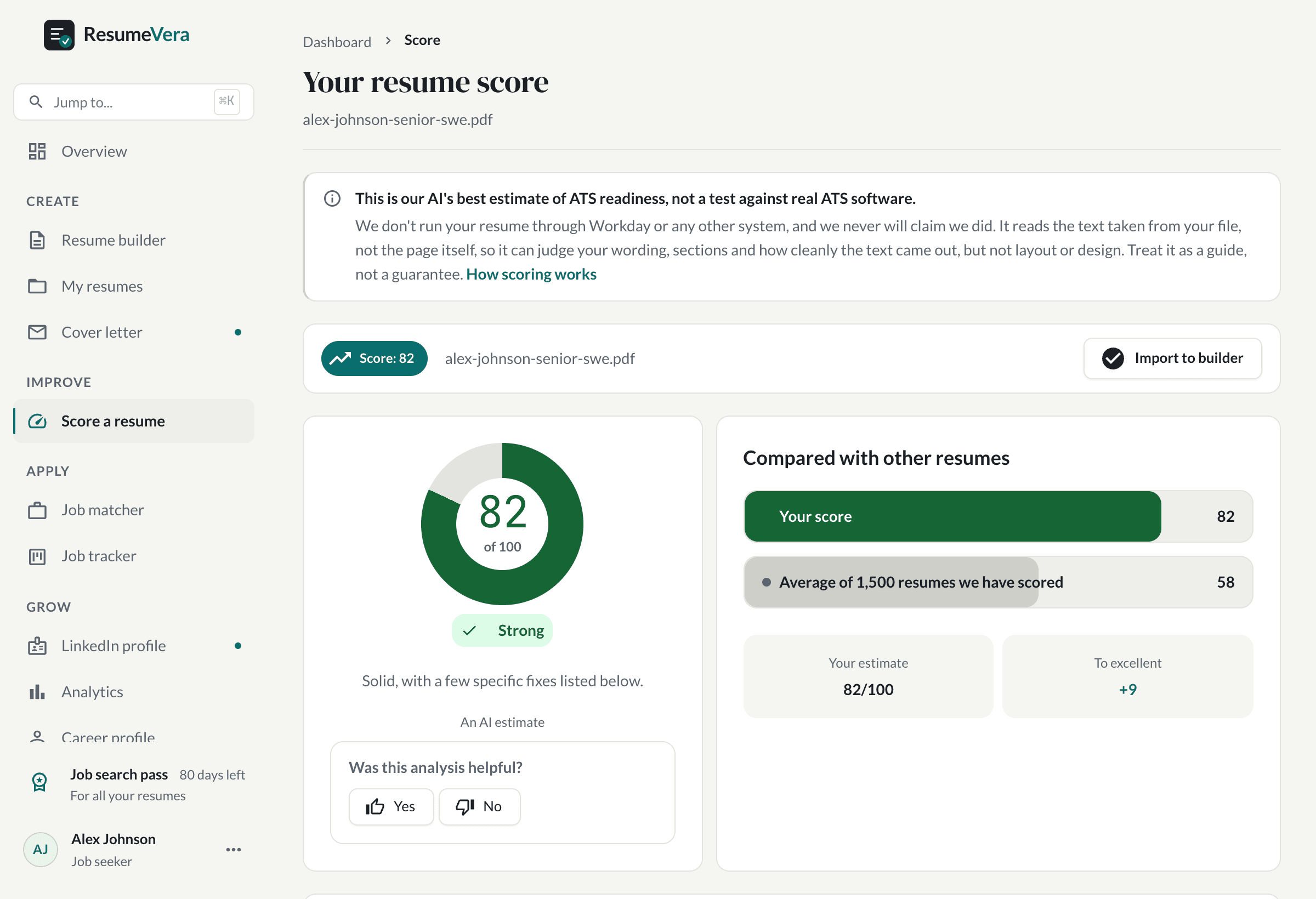
The real score page, with a sample resume and sample scores.
Now make your resume match your salary level
A ₹12L–₹25L salary requires a resume that clears ATS and impresses hiring managers. Build one with AI guidance and a live ATS score. Free to start.